Apologies all for the long pause from my last posting – I just needed a little break, and to recharge my creative juices after getting the show up on the wall. Perhaps this weekend I’ll post the pictures from the opening reception.
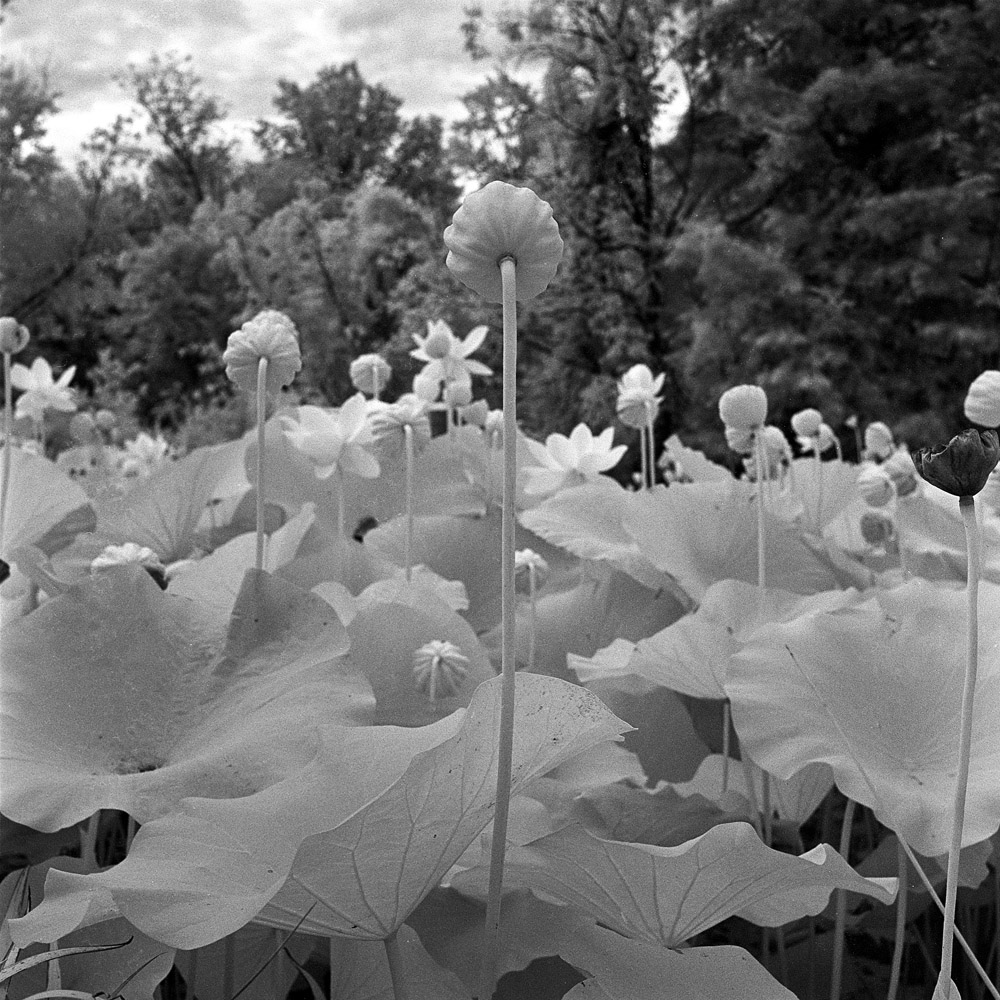
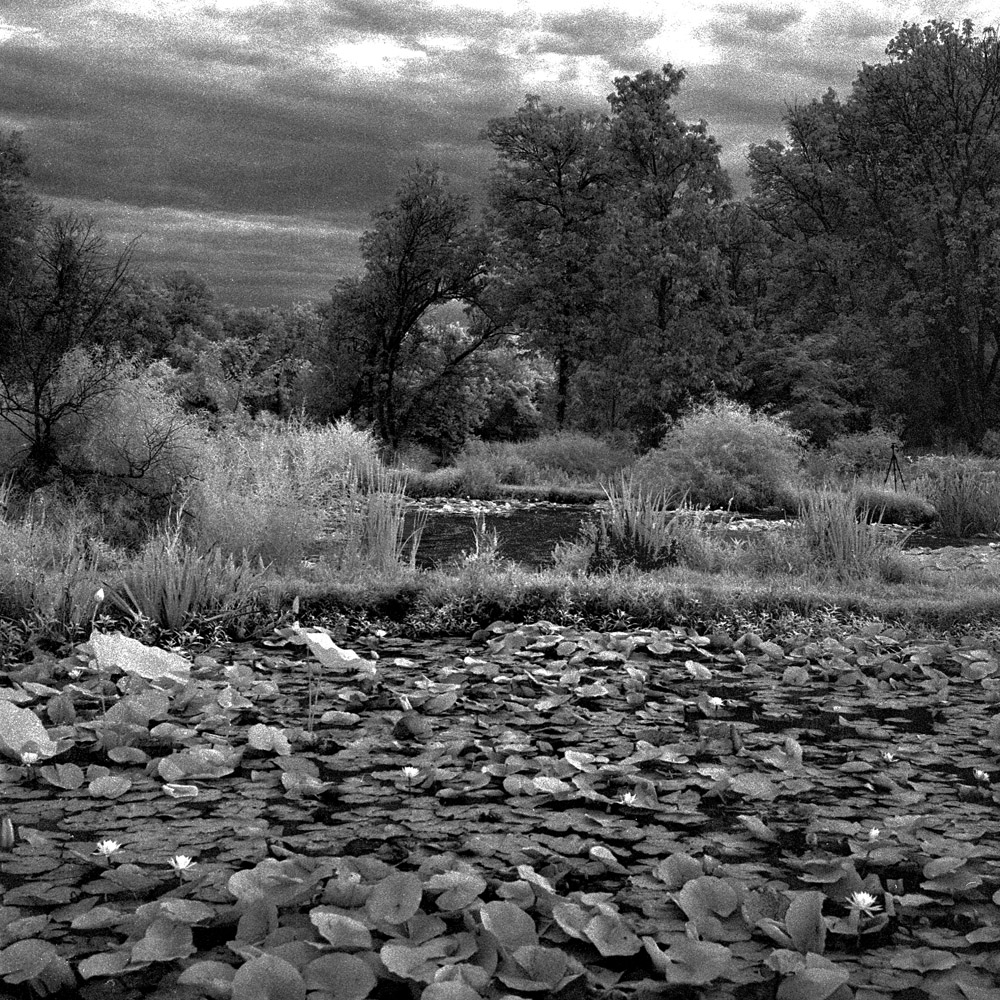
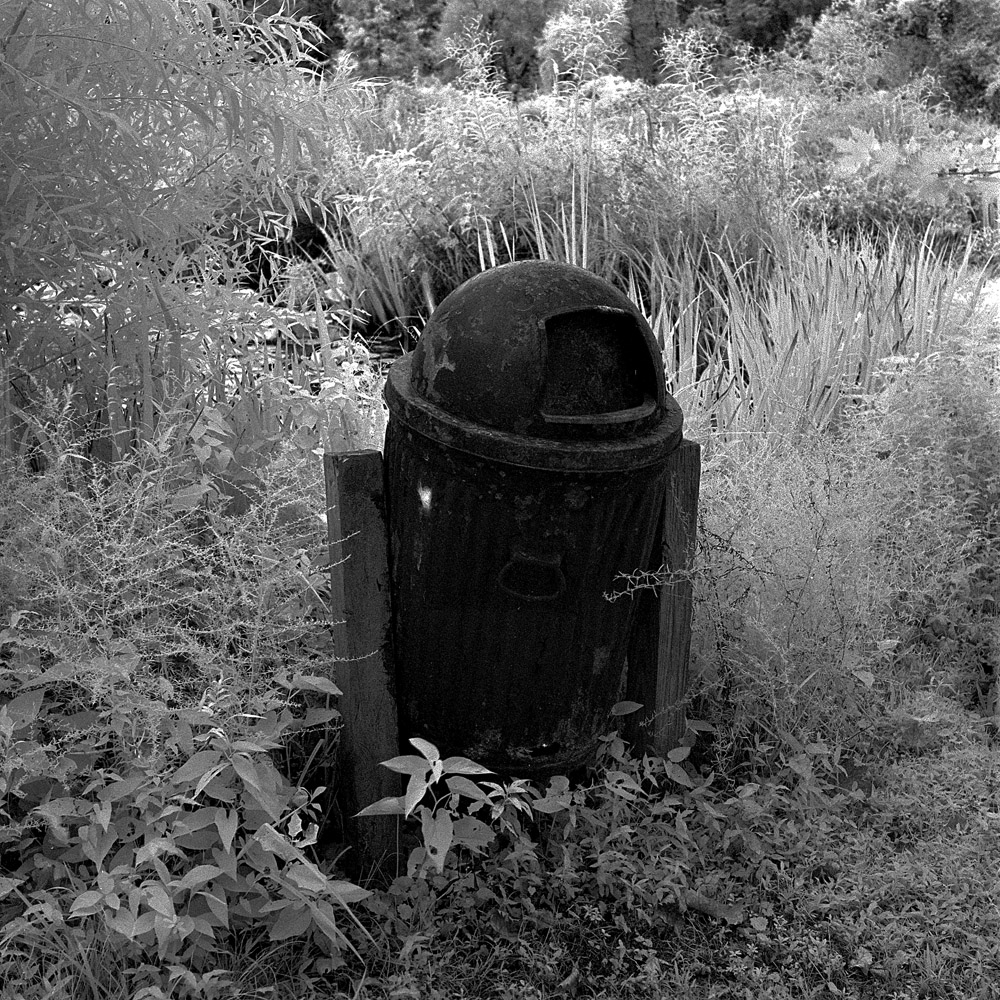
Anyway, here’s some stuff I shot last weekend and earlier this week. I lucked into a modest stash of Konica Infrared film, which hasn’t been made in probably 8-10 years. The stuff I have is older than that. I needed to find out how well it had kept in the meantime – IR films in general seem to age much faster than regular b/w film, and for all I knew, the IR-sensitizing dyes had faded and it would be just another slow b/w emulsion with tons of base fog, but grainy from the degradation (I shot some Kodak HIE 35mm that was from the last batch they did, and it had degraded to horribly foggy and grainy, despite the fact that it was only perhaps 4-5 years out of date). The results are in – while they do have noticeable base fog, the negatives are still quite fine-grained and do exhibit the infrared effect nicely, with very little overall degradation.
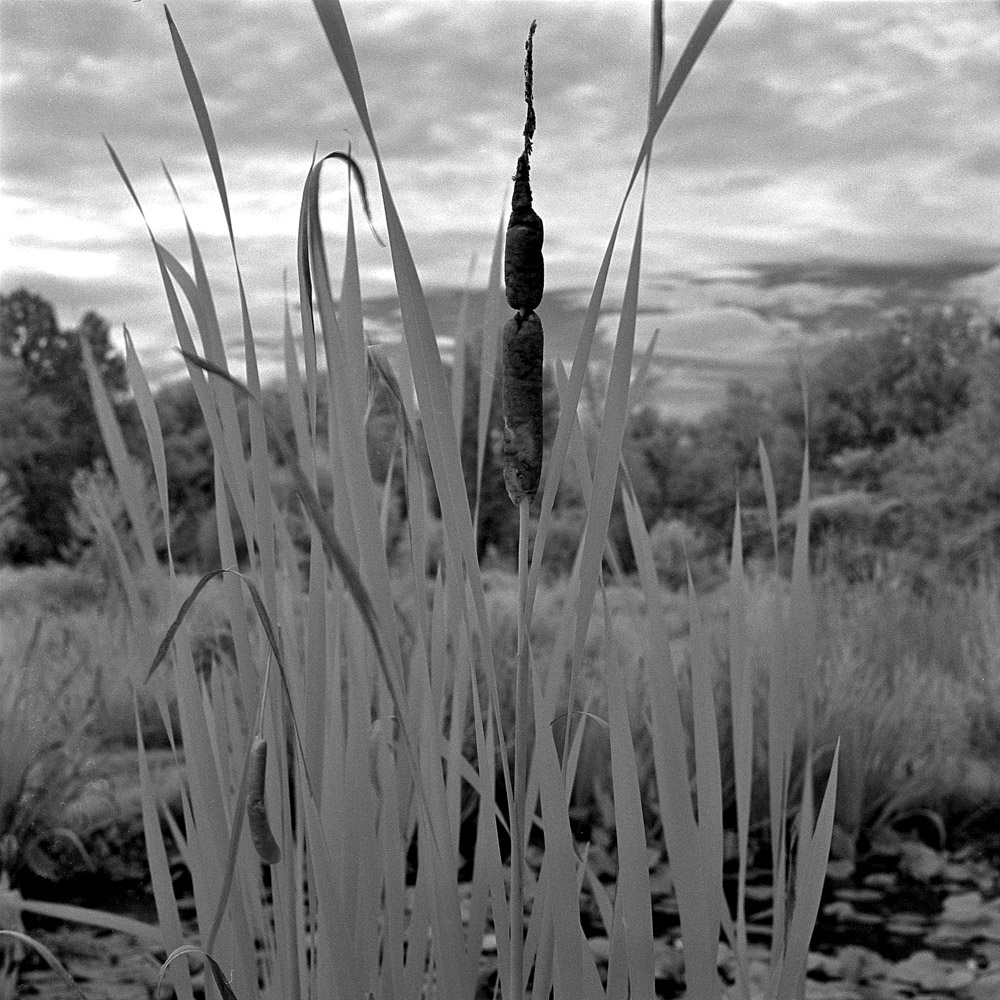
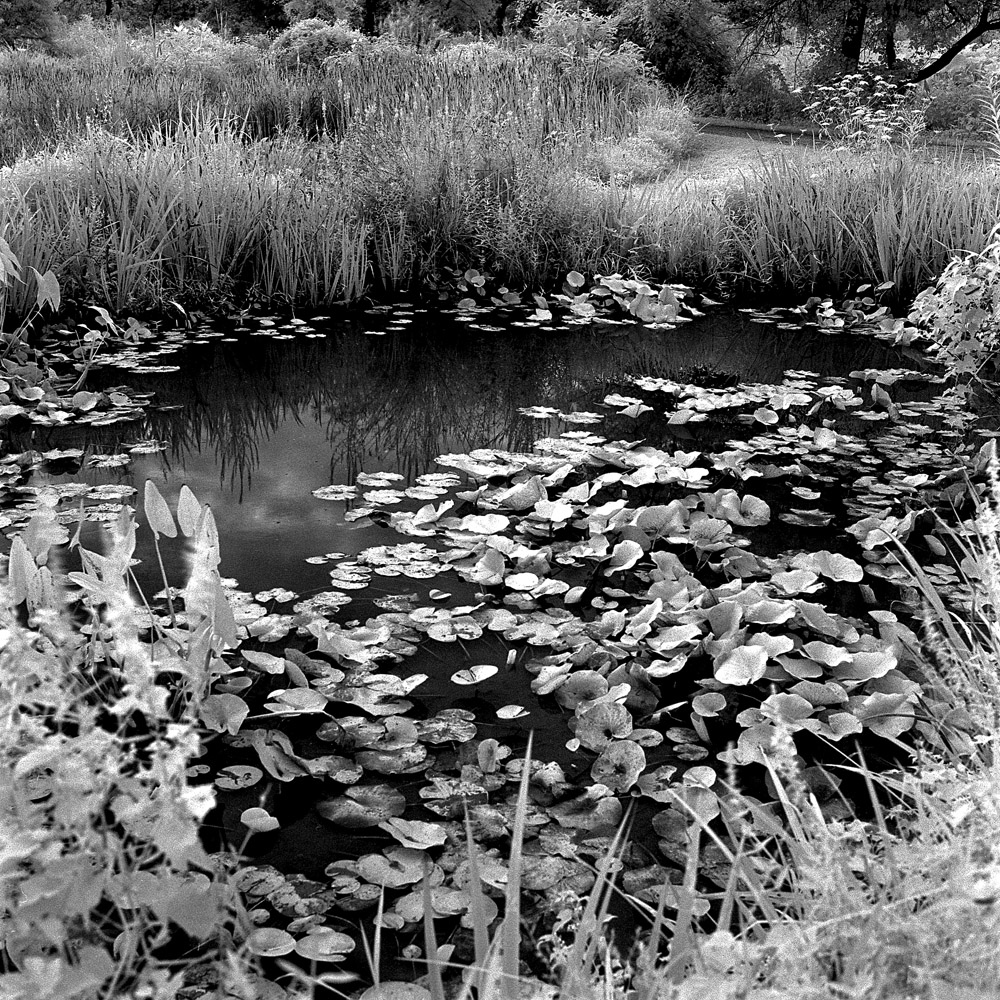
Here are results from two rolls worth, shot on a lunchtime walkabout near my office, and on an early saturday morning excursion to Kenilworth Aquatic Gardens.
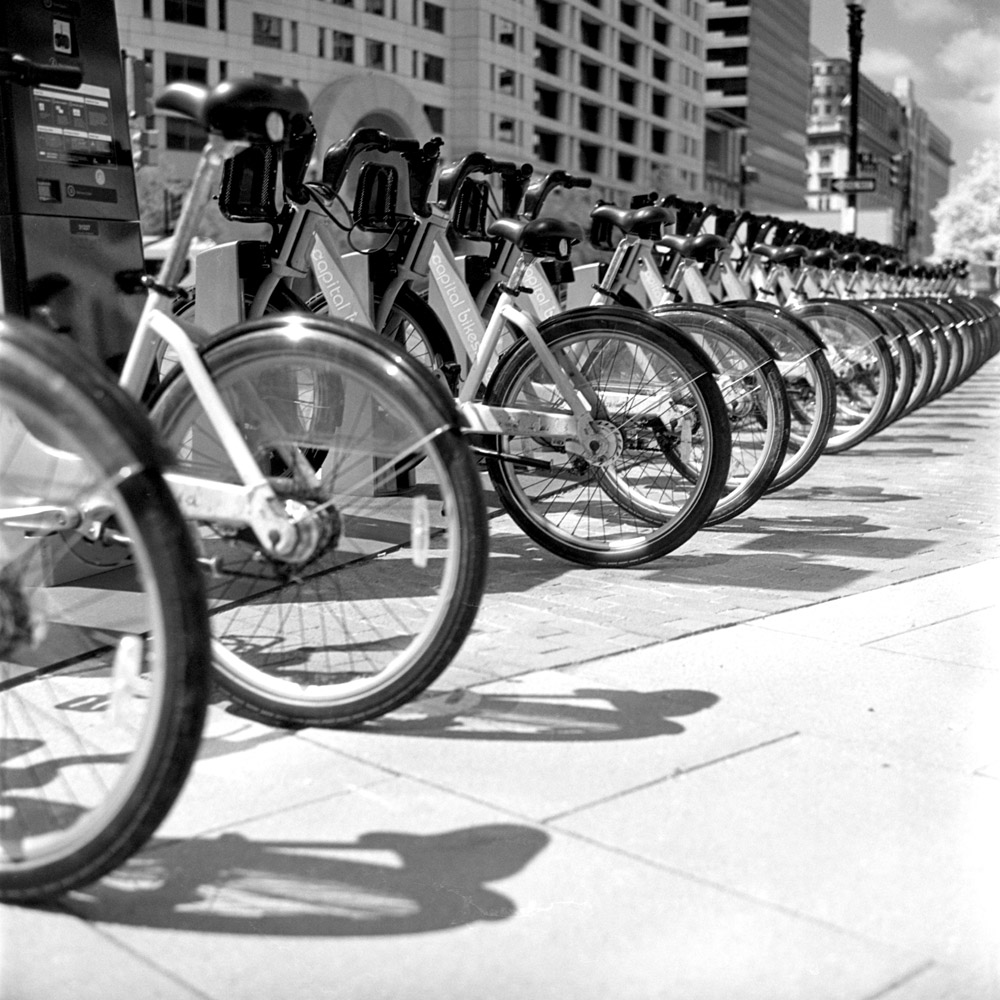
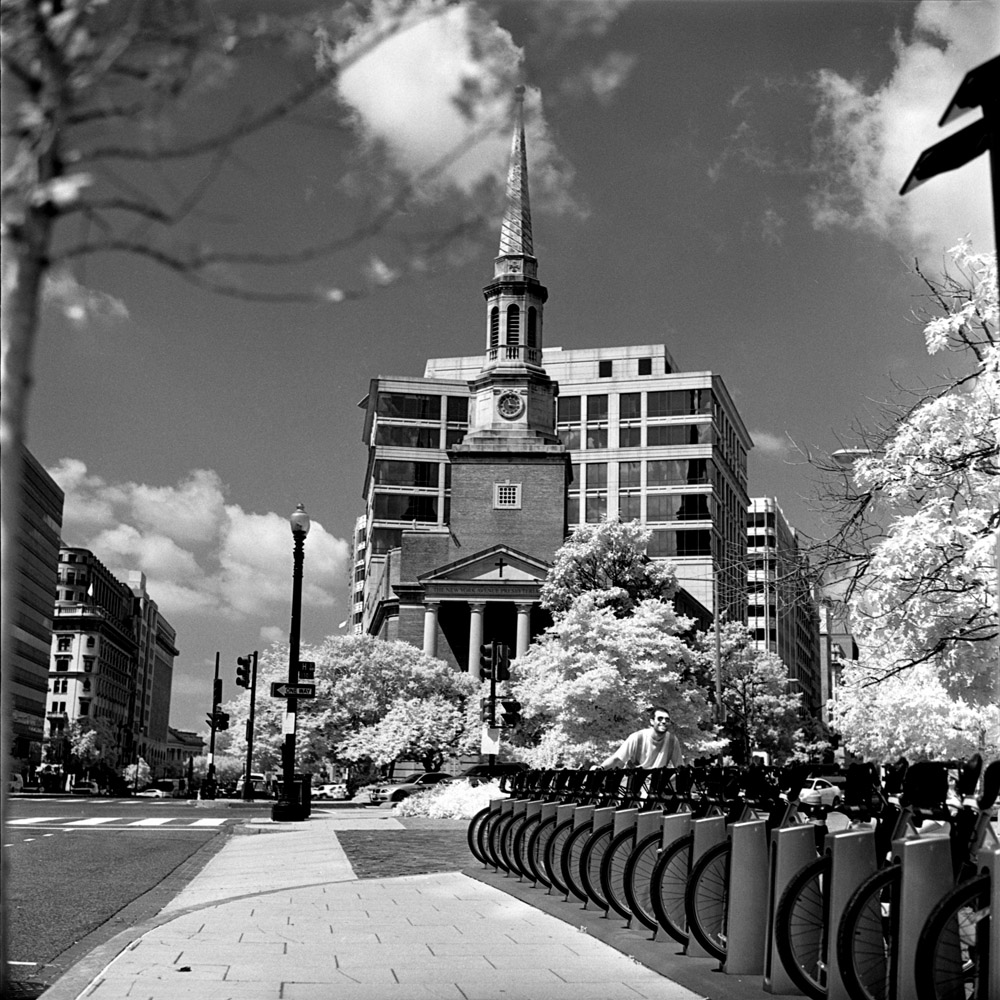
Capital Bikeshare – Konica InfraredNew York Avenue Baptist – Konica Infrared
The infrared effect is somewhat subtle in these first two – the foliage is white, but the sky is not particularly black or contrasty. The red bikeshare bikes though are much lighter than they appear on regular b/w or color film. Also the wheel guards on the back wheels are completely translucent, but in real life they are dark smoked and/or black plastic.
The Rollei is a perfect camera for Infrared photography because you can focus and compose your images with the unfiltered viewing lens, so you don’t have to keep taking the filter on and off (the strong infrared filters like the Hoya RM72 I used are anywhere from nearly to completely opaque to the visible spectrum, making it very difficult at best to operate the camera with the filter installed on a single lens reflex camera).
Kenilworth Aquatic Gardens is a 37 acre plot on the east/south bank of the Anacostia River which runs through Washington DC. Owned and operated by the US Park Service, it is one of the hidden gems of Washington DC. The neighborhood around it is still quite rough, which deters casual visitors not familiar with the area. I went looking for the giant lily pads they usually have, but they were nowhere to be found. One of the park rangers informed me that they had to skip the Victoria Lily pads this year due to budget cuts – they normally import them from the Amazon fresh each year.
I should have been doing this all along through the class, but we’ve had bad luck with scheduling and are as of now still three weeks behind schedule because of holidays, work schedule conflicts and the like.
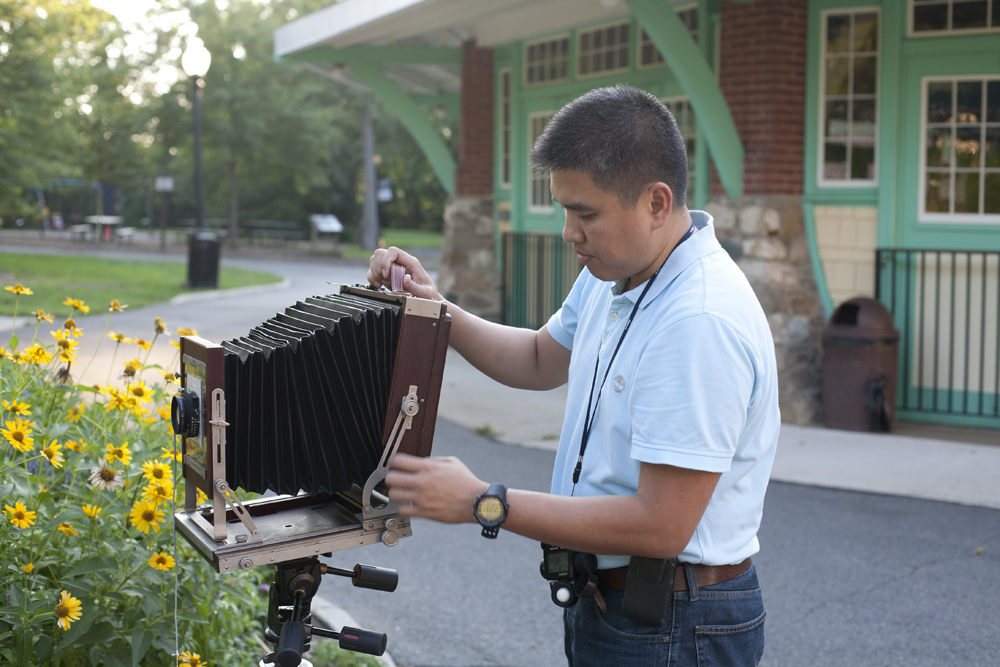
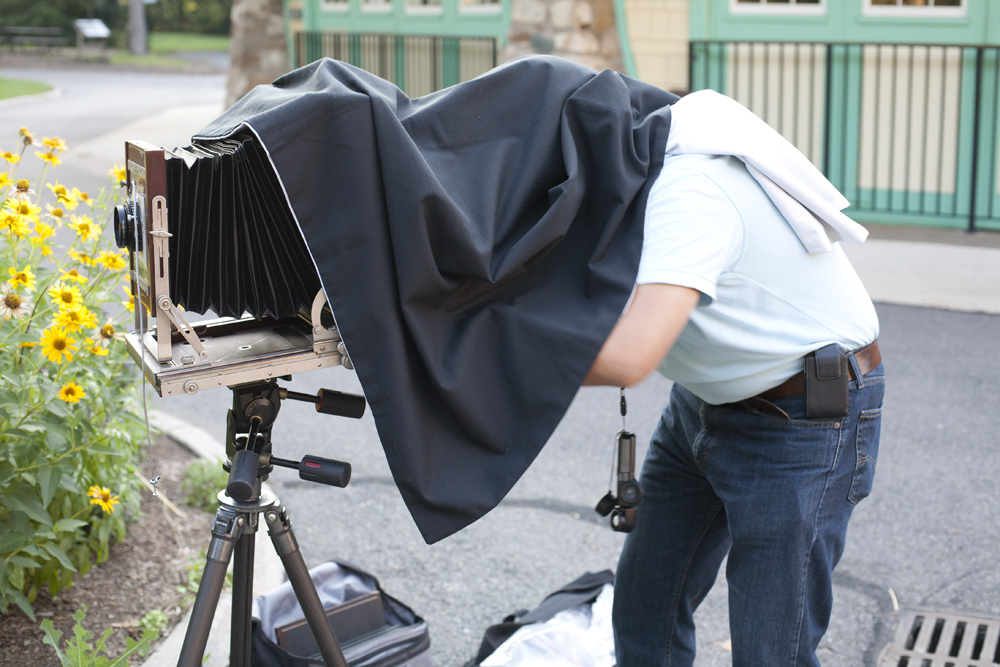
My student brought his 8×10 Deardorff to class, and we went out and shot a few frames around the park. Here he is with the ‘Dorff. Isn’t it a beautiful camera?
Shooting with the Deardorff
And here he is under the darkcloth. I don’t know why he used it white side in, but it’s his camera, he knows how to use it, so as long as he can focus, I’m not complaining.
Under the Darkcloth
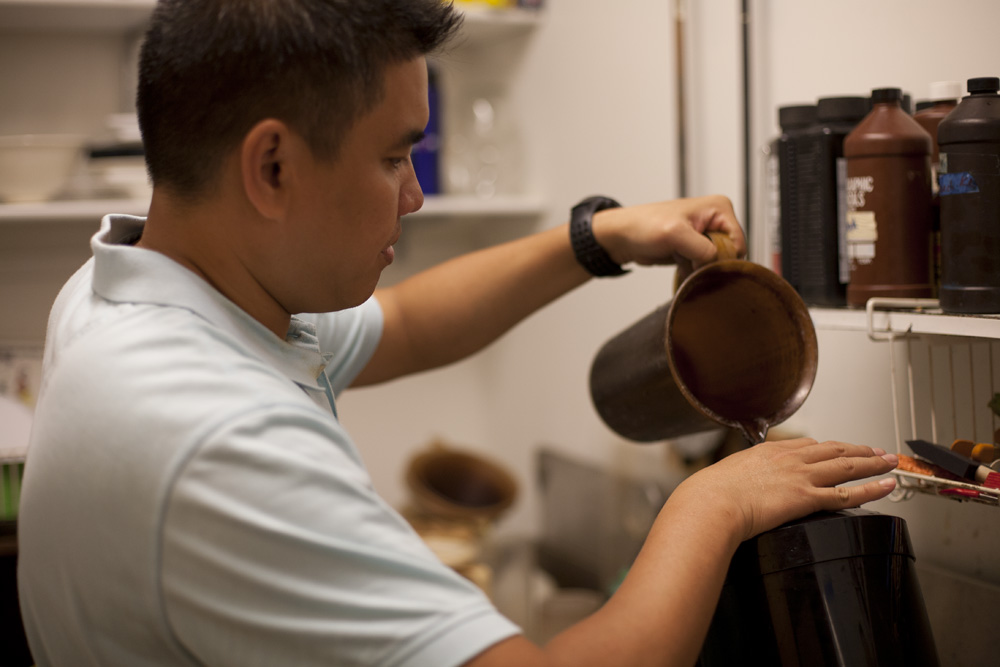
Here he is pouring a water stop bath into the Jobo drum I brought. We used the Jobo free-standing and not on a processor or roller base – I just ran a water bath for it in a regular developing tray and rolled it by hand. This technique works, but it’s much easier on a proper roller system, and infinitely better on the Jobo processor.
Developing Film
Despite the challenges of processing the film with the Jobo tank by hand, we were able to produce some useable frames. Here he is holding one of the negatives, a portrait of me. Every year he goes back to Vietnam for vacation, and while there he does a fundraising project with photography for a charitable organization. This year, his project is to take portraits of the clients of a clinic that provides healthcare to people exposed to Agent Orange, and sell the prints to raise money for the clinic. It feels really good to me to know I’m having a small part in helping his project.
Here are some color shots I took on my neighborhood walk around, last weekend. I noticed a theme of small businesses in the shots I was taking, so I decided to make a grouping out of them for this post. The areas I was photographing are actually very bustling and vibrant, but A: this was on a Sunday afternoon, and B: it was about 93 degrees Farenheit outside, so it looks far more desolate than it actually is, but that allowed me to focus on the appearances of the businesses themselves. My interest in photographing them without people is not to portray an economic state that may or may not be true, but rather the overall feel of small businesses that are in a neighborhood in transition – these are businesses, mostly minority-owned, that have not yet been gentrified in an area experiencing rapid gentrification.
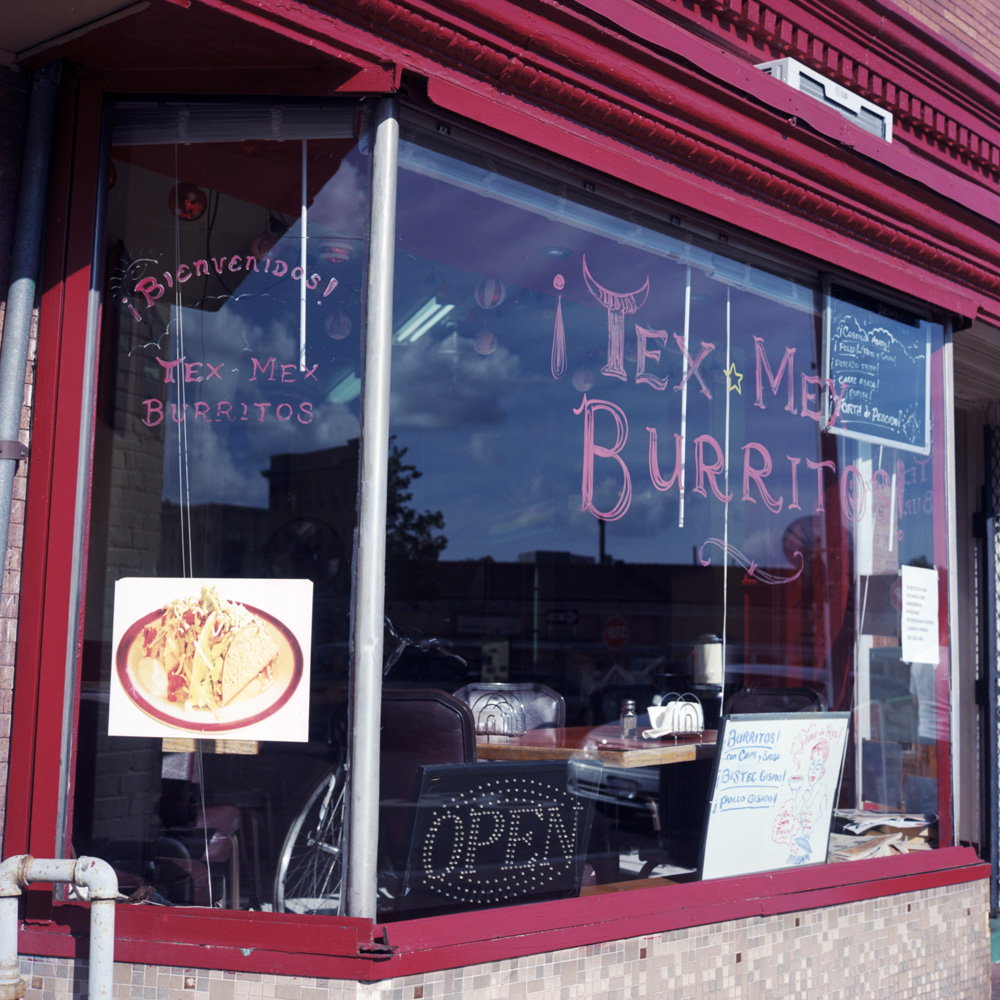
To me, the loss of these businesses to gentrification is the biggest downside to the process. They are what makes up the character of the neighborhood, and why all those gentrifiers moved there in the first place. I will be very sad when Tex-Mex Burritos is displaced for yet another Chipotle.
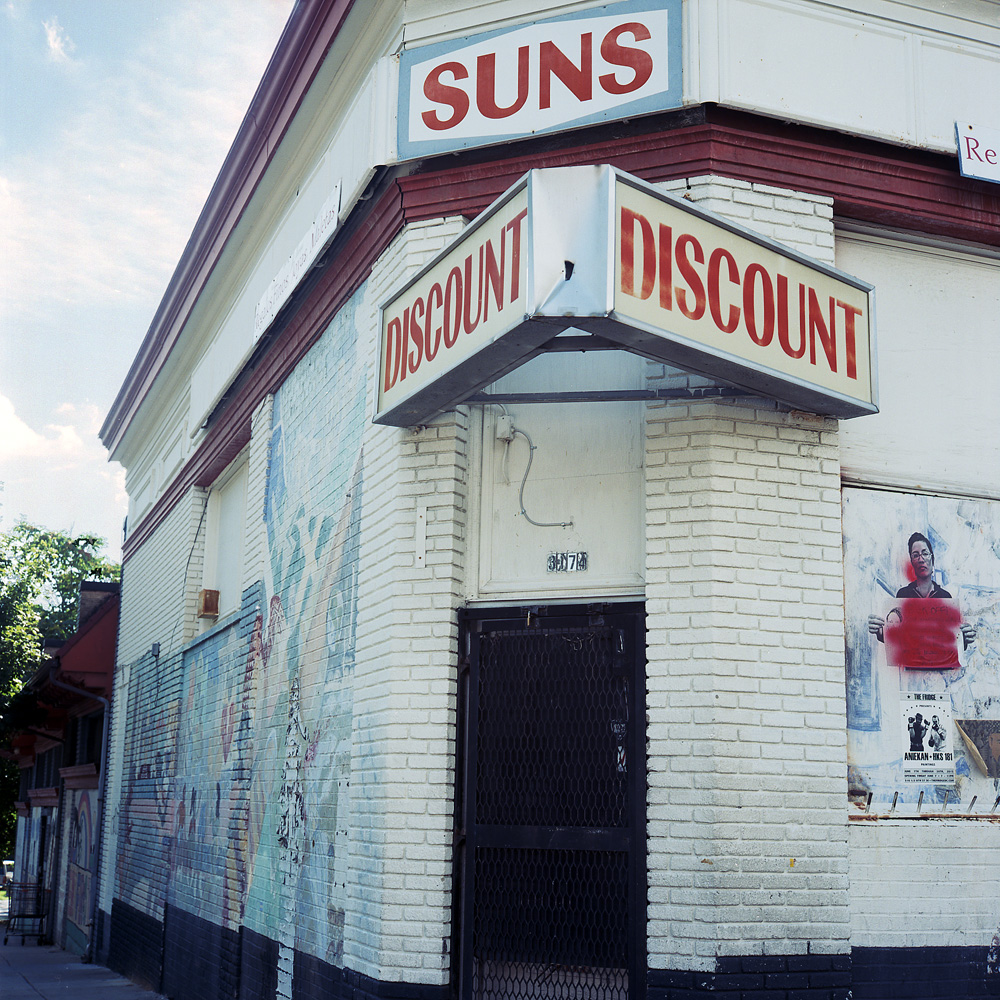
Suns Discount
Sun’s Discount is obviously shuttered. I don’t know how big a space it is on the inside, or what kind of (probably insane) rent the landlord is asking for, but I love the murals on the wall and the protest/message posters plastered on the whitewashed windows. It reflects the character of the neighborhood, and particularly its past – the small ethnic “discount” store that would have carried a hodge-podge of inexpensive products, primarily catering to the Latino community, which has adopted the small business strip along Mount Pleasant Street. Historically a mixed race, upper-middle class neighborhood, after the 1968 Martin Luther King riots, the neighborhood experienced a significant turnover and transformed into a poor Latino barrio in the 1970s. It is in the process of changing back into a largely white, upper-middle class neighborhood, as the housing stock off the business district consists of large, elegant rowhomes and single familys that are being snatched up, fixed up and turned into two and three unit condos.
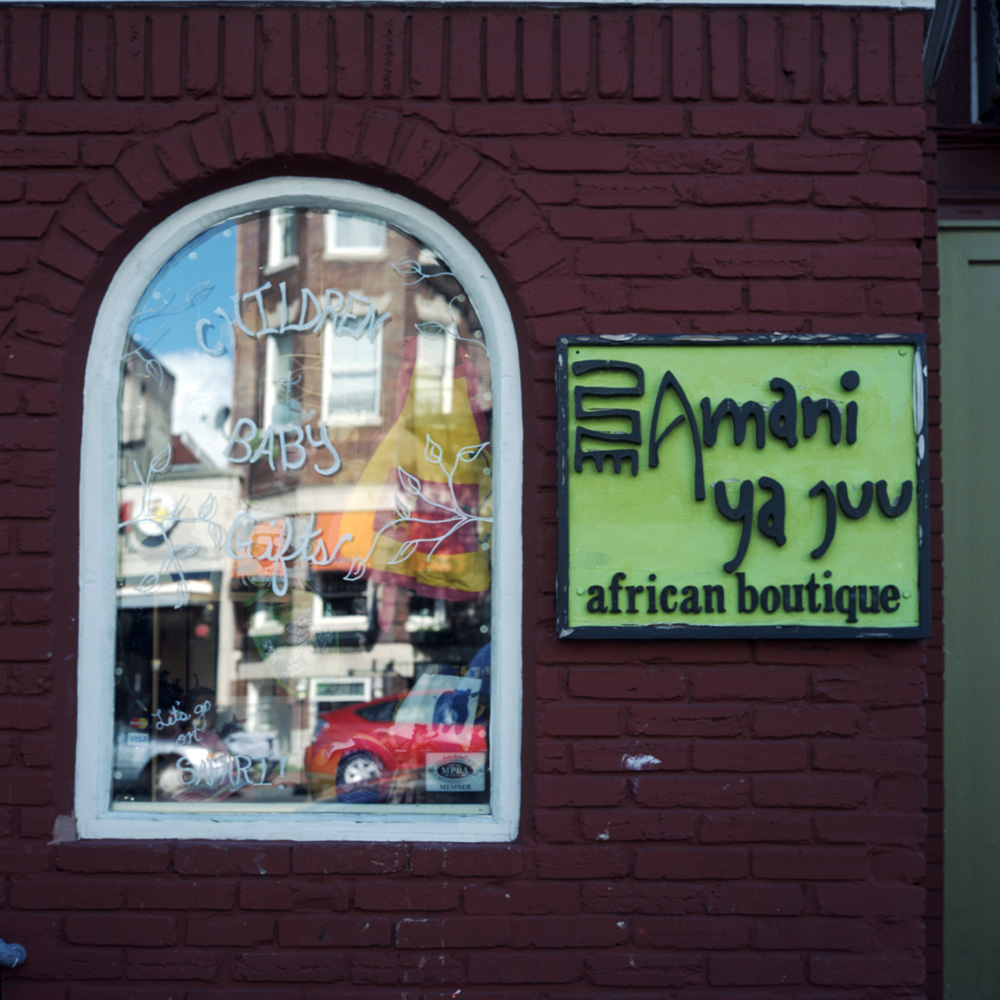
Amani African Boutique
There is still an African-American presence in the neighborhood – a touch of soul remains amidst the sazón. The neighborhood was always multi-ethnic, but the blend has changed over the years.
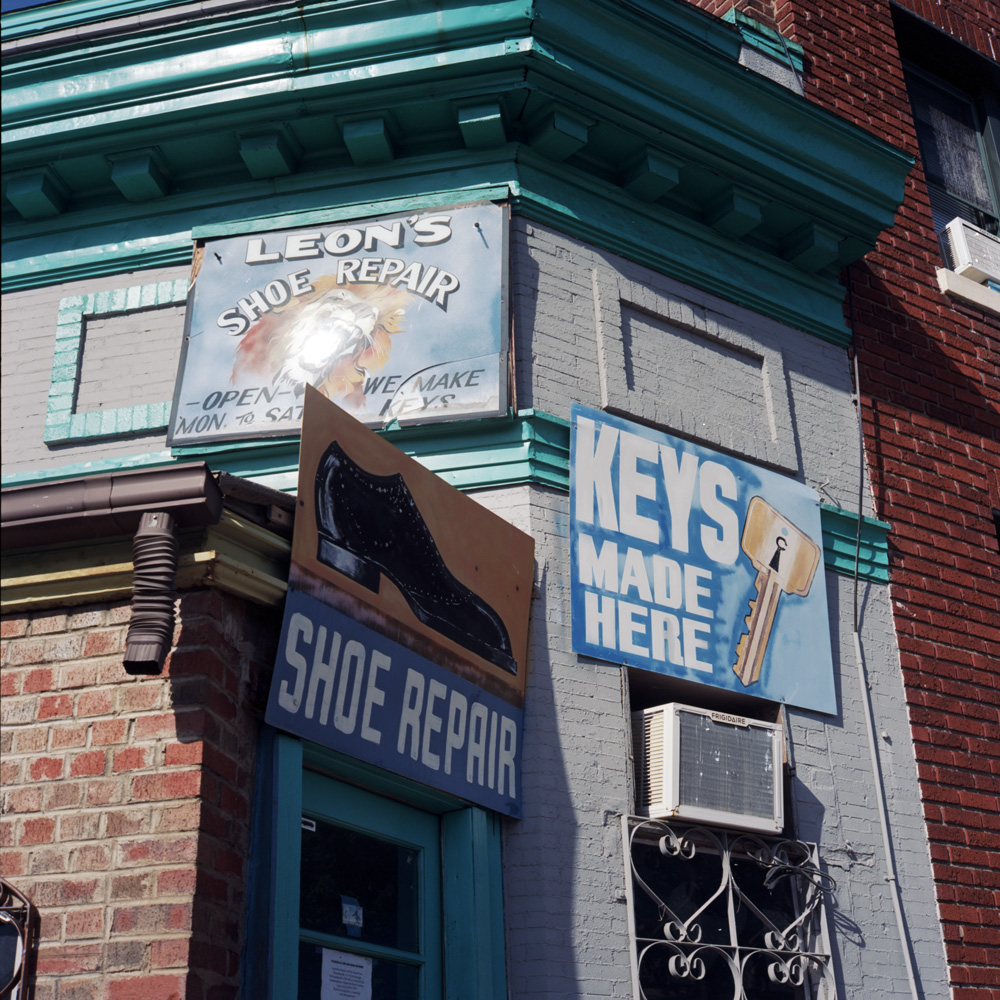
Leons Shoe Repair
Another one of those small businesses that when a real estate developer sets their sights on the block will be one of the first to go. Leon’s operates out of a space not much bigger than a coat closet. In the land of big-box stores and franchises, there’s no room for a 200-sq ft retail operation. And signage like that would never fly in a homogenized shopping mall.
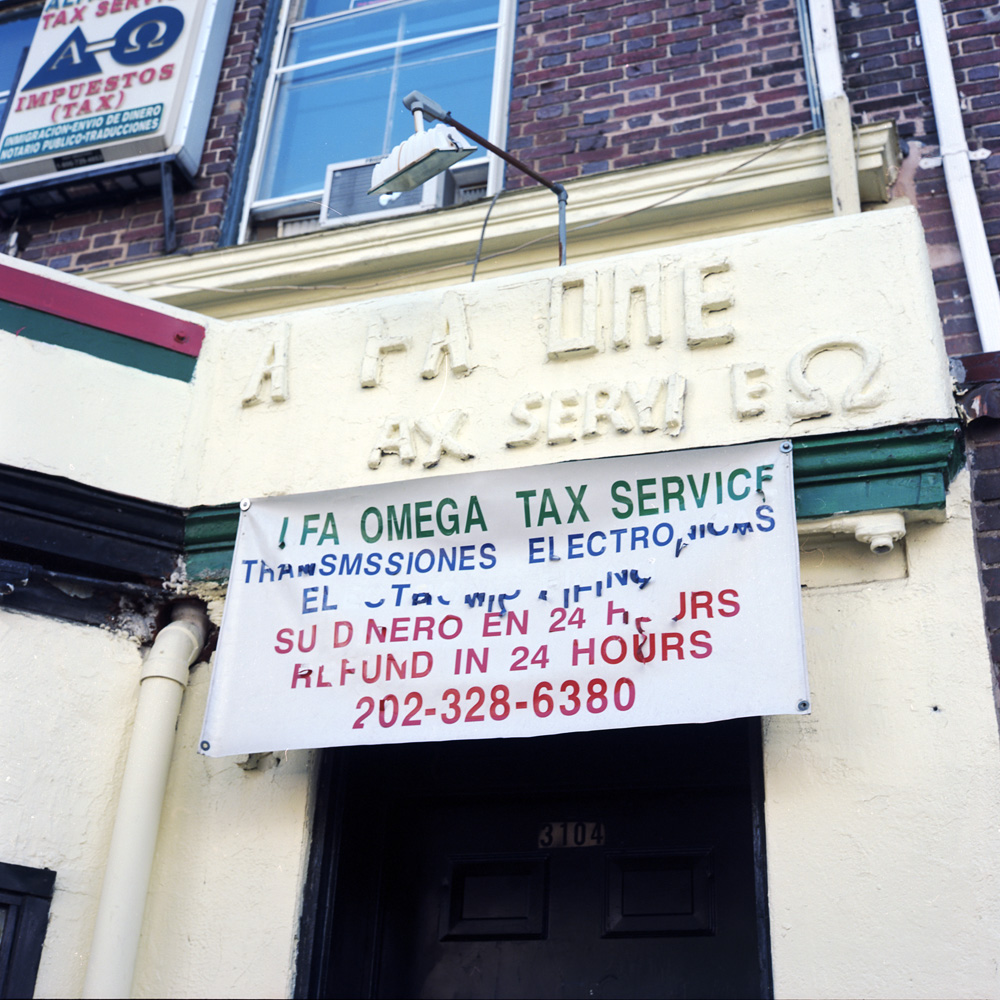
Alfa Omega Tax Services
Here’s one that has been around for decades – witness the missing letters and the layers of paint applied to the original Alfa Omega Tax Service on the wall. Having them there in the 1970s and 80s when this was one of the police patrol beats officers dreaded to be assigned would have been a huge deal to the residents, as there would have been few legitimate businesses willing to provide quality services of any kind in the area.
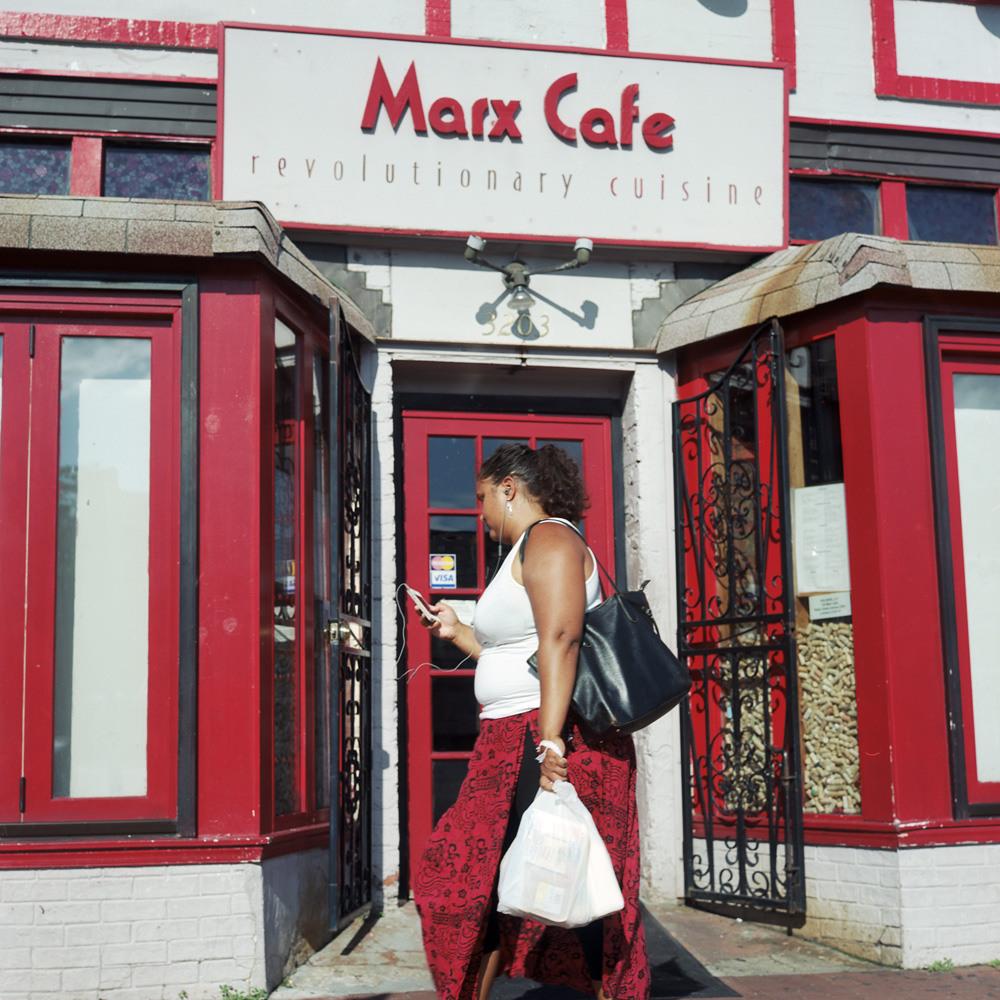
Marx Cafe
The bohemian precursor to gentrification – Marx Cafe (“Revolutionary Cuisine”) brought a little touch of culture and chic.
Tex-Mex Burritos
A typical neighborhood mom-and-pop eatery. This one is newer, keeping within the theme of the neighborhood but brightened up and appealing to the incoming Anglos as well as the long-time residents.
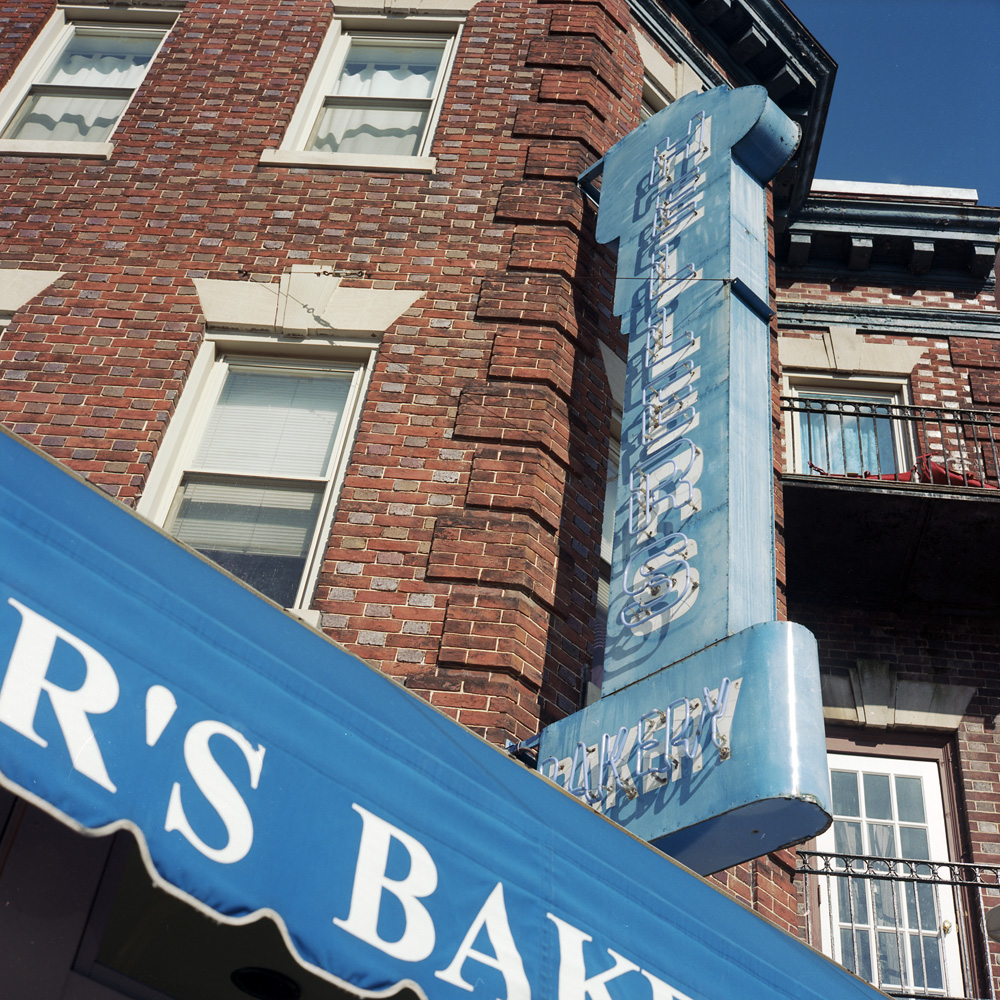
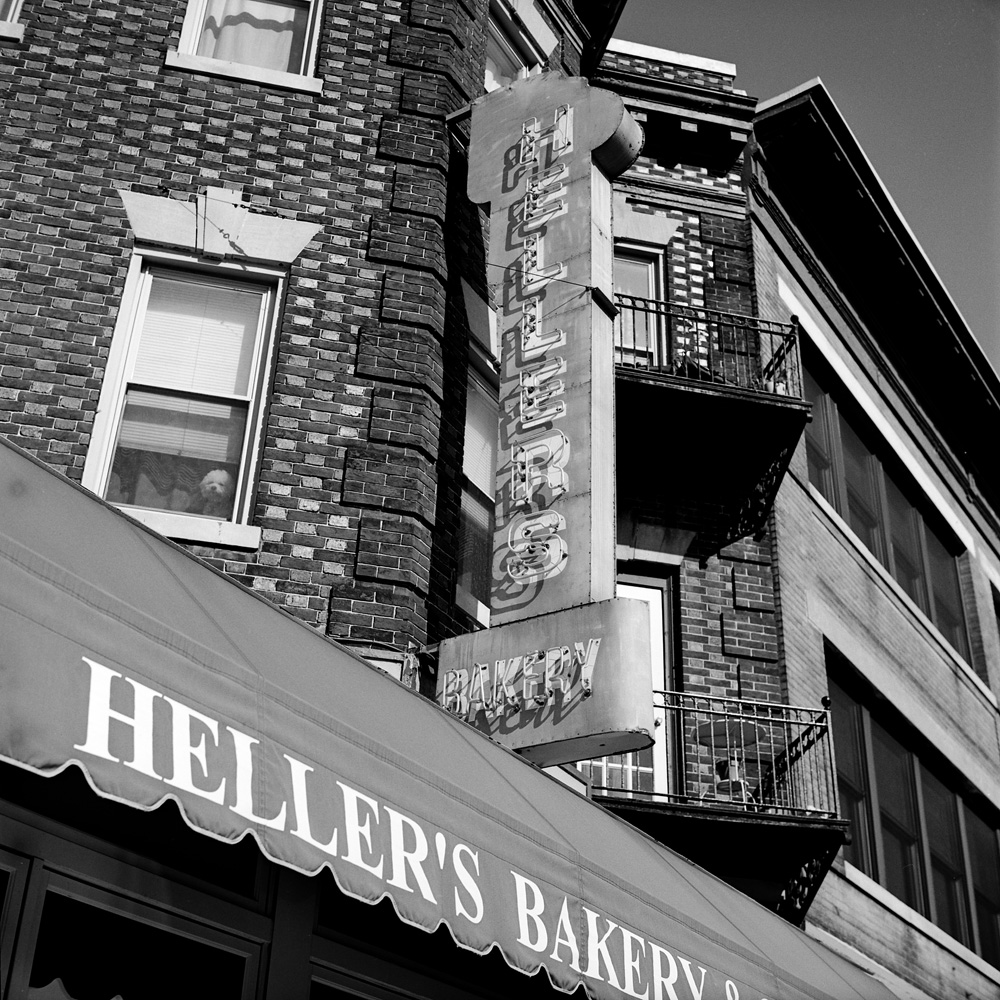
Hellers Bakery
Heller’s Bakery has been here forever, witness the neon sign, from back when the neighborhood was originally an upper-middle-class, white/jewish/African-American neighborhood. It stuck around through the hard times. If you saw the movie, State of Play, starring Russell Crowe, you’ll recognize this as being from outside his apartment.
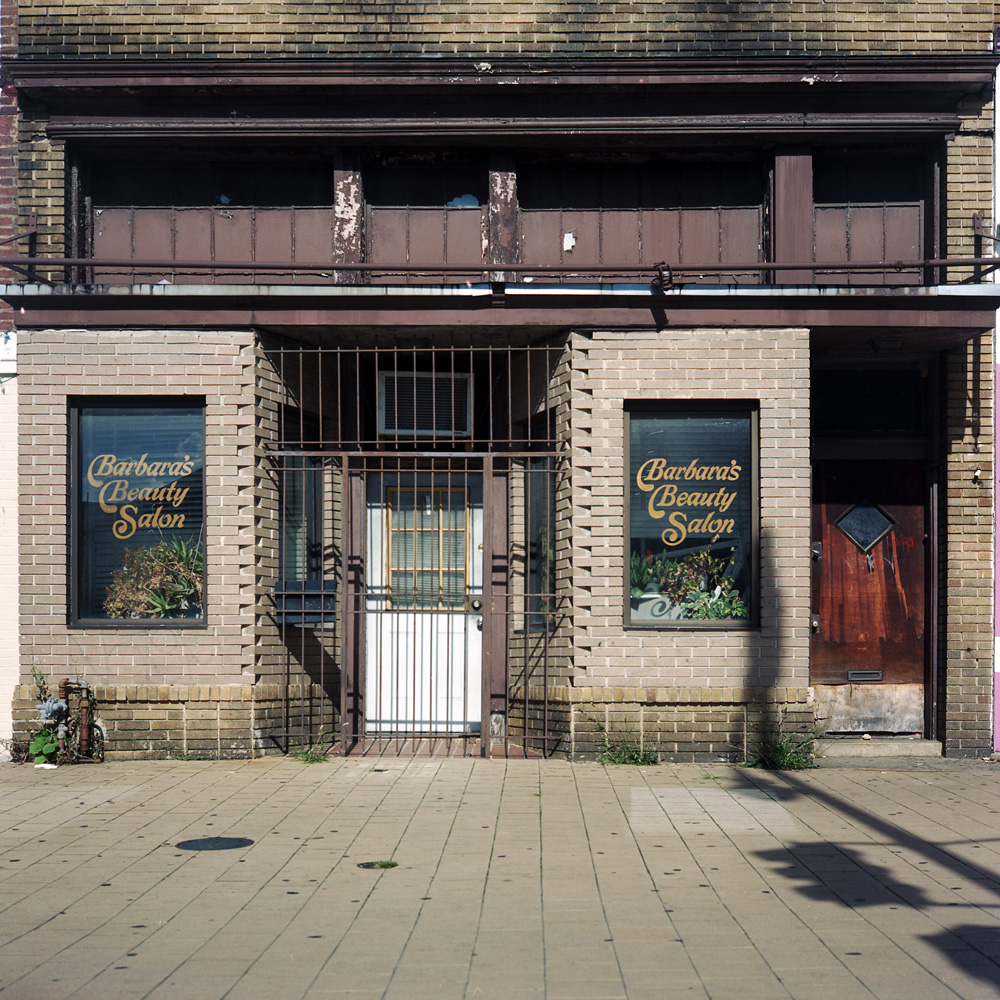
Barbaras Beauty Salon
I’m not sure Barbara’s is still in business – granted I usually never walk by it during the work day mid-week, so it might in fact operate then, but whenever I see it, it’s shuttered, blinds pulled, and half-dead plants in the window. I don’t know if they were a victim of shifting demographics, or just sloppy management – I don’t know that I’d want to trust what little hair I have left to someone whose plants look like that!
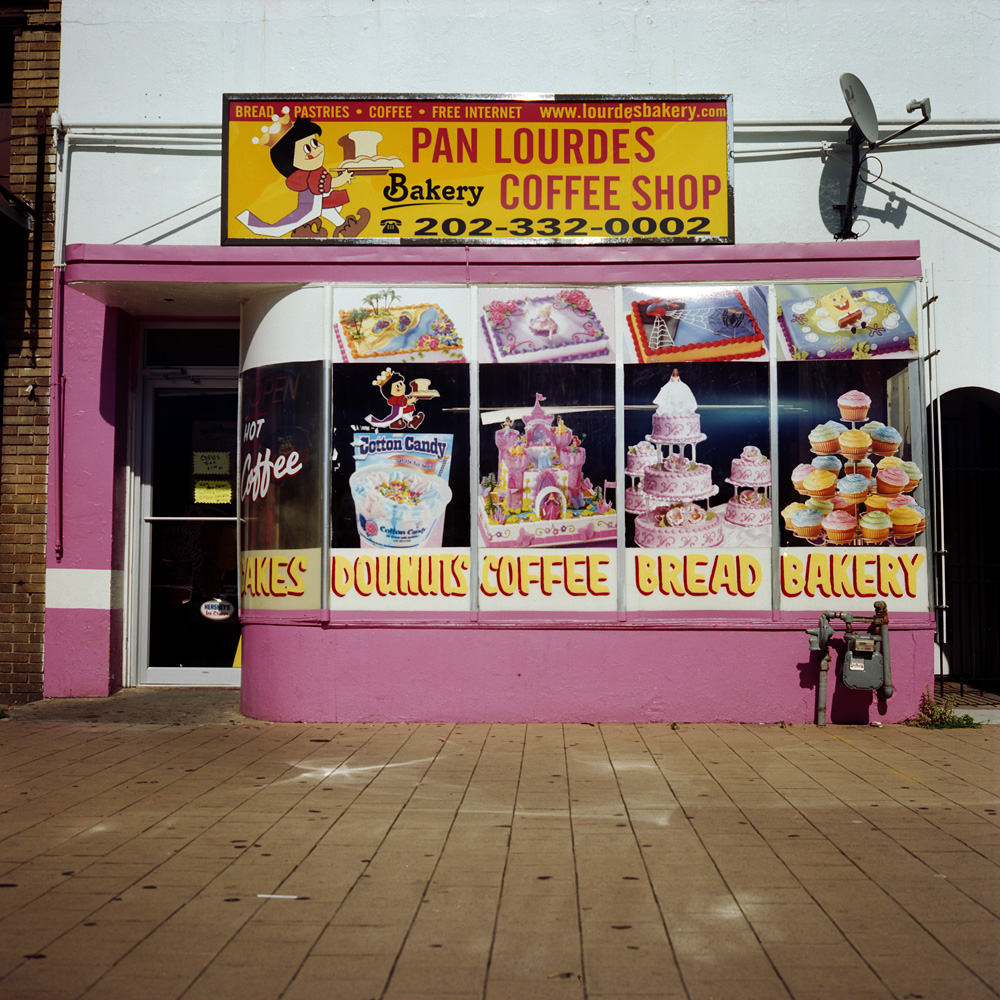
Pan Lourdes, Afternoon
Another small business that will probably be driven out by gentrification in the next ten years. Massive re-development of the neighborhood has happened a few short blocks down the street, with upscale restaurants and pubs, a shopping center with Target, Best Buy, Marshalls, Staples, Radio Shack, GNC, a Washington Sports Club gym, and across the street is Chipotle, a wine store (not a liquor store, but a WINE store), and a FedEx outlet. Like I said earlier, no room in that for a riot of pink selling Central American baked goods. And the neighborhood will be poorer for it.
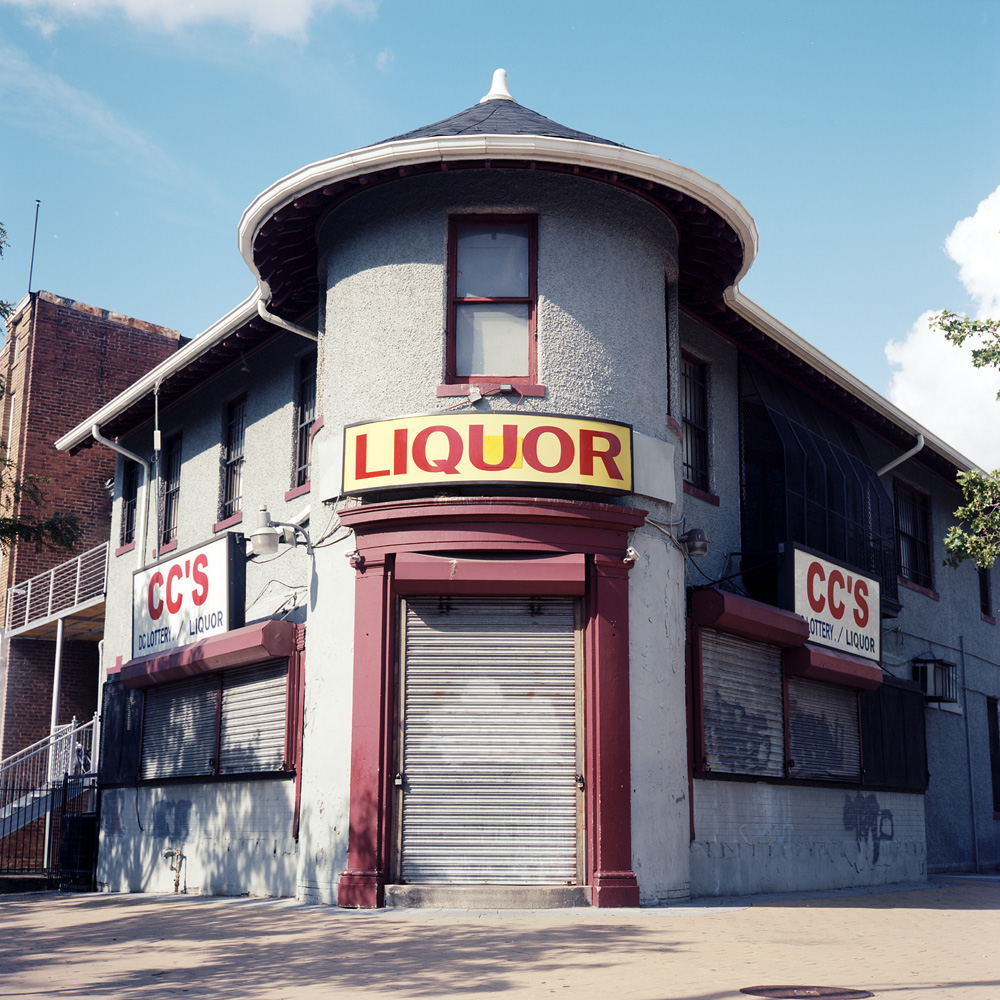
CCs Liquor
In contrast to the wine store down the street, this is a good old-fashioned ghetto liquor store. This one, I could let go, but the Colony Liquor up the street I’d like to see stay around if for no other reason than the fantastic Deco facade and neon sign (see previous posts of mine for pictures).
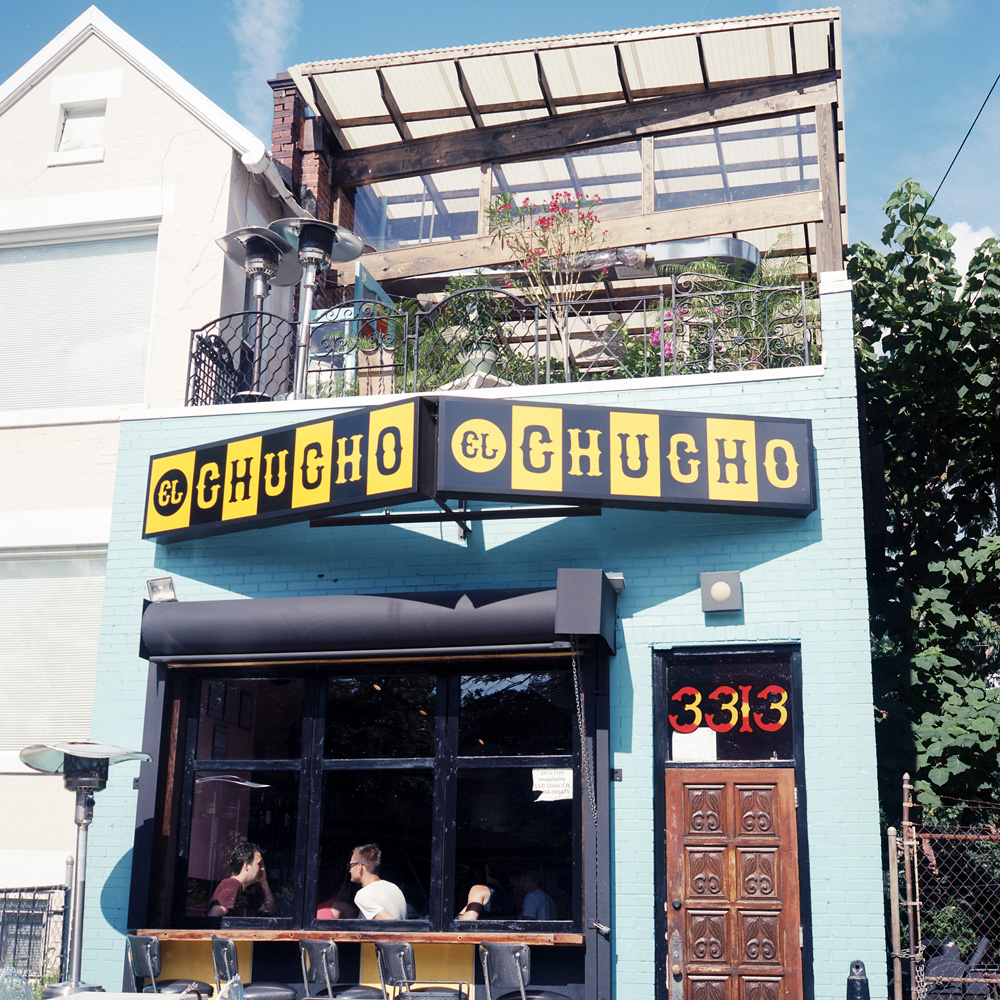
El Chucho Roof Deck
Part of the gentrification wave in my own segment of the neighborhood- its ethnic cuisine by hipsters. Don’t get me wrong, they have very delicious and authentic tacos (and insanely cheap happy hour prices – you can get three tacos and a beer for $10-11!!!), but the truly authentic taquerias don’t have roof decks, bar seating reclaimed from former diners, and waiters wearing plaid flannel, sporting a well-maintained three-days stubble.
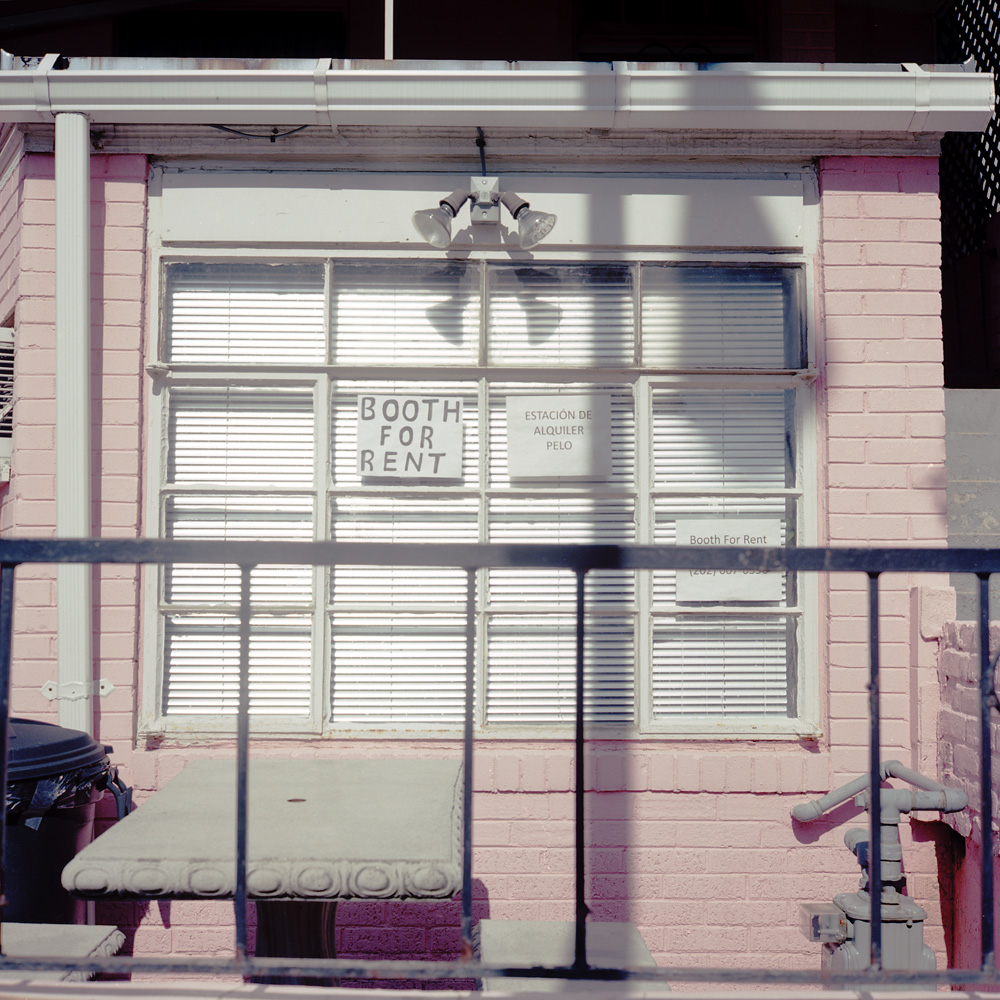
Booth For Rent
Alongside the hipster taqueria you have the basement beauty parlor, which you’d never know was a beauty parlor if not for the booth for rent sign in the window.
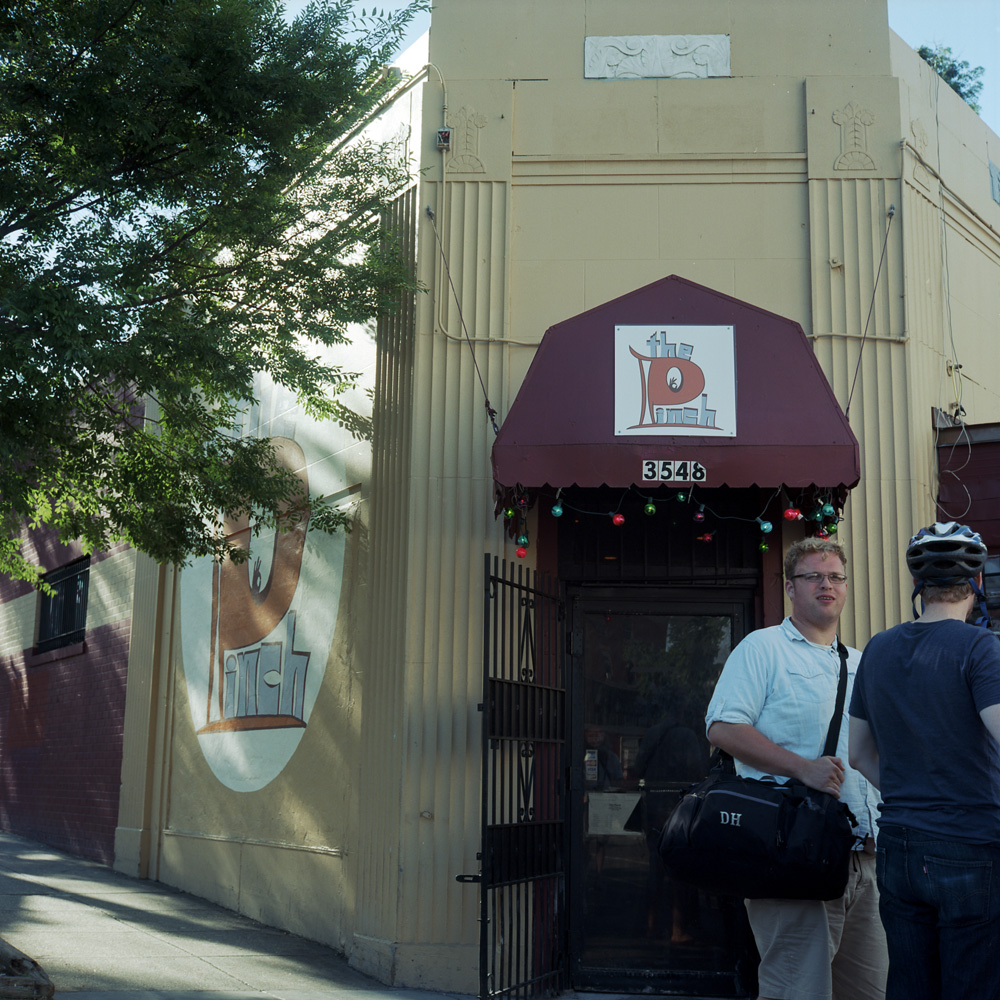
The Pinch Front Door
The Pinch is a neighborhood dive bar featuring live music on the lower level. The graphics outside scream 1970s blaxploitation movie, the patrons now scream suburban white kids who moved to the city to have an “authentic” experience. But it’s good to have a venue that provides space for local live music, where up-and-coming bands needing a break can perform, as there are definitely not enough performance spaces in this town to adequately support the creative talent here.
For wont of anything better to do on Sunday afternoon, I went out for a stroll in the 90+ degree heat (what was I thinking!!!) with the Rolleis for company. I wanted to do a little film and development test to see how well my results would come out. I’d say I nailed it based on these shots. The film I was testing is Ilford PanF, a very slow, fine-grained emulsion. The film speed Ilford recommends for this film is ISO 50. Quite a few folks I know recommend giving it a more generous exposure and rating it at EI 12. I shot some before at EI 25 and got good but not knock-your-socks-off results, so I thought I’d try the 12 and see what difference it makes. I took a risk and changed two variables at once – film speed and development technique. Normally I use Rodinal at a 1:50 dilution and develop for 14 minutes, agitating the chemistry for five seconds out of every 30 seconds. This time, I used Pyrocat HD for my developer, gave it twice the normal dilution (I usually use it diluted 1:1:100, but this time I used 1:1:200) for 45 minutes, with 5 seconds of agitation every 15 minutes.
This development technique is known as semi-stand development. Semi-stand uses highly dilute developers for greatly extended periods of time, with minimal agitation. What this does is it allows micro-contrast areas to form on the film where byproducts of the development process accumulate on the edges of light and shadow. These byproducts serve as a mask and lead to a boost in contrast at that edge, increasing the appearance of sharpness. If you look at the emulsion side of a negative that was developed using semi-stand, stand, or extreme minimal agitation technique (variations on a theme), the emulsion will actually appear in relief as if it had been etched.
This technique is also useful for managing high contrast situations because it allows for greater adjustment of the length of development to manage highlights. When you develop a roll of film, the shadow areas develop first, and once they have reached their maximum recorded density, they stop. Highlights will continue to develop long after the shadows have finished. This is one of the primary means for controlling contrast in an image- if the highlights are known to be too bright before developing the film, you can simply reduce total development time to keep the highlights from becoming unprintable.
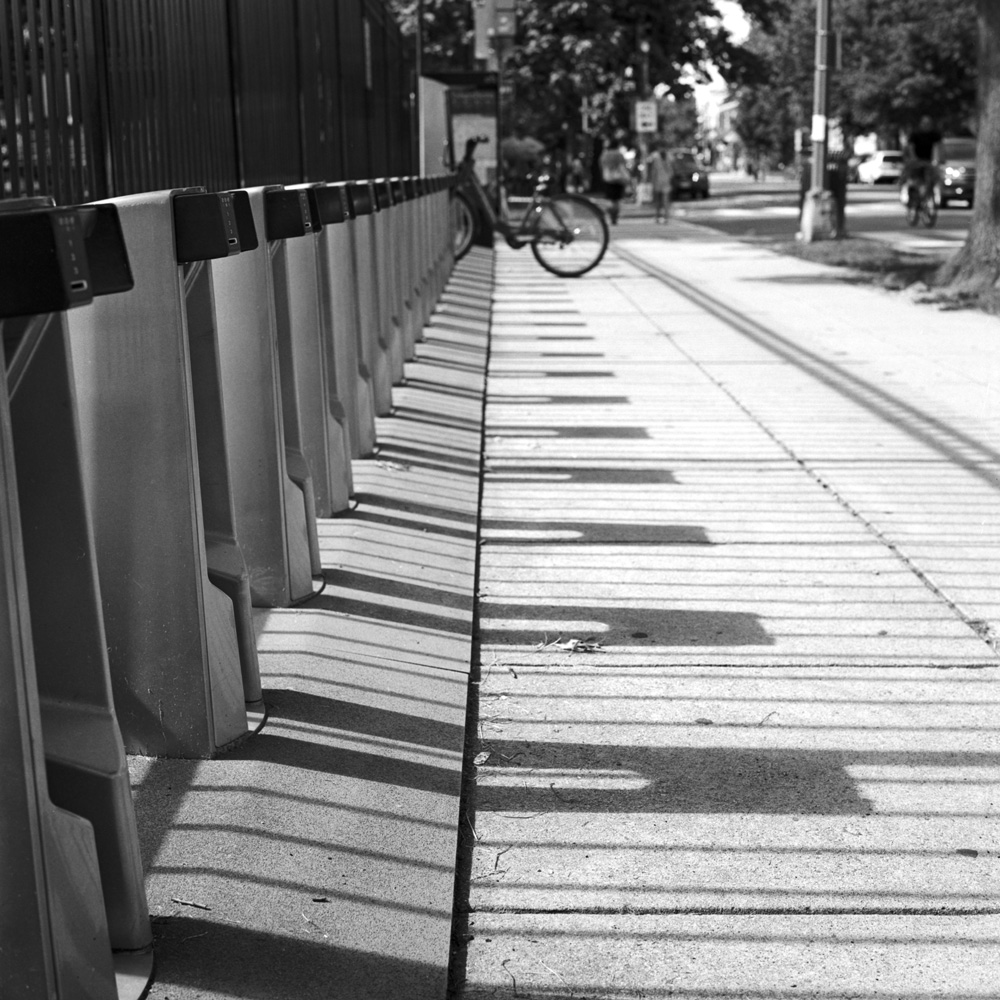
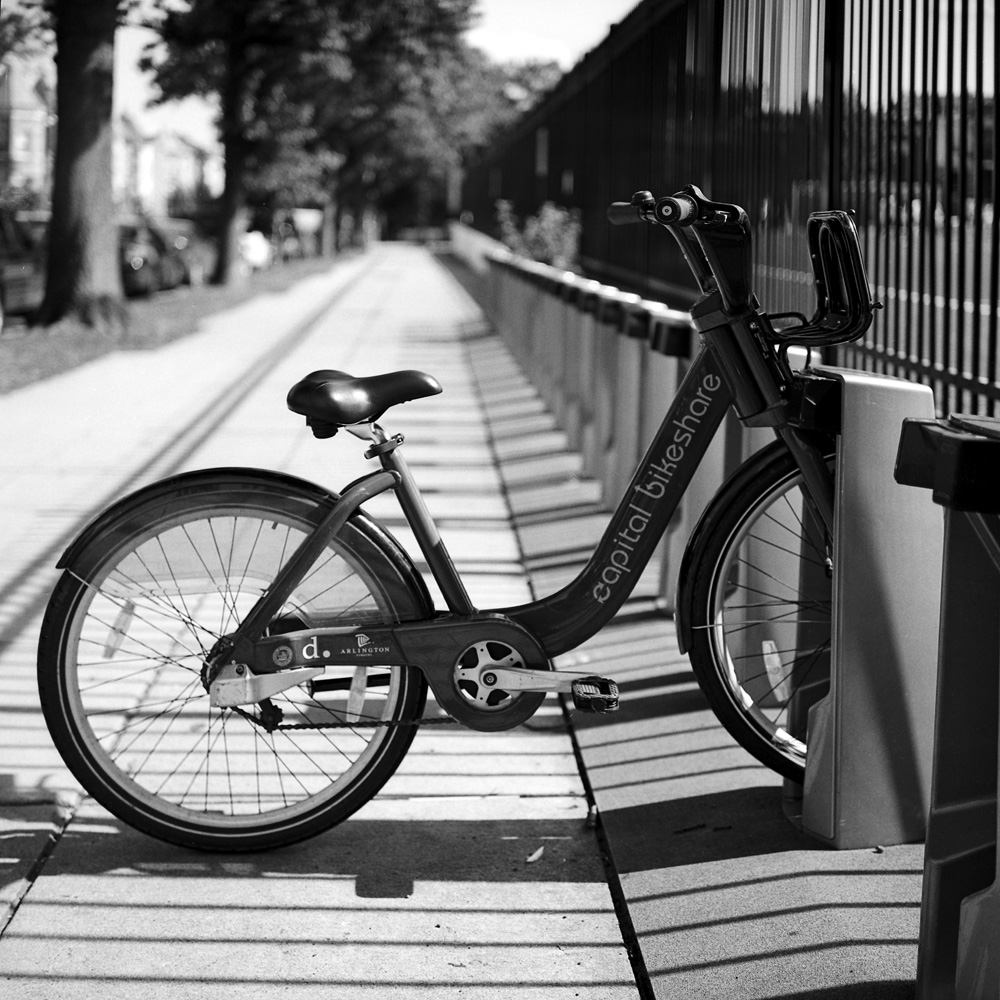
Bike Rack, 11th St. NorthboundBike Share Rack, 11th Street
These first two images are of the Capitol Bikeshare rental rack near my house. I’ve photographed the Bikeshare racks before, with full racks of bikes, to capture the receding perspective of the bike wheels. This time, I shot the bike rack with only one bike in it, to work with the late afternoon shadows created by the rack itself, and also to demonstrate the popularity of the Bikeshare, at least in my neighborhood. As you can see, on a Sunday afternoon, with the heat rising to over 90 degrees F, all but one of the bikes from this rack are in use.
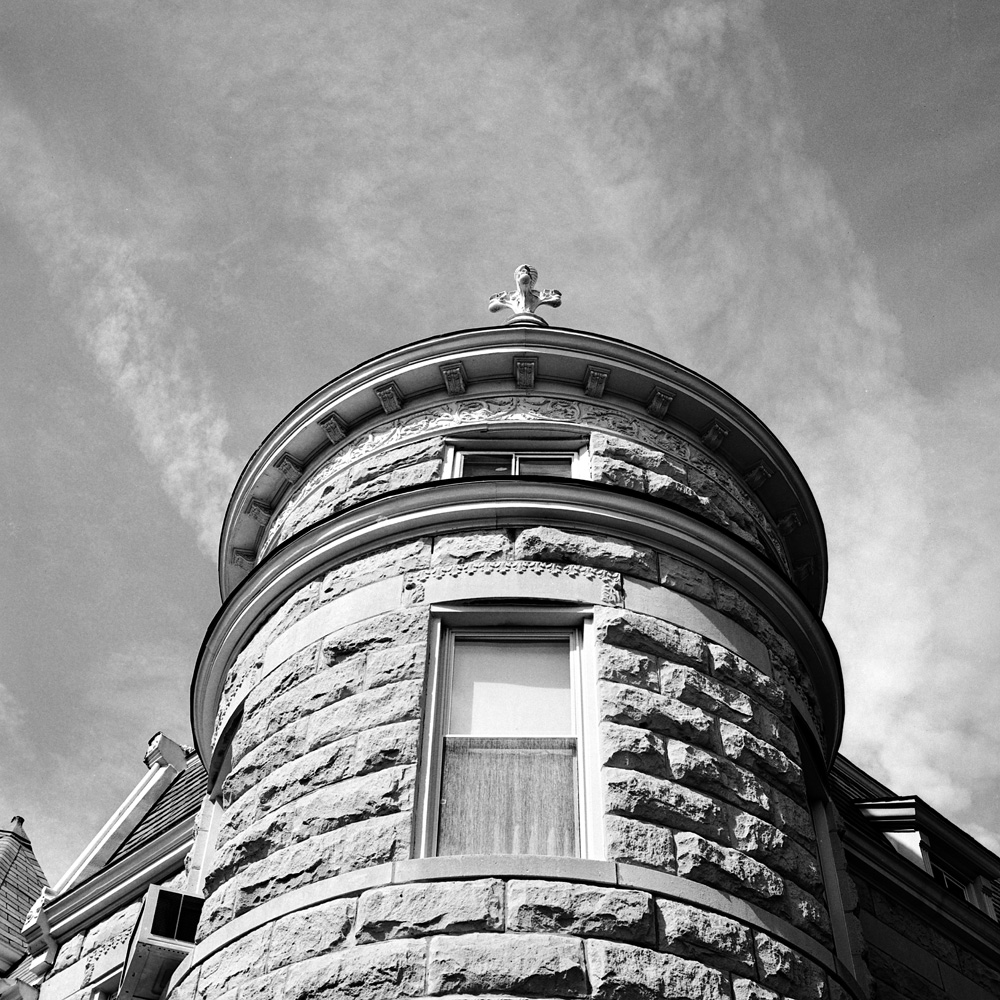
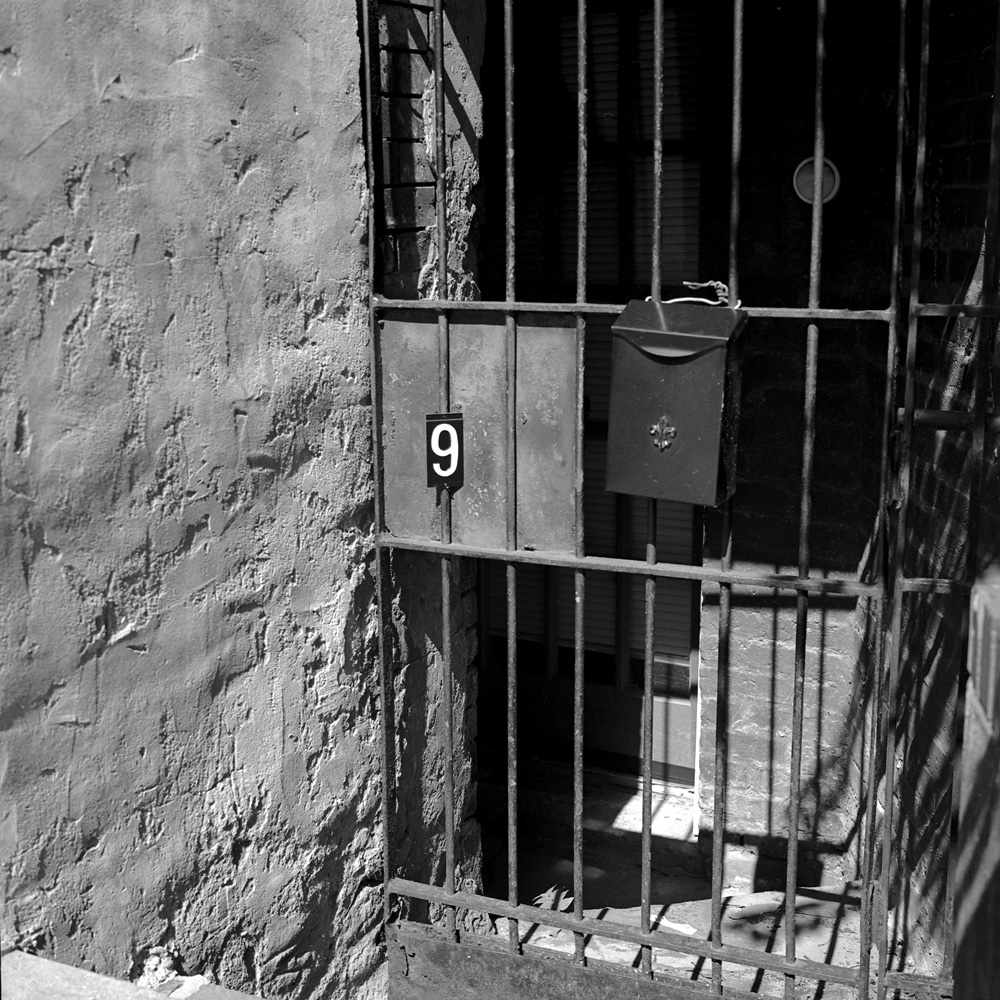
Stone Turret, 11th StreetNumber 9, Basement Door
Very much in the same stretch of 11th Street as the bike rack is where these two scenes can be found. The stone house is a bit of a neighborhood landmark – there are maybe half a dozen or less in the neighborhood with similar facades, and the rest (hundreds of houses) are varying types of brick or stucco over brick. The basement door photo was taken as part of this exercise, not only because I like wrought iron, but because the scene had extremes of contrast that I wanted to see if I could tame with the semi-stand development.
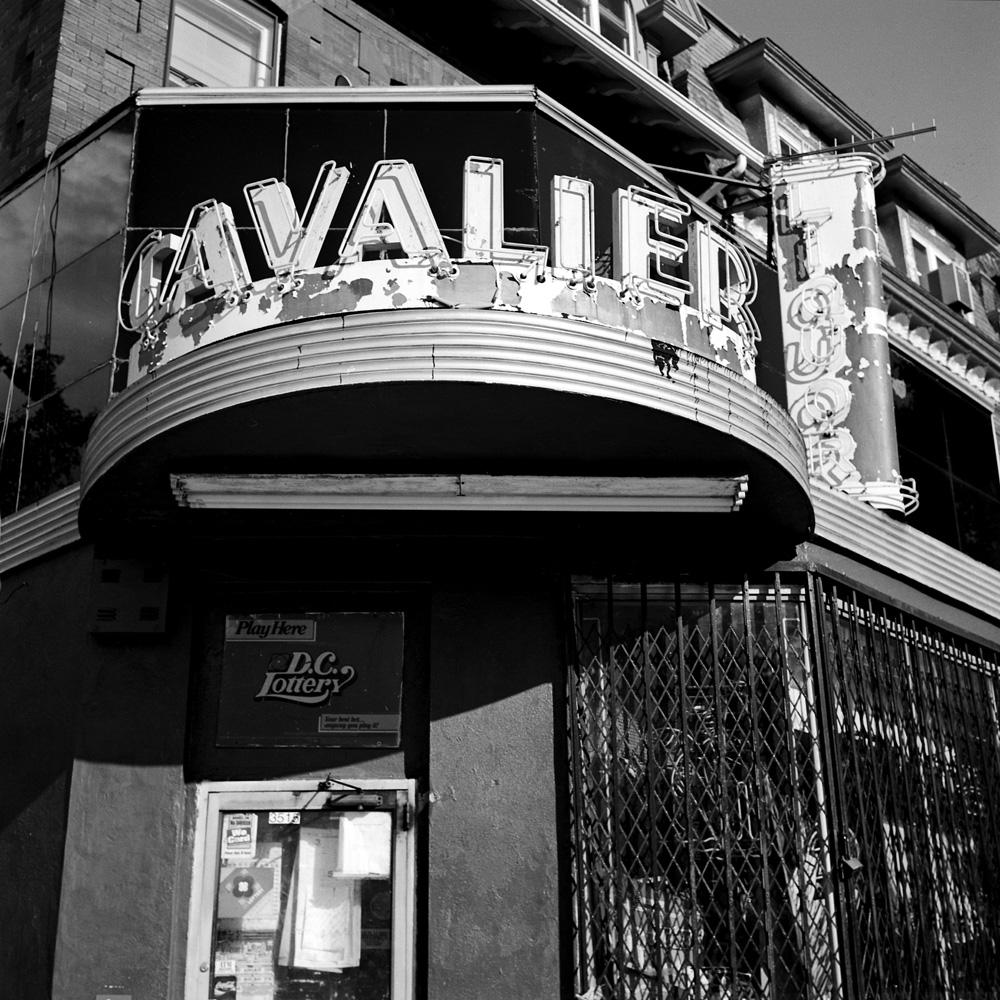
Cavalier Liquor Sunday AfternoonHellers Bakery
These two photos are of neighborhood icons – you’ve seen my color photo of Cavalier Liquor at night before. It has been the subject of many a photograph by fans of urban texture, neon, and Deco architecture. Hellers Bakery has been in their current location for many many years, and if you saw the movie “State of Play” starring Russell Crowe as Cal McAffery, a hard-luck, hard-boiled reporter who uncovers a Washington conspiracy, you’ll recognize their neon sign from below his apartment window. I’m very annoyed with Hellers that they don’t illuminate their sign very often, so it makes it very hard to get a good photo of it after dark!
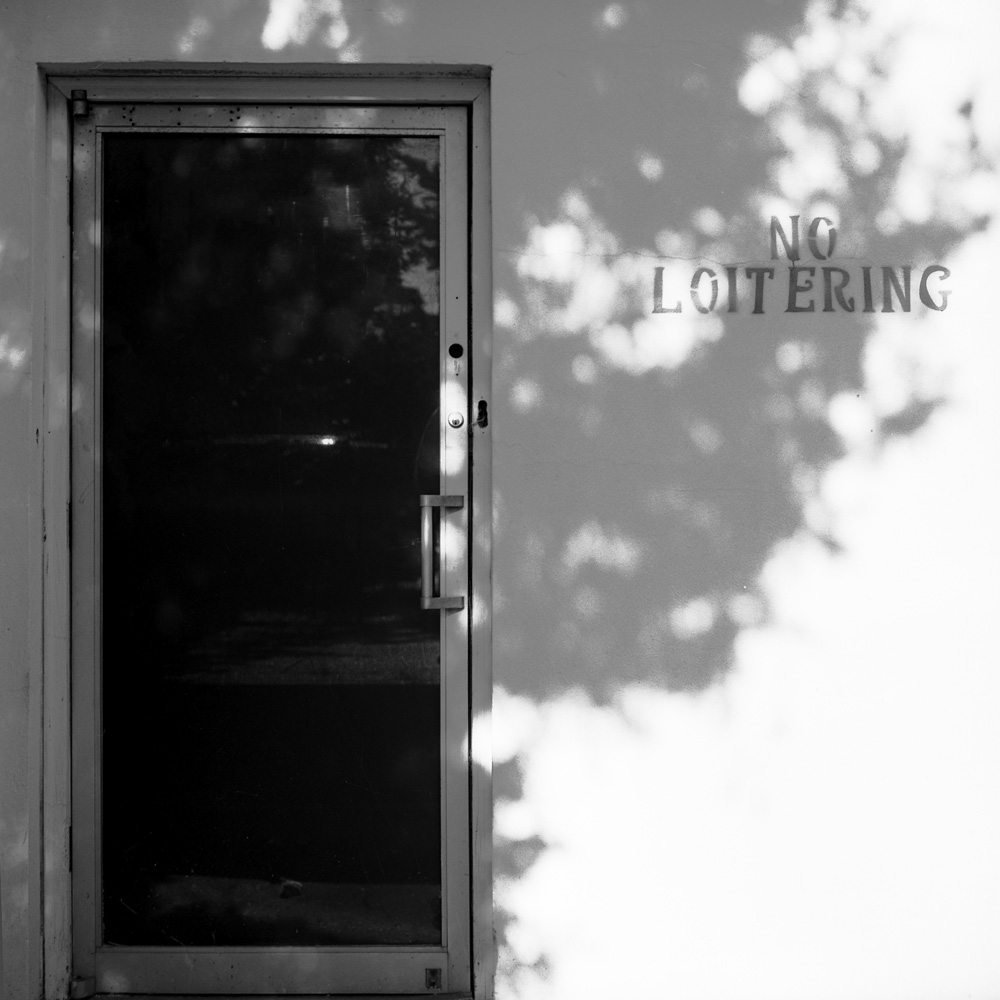
And last but not least, an appropriate sign to end the post with:
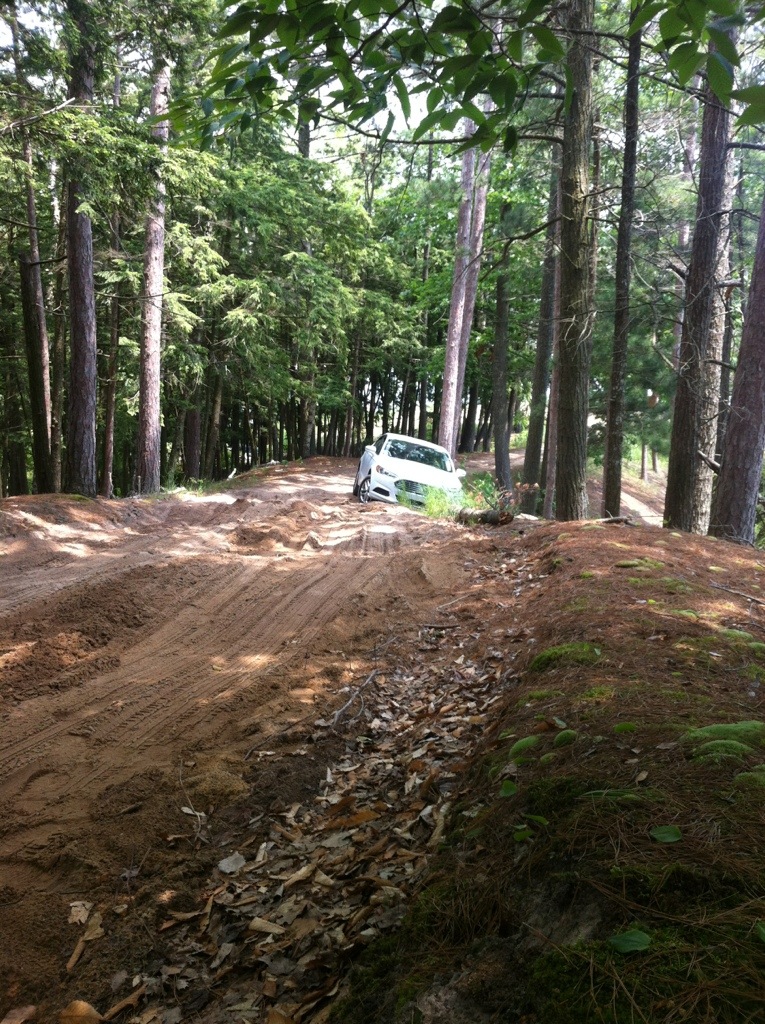
I don’t recall if I regaled you all with the saga of my stuck rental car. I had heard from some other folks at Photostock about Lake Oneal, which they said was absolutely beautiful, but really needed to be photographed in foggy conditions. Something was mentioned about the road to it being challenging, but that kinda got lost in my memory at the time. On my last day at Photostock, I decided to drive around on my own and take some photos. I had stopped in the general store in Good Hart and the owner gave me a map of Emmett County and marked a number of photogenic sights on it. I headed out, map in hand, stopping at the boat launch in Cross Village to get my shots of Lake Michigan. Carrying on, I saw the road to Lake Oneal marked on the map. At the end of the road there was a symbol for a boat launch. I thought, “how bad can the road be if there’s a boat launching ramp at the end?”. So, naive as I was, I drove back there. The road had some sandy spots in it, but nothing I couldn’t navigate around in my Ford Fusion. Then, at the very end of the road, there was a tall uphill, and on the downslope to the parking/unloading area, a VERY sandy stretch. I managed to get down the slope fine, so I figured I could follow the same track back up. NOT. I tried, several times, and ended up getting the car stuck on the side of the road. Long story short, two and a half hours and $300 later, my car was back on a hard surface road.
The Sandy Uphill
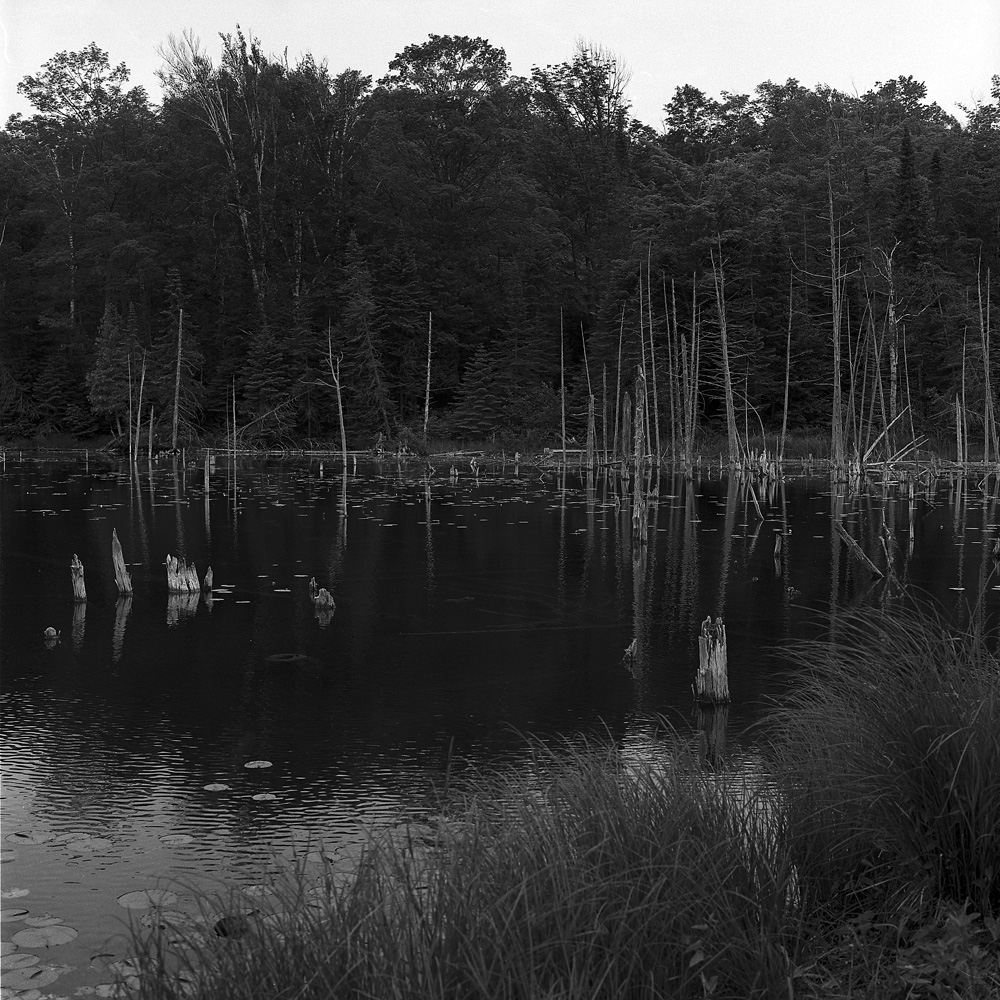
While I was stuck there, in the bright beautiful sunlight of a fog-less afternoon, I decided I would take on the challenge thrown down by the other photographers of getting a good shot of the lake with no fog. Here are the results:
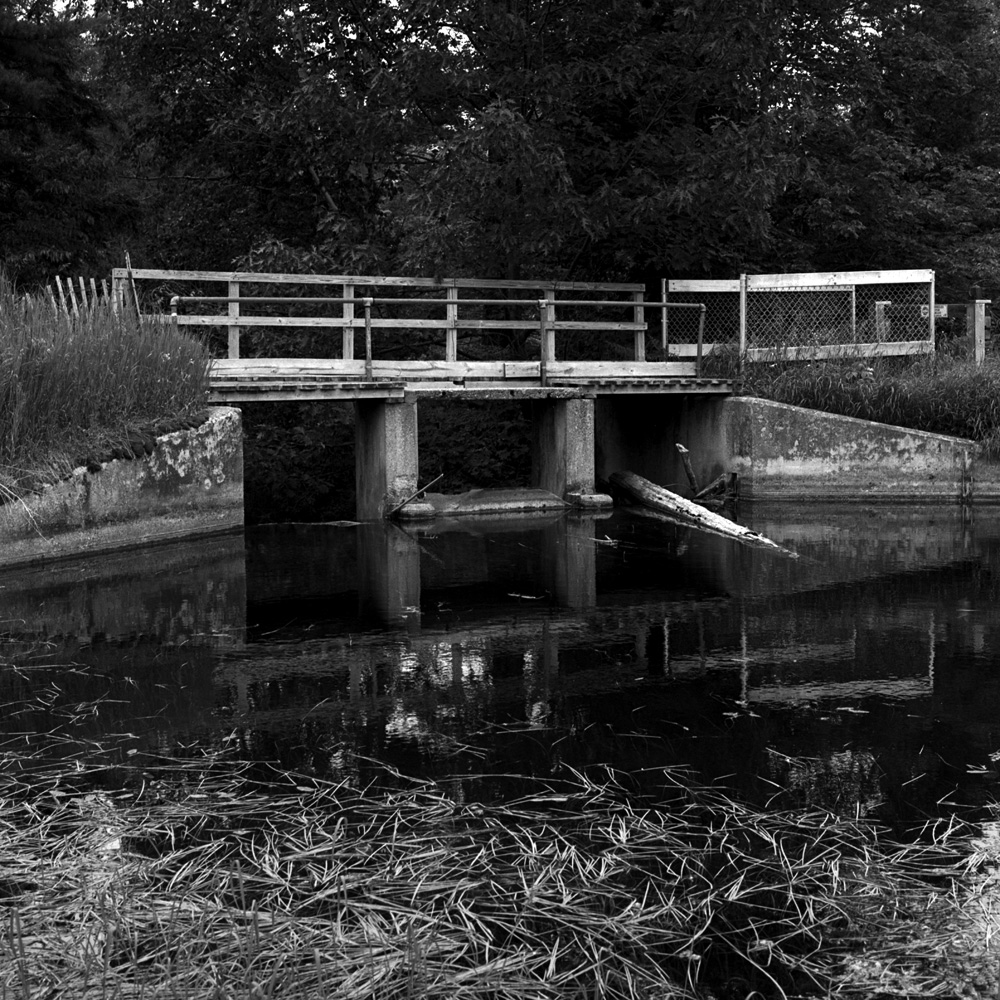
Bridge, Oneal Lake
The bridge is over a sluice/runoff drain for the lake. Judging from the stands of dead trees sticking out of the lake waters, the lake was an artificial lake. Why it was created I’m not sure, but I’m not about to complain.
Oneal Lake
Here you can better see the snags of dead trees reflected in the waters. Other than the leaden white sky (there was a little overcast, but still bright sun), I’d say challenge met.
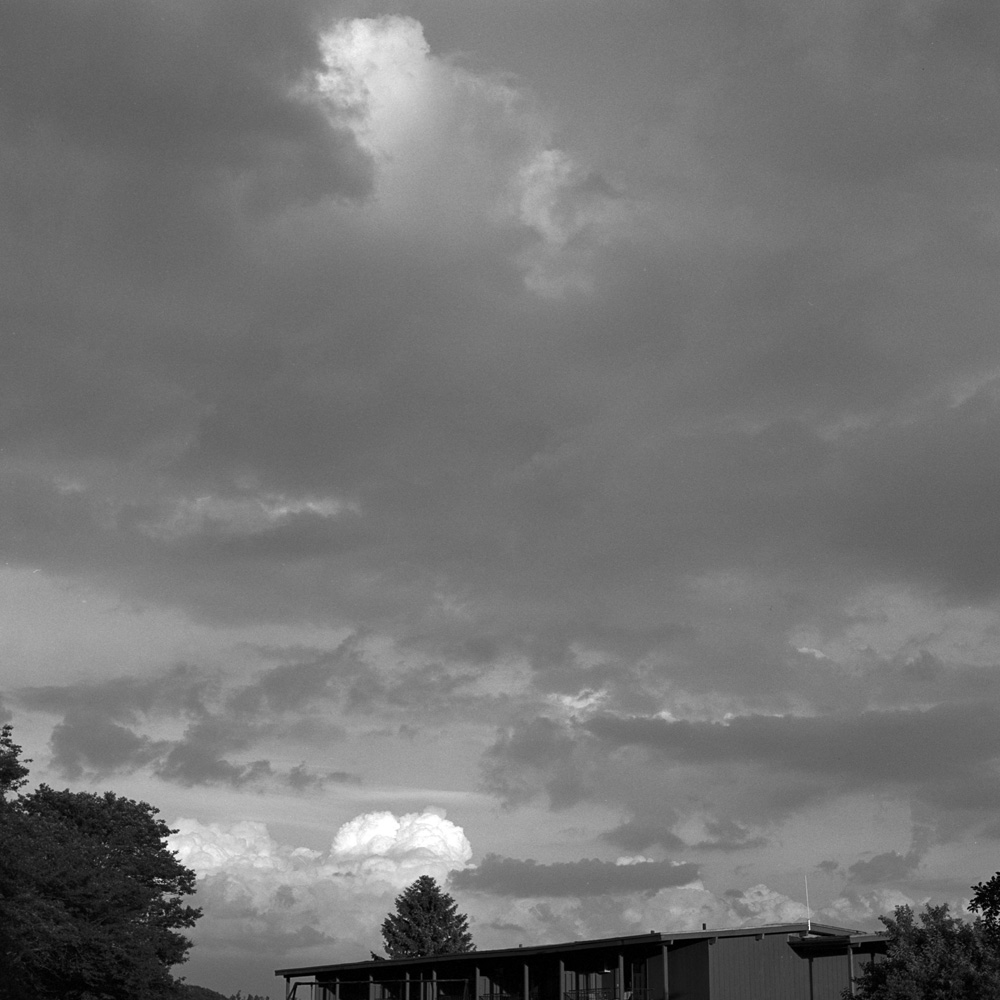
These next two photos are of/at the Birchwood Inn, our headquarters for Photostock. The first one is of some magnificent clouds we had one evening. The roof of the annex to the inn is just visible at the bottom.
Clouds, Birchwood Inn, Evening
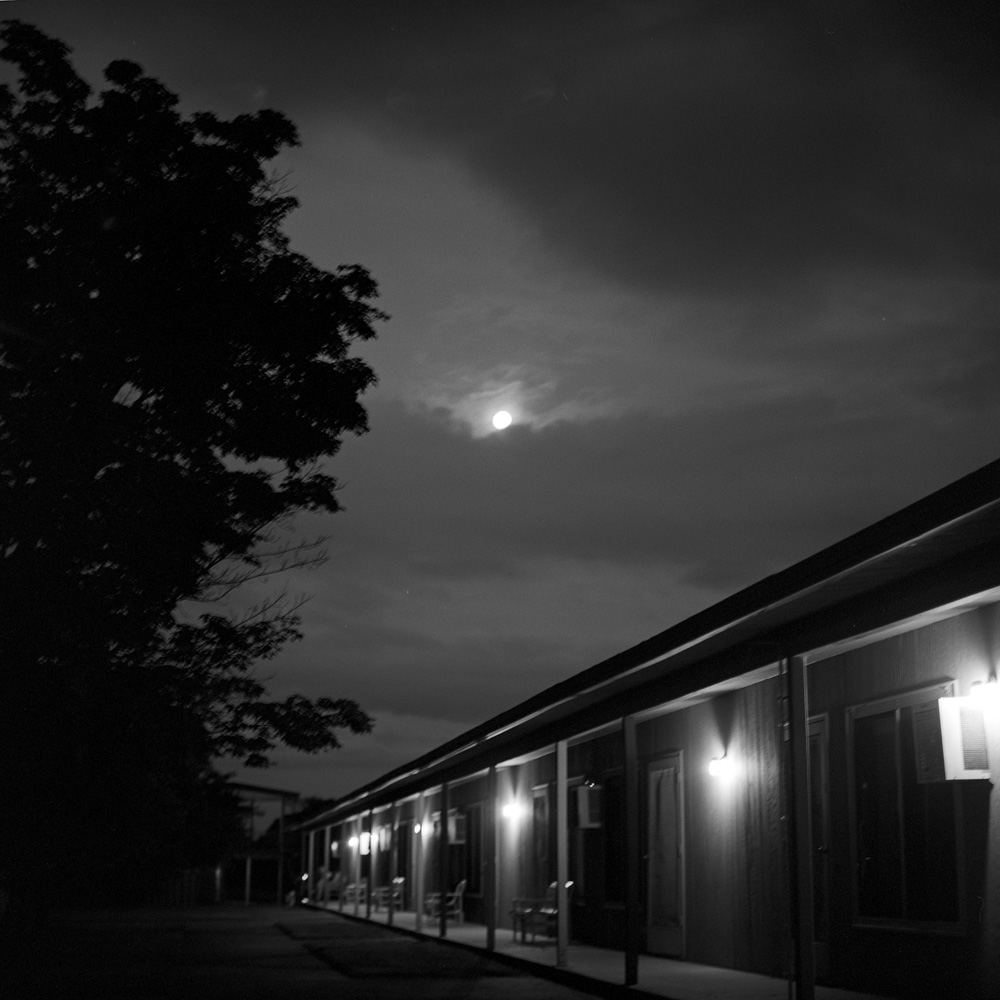
The last photo of this post is the Birchwood Inn’s patio illuminated by the full moon. This was I believe the night of the “super-moon”, but late enough it no longer appeared larger than normal. But it sure was bright and beautiful.
The Birchwood, Moonlight
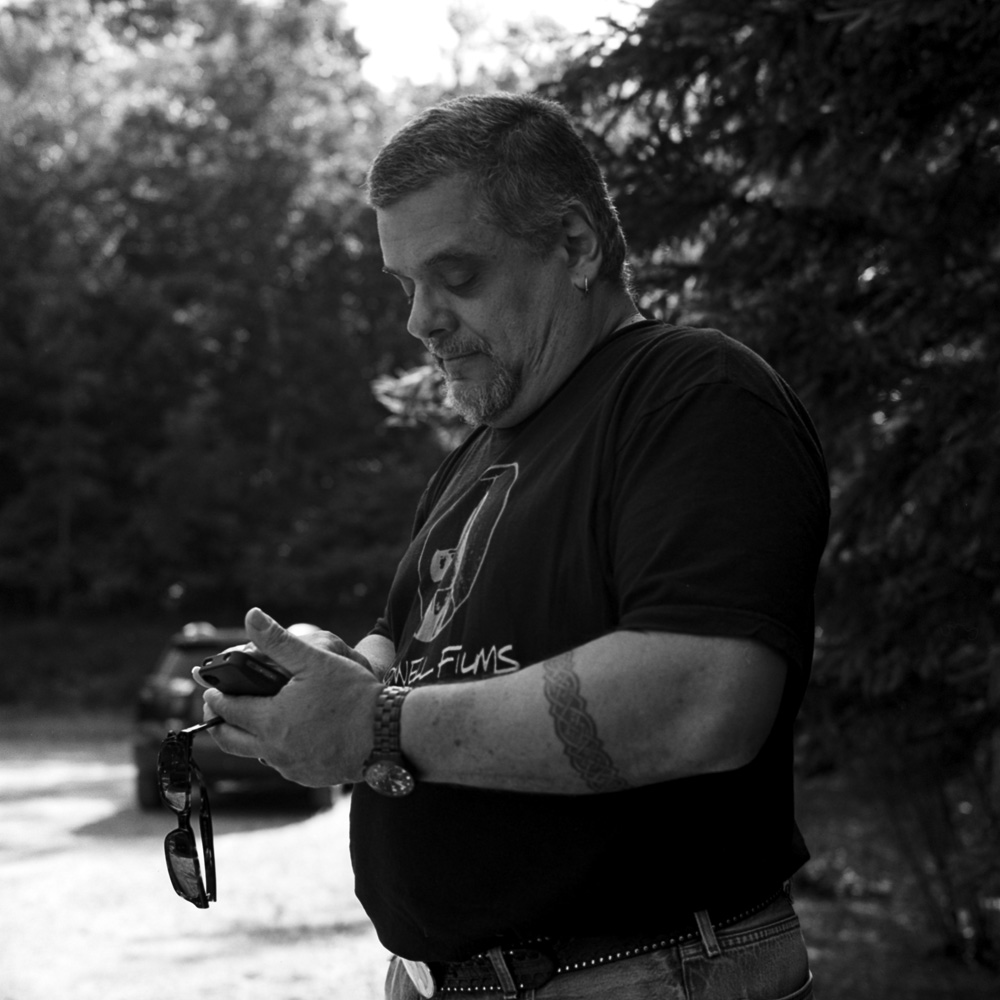
All the black and white images were taken with my Rolleiflex 2.8E, on Ilford Delta 400 film. The color shot was from my iPhone. Which was my lifeline to getting un-stuck, but barely – signal at Lake Oneal was so bad, I kept dropping my calls to AAA. So two words of caution should you ever want to visit Lake Oneal yourself – ONE: bring your own 4-wheel drive/offroad vehicle, preferably with a bumper-mounted winch, and TWO: a satellite phone would not be a bad investment. I watched two different 4wd vehicles go up that hill, and both had trouble, although one fared better than the other. The first one was only technically 4wd, because his front transfer case was acting up and so the power was only going to the rear wheels. His knobby tires and high clearance were what enabled him to get out. The other one spun and sputtered and wallowed through the sand but made it out in one pass.
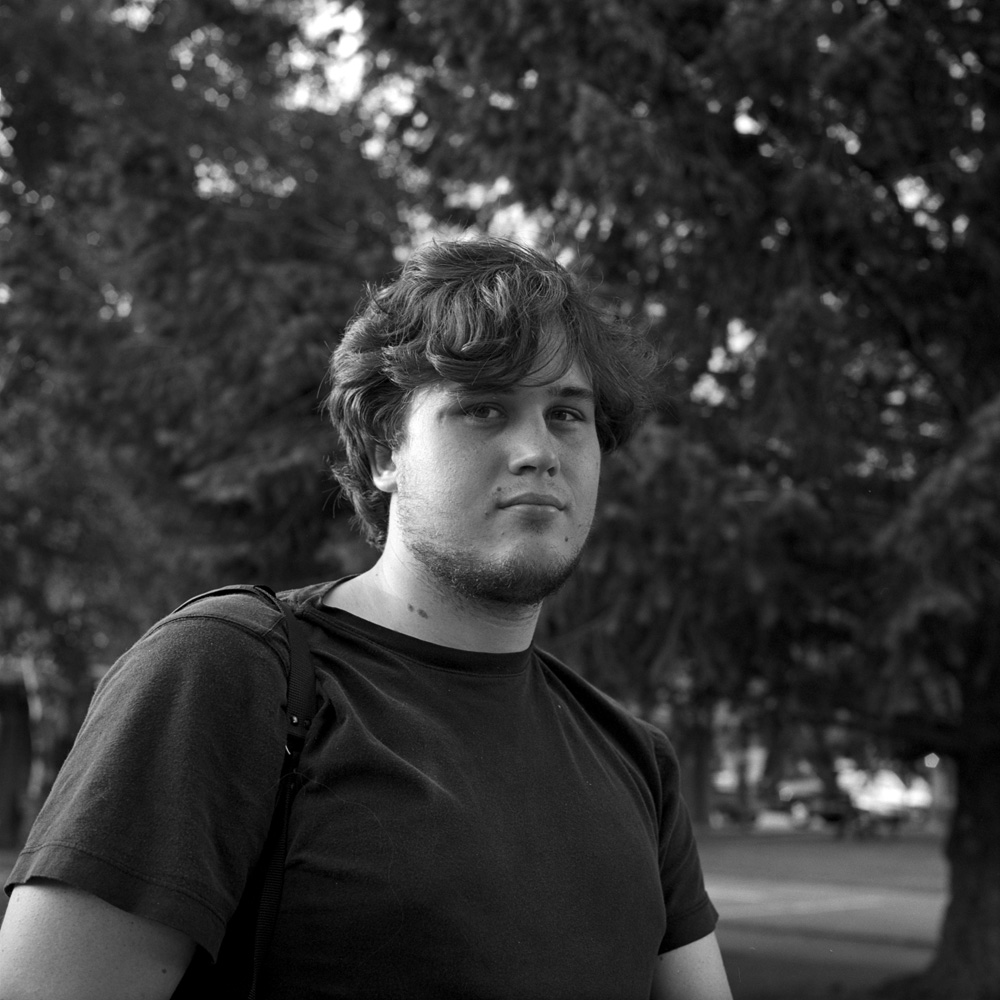
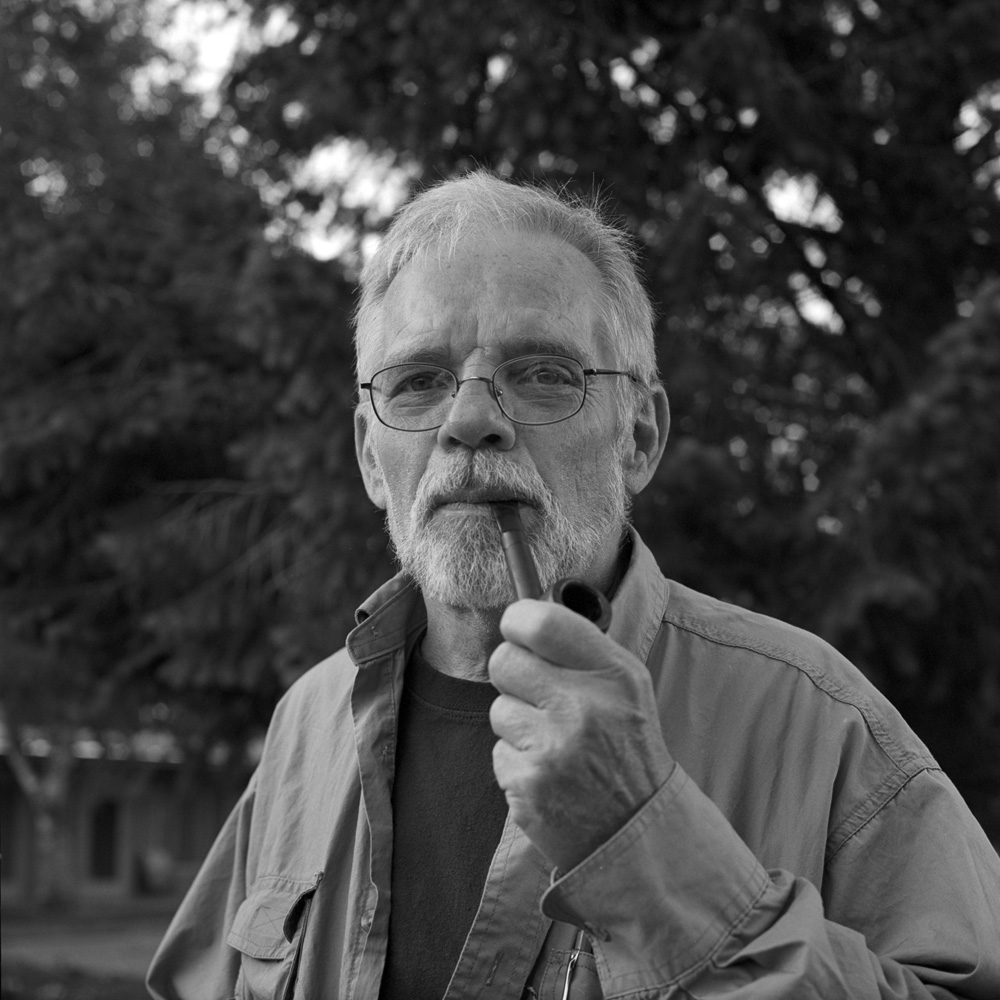
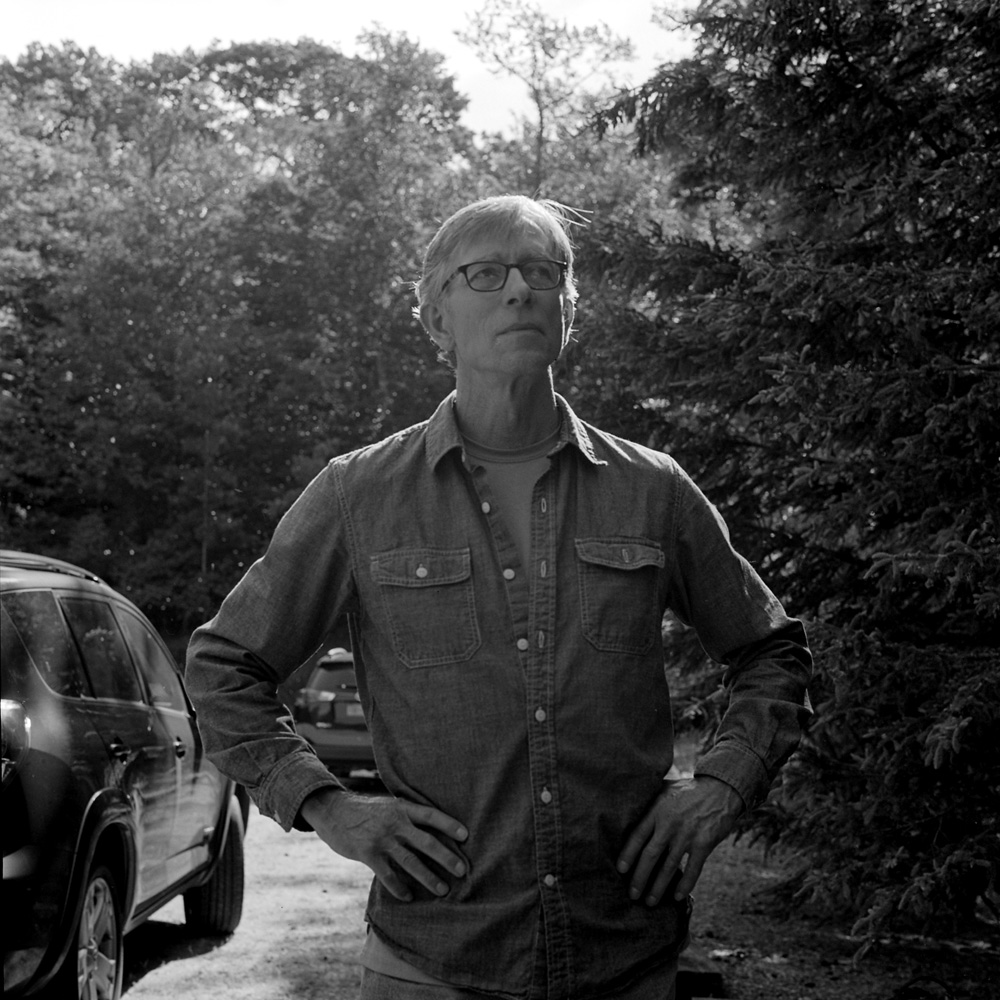
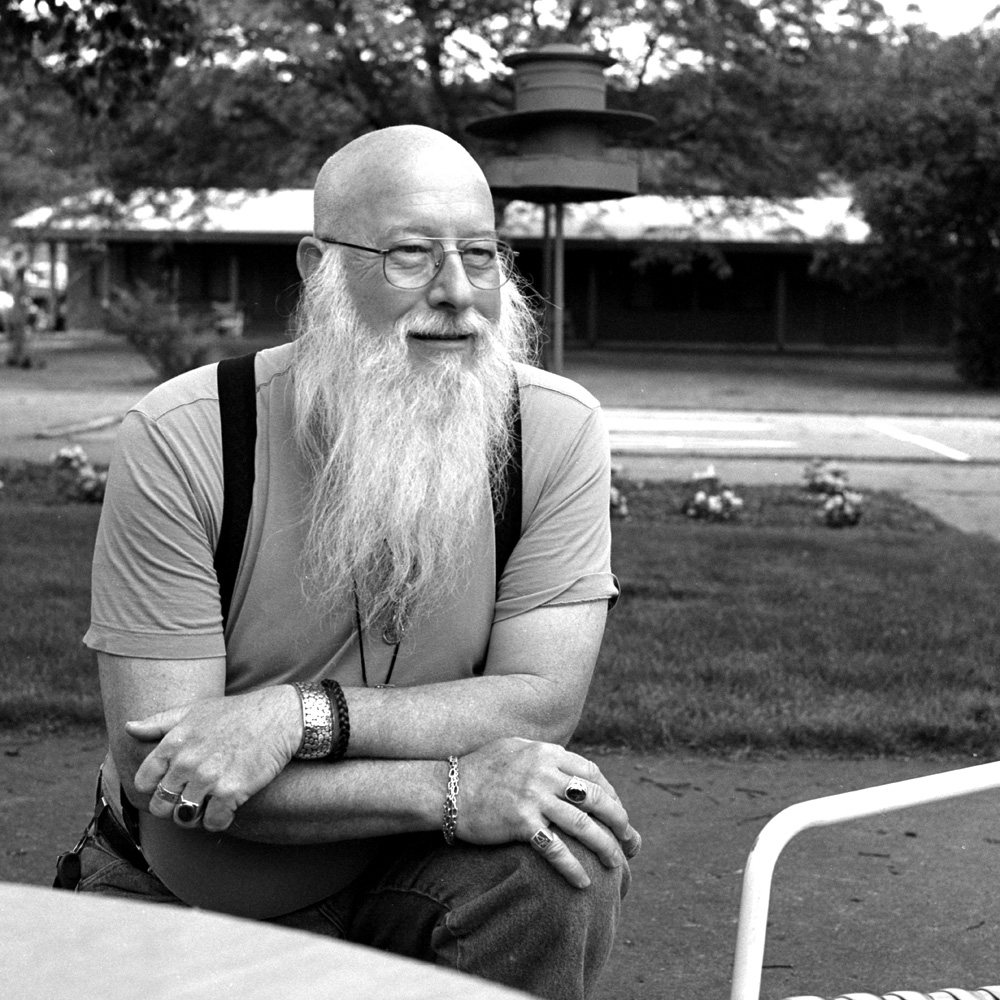
Well, no particular order other than I bracketed the series with folks not looking directly at the camera. I’m including these shots for sentimental reasons more than for the quality of the portraits.
All shots taken with my Rolleiflex 2.8E, on Ilford Delta 400 developed in Pyrocat HD. That Rollei is a fantastic portrait camera, considering it has a fixed “normal” lens on it, isn’t it?
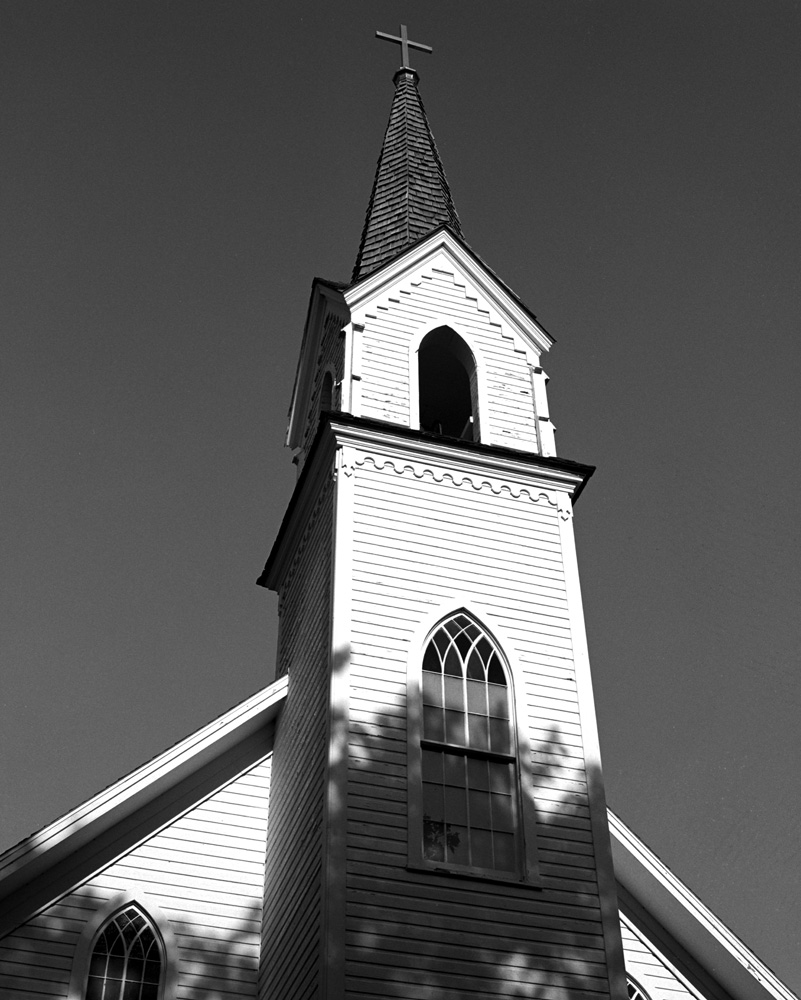
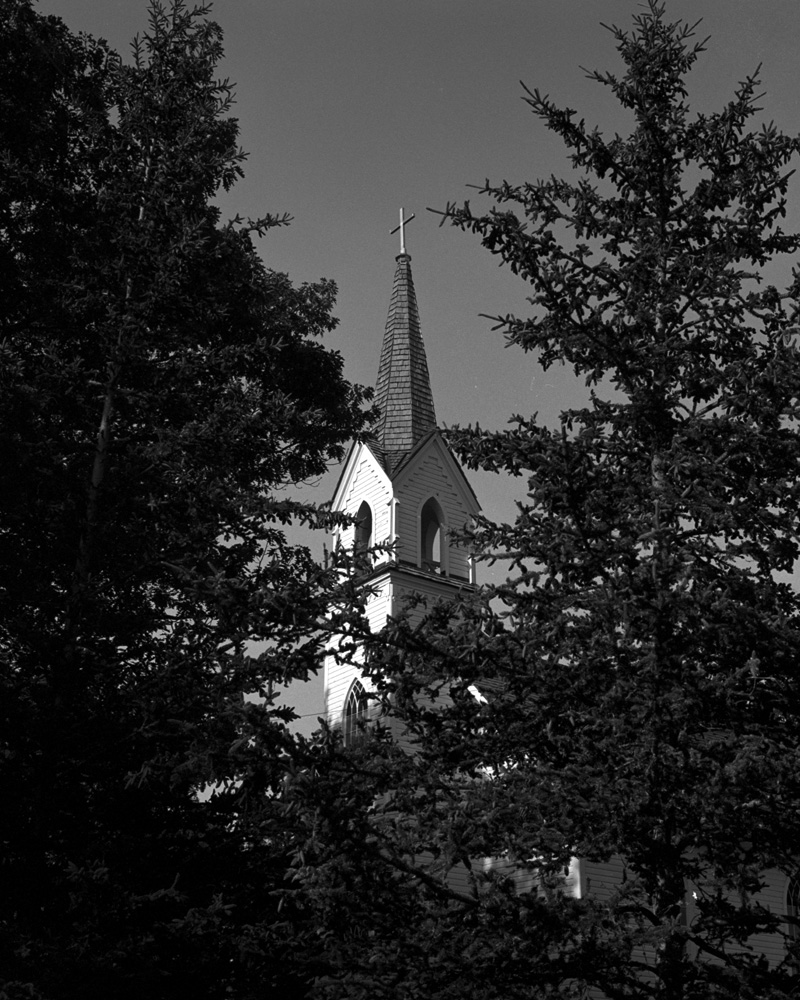
Here are the promised photos of St. Ignatius Church and the cemetery next door. St. Ignatius Church as it currently stands is the third structure to have been erected on the site, the oldest of which was the French Catholic mission to convert the natives in the 1700s.
St Ignatius SteepleSt Ignatius, Trees
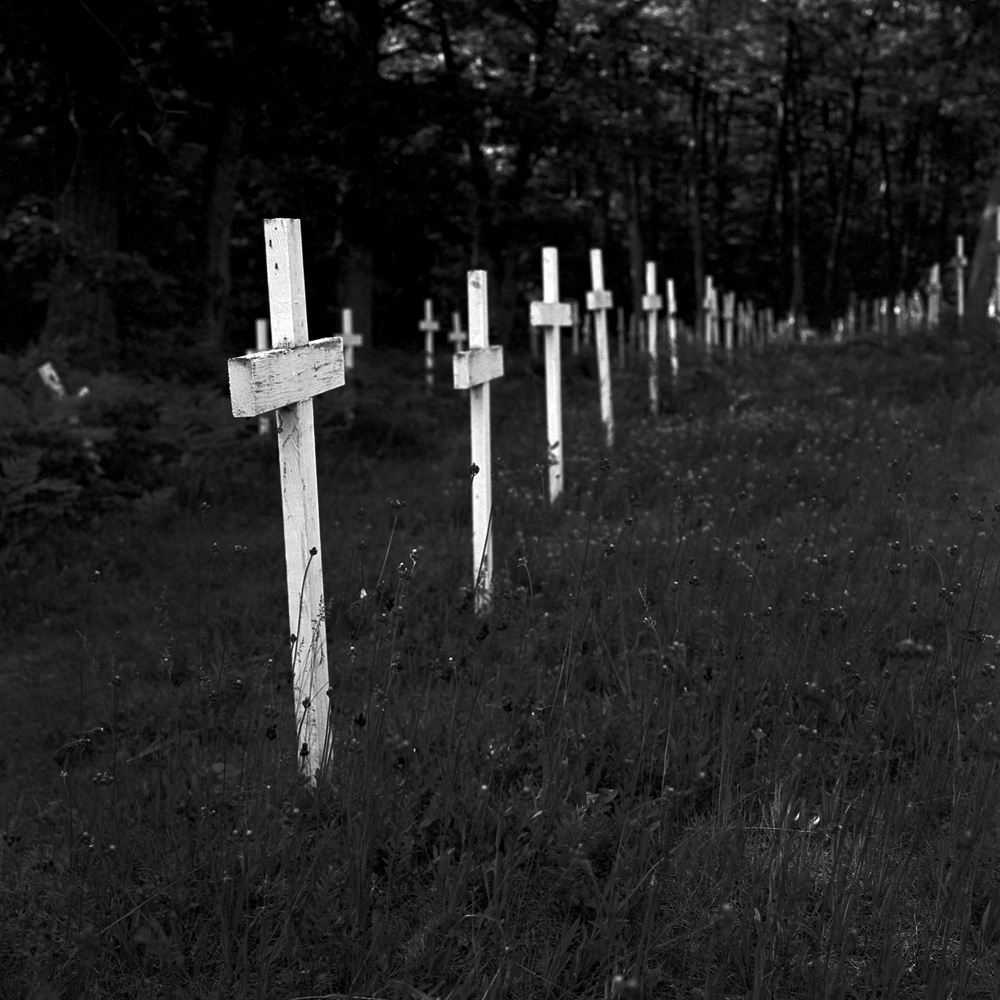
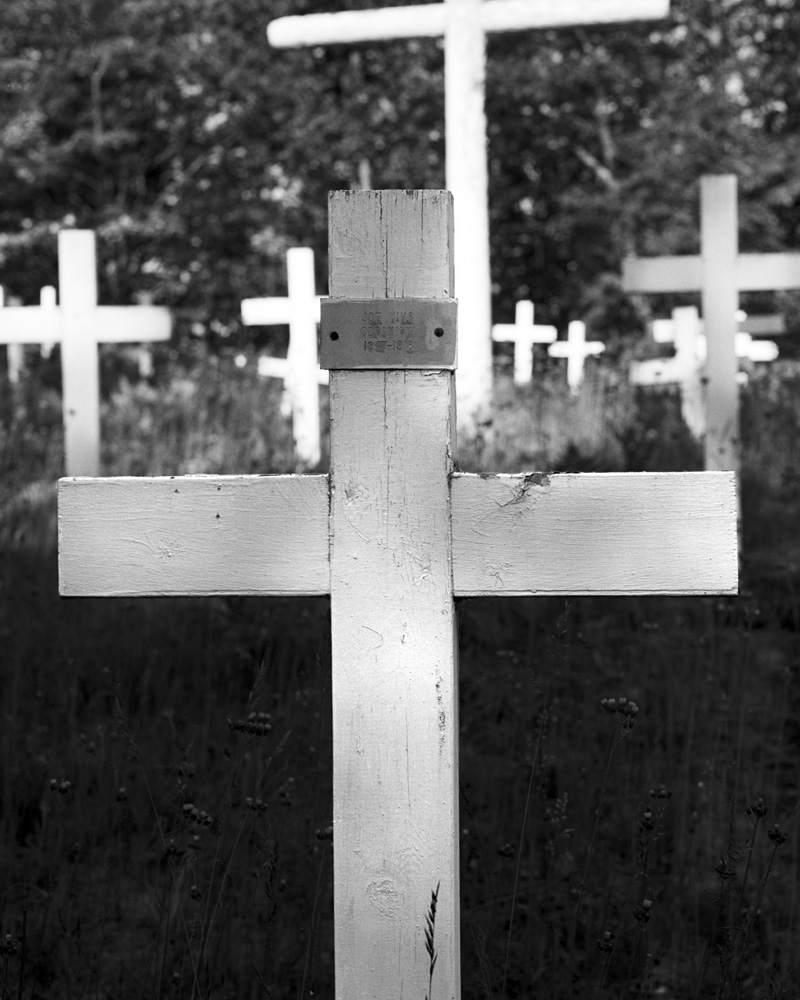
Today, the churchyard contains mostly 19th and early 20th century burials of Polish and Scandinavian immigrants. The churchyard is famous for the white wooden crosses for grave markers.
Crosses, St. Ignatius Cemetery
Here is a close up to show the tin markers with the names and biographical data on the crosses.
Joe King Odganicki
The church no longer has an active congregation, but is maintained by a local organization for its preservation.
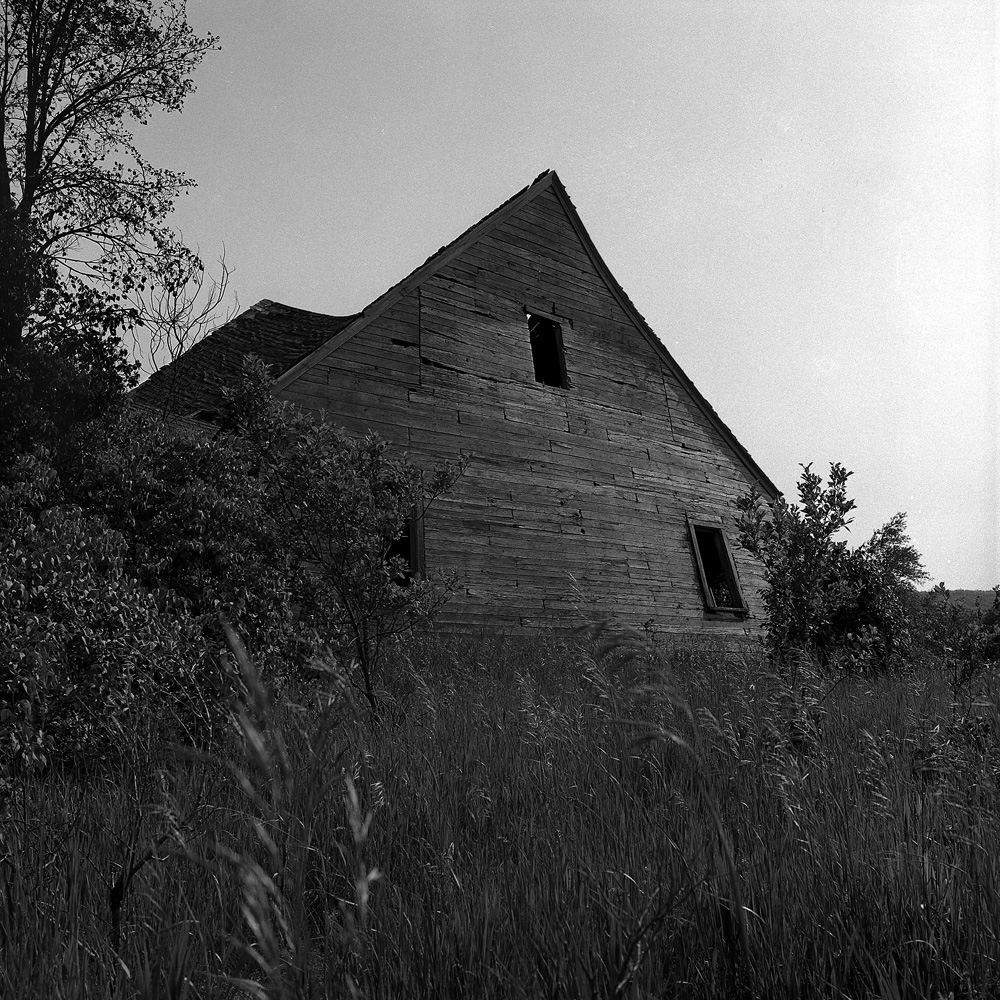
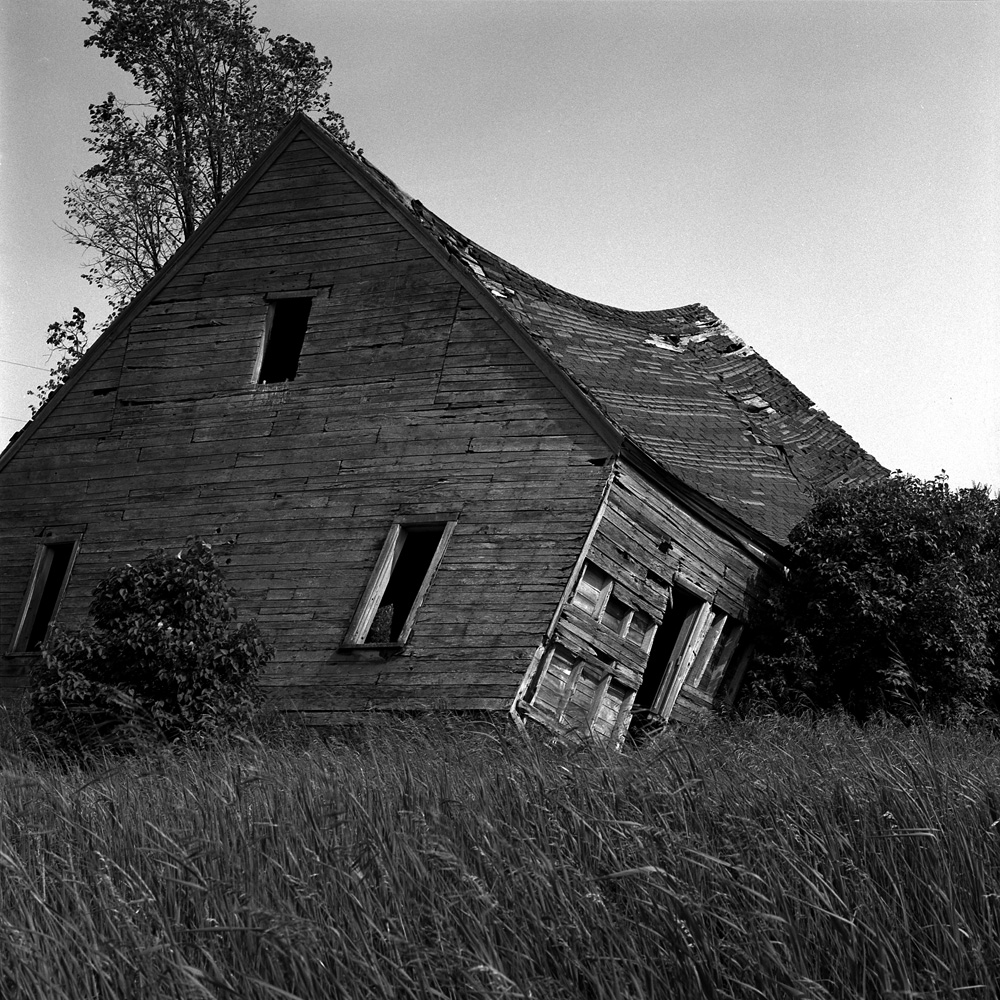
Although these houses are familiar to Photostock participants from years past, I figure most of my readers have never seen them. The first building is across the intersection from Moose Jaw Junction, a roadside restaurant and bar near Larks Lake. The property is for sale, should anyone want a total tear-down.
The Slumping House, End View, Moose Jaw Junction
A different view of the building:
The Slumping House, Moose Jaw Junction
This house is/was a little cabin across the street from the St. Ignatius church in Good Hart, Michigan. Pictures of the church and its cemetery will be forthcoming in another post. From what I hear tell from past Photostockers, the cabin used to be far more intact than it is now and they have watched it deteriorate into this condition over the last half-dozen years.
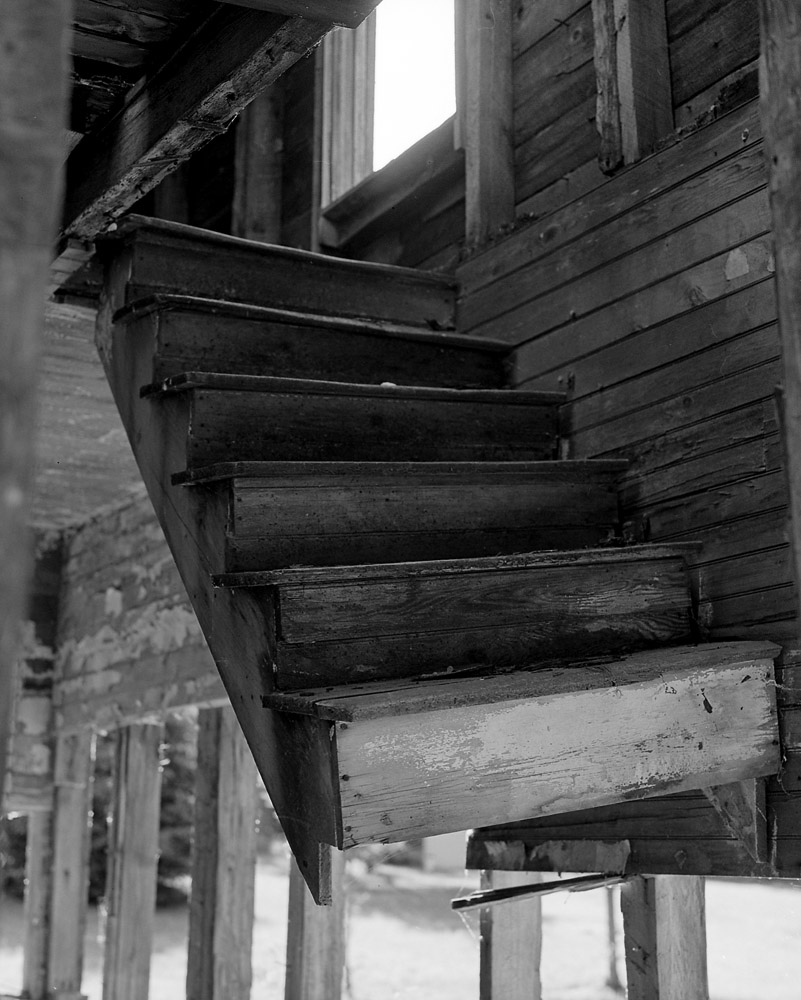
One wall of the house is essentially gone, and you can look inside the structure through it. I would NOT attempt to enter, as there is a considerable debris field on the floor of the lower level, making for a prime residential facility for wildlife of the four-legged and no-legged varieties. You can see the remnant of the staircase through the opening in the wall, though. The texture of the wood and the coloring of it reminded me a bit of Bodie, the California gold-mining ghost town in the Eastern Sierra.
Hanging Stairs, Good Hart
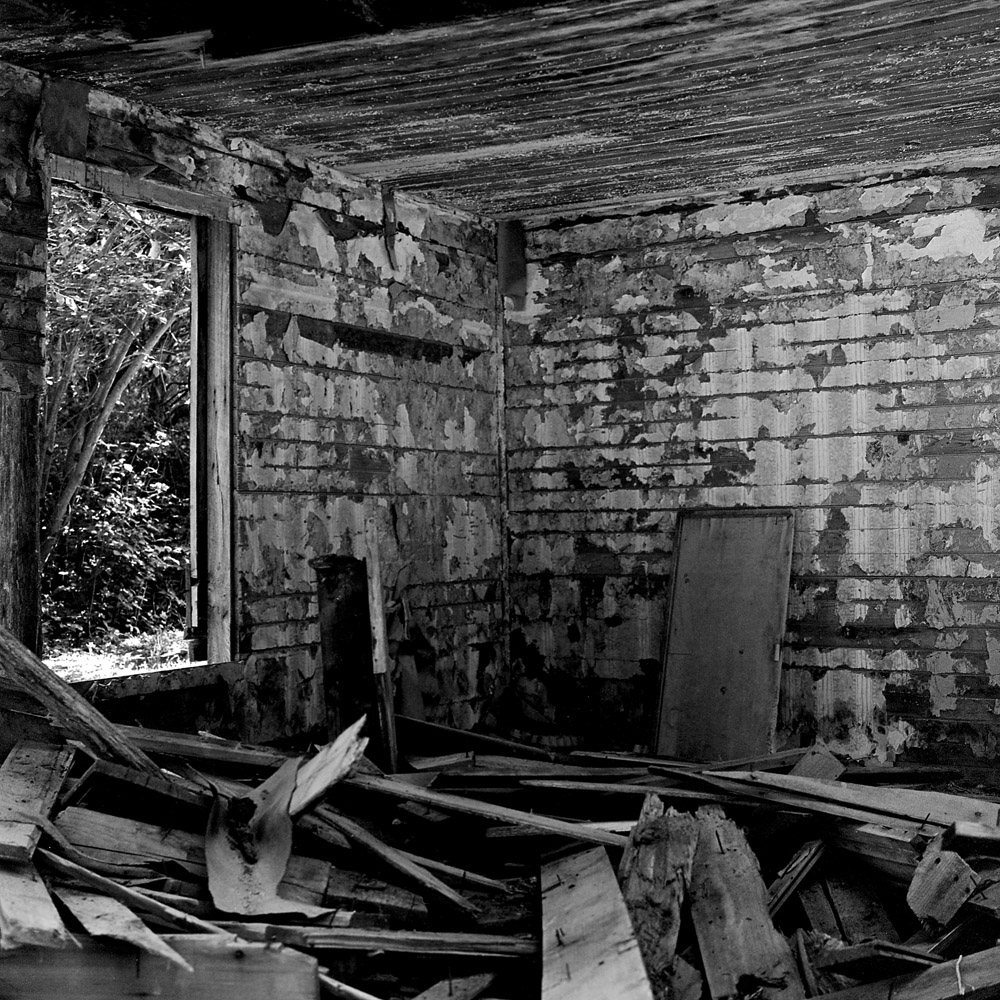
This is a view of the debris field and the remaining structural walls of the house. Amazing how the light level balanced between inside and outside- no HDR or even burning/dodging required to preserve interior and exterior detail alike through the window frame.
House Interior, Good Hart
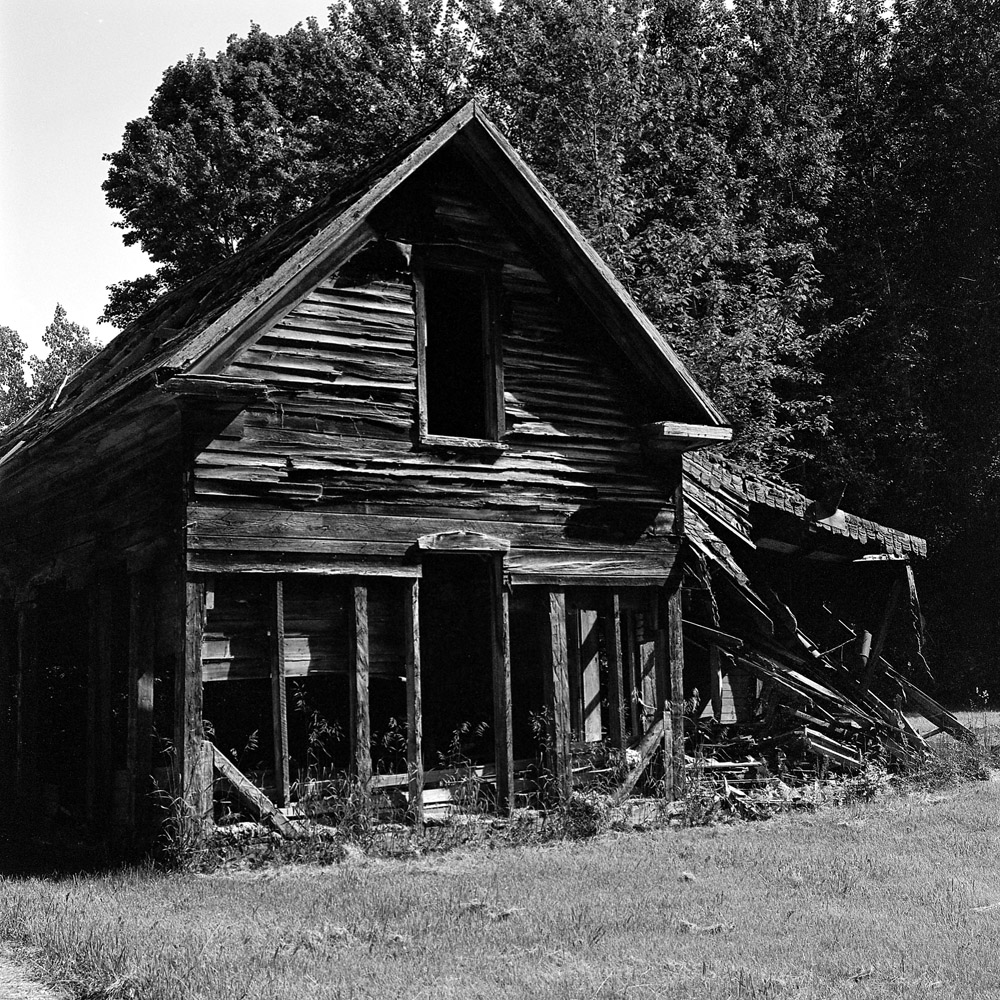
Here is a view of the end of the house, showing the whole of the structure.
Collapsing House, Good Hart
All shots taken with my Rolleiflex 2.8E on Ilford Delta 400, developed in Pyrocat HD developer at 1:1:100 dilution.
This is an exploration of twilight into dusk in and around the 14th Street and U Street corridors in Northwest Washington DC. All these shots were taken in the same evening, and are within walking distance of one another (although in the name of time efficiency I drove from one area to the other so I wouldn’t lose the last light in the sky).
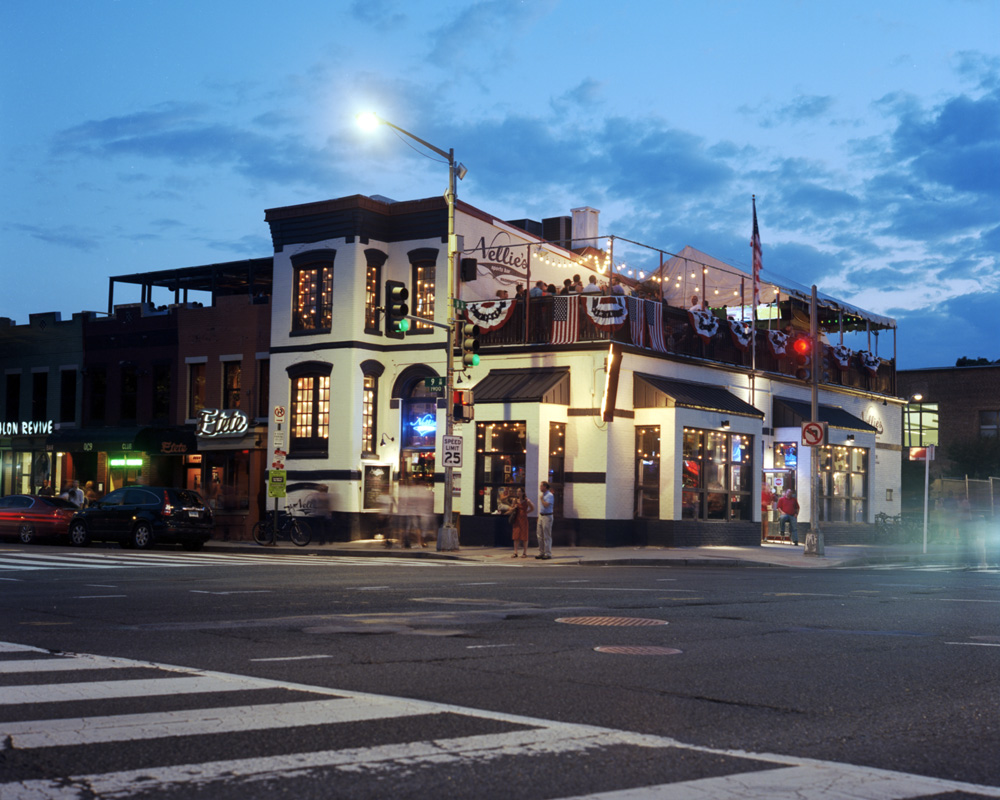
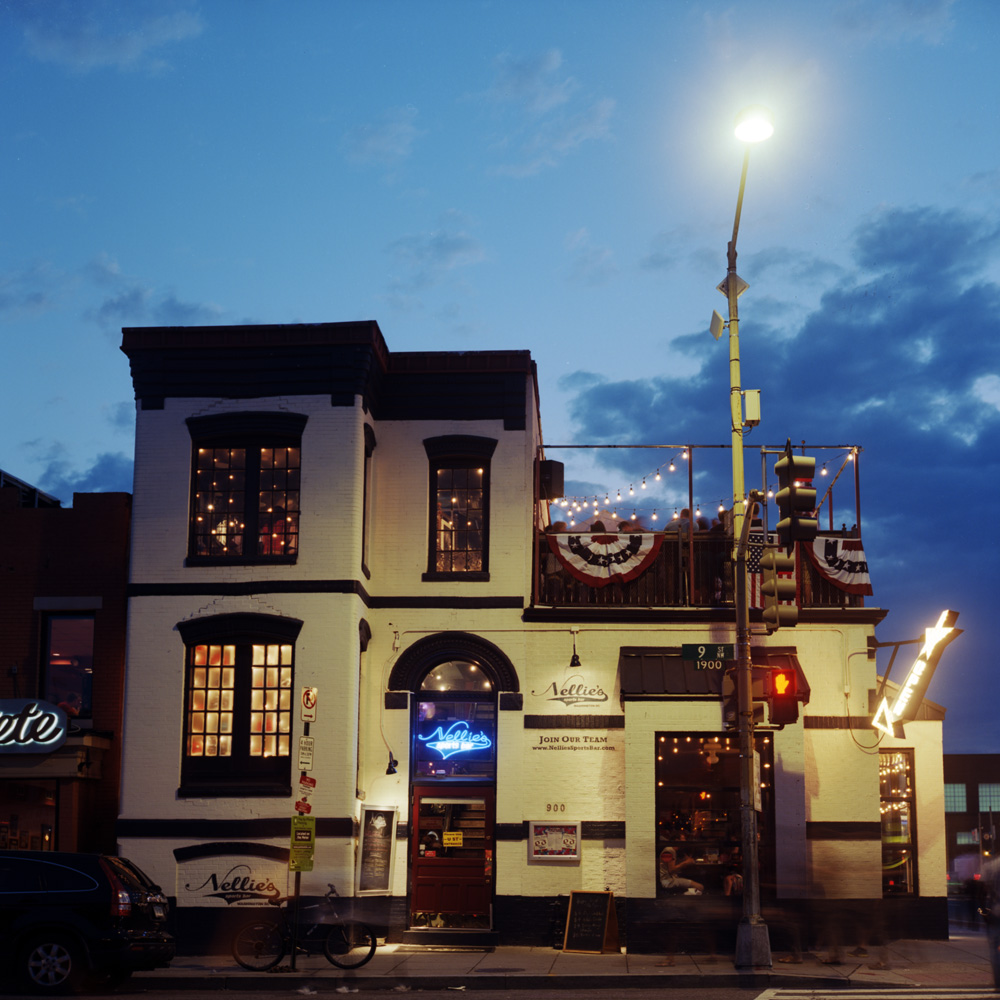
Nellies is a gay sports bar (betcha never thought you’d hear THAT particular combination!) at the corner of 9th and U Street and Florida Avenue (U Street turns into Florida Avenue at 9th). I’ve driven by hundreds of times and always thought about photographing their lights, specifically the “OPEN” arrow on the corner. The night I started this project, I decided to shoot the building from two different angles, one to capture the general ambiance of the intersection, the other to specifically address the OPEN sign.
Nellies Sports Bar, From Florida AvenueNellies Sports Bar, From 9th Street
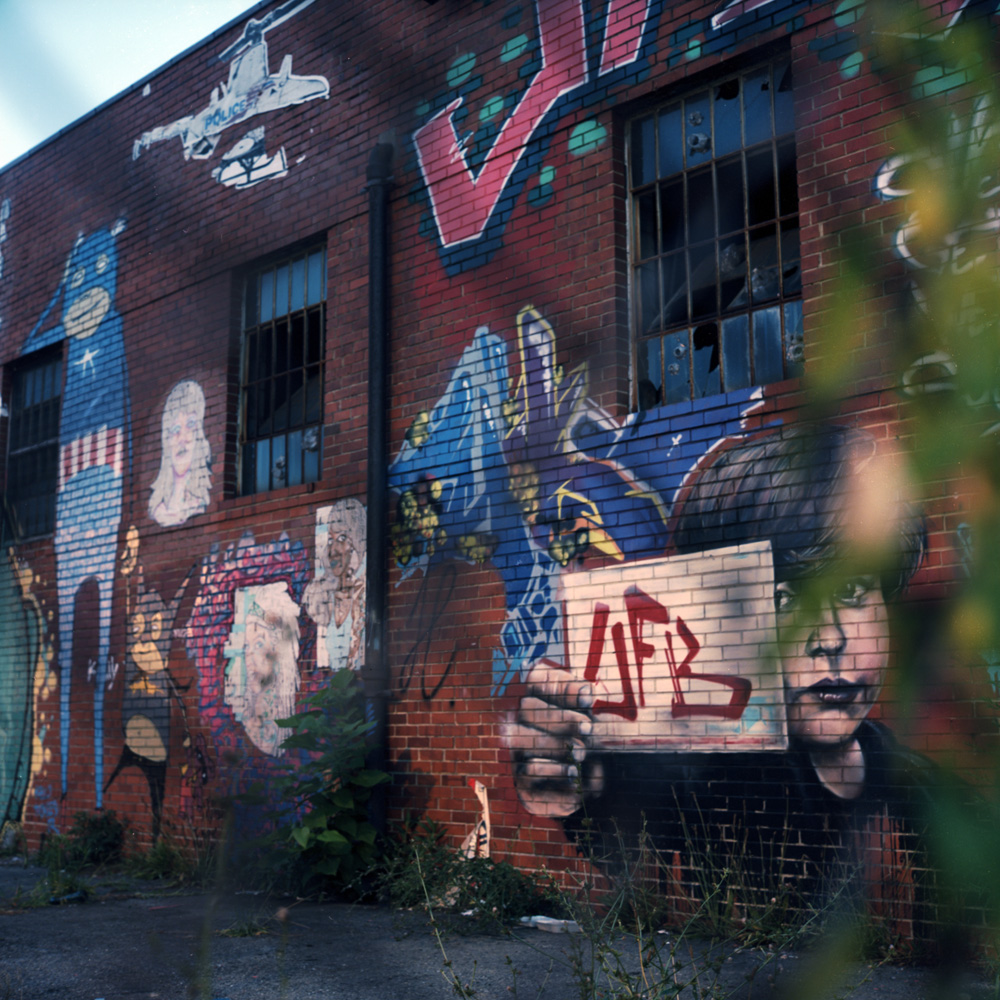
Around the corner from Nellies is this abandoned warehouse which has some really wild and cool and somewhat disturbing graffiti on it. I shot some of this graffiti through the chain link fence around the side lot. The disturbing piece I intentionally cropped out of the shot, as it is the nude lower half of a female body that appears to have been severed from its torso.
Graffiti, Chain Link Fence, Twilight
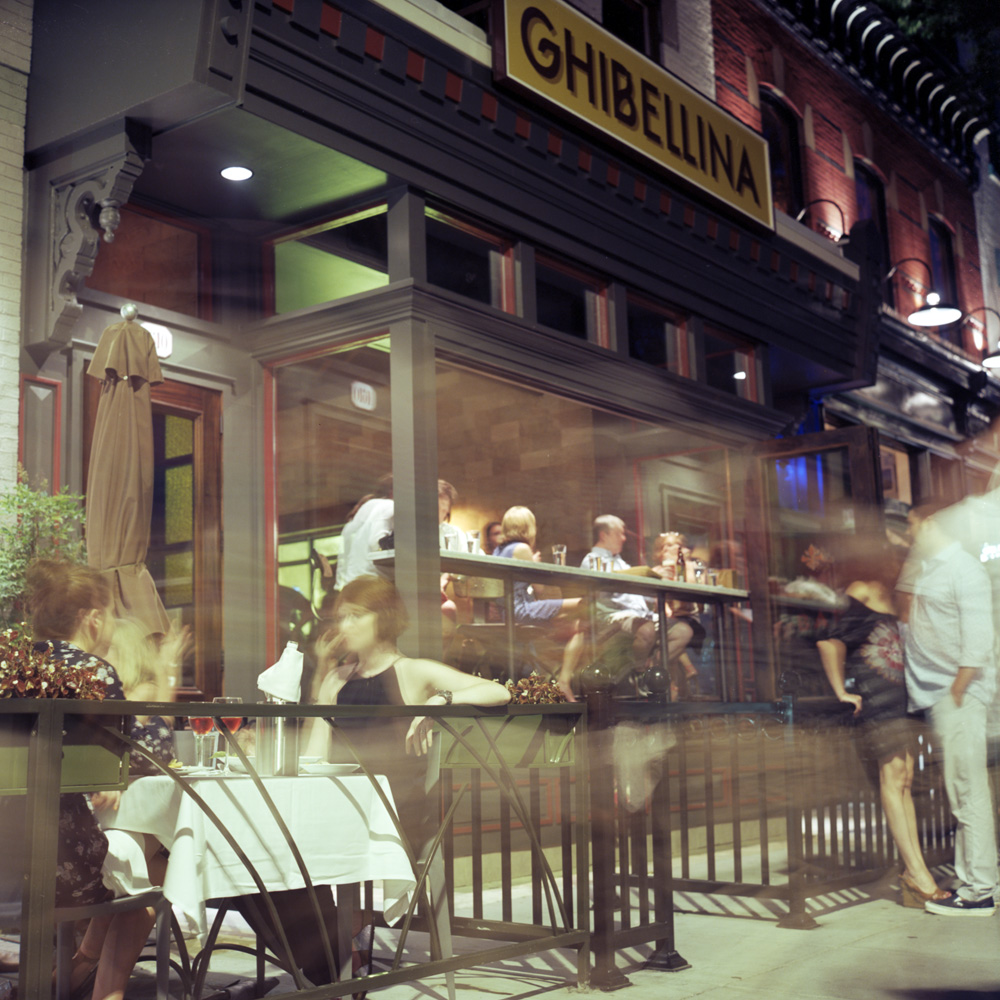
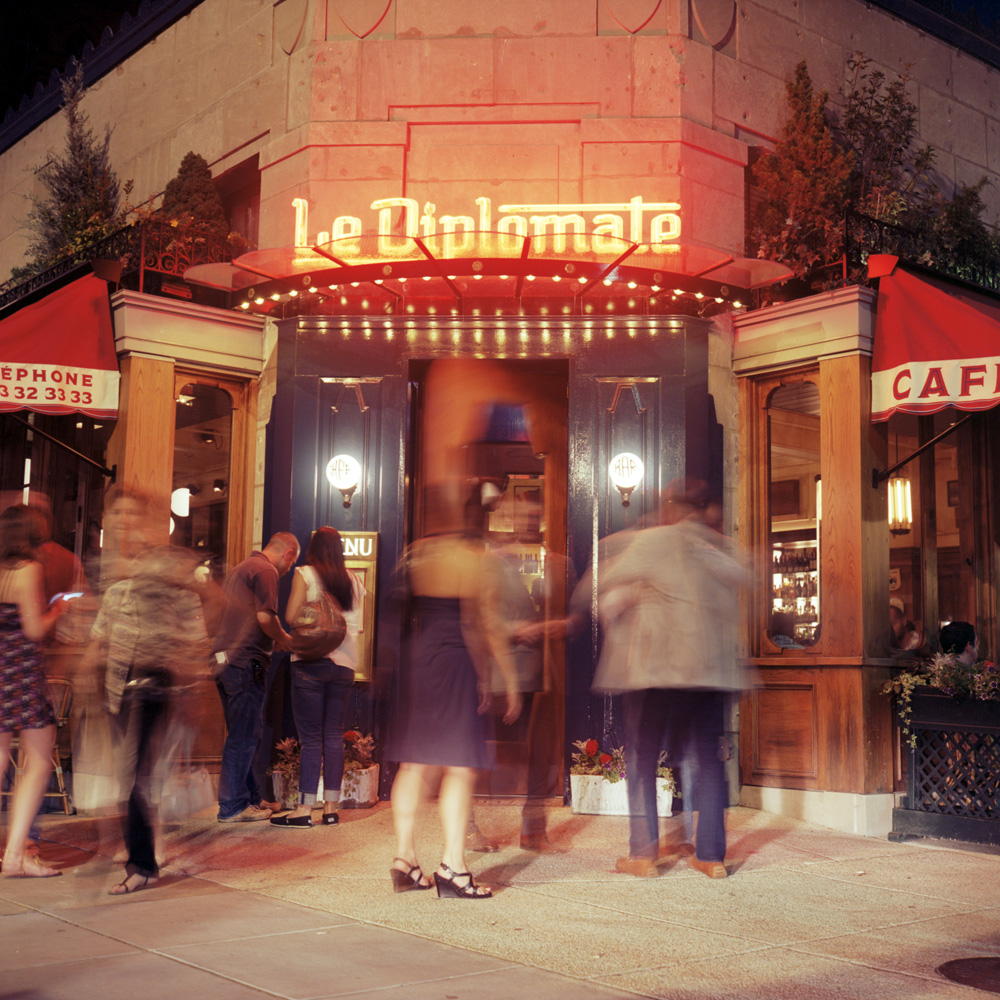
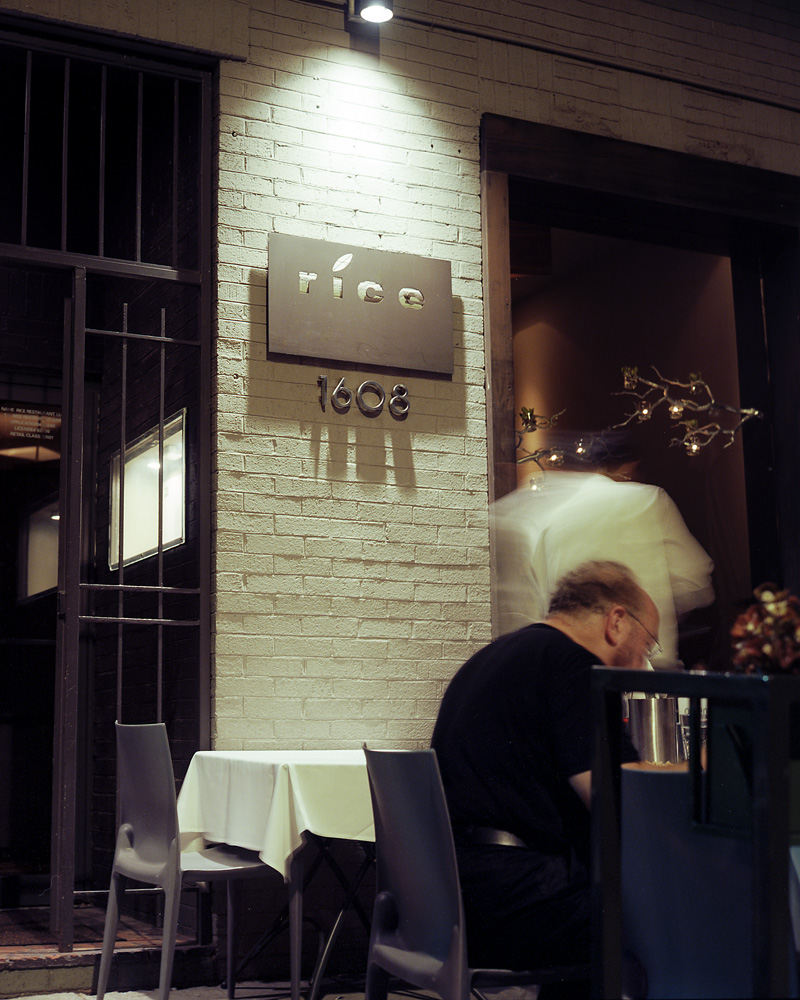
Over on 14th Street, we have had an explosion of new restaurants in the last five years, with a huge spate in the last year alone. Rice Restuarant is arguably the best Thai restaurant in DC, and certainly the most innovative. A good friend of mine opened it gosh, maybe ten years ago, virtually pioneering the restaurant boom in the neighborhood. Now next door to Rice is Ghibellina, an Italian joint that opened this year, and next door to that is Pearl Dive, an oyster bar, which opened perhaps 2 years ago. Le Diplomate is a French bistro across the street in what was originally a car dealership in the 1920s, then became a laundromat. Le Diplomate also opened earlier this year.
GhibellinaLe DiplomateRice Restaurant
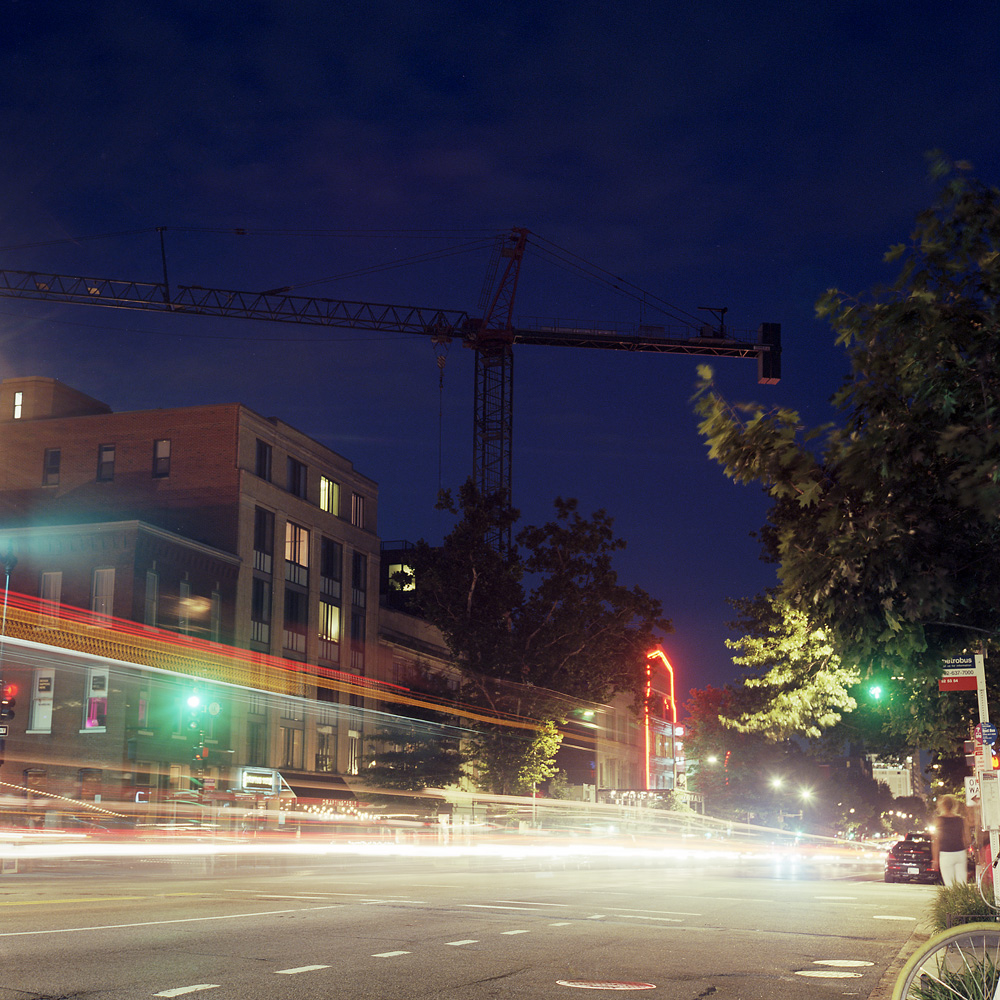
At the intersection of 14th and Q Streets, I pointed my camera south on 14th to try and capture the energy of the neighborhood, through the traffic, the lights, the construction boom represented by the crane, and the people on the sidewalks.
Crane, 14th Street, Twilight
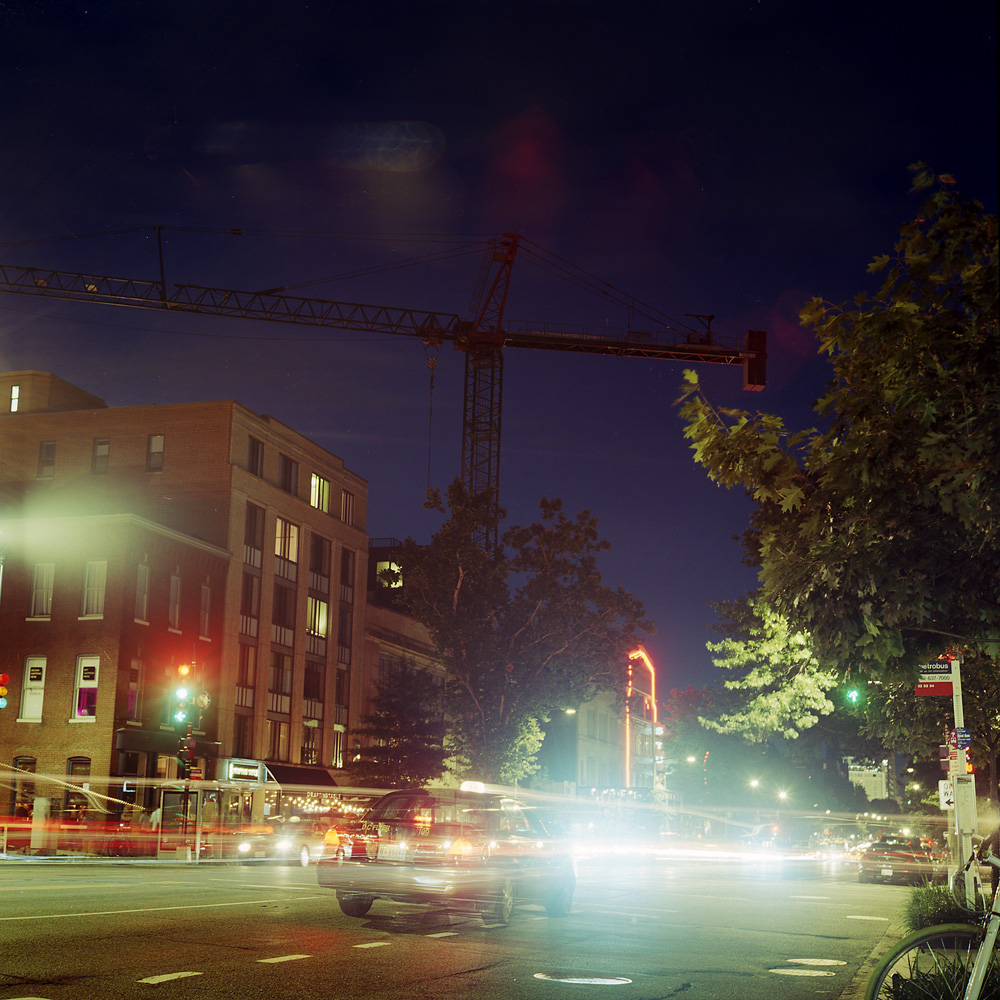
Here is a second version of the shot, a longer exposure, that captures the car sitting at the traffic light, then traffic taking off when the light changed. The funky stuff in the sky is a combination of reflections of the tail-lights and head-lights of the cars reflecting off the clouds and lens flare caused by the lights directly shining into the lens.
Crane, Traffic, 14th Street, Dusk
I’m not sure if I like this one well enough to keep it or if some other night I go back and try to re-shoot it. Feedback welcomed. All shots, as is becoming normal to say now, were taken with my Rolleiflex 2.8E, on Kodak Ektar 100 film. This was in part an experiment to see how well Ektar would fare against Portra 160 as a low-light film. I’ve loved Portra as a low-light film for its ability to handle mixed lighting conditions. I’d say this put to rest any thoughts of Ektar 100 being inferior- it does look different, to be sure, but I’d say it did a pretty darned good job. I think I might even prefer it in some cases.
Here are a few shots from my visit to the 2013 Smithsonian Folklife Festival. The Folklife Festival is held every year on the National Mall, and it is a celebration of cultures and traditions from around the world. This year’s featured country is Hungary, and the overall theme is “One World, Many Voices”. There are representatives of many indigenous cultures around the world from Hawaiian Islanders to Penobscot Indians to Quechua speakers from Bolivia and Peru to Tuvan people from Siberia. The “many voices” part has to do with showcasing efforts to preserve vanishing languages and cultures. Go to the Smithsonian Folklife Festival Official Page to learn more about the events and programs for this year’s festival.
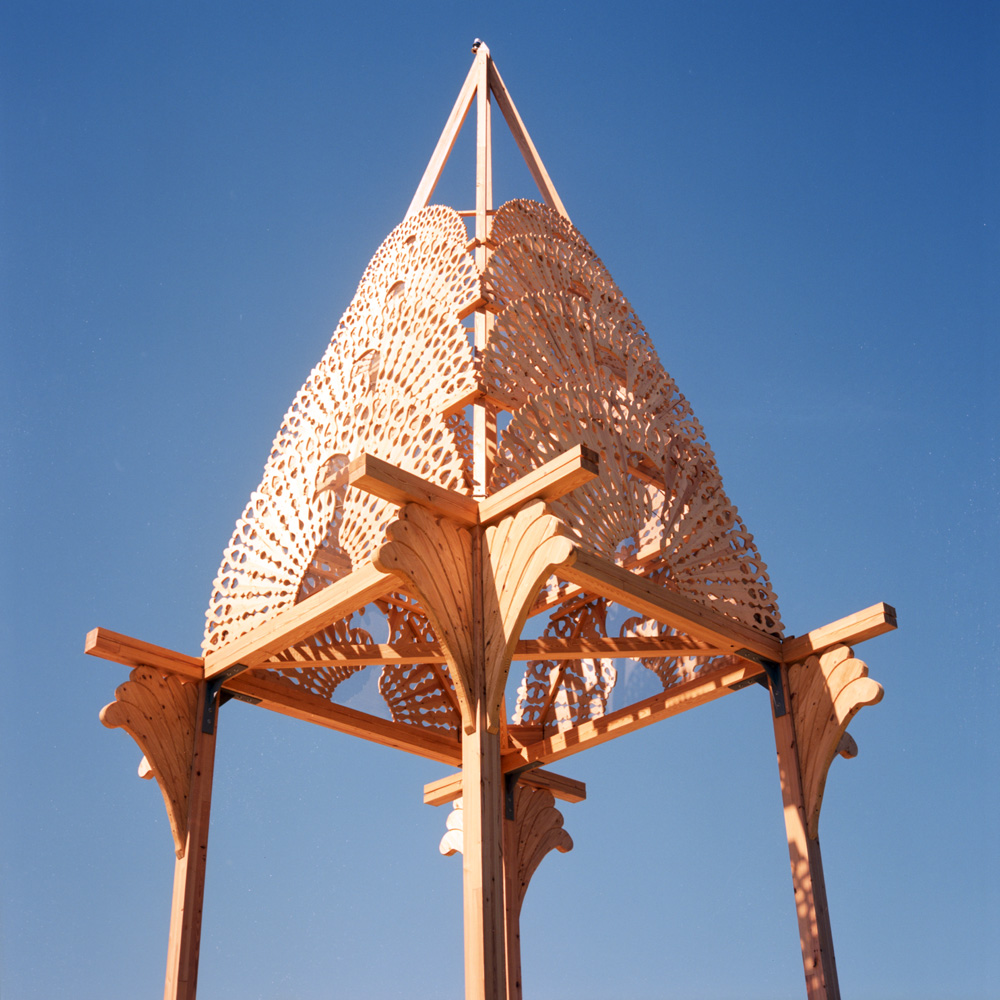
This pavilion is part of the Hungarian exhibit – playing on traditional Hungarian crafts like lace-making and using the forms and styles in a wooden structure.
Hungarian Pavilion
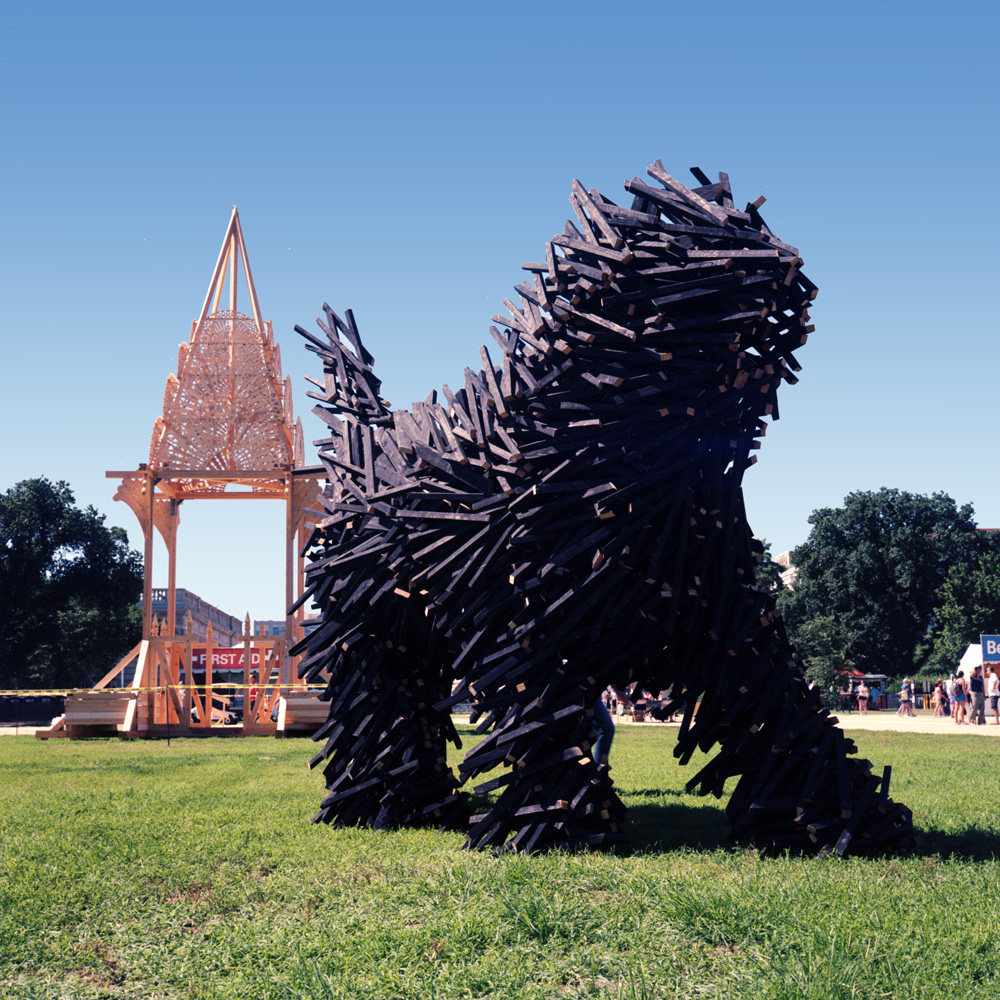
And here is a sculpture of a Puli shepherd dog, rendered in blackened wood. Pulis are similar to Komondor sheep herding dogs except they are black, not white. They used to get shorn along with the sheep they guarded, but now are left to grow their coats out as a fashion statement, to the impairment of the dog’s mobility.
Kuvacs Sculpture
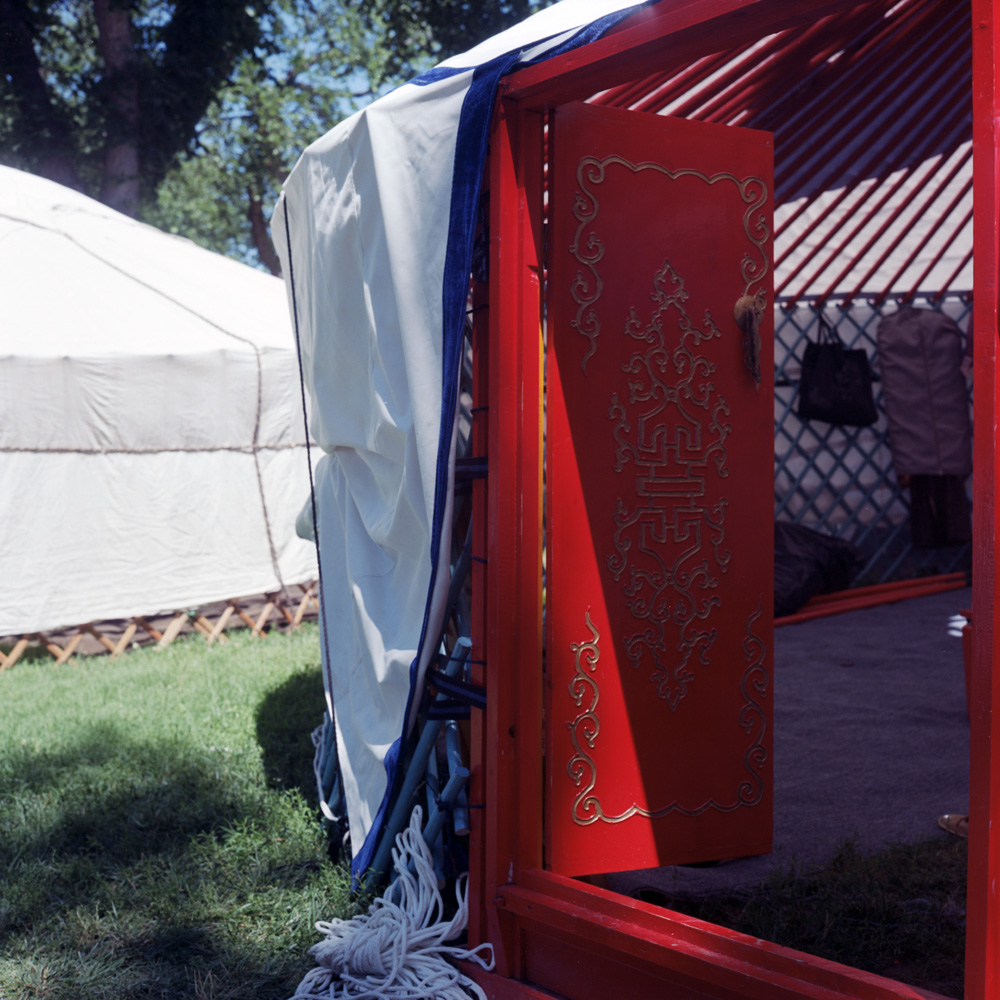
The door of a Yurt, representing the various nomadic peoples of Siberia who are sharing their culture this year at the Folklife Festival. Yurts are traditional nomadic home structures – they are portable like tents, with canvas or fabric tops and latticework side walls.
Yurt Door
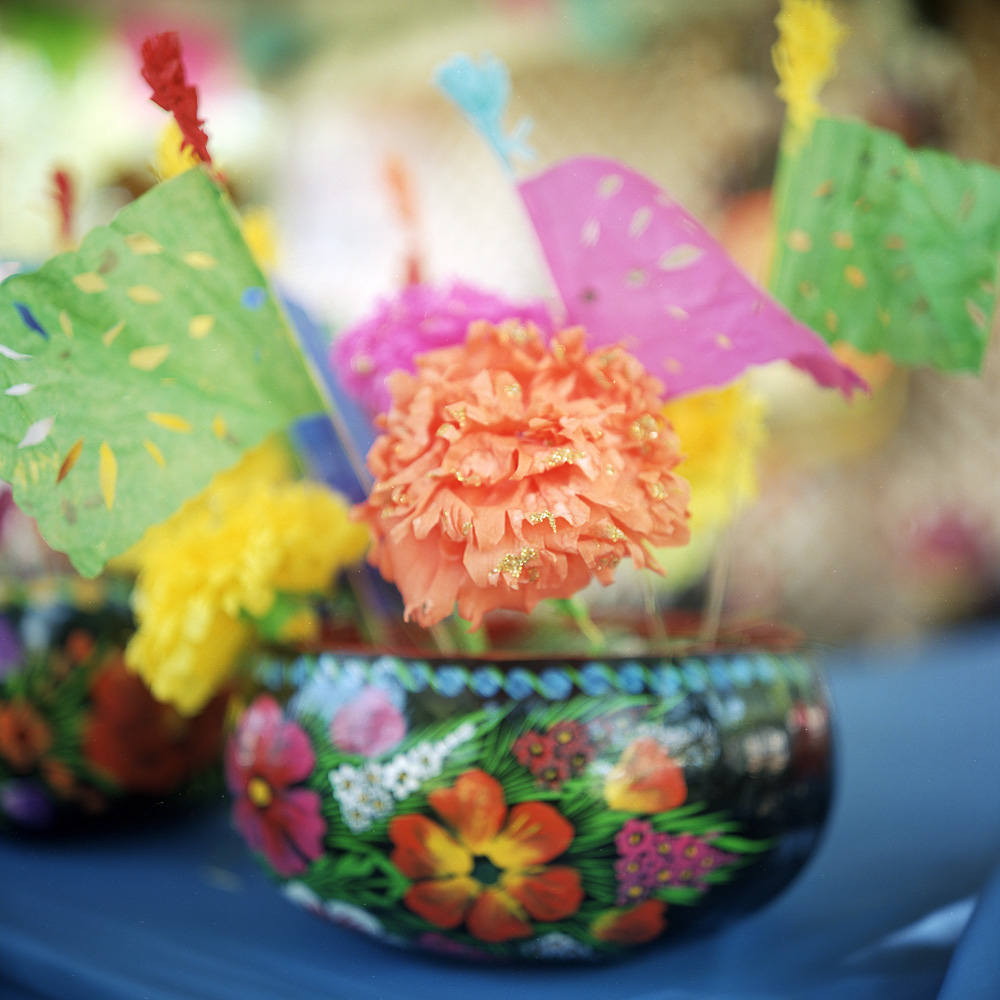
Paper flowers in the Mexican pavilion:
Paper Flowers, Mexican Pavilion
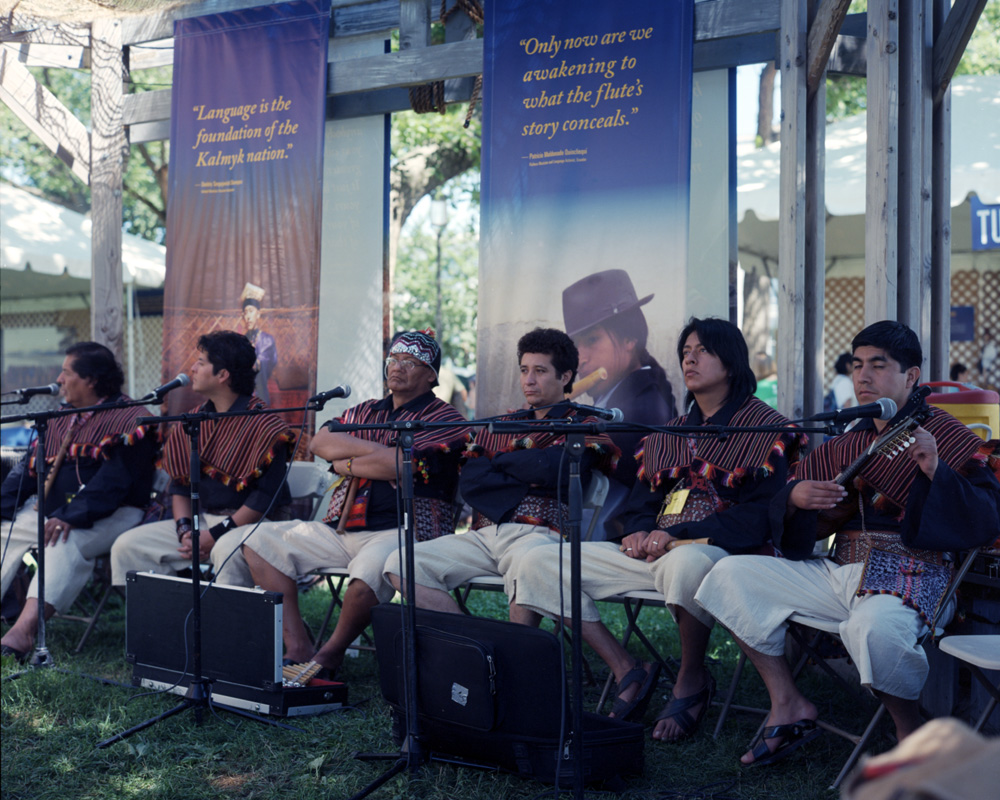
Quechua musicians, getting ready to perform a traditional Quechua song, talking about the meaning of their indigenous language and the importance of preserving the language, to pass on the connection to their cultural traditions of respect for the environment.
Qechua Musicians
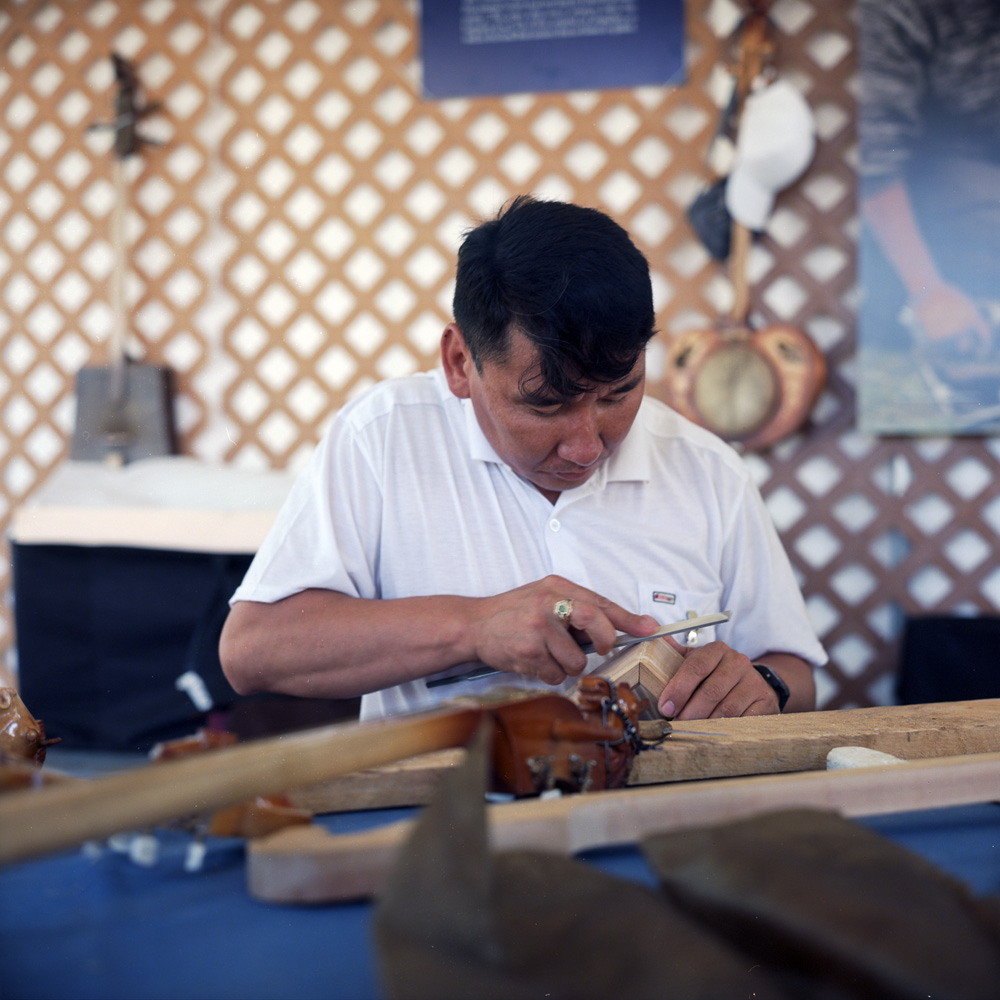
A Tuvan instrument maker, carving the body of a lute:
Tuvan Instrument Maker
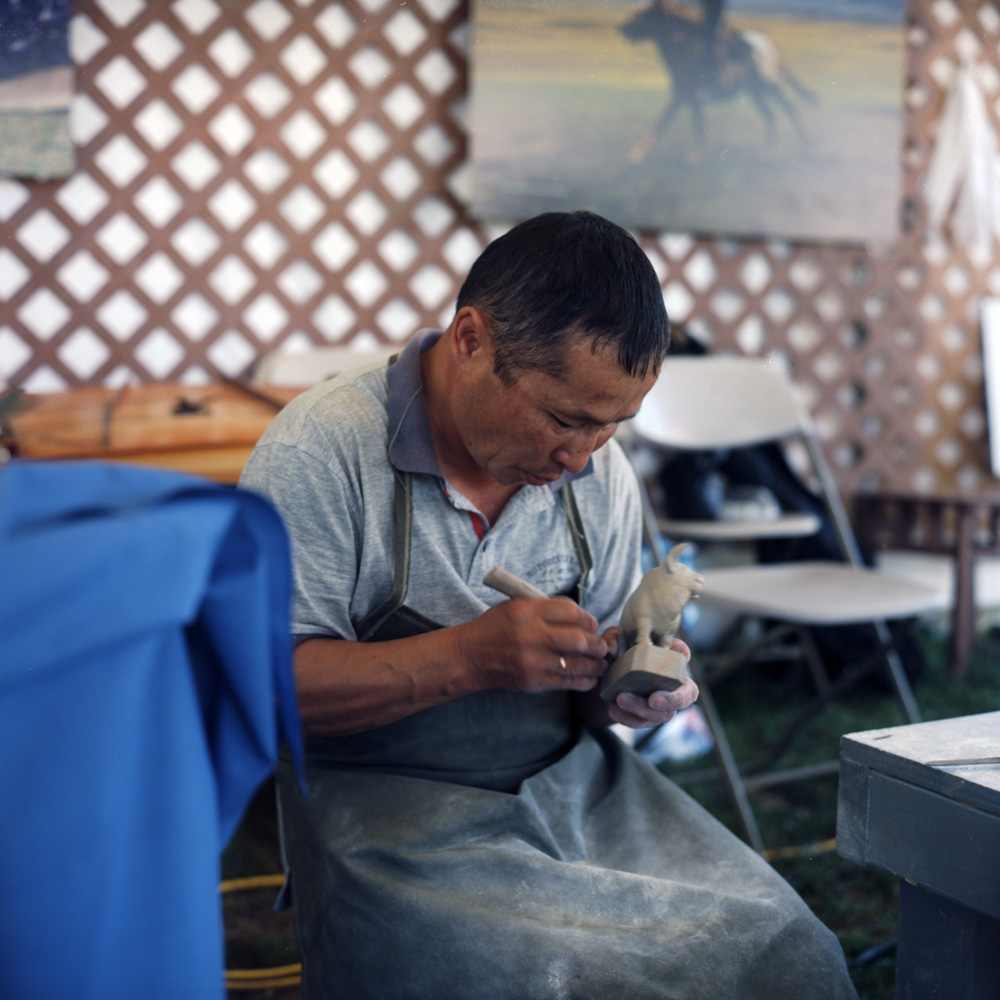
A Tuvan stone-carver, demonstrating hand-carving techniques, making a bull out of soapstone:
Tuvan Stone-carver
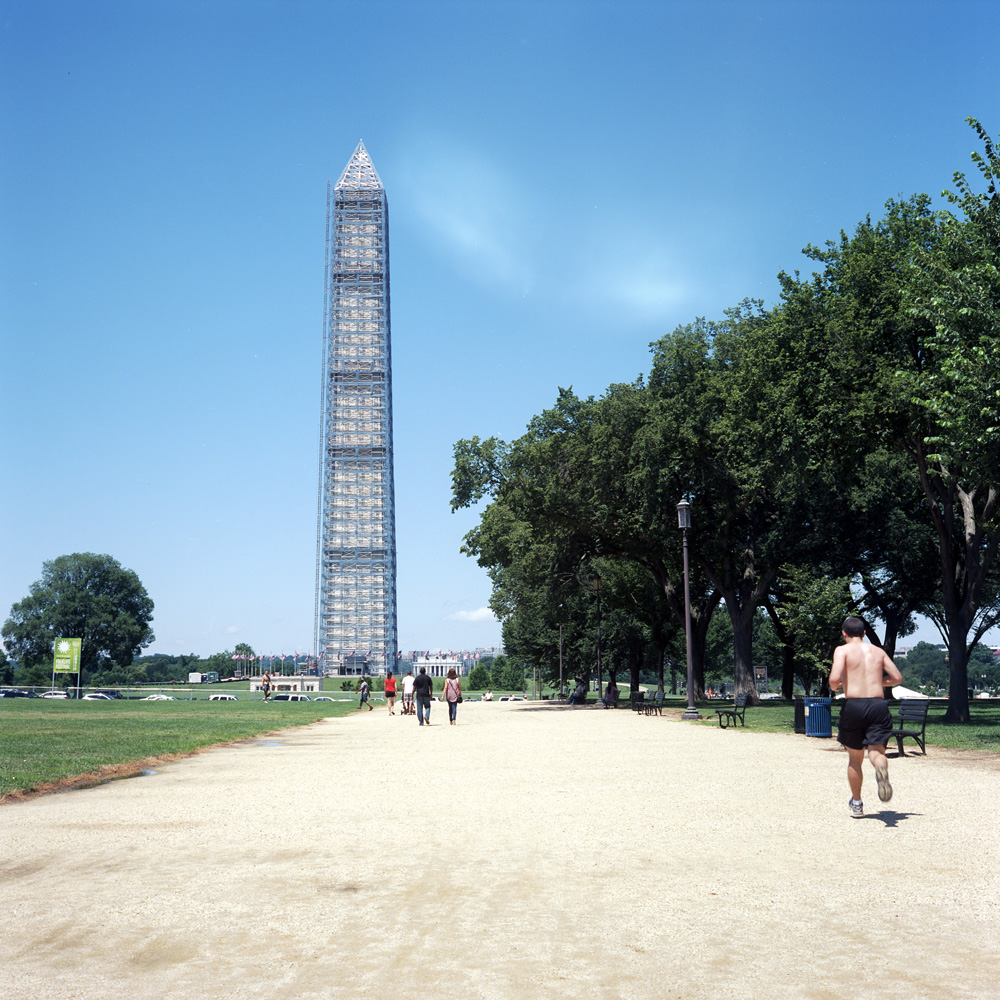
These last three shots are not specifically of the Folklife Festival, but are representative of the location and the spirit of the day. The weather was quite hot, but at least we had a relatively dry day with periodic breezes (Washington DC, particularly the area of the Mall, was built on a swamp, and big chunks of the Mall area, especially west from the Washington Monument, are actually landfill. Which is why the Washington Monument is sinking very slowly. So summertime in DC can be particularly miserable – almost New Orleans-esque in its heat and humidity).
Washington Monument
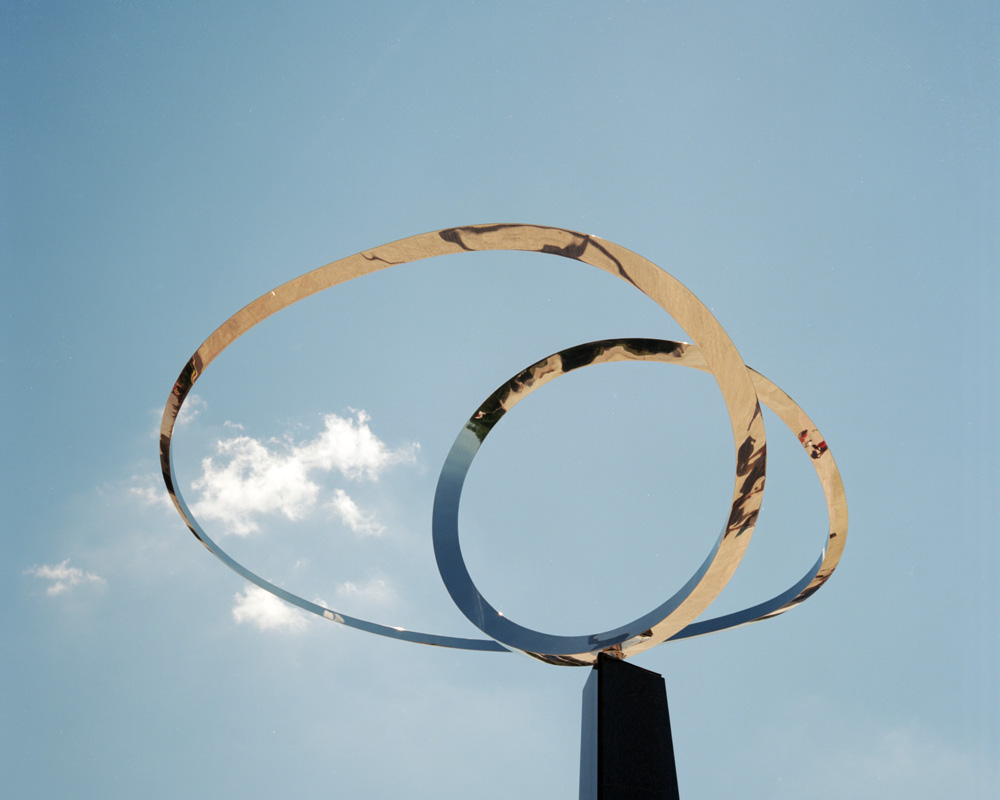
The sculpture is outside the American History Museum, which caps one end of the Folklife Festival and plays host to the temporary festival gift shop.
Sculpture, Cloud, American History Museum
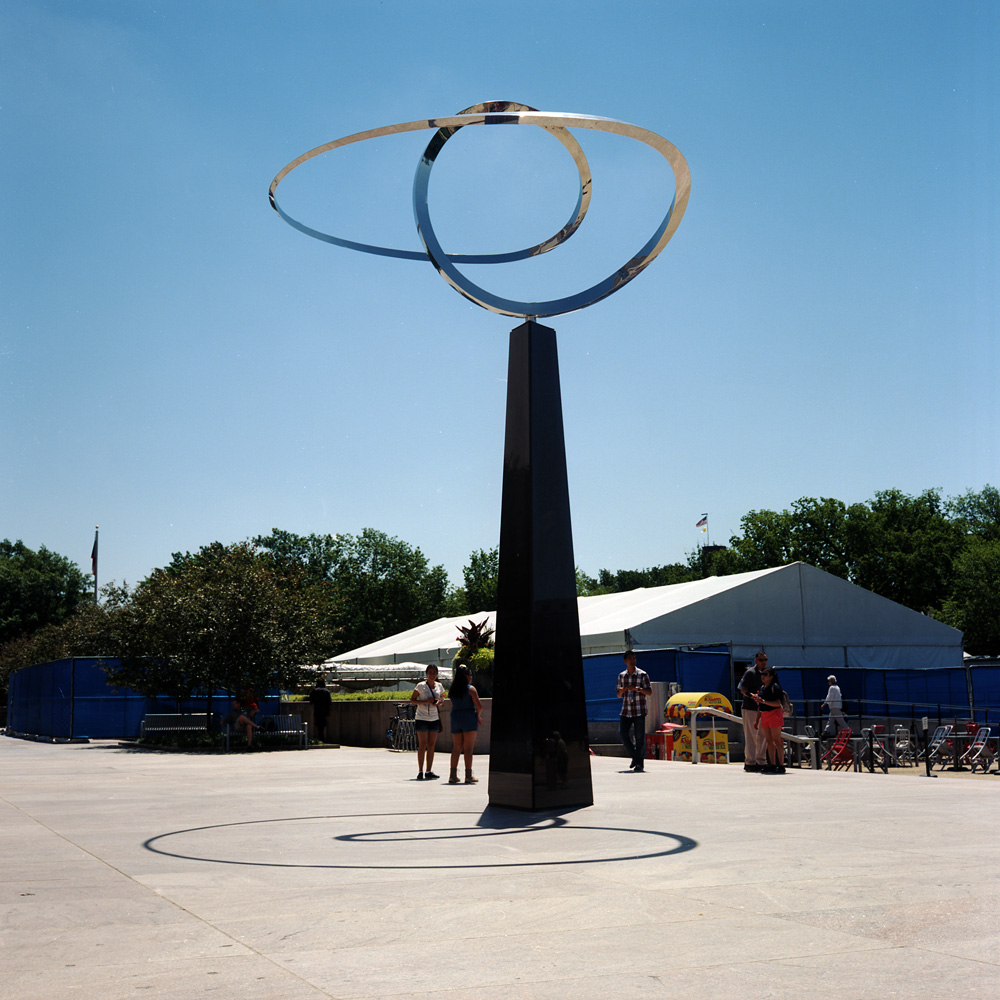
It was tough waiting for people to NOT be walking through the shadow of the sculpture on the pavement. I’ll have to come back and shoot this again in the wintertime when it casts a longer shadow and there are fewer people out on the plaza so I can catch it as more of an abstract piece.
Sculpture, Shadow, American History Museum
All shots were taken with my Rolleiflex 2.8E, on Kodak Ektar 100 film.

 dcphotoartist