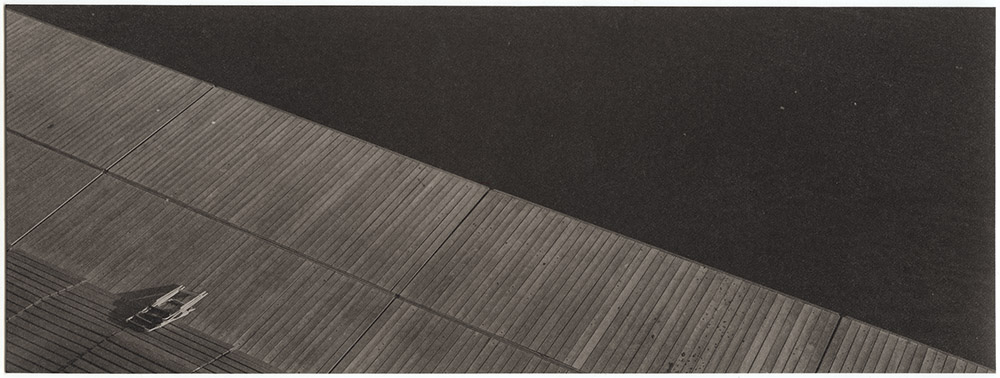
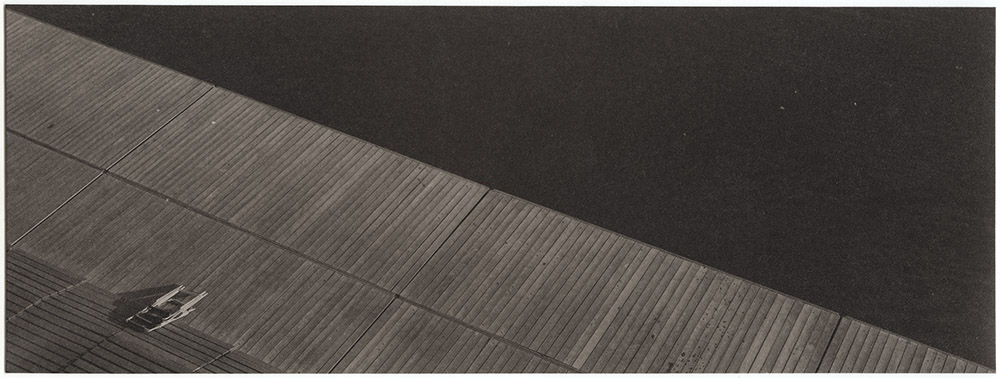
I was up on the old abutment for the C&O Canal viaduct that connected the canal from Georgetown to Alexandria over the Potomac River and looked down to the boat dock for the Georgetown Boat House and caught this composition. I had been photographing Key Bridge with my 5×12 (previously described here) when I looked down and saw this scene which cried out to be shot in the format.
Boathouse Dock, Georgetown
The simple geometry and the contrast between the rigid lines of the dock broken up by the deck chair contrasted with the smooth water of the river really makes the image. Without the deck chair, it would actually be pretty boring. But adding that one small compositional element makes it go from so what to interesting.
This series of images are what inspired my current project – Sinister Idyll. Sinister Idyll as a title came about from standing on the Best Farm property at the Monocacy National Battlefield monument outside Frederick, Maryland, and seeing the beautiful summertime landscape of rolling hills covered with cornfields, knowing the horrors of American slavery that were practiced on the property. At the end of the 18th century, the Vincendieres, a French Creole family fled to Maryland from Haiti to escape the slave revolts.
Headed by a woman, Victoire, they re-established their plantation life outside Frederick, Maryland, on a 750-plus acre property they called L’Hermitage. At their peak, they owned some 90 slaves. This was an extraordinary number – across the Potomac River, Oatlands plantation had 120 to work 3500 acres. It is not known why they had so many slaves as records of their business do not survive, and they may have been trying to cultivate labor-intensive crops such as tobacco. What is known, however, is that they were also operating a stud service – slave breeding for hire – and that their own methods for treating their slaves were harsh enough that the sheriff was called to their property multiple times by neighbors on complaints about cruelty and mistreatment of the enslaved population.
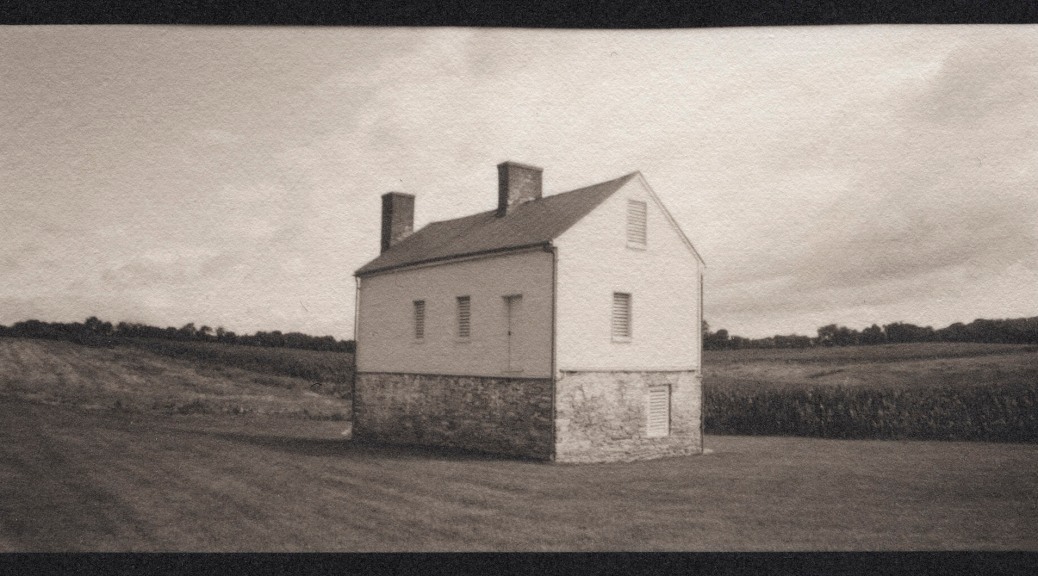
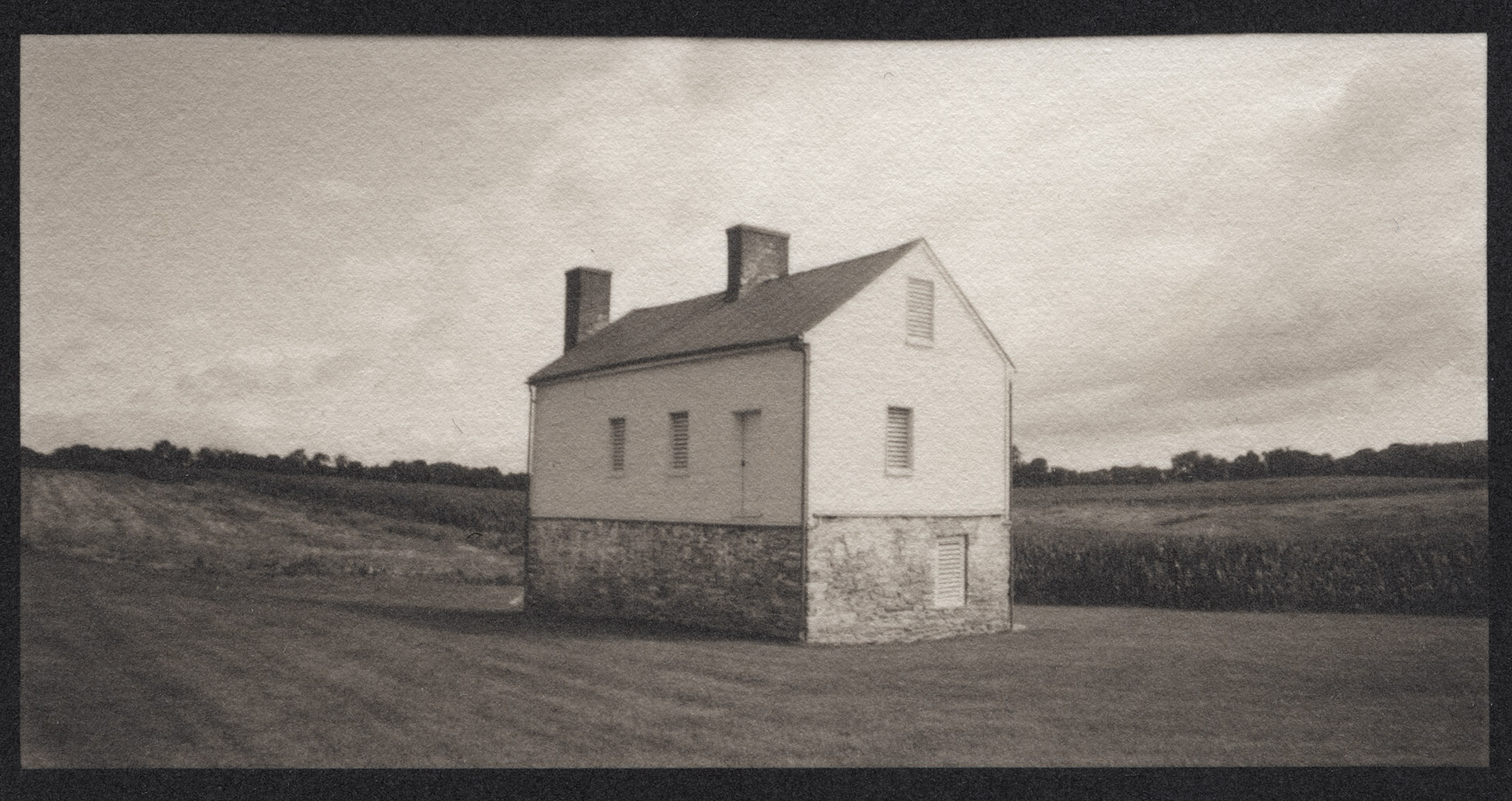
Bachelors House, Best Farm
This building is the Bachelors’ House, a secondary dwelling for the young men of the family to live outside the main house until they married and started their own property and family. Today it presents an idyllic scene, but on the ridge behind it and to the right was the location of three slave cabins, each not much different in size to the Bachelors’ House, but housing roughly thirty people per structure.
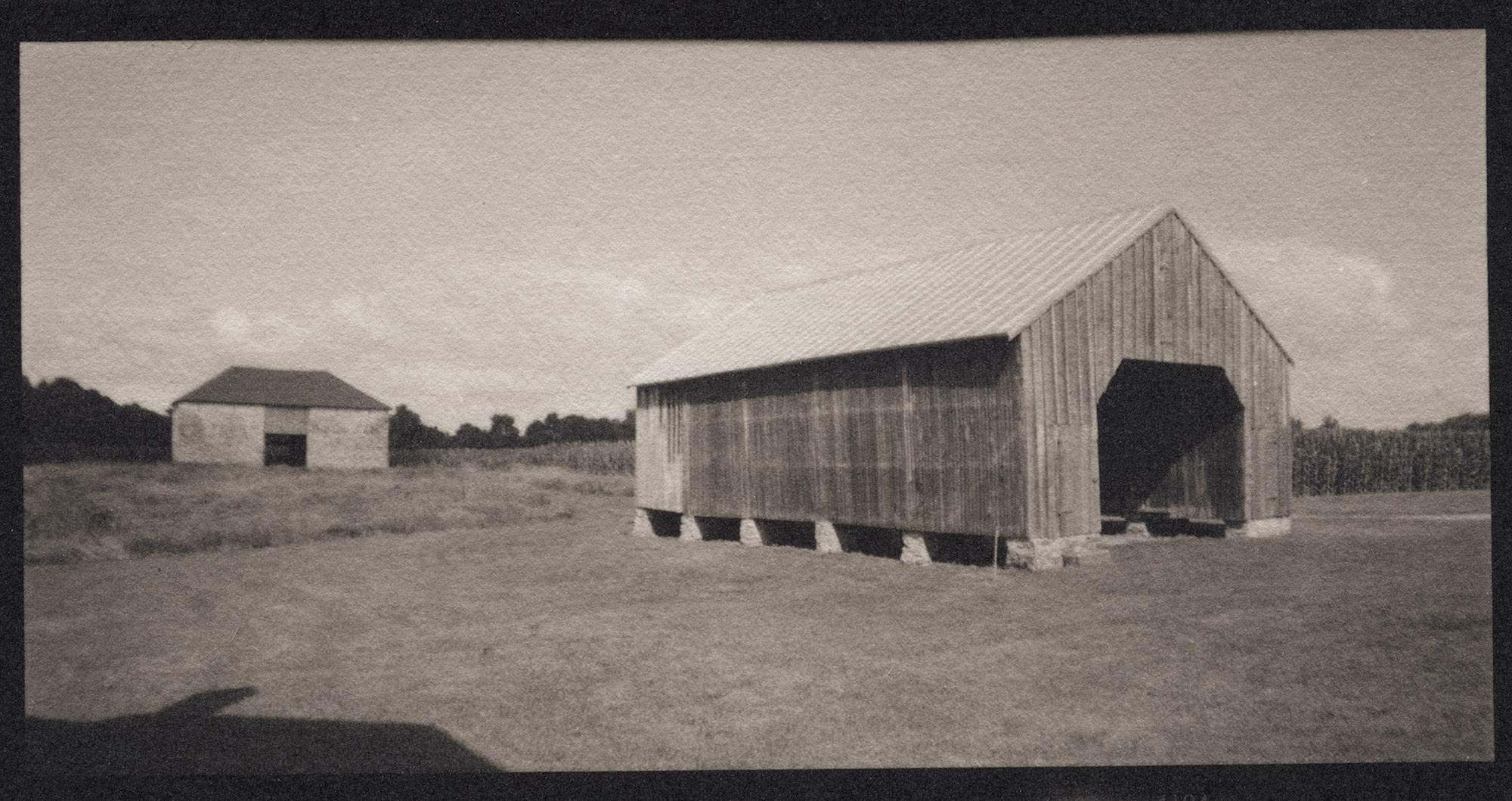
Corn Crib, Best Farm
This is the corn crib on the Best Farm. It is called the Best Farm today, rather than L’Hermitage, because the last family to operate the farm was the Best family – they leased the land from 1863 into the 1990s. The corn crib is another site of slave labor in an otherwise bucolic landscape. The stone barn you can see in the background would have housed farm animals and machinery. It is a far better, more sound and protective structure than the cabins where the slaves would have lived. You can see the shadow of the big house intruding on the foreground, much as it would have loomed over the lives of all the enslaved population.
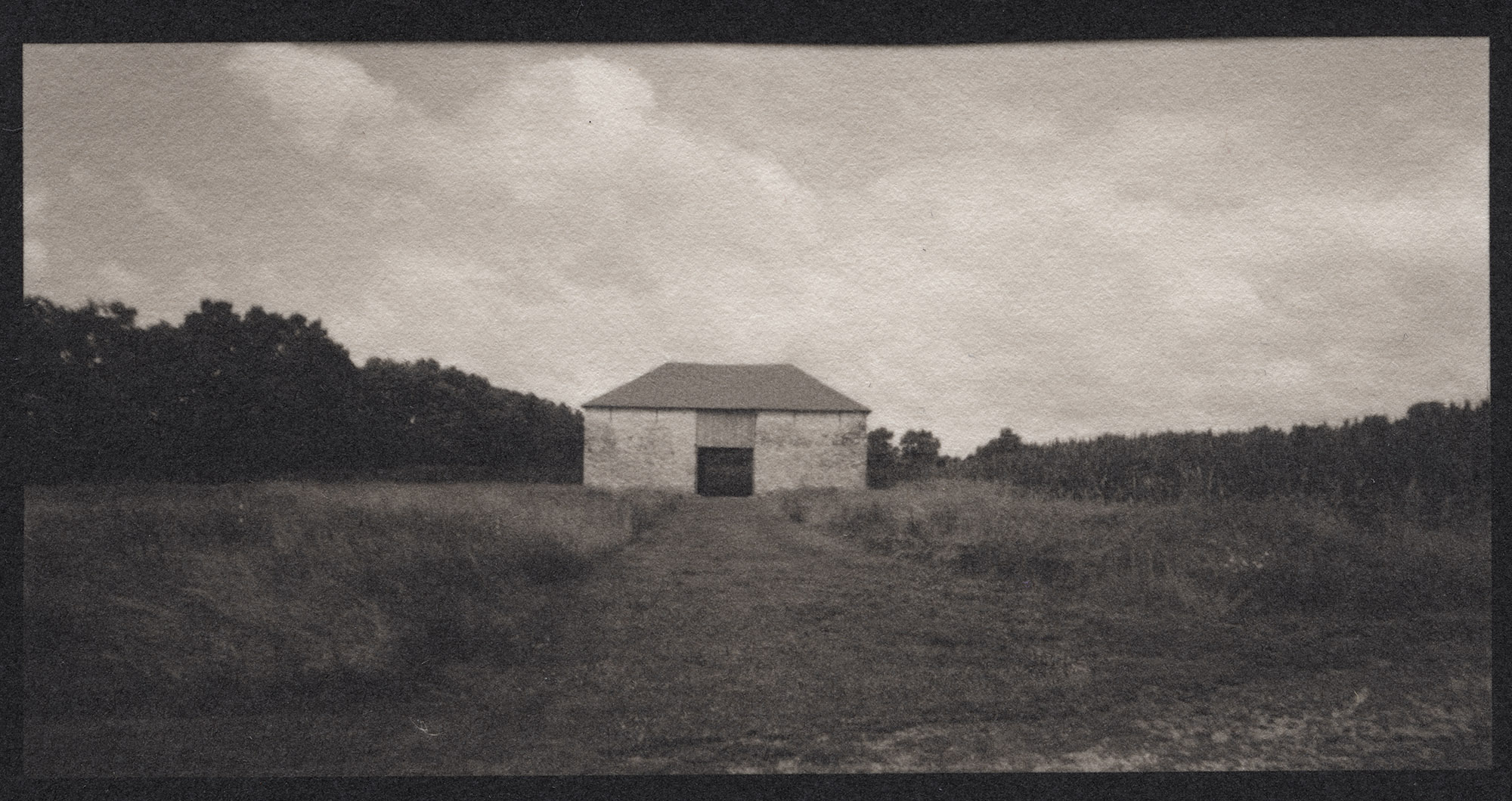
Stone Barn, Best Farm
If the stone barn gives you echoes of northern France, you’d be correct – architecturally it is styled after the structures of the homeland of the Vincendiere family. It is one of the oldest stone barns in Maryland, if not in the US. There is a tremendous sense of irony that a structure styled after the home of freedom of thought and equality of mankind would be the site of barbaric enslavement. There is also a tremendous irony in such a property being operated in such a way by a woman in the first decades of the 19th century, when such things were highly anomalous at best.
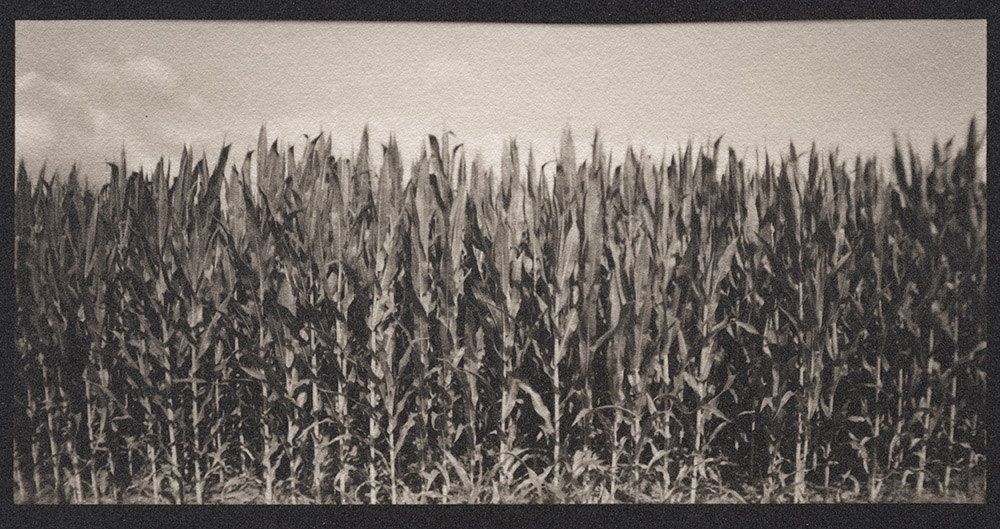
Corn Field, Best Farm
Today this field grows rich with corn. Clear blue skies and puffy white clouds cap the scene. In 1862, in this cornfield, a turning-point of the Civil War almost happened. Robert E. Lee’s army had camped here, on the march to Antietam. Left behind was a copy of General Orders #191, which detailed Lee’s plans. It was found wrapped around three cigars, abandoned in the camp. Delivered to General MacLellan, they practically handed him Lee’s army on a platter. As usual, MacLellan failed to follow up completely on this intelligence coup, and the end result was the single deadliest day in U.S. military history with some 22,000 dead, wounded or missing, and a war that would drag on for three more long, bloody years.
I have chosen to photograph these scenes in panoramic format because the wide aspect ratio emphasizes the landscape surroundings and provides a context for the structures and places. I purposefully chose to print them as very small contact prints to force intimacy with the subject – to view them you can’t hold yourself at a remove and distance yourself from the context – the echoes of slavery on this landscape are very much still with us if we stop for a moment to look and listen. I am printing them in palladium because the warm tone of the image evokes a certain historicity of the scene, reminding you that these hidden scars upon the landscape and the soul of the country are eternal.
My plans are to continue this project on locations throughout the Washington DC metropolitan area and expanding beyond as time and budget permit. Next up, Sully Plantation.
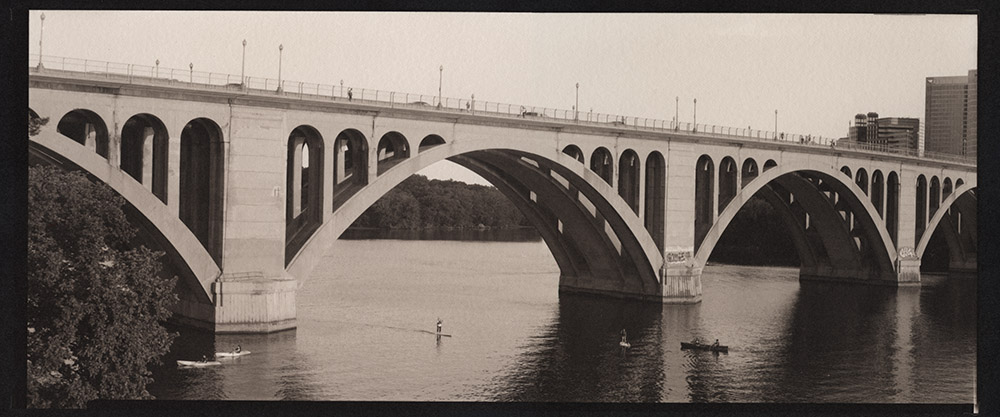
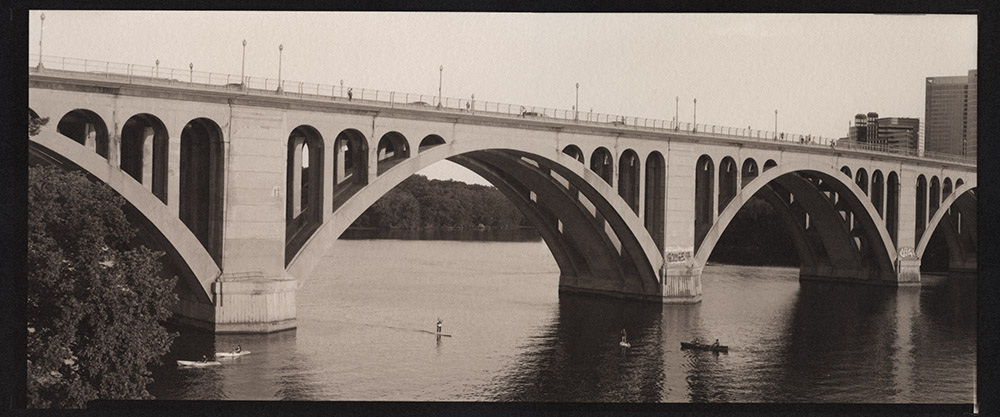
Another print I made this weekend – Key Bridge, in palladium. This is a 5×12 negative from my Canham. For the technically minded, I used a circa 1949 Kodak Commercial Ektar 12″ lens for the shot. It’s a very sharp lens with pleasant rendering, and a good match for the subject matter. I also want to talk for a second about the printing – this is a pure palladium print, with a touch of NA2 added for contrast. Sodium Platinum (NA2 for short) is a contrast agent you can add to a palladium print to boost the contrast if required. NA2 is very powerful stuff – a tiny bit goes a long way. In this case, I needed just one drop of 2.5% NA2 added to the 12 drops of Palladium and 12 drops of Ferric Oxalate sensitizer. NA2 comes from the manufacturer in a 5% strength solution, so you can see how little was needed to give the print some snap.
If you are using blended platinum and palladium, or trying to do a pure platinum print, and are in need of a contrast boost, you cannot use NA2 as a contrast agent – the platinum in it binds with platinum in your paper and what ends up happening is you reduce your highlights, blowing out detail, without actually increasing contrast. If you are using a blend, or pure platinum, you have several options – you can boost the contrast with a different additive, such as gold chloride, you can pre-coat your paper with fumed silica, or you can use a dichromate infused developer. I prefer adding a contrast agent into the emulsion rather than in the developer, because to do the infused developer route, you’ll need to have six or eight bottles of developers with different concentrations of contrast agent, and then you’ll have to play with chemistry to mix up replenisher for each developer concentration as it gets used. That realistically means keeping twelve to sixteen bottles of developer around. The downside to additives to the emulsion is that most of them will alter the color of the print. Gold Chloride will do anything from slightly cooler gray tones to eggplant/aubergine tones, depending on how much of it you use. Sodium Tungstate will actually reduce contrast in the print, and give you reddish brown tones. You can use dichromate in the emulsion as an alternative to the developer, but you must be careful in handling the undeveloped print as dichromate is toxic.
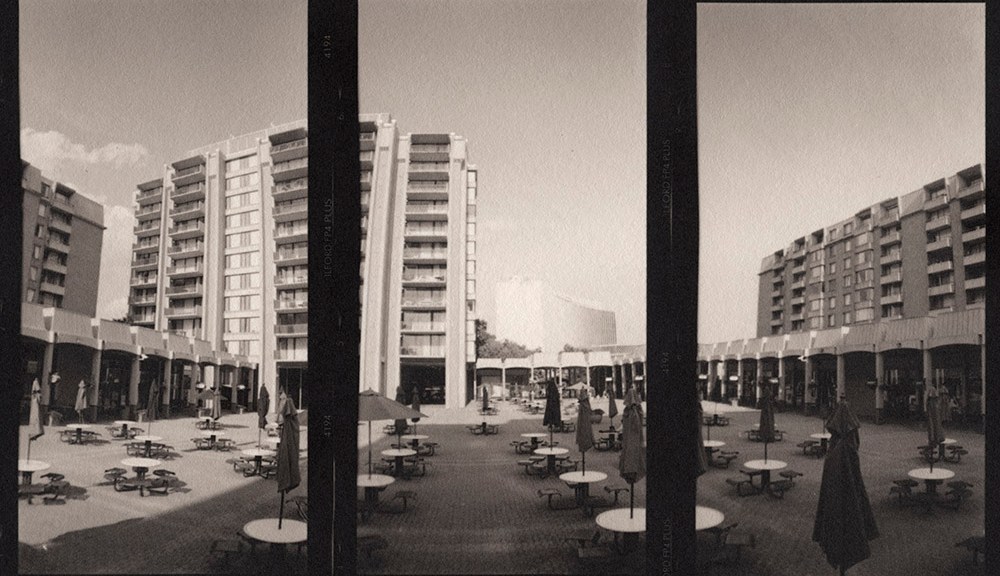
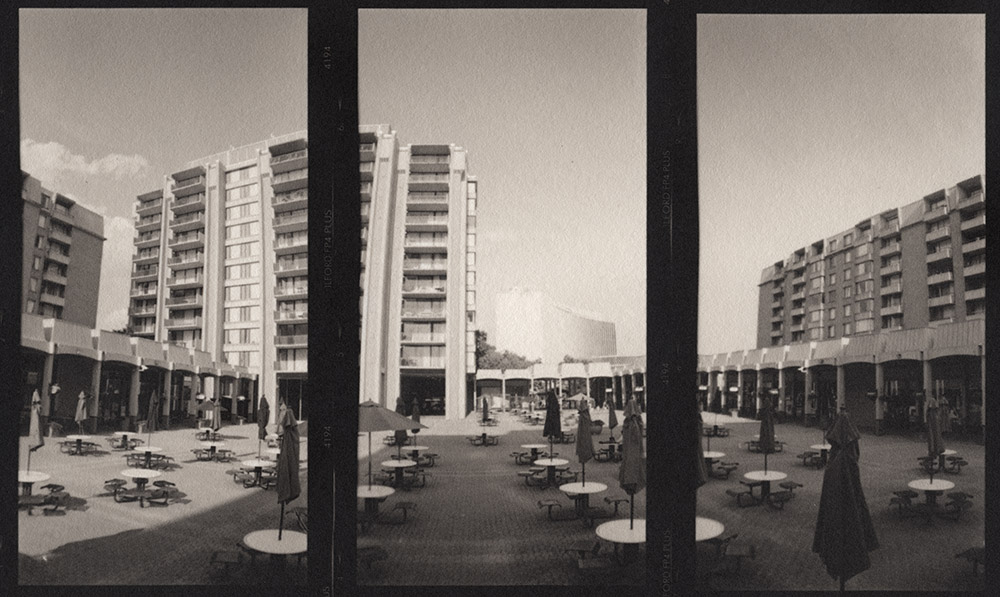
You may recall I recently posted some triptychs I did with my Lomo Belair X/6-12. I had been postponing printing them because I was A: being lazy, and B: I knew that they would be challenging to print because 1: lining up two negatives is hard enough, but getting three is even harder, and these are three pieces of roll film which doesn’t want to lay flat, and 2: I was concerned that there would be too much space between the frames because of the size of the image area vis-a-vis the negative size.
Inertia being the greatest of obstacles, it took me until now to get around to printing them. The challenges of registering the negatives to map my coating area, then re-registering them so they would align properly when exposing were substantial, but not as bad as I thought they would be. I guess there was enough humidity in the room that they cooperated for the most part and didn’t act as dust magnets or tensioned leaf springs while trying to place the cover glass in the contact frame.
Columbia Plaza, Horizontal Triptych
I think of this first one as a panorama of panoramas – it’s a horizontal panorama in the end, made of three vertical panorama shots. It’s the more conventional of the two in that it shows a fairly straightforward interpretation of the scene.
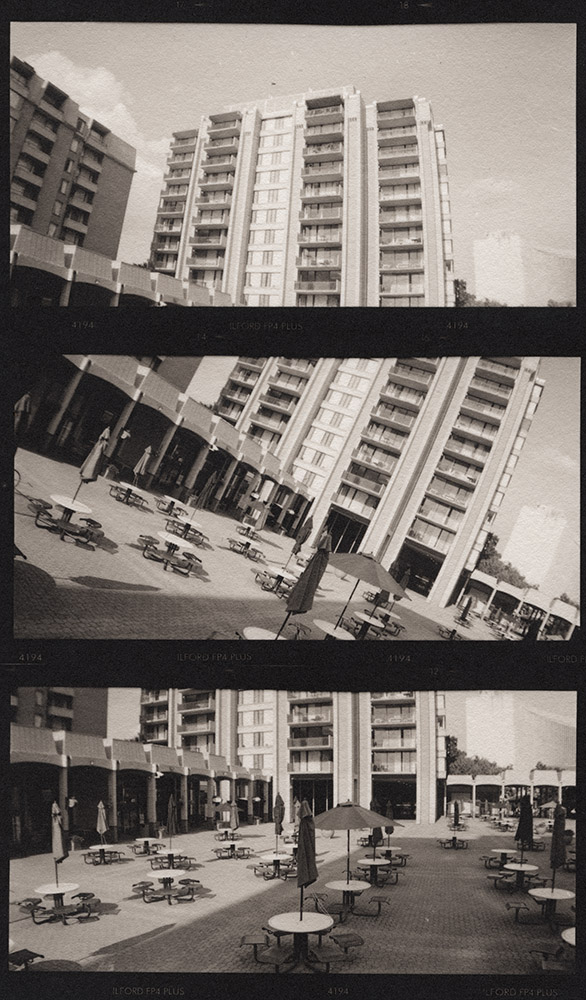
Columbia Plaza, Vertical Triptych
The vertical triptych I got a bit more creative in my interpretation, showing the middle frame askew, and each frame is not discreet in what it depicts – if you look carefully, they overlap in their subject matter, and you could almost do the top and bottom frames as a square-isn diptych.
Both images were printed on #Hahnemuhle #PlatinumRag in pure #palladium. No contrast agent was used, and they were developed in #PotassiumOxalate.
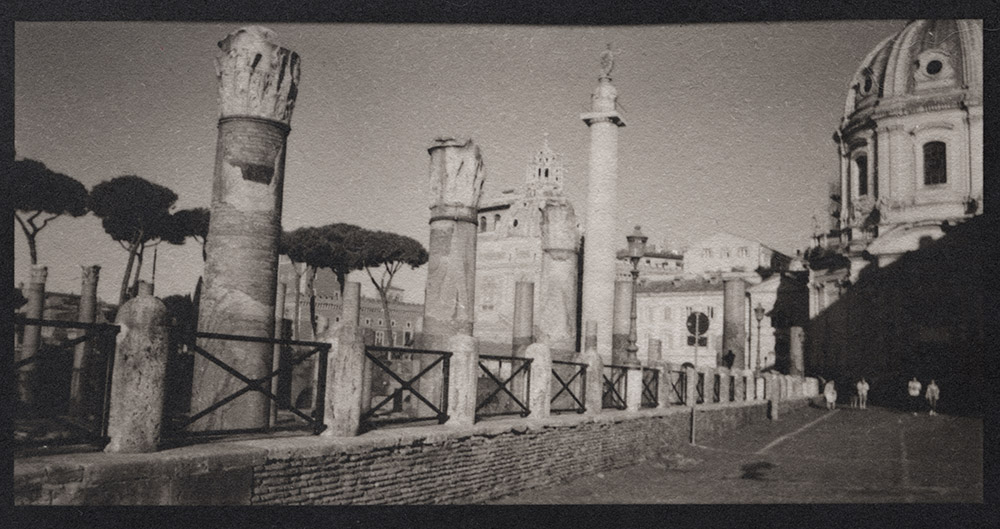
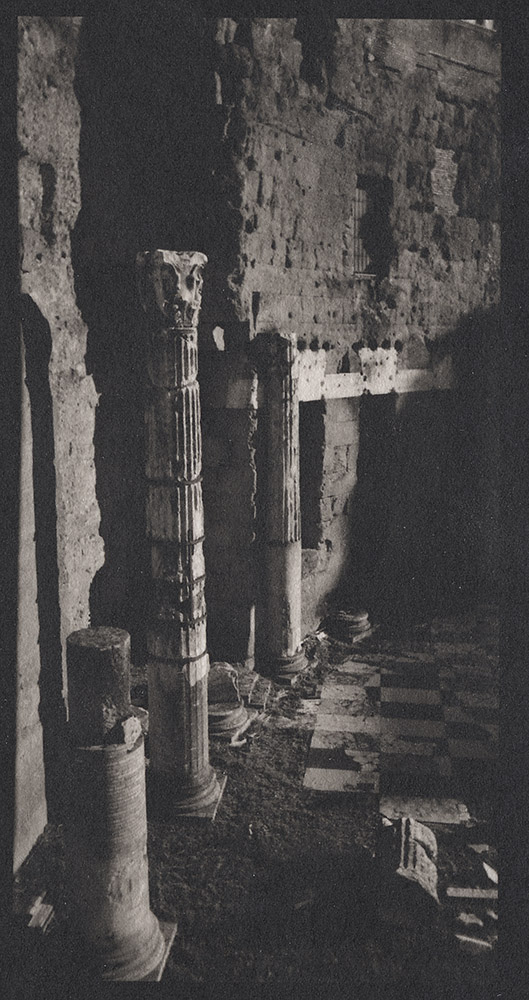
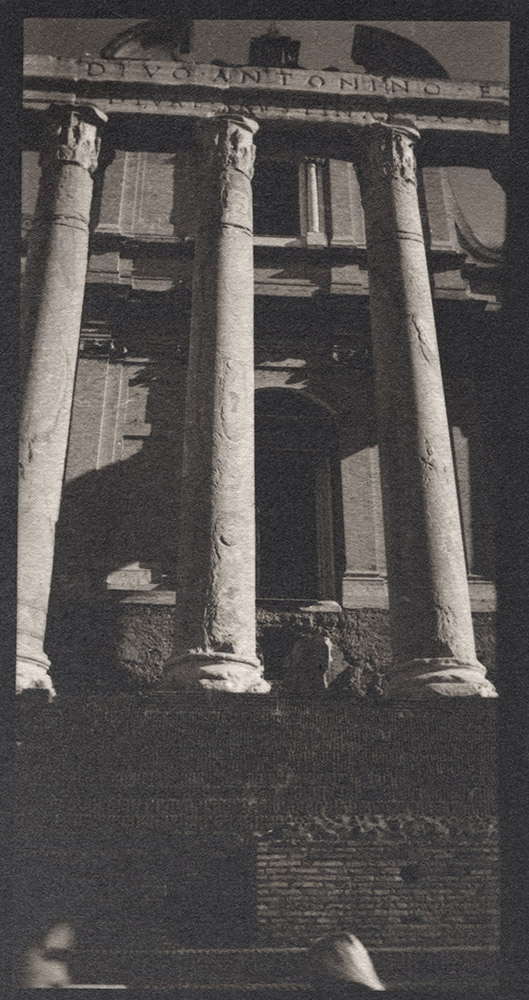
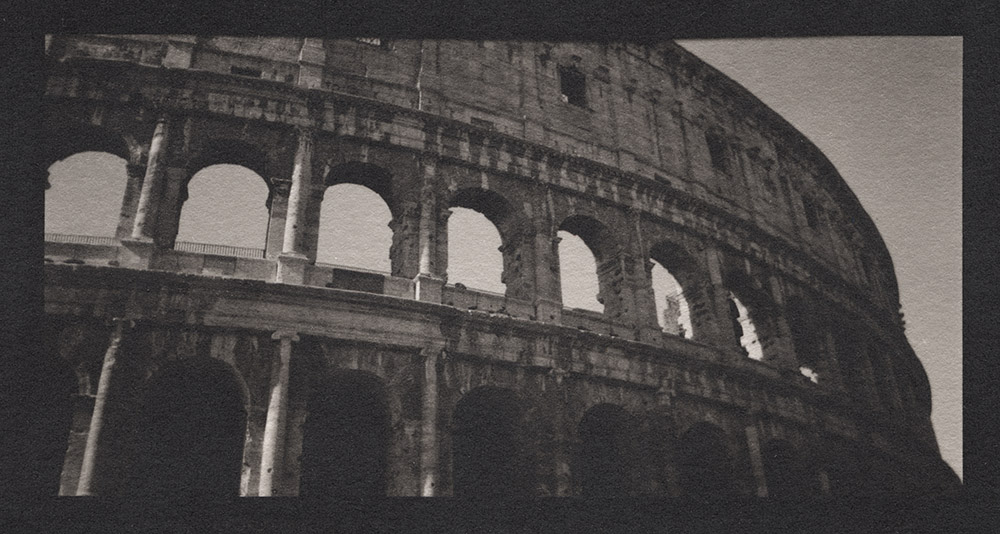
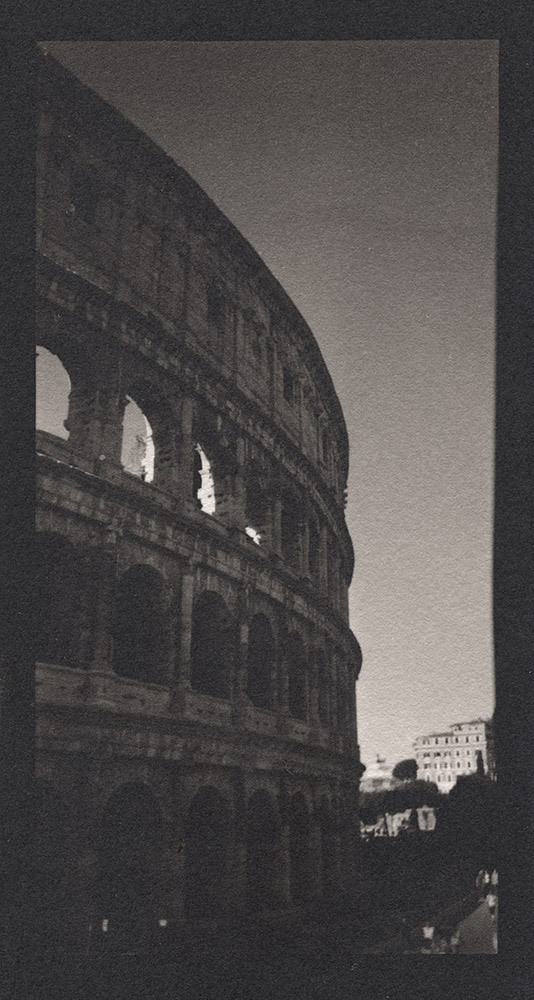
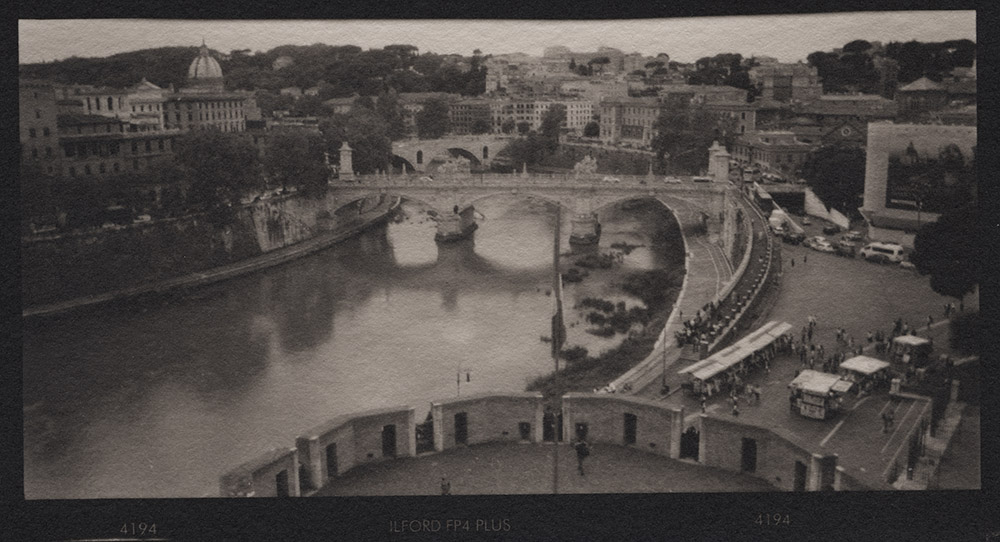
After printing a few of these panoramas from Rome, I was so taken by the intimacy of the miniature format of the 2 1/4″ x 4 1/4″ contact print, I went and made a whole series of them. I’m at fourteen of them now, but that number will fluctuate a little as I finish printing and edit down from there. I’m going to go out shooting this weekend and make some more images in the format and perhaps build a full show’s worth.
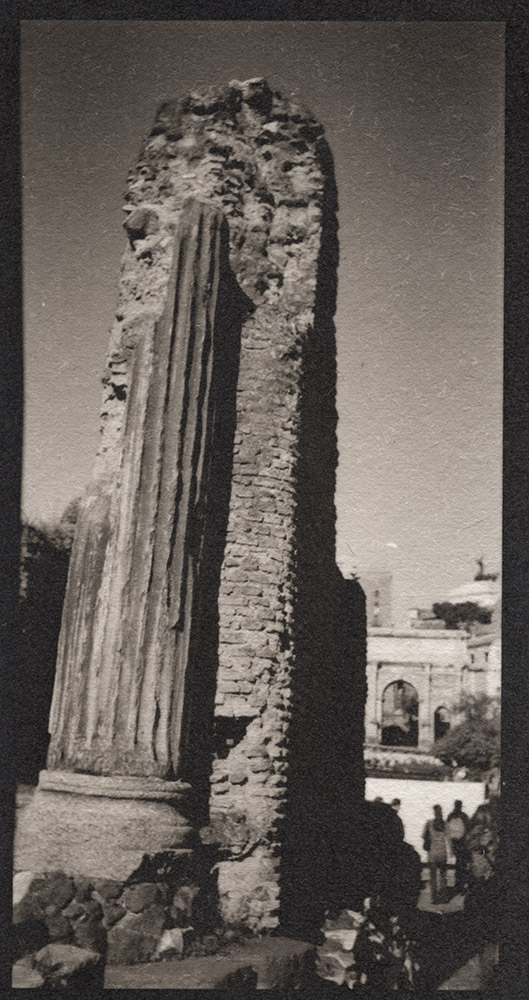
Columns, Marble Floor, Trajan’s Market
I took the portfolio to the Sunday morning critique we have at Glen Echo, and instead of presenting them as raw prints, I matted them with 8-ply mats with oversize margins (11×14 inch mat boards, so roughly 4-6 inch margins around the 2 1/4 x 4 1/4 inch window). I also cut the windows such that all the mats could be viewed in landscape orientation regardless of whether the image was in portrait or landscape orientation.
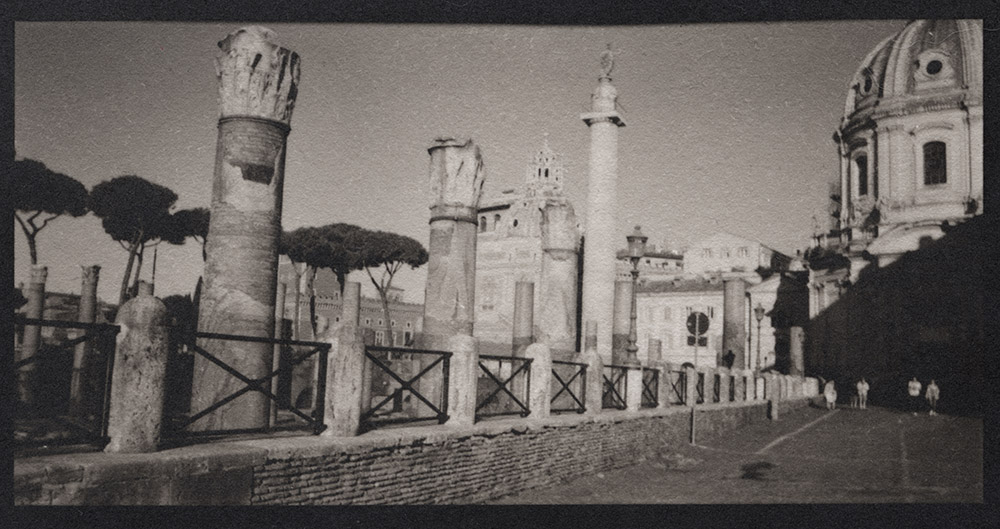
Trajan’s Column, Via Fori Imperiali
Presentation is very important when considering your work. It should be the first thought on your mind when planning a show – of course you need to edit the body of work, but how it will look on the wall is just as critical to successful reception as the work itself. Good presentation will focus the viewer’s attention on the work and block out the distractions of everything else going on around it.
Temple of Antoninus and Faustina
Also, if you’re at all concerned with selling your work, makes a huge difference in the sales price – poorly presented, someone would pay a poster price for an original Ansel Adams, if they bought it at all. Properly presented, your work will fetch premium prices even though nobody has really heard of you outside your own city.
Column Fragment, Imperial Forum
This webpage is a prime example of the issue of presentation – showing these images here in this size on this medium is a complete and utter failure to represent the scale, quality and impact of the images. You’re looking at them on your monitor, in a size well beyond their actual physical size in reality. And because they’re scans of the prints, the paper texture is exaggerated as are any minor flaws due to the handmade nature of the prints.
Here is the continuation of the tiny prints series. All of these are still from Rome, again the Lomo Belair X6-12 as the camera of choice. I was having a conversation yesterday with a friend about these and while sharing them online is great, seeing scans of them at what ends up being a much larger size than the actual print, they lose some of their impact.
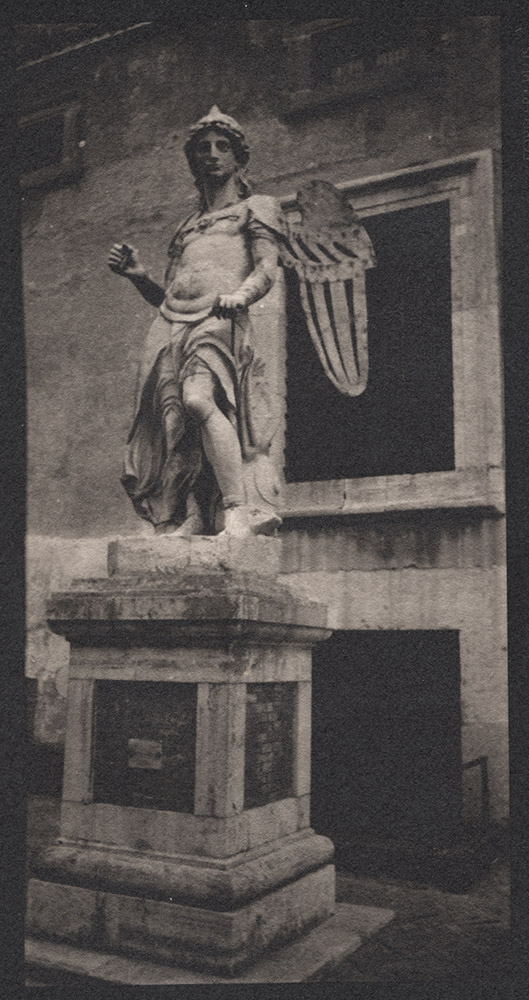
This is a statue of the Archangel Michael, in the Castel Sant’Angelo. His body is stone but the wings are bronze.
Archangel Michael, Castel Sant’Angelo
The umbrella pine image is one of those that when I scanned the negative and worked with the image in Photoshop, all the “flaws” of the negative become quite apparent, and you start thinking it’s not a successful image. But contact printed, it cleans up nicely and really sings.
Roman Umbrella Pine
St. Peter’s Basilica Facade. This is one of the images that made me respect the Belair and its results more than I did initially. It’s still not going to ever match a serious panorama camera like a Horseman 6×12 with a highly corrected glass lens, but it does a great job for what it is, and certainly it scores extremely well in the value-for-money proposition – I got mine used for $200, whereas a used Horseman would set you back closer to $2000.
St. Peter’s Facade
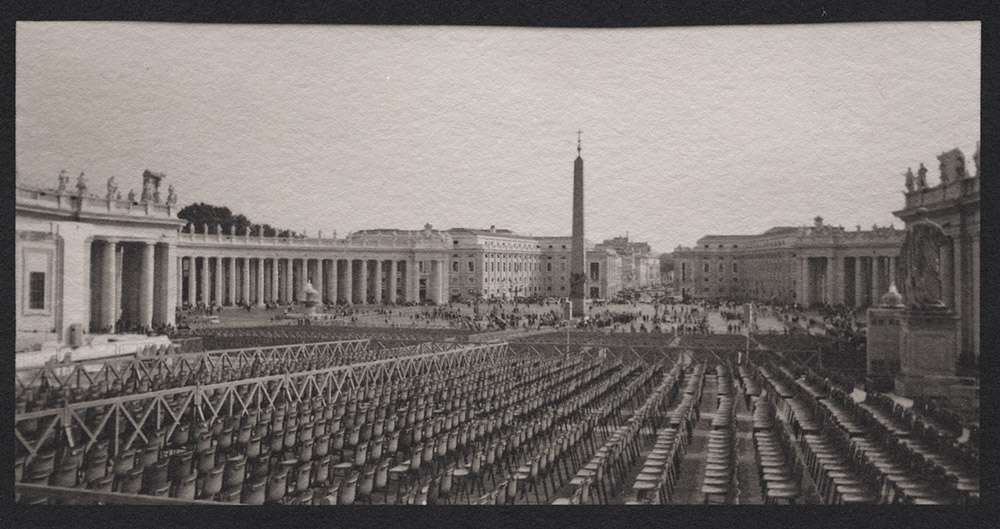
The plaza in front of St. Peter’s was set up for a Papal Mass when I was there. The sea of folding chairs made for an interesting composition, leading your eye back to the obelisk and beyond.
St. Peter’s Plaza
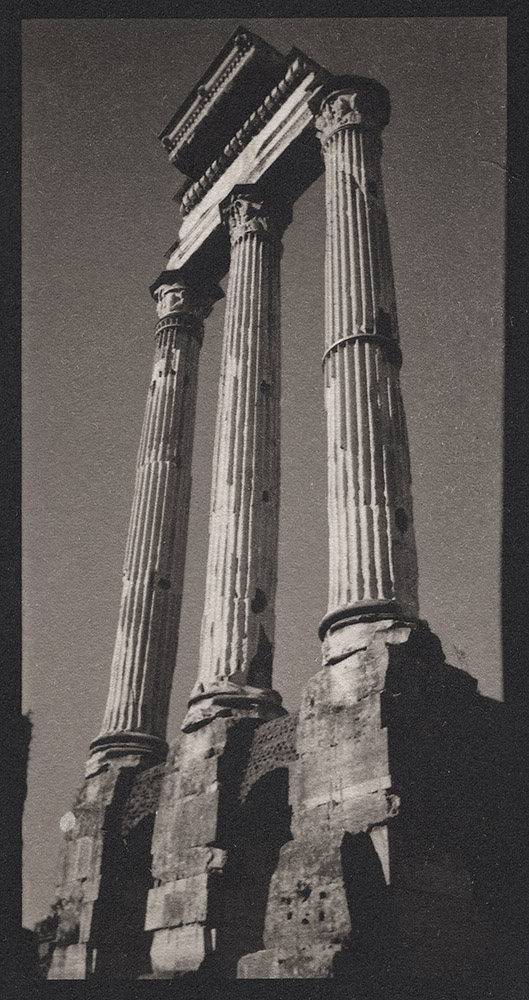
These are the famous three remaining columns of the Temple of Vesta in the Roman Forum. This one really strikes me because of the simple, graphic nature of the subject. It’s another one of those images that everyone photographs when they’re at the Forum, and everyone knows it, even if you haven’t ever been to the Forum. Printing in platinum/palladium takes it somewhere new and different and it doesn’t feel like just another tourist image.
Three Columns, Temple of Vesta, Roman Forum
All these images are platinum/palladium prints, in this case all are a 50/50 blend of platinum and palladium, on the new wonderful Hahnemuhle Platinum Rag paper. I’m going to have to try a pure platinum print with it next and see how it behaves.
When I was in Rome last year… (no jokes please!) I shot a bunch of panoramic images with my new-to-me Lomo Belair X6-12. My just completed session of the Intro to Platinum/Palladium Printing class I teach inspired me to dig them out and see how they would fare in the medium. I’m really loving these tiny prints – 2 1/4 by 4 1/4 inches! They make you get up close and intimate with the print. I’m matting them in 11×14 inch 8-ply mats for extra measure.
Sometimes you have to walk away from a process or a practice for a while, which happened to me with platinum/palladium. I was on a kick of doing other stuff, shooting my travels with the Rolleiflex. Then it was the Fuji rabbit hole with digital and the X-T1. Then this class came along and I needed something to jumpstart my printing. These images were just the ticket. Photographers in general have an obsession with how big they can make their prints, and even the general public too. But there’s something to be said for tiny prints. I still remember the Andre Kertesz show at the National Gallery where they had a lot of his early work on display – in his youth, he could only make contact prints off of small negatives from roll film cameras because he was poor and didn’t have space for a dedicated darkroom. Getting up close and personal with his images, like “Underwater Swimmer”, which is all of 1 1/2 by 2 1/4 inches, really makes you think about the image itself instead of being awed by its size. Not that I have several million dollars to spare, but I’d much rather spend that kind of money on a print of “Underwater Swimmer” than on Andreas Gursky’s “Rhein II”. Fortunately, the Kertesz would be a lot cheaper to buy than the Gursky anyway.
On a separate note, I’d like to give a shout-out to Carol Boss at Hahnemuhle papers. All three images above were printed on the new Hahnemuhle Platinum Rag paper. She has very generously become a sponsoring partner of my Intro to Platinum/Palladium class at Glen Echo Photoworks, and is supplying us with our paper. It is a wonderful new paper- very easy to coat and print on. It may well displace my old standard Bergger COT 320.
I have some very exciting news to announce – my upcoming Introduction to Platinum/Palladium Printing class is now sponsored by Hahnemuhle, makers of fine art printing papers since 1584. They recently introduced a new paper specially formulated for alternative process printing, specifically platinum/palladium, and are graciously supplying the class with a very generous stock of paper for the students to use. I hope this will be the beginning of a long and fruitful partnership.
How did you get into photography as an art medium (as opposed to casual or professional use)?
I do not remember for sure, I have a darkroom since 1966 and soon was interested in fine art printing, made solarisations and lith-printing. Later I hand-coloured my still life photographs.
Which alternative processes do you practice?
copperplate photogravure following method of Talbot/Klic.
What attracted you to alternative processes in general?
Interest in photohistory and in aesthetic well composed pictures.
What drew you to the specific media you practice?
Pictorialistic photogravures in literature and museums.
How does the choice of media influence your choice of subject matter (or vice versa)?
The medium fits the message.
In today’s mobile, electronic world of instant communication and virtual sharing of images, how important is it to you to create hand-made images?
Important enough to spend three days work per print edition
Is your choice to practice alternative, hand-made photography a reaction to, a complement to, or not influenced by the world of digital media?
When I began photography, there was no digital. Later I had my first computer. It was a Tandy TRS 80 model 3 and already had a mouse. She crawled through the floppy drive slot and tragically died within. I suppose, then the mouse did not like computers. I made some stills with dead mice. This was the strongest influence of digital media to my work.
Do you incorporate digital media into your alternative process work?
Photogravures need an inter-positiv, which I make chemical-based on document-film or digital on pictorio ohp. Digital so-called full frame cameras give freehand a quality like 24x36mm film cameras on tripod, but tend to have no soul.
I use digital capture sometimes if film is not possible. In the scrap project I captured pictures as well electrical as film-based (middle-format to 8x10inch).
If so, how do you incorporate it? Is it limited to mechanical reproduction technique, or does it inform/shape/influence the content of your work?
I use digital media for inferior photowork and seldom for multimedia projects.
What role do you see for hand-made/alternative process work in the art world of today? Where do you see yourself in that world?
This may be decided some 50 years later
How did you get into photography as an art medium (as opposed to casual or professional use)?
That went hand-in -in hand with the discovery of alternate processes
Which alternative processes do you practice?
Just about anything: platinum/palladium, silver/iron processes, chrysotype (gold), gum bichromate
What attracted you to alternative processes in general?
I was attracted to the chemistry at first and then the aspect of creating one of a kind hand made images
What drew you to the specific media you practice?
Platinum and palladium prints were are of the technically most accomplished and able to produce most delicate highlights and deep shadows. Seeing great examples of early XX century work in museums and galleries made mu pursue the process . I have started over 25 years ago and the information back then was scant and confusing
How does the choice of media influence your choice of subject matter (or vice versa)?
When taking and composing a picture I try to visualize which alternative process would fit, whether I wand process edges showing, etc.
In today’s mobile, electronic world of instant communication and virtual sharing of images, how important is it to you to create hand-made images?
Two aspects are important. Education of consumer in the existence and quality of hand made images and history of photography through a practice of XIX century processes. The second is keeping and enlarging patron/collector market. Real collector wants something to be touched and held in hand, not a shared digital image.
Is your choice to practice alternative, hand-made photography a reaction to, a complement to, or not influenced by the world of digital media?
It would be totally silly to ignore the digital world. It exists regardless of our feelings about it (good, bad??). SO with that respect it is just a complement. But it is also a strong protests against huge color enhanced digital prints that have invaded galleries.
Do you incorporate digital media into your alternative process work?
Yes, I use the technology as a toll. Some of my captures are digital, most of my negatives are created with digital processes. I am also not against digital alterations of the photograph in the process of creating a picture
What role do you see for hand-made/alternative process work in the art world of today? Where do you see yourself in that world?
I see myself as a part of alternative photography movement. A small (by digital standards) but growing group of practitioners and educators that shares information, practices and the word of photography at its roots



 dcphotoartist