Category Archives: Black and White

New Toy, On The Road

As many of you who have been following my blog for any period of time are now aware, I’m a camera-toy junkie. My latest foray in camera toy land has been into the world of “toy” cameras. I’ve been working for several years on my Sinister Idyll series using my Lomo Belair X-6/12. Many would call it a “toy” camera because it is a plastic fantastic body, with aperture-preferred automatic exposure only, only two aperture choices, and manual guesstimate focusing only. It’s upgradeable (as I have done) with two Russian-made glass lenses (which are absolutely superb), but beyond that, it’s a glorified point-n-shoot that takes panoramic images on 120 roll film.

Well, I just acquired its spiritual cousin, the Lomo LC-A 120. The LC-A has a super-wide lens, also a Russian glass lens, and a fully automatic shutter and aperture (you have no say whatever in the exposure other than if you game the system by changing the ISO, and no idea which aperture it’s using because there is no indicator in the viewfinder, just a slow-shutter warning light). Focusing is achieved by selecting one of four focus zones via a lever on the side of the body. I’ve been plinking around with it here around Washington DC, and just gave it its first serious workout on the road when I took it with me to London.
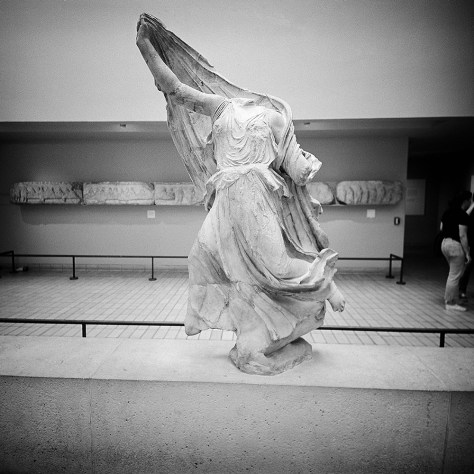
DiscoGrecian
“Disco Grecian”, British Museum

One of the most obvious characteristics of the lens is a noticeable vignette in the corners. Applied properly, this is a very effective tool. Thanks to the automatic aperture, it’s not always predictable how much you’re going to get (see comment above about the aperture – with wider apertures and infinity focus, you get more vignetting. With smaller apertures and closer focus, you get little or no vignetting).
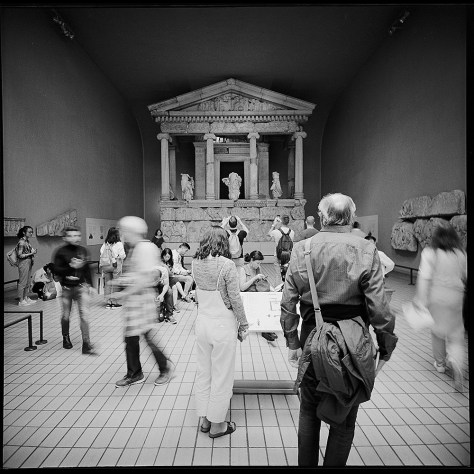
GreekTempleBritishMuseum
Greek Temple, British Museum

As you can see from the people moving around in this scene, the camera is quite sharp even at a larger aperture, and the extreme wide-angle (the same field of view as a Hasselblad Superwide) lets you hand-hold at speeds that would be very difficult with a normal lens on a reflex camera. I’m guessing this was somewhere between 1/8th and 1/2 second.
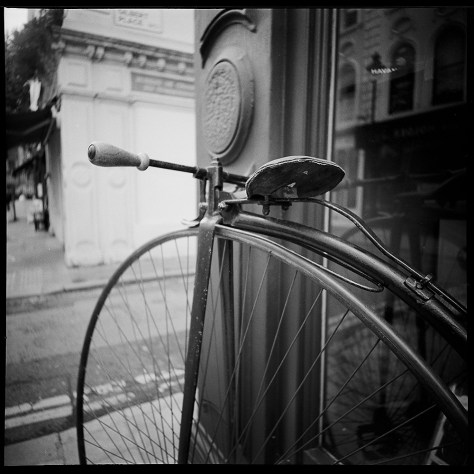
PennyfarthingMuseumStreet
Pennyfarthing Bike, outside Thomas Farthing’s, Museum Street, London

Even with the lens being so wide, you can achieve selective focus effects with it if you get in close. I highly recommend getting in close!
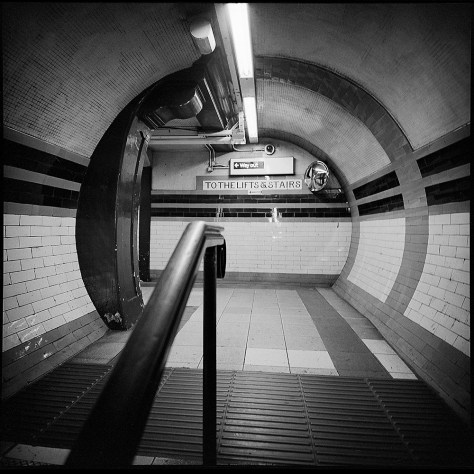
RussellSquareTubeStairs
Exit, Russell Square Tube Station, London

An extreme example of hand-holding (yes, I know – I have supernaturally steady hands). This was at least a one-second exposure.
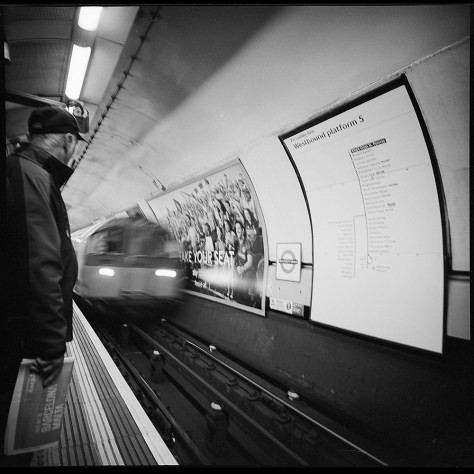
UndergroundStationOldStreet
Approaching Train, Waiting Passenger, Kings Cross Tube Station

The LC-A is a great travel camera because it’s so wide, it allows you to include a near-human-eye field of view, and the extreme light-weight and compact form factor make it very easy to take anywhere and carry all day. Ditto for the minimalist operation technique – you really just point, set focus range, and shoot.
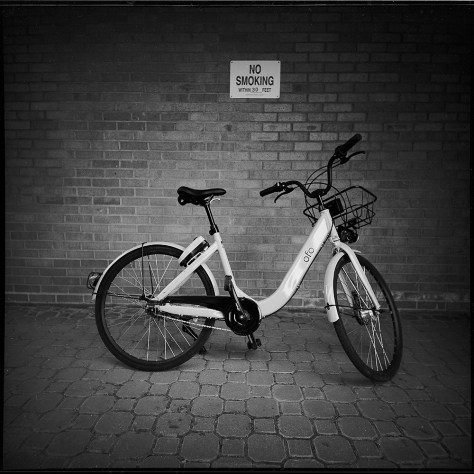
OFOBikeLCA
No Smoking

Back here in DC, you can see another example of the vignette effect. I did tweak this a little to amplify it, but this is not a significant manipulation beyond what the camera did.
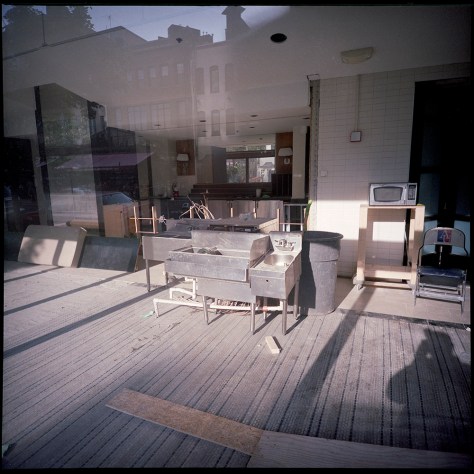
BarSinkRenovations
Under Construction

I like getting multi-layered images with partial reflections in glass. And it’s a bit of a self-portrait too, with my shadow falling in the image. I love how the construction workers have the microwave set up and working in the middle of a kitchen remodel – you have to have your priorities straight and keep the coffee warm!
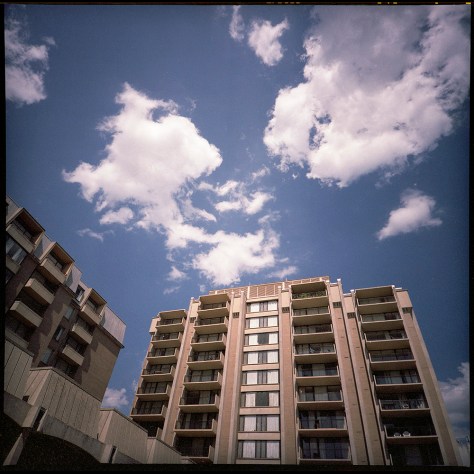
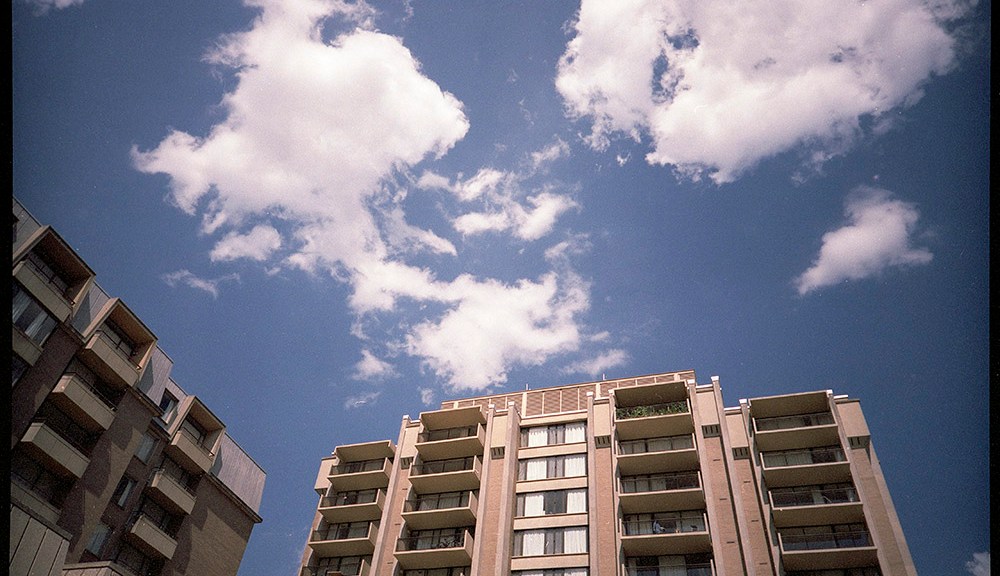
ColumbiaPlazaClouds

A demonstration of not only the extreme field of view, but the color rendering of the lens. The camera has a reputation for deep, saturated colors. This was taken with 10+ years out-of-date Fuji Pro 400 H.
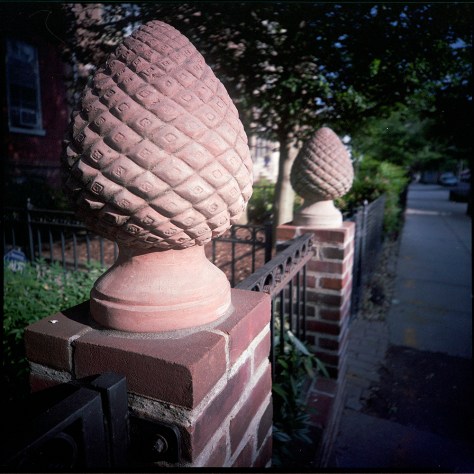
ConcretePineconeDupontAgain, you can never really get too close. This was a test of the close-focus/selective focus capability (the minimum focus setting is 1.5 feet).
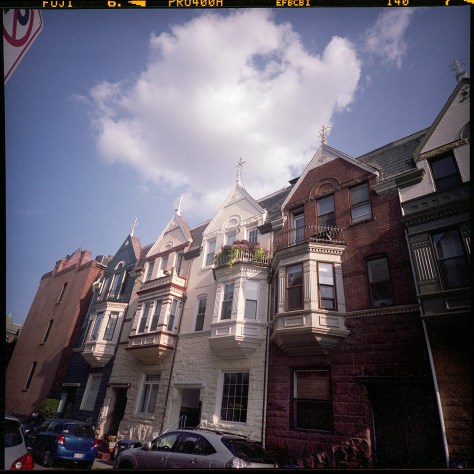
FiveHousesDupont

Nice saturated colors even on decade-old film.

One of the things I’ve been enjoying about these “toy” cameras that give you very little control over your photograph is the way that they in many ways demonstrate the lack of need for that level of control to make good images. The extreme wide-angle of not only the LC-A but also the Belair force you to think very seriously about your composition, use of perspective, and manipulation of forced perspective to emphasize/de-emphasize compositional elements. With the Belair, I do have a “B” setting for the shutter to do long exposures and intentionally play with time, something I don’t have on the LC-A (but wish I did). Time is the one other critical component to a photograph that we do and simultaneously do not have control over – I can control when I open the shutter, and to some extent when I close the shutter (if I want a “correctly” exposed image, I must close it when it needs to be closed, not when I want it to be closed), but beyond that we have no real control over what happens WHILE the shutter is open. Things happen on their own. Movement is never fully predictable. Moving subjects speed up, slow down, change direction, or stop without warning.

I’ve started thinking of these cameras that I’ve been using – the Belair and the LC-A – as “serendipity boxes” because to use them successfully, they require an acceptance of serendipity, chance, and fortune. They’re life-metaphors in a way – just like in my own life, I can point them a certain direction, look at specific things, get closer, and turn away.  But if I don’t learn how to see through them, to take in the periphery, work within the uniquely skewed perspectives that they offer, I’ll miss out on things that are presented to me because they didn’t fit in the tightly-controlled box I wanted them to fit into.
 

Garuda Boy – Now and Then

GarudaMural2018BWFisheye
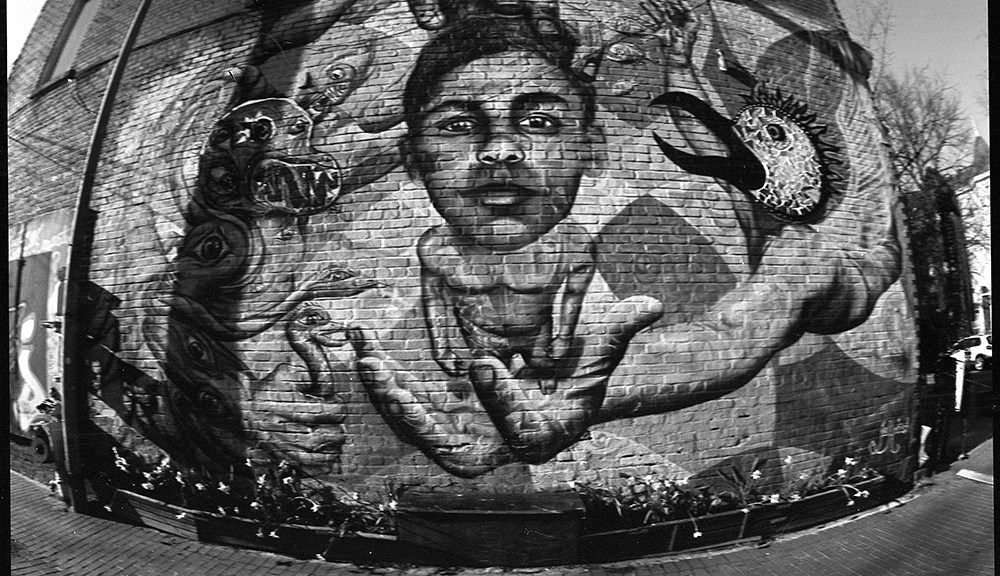
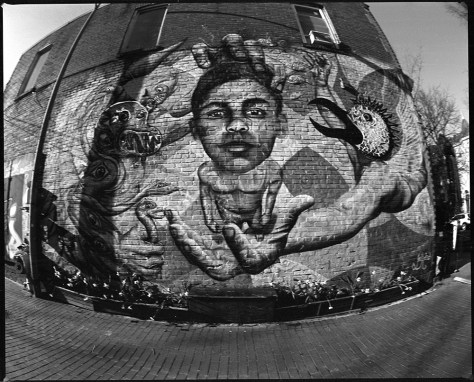
Black Boy, Garuda, 2018

I’ve walked past this mural for years, and they re-do it every so often. The primary change from visit to visit is the color palette, but over time, major compositional elements change as well. I’m showing the previous version (circa 2013) and now both in black and white just to keep the comparison visually fair.
Black Boy, Garuda, B/W

The bird’s head on the right is a mosaic, originally including mirror fragments, now painted. I think the fisheye treatment in the first image works well because the mural already has a bit of a fisheye perspective to begin with.

Happy Accident – double-exposure

DoubleExposureHappyAccidentFisheyeRZ

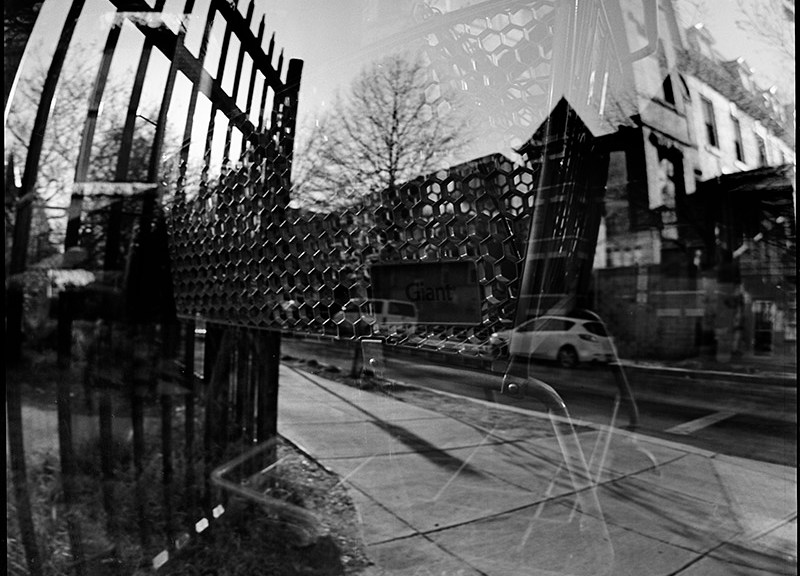
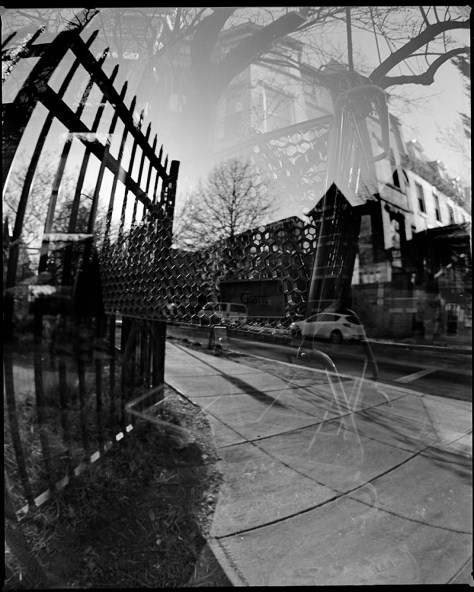
Double-exposures, especially accidental ones, can be so much fun! You never know what you’re going to get, and how it will work out. Here I have two very different images layered one atop the other, both with my Mamiya RZ Fisheye lens. Had they been done with different lenses I don’t think this would have worked out so well.

Playing with a Fisheye

I decided to treat myself to a lens toy – I got a Mamiya RZ Fisheye lens for my RZ67. It arrived this weekend and I took it on a walkabout in my neighborhood to put it through its paces. I especially wanted to try and do some shots that did not scream “shot with a fisheye” to see if it could be versatile enough to keep in my camera kit, or was it really a one-trick pony.

SolarLightsFisheye

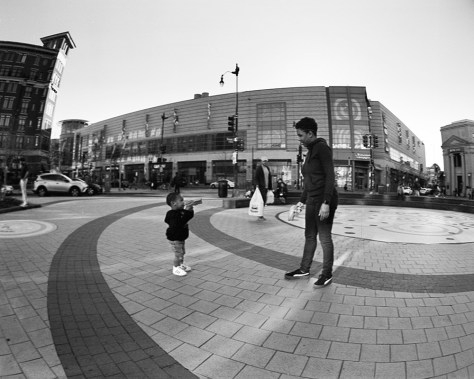
In this shot, it shows that you CAN use it for street documentary if you want. It’s still a challenge, though, with the distortion it brings to background subjects. And it forces you to get right up on top of your subjects – They were maybe five feet away from me.

SquirtgunFightFisheye

Applied sensibly to architecture, it works. You do have to be extra careful that your horizons are level and square, or you will get wild distortion.

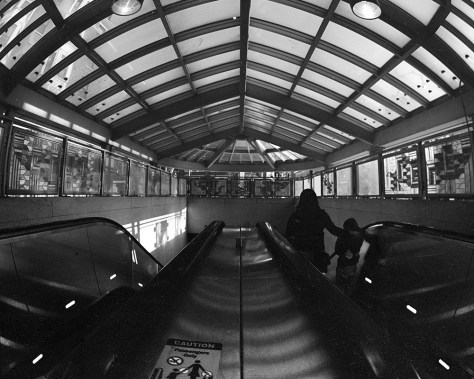
CoHiMetroEscalatorFisheye

This is perhaps my favorite image of the shoot. Leading lines abound and the backlit subject with the sun in the frame create drama.

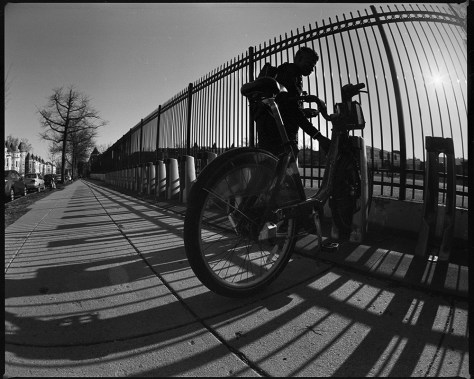
CyclistRentalFisheye

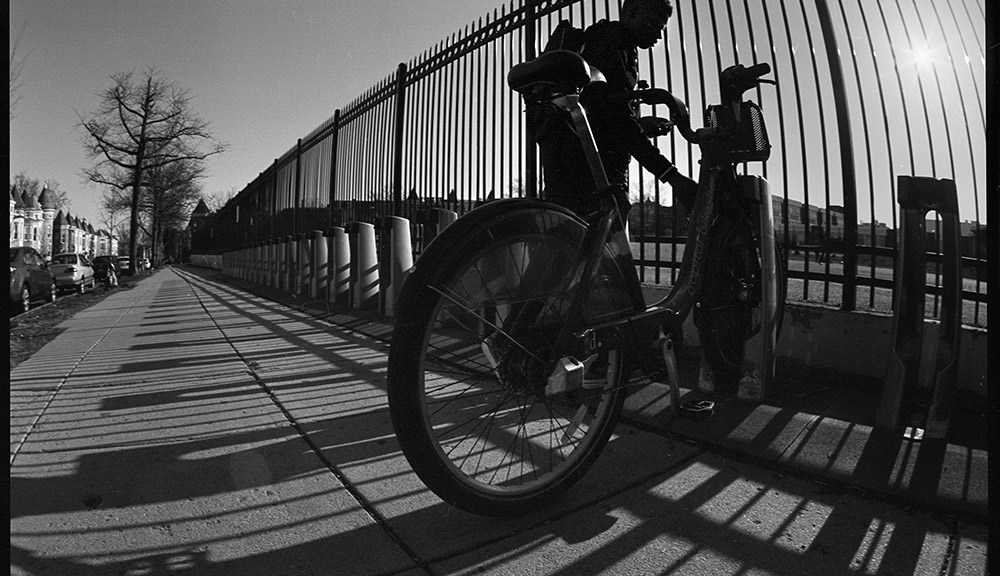
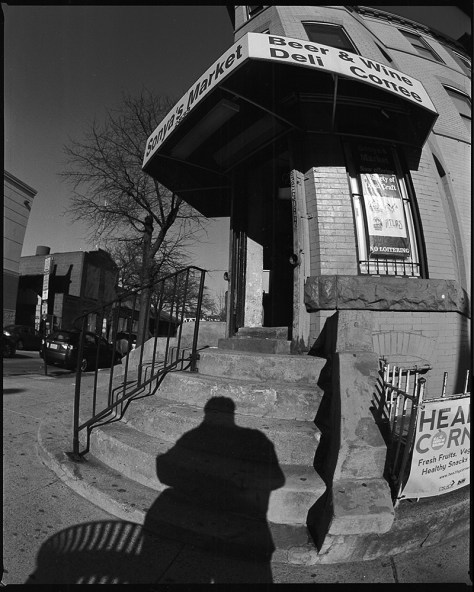
Selfie with the fisheye – with the sun behind me, it’s impossible to keep yourself out of the photo (or at least your shadow).

SonyasMarketFisheye

Protests In Washington DC

Given the polarizing nature of the current president’s personality and demeanor, it should be no surprise that he attracts a LOT of protestors. There are always protestors outside the White House – for as long as I can remember, there was a 24/7 anti-nuclear weapons vigil in Lafayette Square, going back to at least the Reagan administration. The woman who spearheaded that protest has since died, so now the round-the-clock vigil encampment is immigration themed, if I recall correctly.

I don’t usually attend protest rallies or photograph them, given that they can be very sensitive events and I don’t want to be associated with anything that might go wrong when two opposing groups confront each other. Fortunately this is a rare thing in DC, but it does happen.

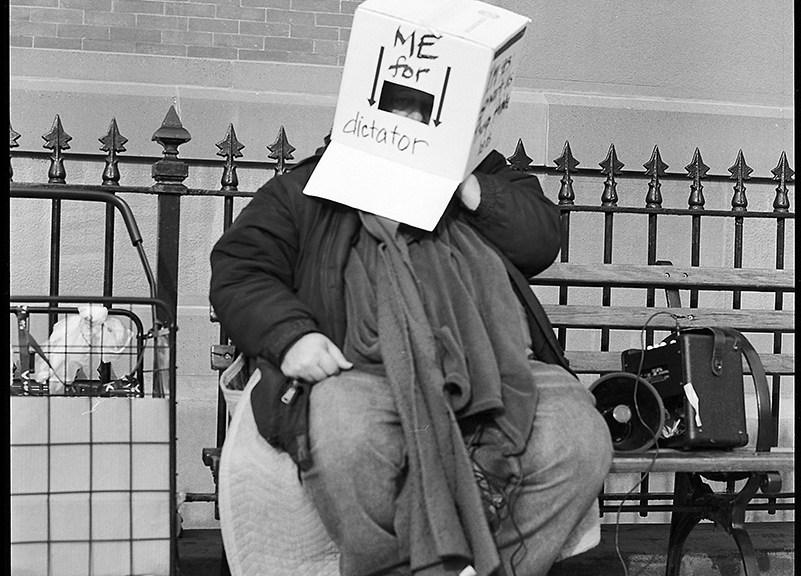
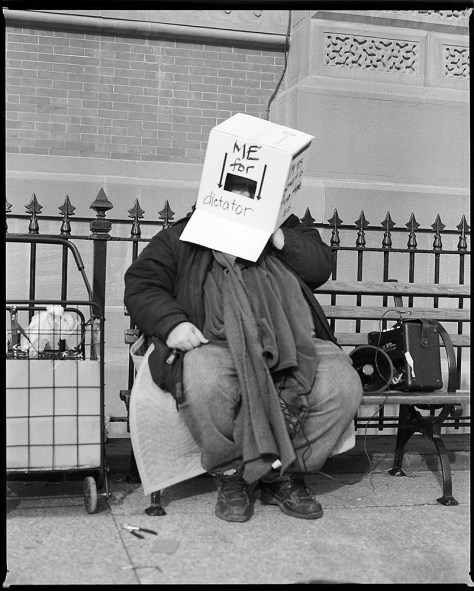
I was out playing tourist/tourguide with some out-of-town friends over the Martin Luther King Birthday holiday. We walked from the Air and Space Museum up Pennsylvania Avenue past the White House, then on to the Washington and Lincoln Memorials before finishing at the MLK Memorial. Outside the Renwick Gallery there was this character:

MeForDictator
Me for Dictator

Inside his white box, he was playing the harmonica through a portable amplifier. There was no discernible connection between his song choices and the overall theme of his demonstration, so I don’t know to what extent he was consciously protesting, making social commentary, or just serendipitously expressing the zeitgeist because his meds were wearing off.

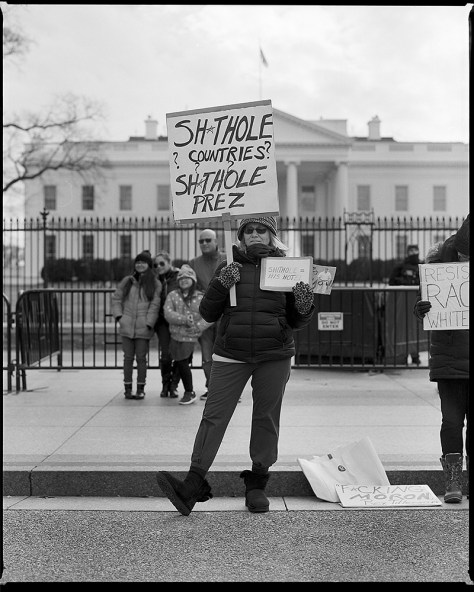
Outside the White House was a different matter, and a much more pointed display of discontent. This was right after the president had made his “shithole countries” comment, so much of the signage centered around that.

ShitholePrez
Shithole Prez

I chose this image because of the profoundly ironic juxtaposition of the happy tourists posing for a family photo in front of the White House with the protesting woman in front. This is something you will experience here in Washington that I don’t think you see many other places – the cognitive dissonance of “oh look, we’re jazzed to be here!” immediately adjacent to “I’m righteously indignant and I’m not going to take it any more!” expressed over the exact same subject.

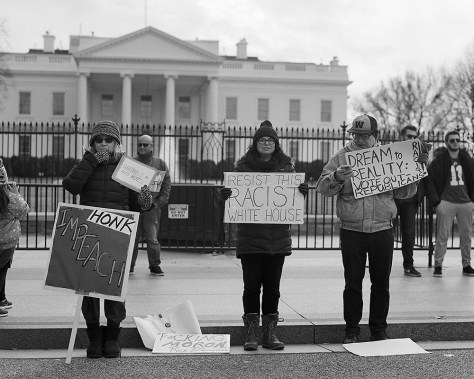
ResistRacistWH
Resist This Racist White House

One good thing about photographing protestors is that if you want to get better at “street” photography, they’re a great subject to practice on, because they absolutely want their pictures taken to get their message out to the larger world.


Panoramas around DC – The National Gallery of Art

Last weekend I took an excursion down to the National Gallery of Art to do some book shopping in their bookstore. I brought the Lomo Belair with me to play around a bit.

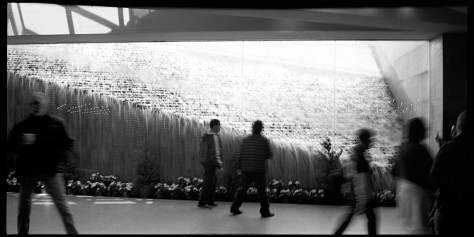
Waterfall, National Gallery
Waterfall, Cafeteria, National Gallery of Art

The cafeteria and bookstore for the NGA is below ground. There’s a great big window that looks out at a fountain that cascades from the plaza at street level above, and transforms what could otherwise be a dark and oppressively cavern-like space into something almost airy.

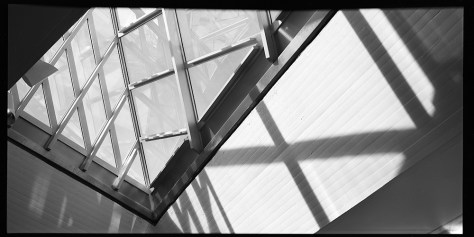
Skylight,National Gallery Cafeteria
Skylight, Cafeteria, National Gallery

Also directly above the cafeteria and facing the waterfall are the glass pyramidal skylights. They’re not true pyramids, as they’re actually irregular tetrahedrons (four-faced geometric structures with each face being a triangle).

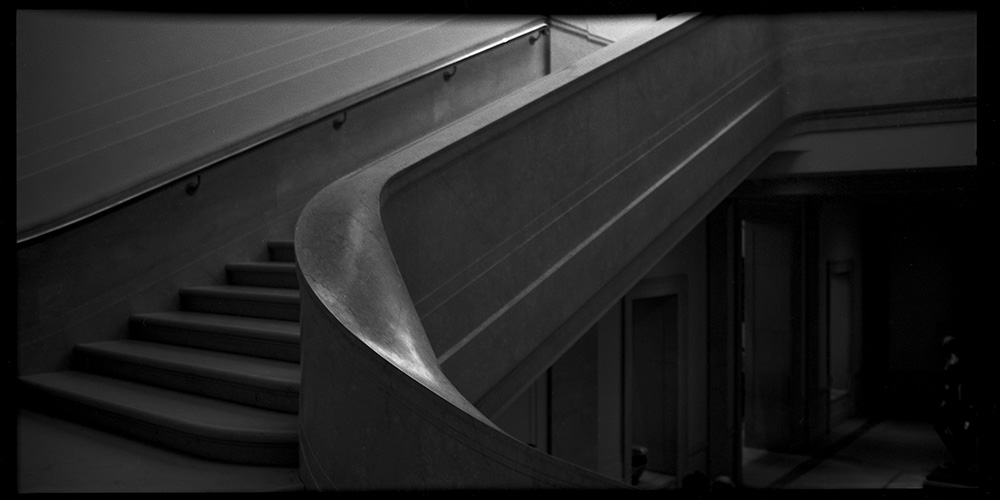
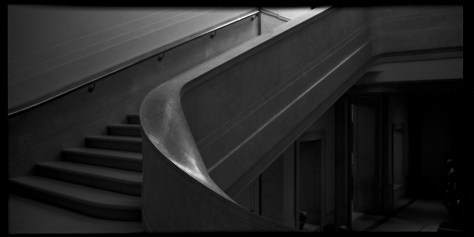
Stairs, National Gallery
Stairs, West Wing, National Gallery of Art

Contrasting to the brutal modern geometric structures of the cafeteria and the East Wing (itself a wedge-shaped structure designed by I.M. Pei and completed in the 1970s), the original gallery building is supremely neoclassical, designed by one of the late-19th/early 20th century’s greatest American architects, John Russell Pope. The marble staircase shown here has the sweeping grandeur and majesty of a European royal palace.

The images as you see them here are an interim step- my plan is to make platinum prints from all of them. The originals are shot on 2 1/4 inch roll film, so prints directly from the in-camera original film would be quite small – 2 1/4 x 4 1/4 inches. I want to make slightly bigger prints, and I want to try out making digitally enlarged negatives with another technique I recently came across for the digital negative process. I’ve been around and around with making digital negatives for a while and never been especially happy with my results. All the techniques I’ve seen and tried so far are rather labor-intensive and involve making several rounds of test prints just to develop the adjustment curve needed to make the negative print well in pt/pd.

I came across a video from Bostick & Sullivan that explains the process quite simply and clearly, and the website provides you with a downloadable pre-made curve for adjusting your negatives to make them suitable for pt/pd printing. I’ve made the appropriate digital files from these images, and the next step will be to print them over the weekend and try making my prints from them. I’ll post the results of the printing session as soon as I have them.

Here is the video from YouTube:

And the page to download the curves for Pt/Pd, Cyanotype, Kallitype, and Van Dyke:

Digital Negative Adjustment Curves – Bostick & Sullivan

Victor – Portraits

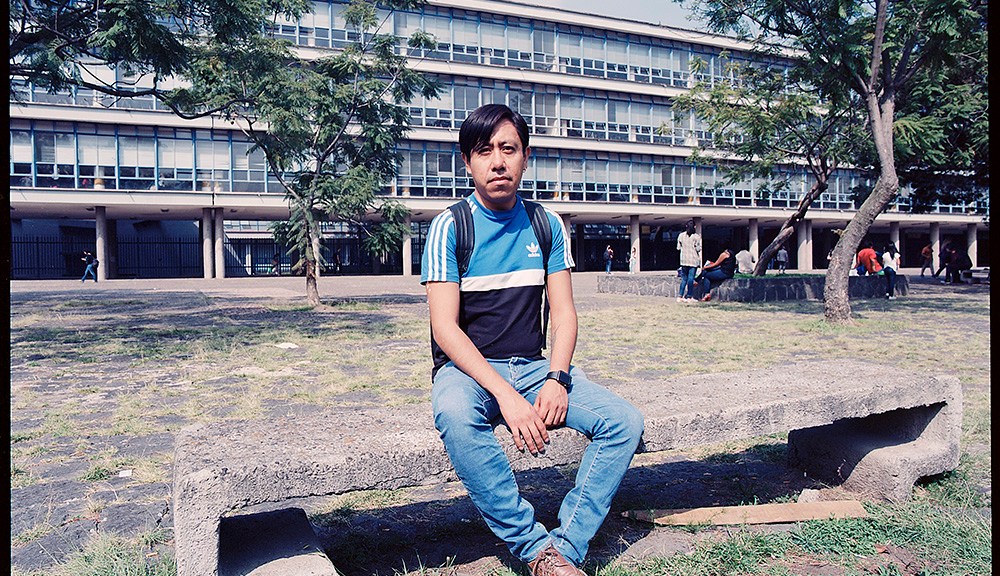
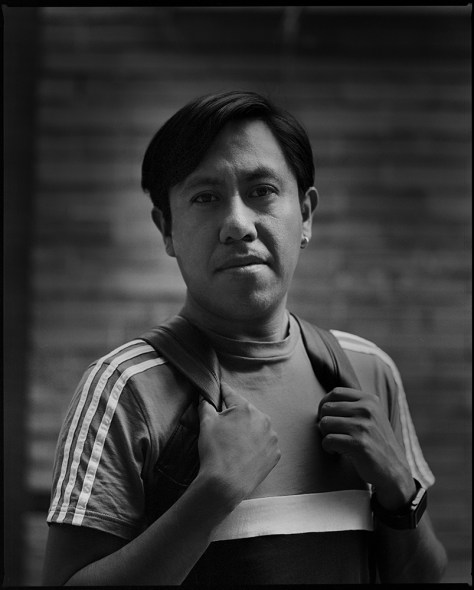
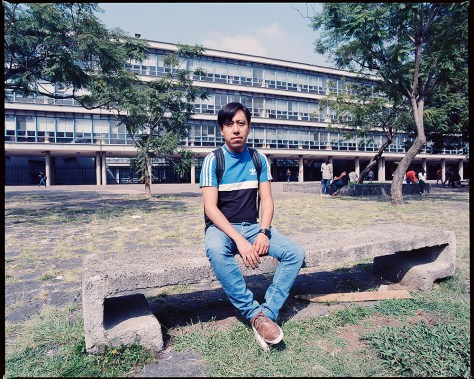
Part of the reason for my trip to Mexico City was to see Victor. It’s a developing thing – we haven’t placed a label on it but whatever it is, it’s good. And he’s a willing subject for the camera, which is a nice change of pace from my ex.

VictorAtUNAM1

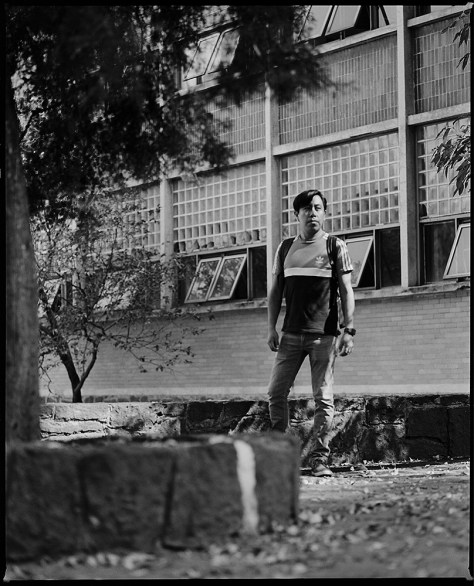
It was also an opportunity to test out the portrait lens on my Mamiya RZ67 (the camera is new to me, but the lens’ quality is known far and wide – I just needed to see for myself what it would do and if I liked it. I do).

We spent an afternoon wandering around the UNAM (National Autonomous University of Mexico) campus when I shot these.

VictorUNAM2

VictorUNAM3

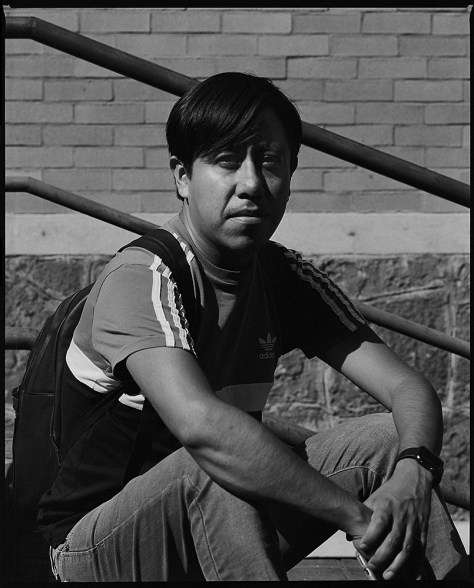
This last one was taken with the 110mm f2.8 lens. It’s an equally good lens for portraits when you need something that gives a bit more background and/or a closer working distance, like this shot.

VictorZonaRosa

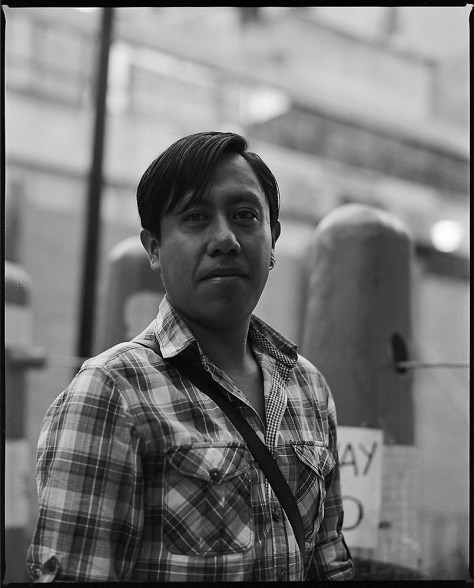
All images made on Kodak Tri-X 400. I really like Tri-X for the tonality it has, and the just-a-little-bit of tooth.

VictorUNAMDerechos

This very last image was made with the 50mm lens as an example of environmental portraiture. The film was Kodak Ektar 100, which I love for the color saturation and sharpness.

Mexico City, in Black and White

This was a return trip, just a quick three-day weekend over the Veterans’ Day holiday, so I only shot four rolls of black-and-white and six rolls of color (to be processed today). Here are some highlights.

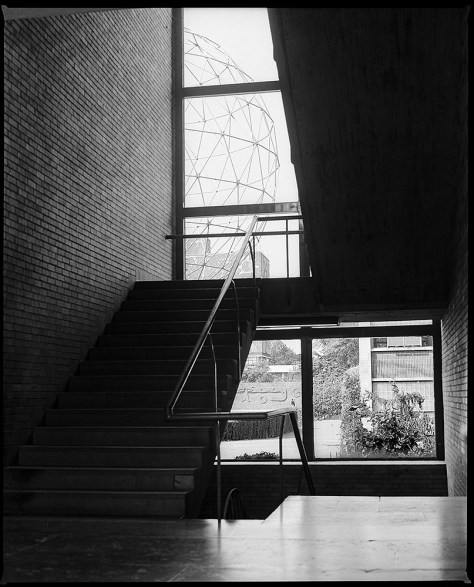
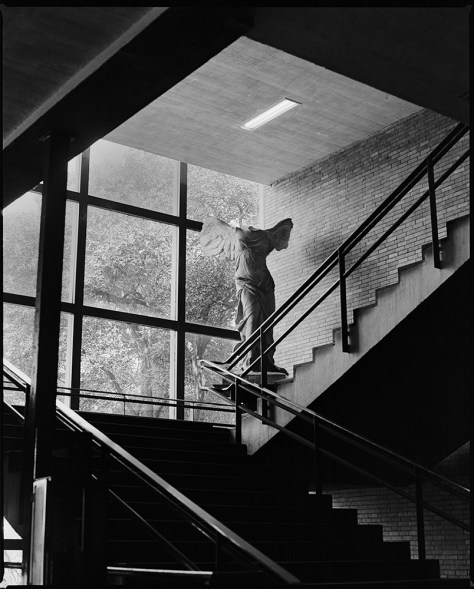
I took a trip to the UNAM (Autonomous National University of Mexico) campus, which is famous for its 1960s architecture (it’s the site of the 1968 Olympics, and the Olympic stadium which seats some 80,000 (if I recall correctly) is across Insurgentes Boulevard from the campus). My partner is in law school at UNAM, so we met up after class and wandered around a bit. These images are from the Architecture school buildings, another program that UNAM is famous for.

UNAMArchitectureStairs

AngelUNAMArchitecture

You may be wondering- what’s with the rectangular images? He almost always shows us square photos! Well, I traded in some gear I wasn’t using and got a Mamiya RZ67 and a trio of lenses for it. The RZ67 is effectively a Hasselblad on steroids – unlike my Rolleiflex, which is a TLR (Twin Lens Reflex), the RZ is an SLR (Single Lens Reflex). The advantage is that with an SLR, interchangeable lenses make a lot more sense, since you only have to have one of them per focal length. The RZ also shoots 6x7cm negatives on 120 film (NOT 120mm!!! Pet Peeve alert – 120 is the film size, not 120mm. 120 was a Kodak internal designation for the format that became universal, kind of like Kleenex). The RZ solves the problem of having to rotate the entire camera when switching from horizontal to vertical by instituting rotating backs. This of course makes the camera bigger and heavier. It’s an additional challenge when traveling, but I think the images speak for themselves.

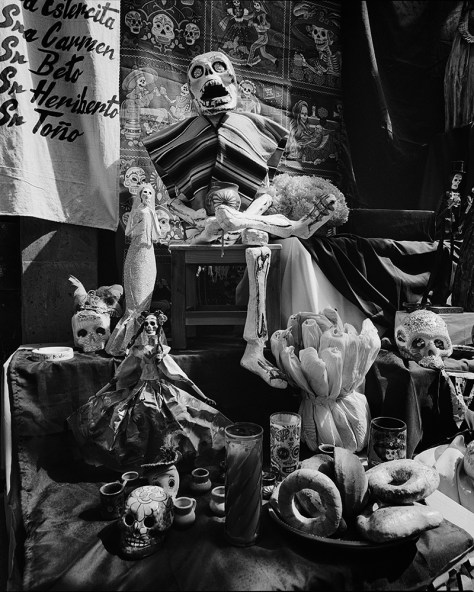
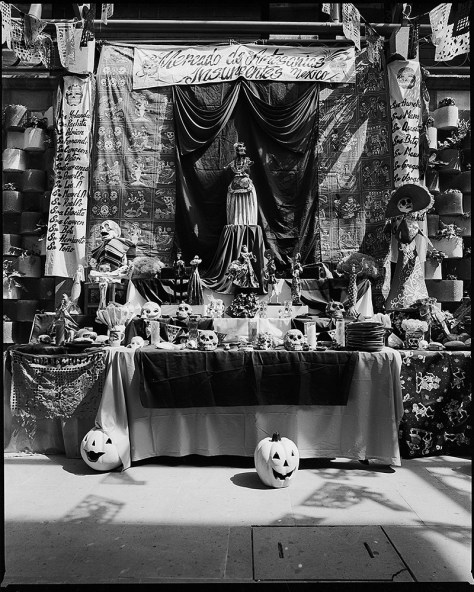
Back in the city center, I was wandering around on the street where my hotel is located, Calle Londres. Down the block are a pair of markets – the Mercado del Angel, which specializes in antiques, and the Mercado de Artesanias which specializes in modern handicrafts of all varieties from wood carvings to ceramics to sterling silver jewelry. The Mercado de Artesanias had a Day of the Dead altar still up in their entryway.

DiaDeLosMuertosAltar

DiaDeLosMuertosAltar2

You can’t tell it in black and white, but those pumpkins on the ground were fluorescent purple and pink. I like them better in b/w, don’t you?
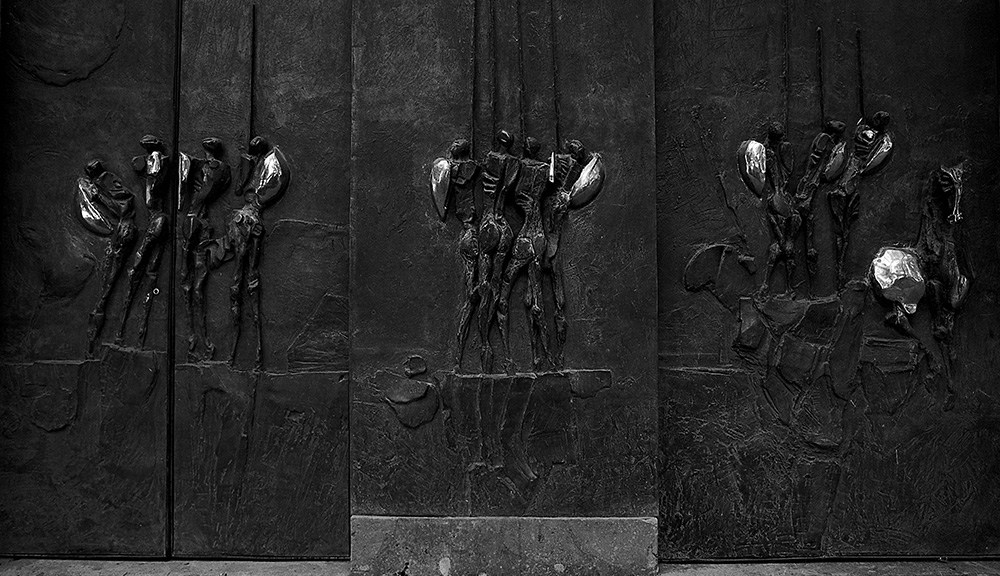
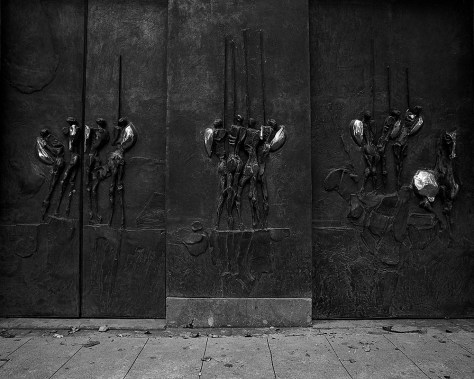
BronzeDoorsLondres

Also on Calle Londres, these bronze doors can be found. I’m still not sure what they belong to, but they’re quite impressive.


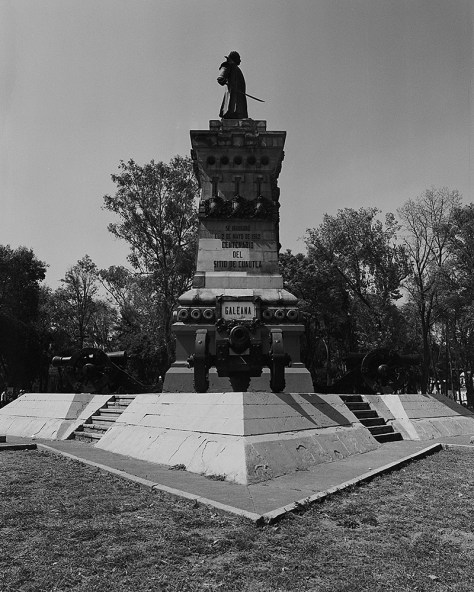
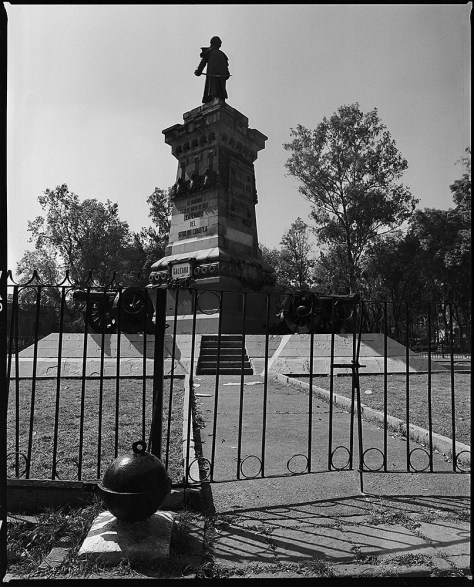
GaleanaMonument

Another aspect of the trip was to take in some of the exhibits of FotoMexico, a nation-wide, three month long photography festival that covers some 600 exhibits around the nation. The headquarters for the program is the Centro de la Imagén, located inside the Biblioteca México (I’ll have more to say about FotoMexico in another post). The Biblioteca México is located in an 18th century tobacco factory-cum-military facility that was used as a prison during the waning days of Spanish colonial rule. This monument is in the park in front of the Biblioteca, commemorating Jose Maria Morelos, a Mexican general who led a valiant 40 day resistance against colonial authorities at Cuautla, after which he was taken prisoner, held in the jail in the Ciutadela (now the Biblioteca) and then executed for treason.
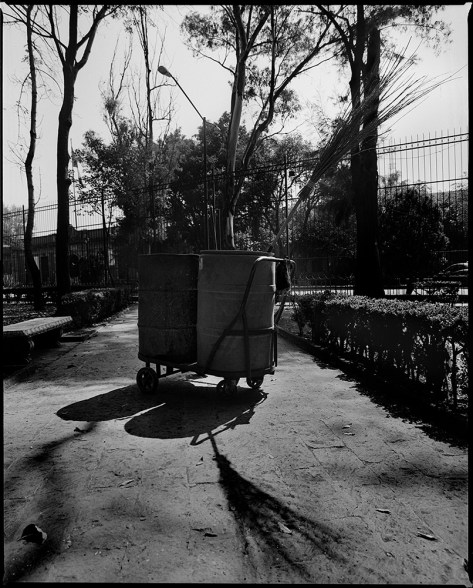
ParkSweepMexicoCity

The cart and broom of one of the caretakers of the park.
MorelosMonument2

Another view of the Morelos monument. It was erected in 1912, as part of the centenary commemorations of Mexican independence from Spain, and coincidentally the Mexican Revolution of 1911 which overthrew the dictatorship of Porfirio Diaz.
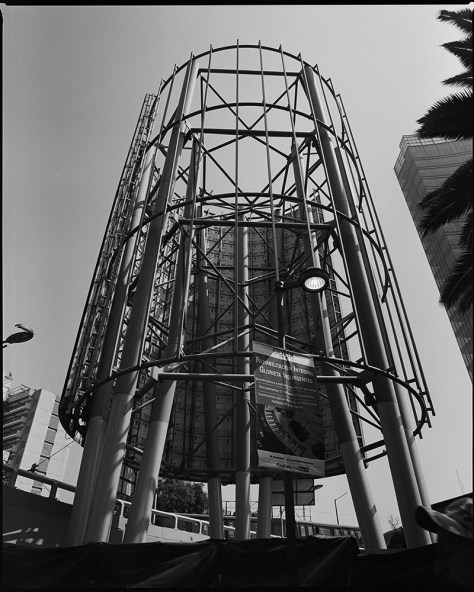
GlorietaInsurgentes

Last but not least, the advertising billboard structure in the Glorieta Insurgentes. The Glorieta is a major traffic circle on Avenida Insurgentes Norte, and is a transportation hub – the subway and express buses have stops in and around the Glorieta. I photographed the billboard structure because it has a look to it reminiscent of a Bernd and Hilla Becher photograph of industrial structures.

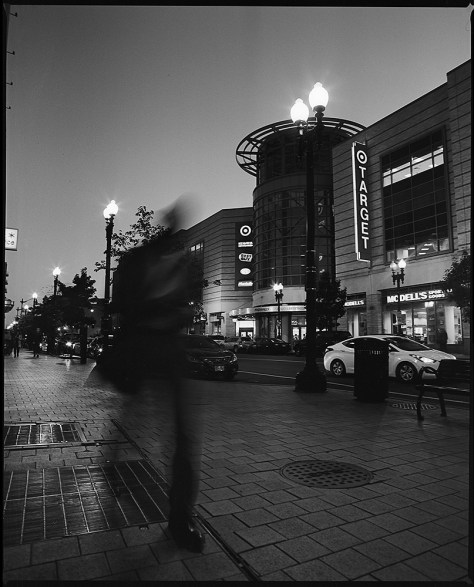
Ghost Man, Columbia Heights

GhostManCoHi

This is a case of where the mechanics of photographing lead to something emotionally resonant in a powerful way – the blurred moving man under other circumstances could be considered a flaw, but here becomes a metaphor.

WHO/PAHO HQ, Washington DC

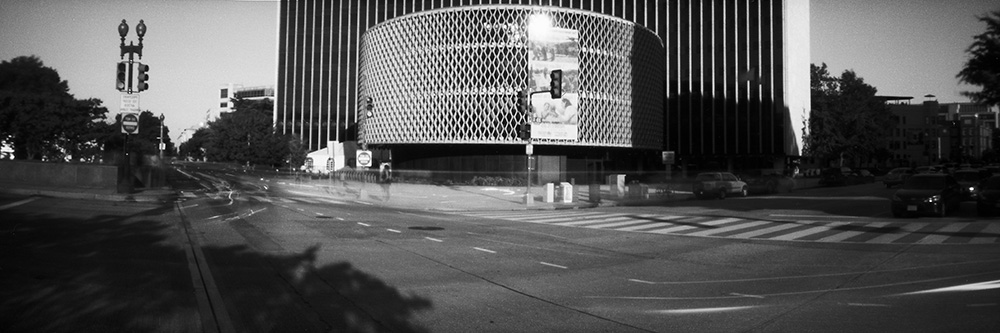
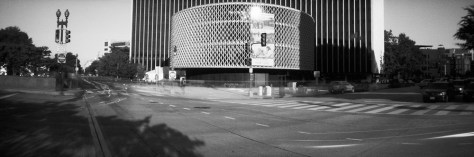
I keep shooting this building and the surrounding intersection because the architecture provides all kinds of graphical possibilities. Here, today, the drum in front of the tower looks almost like polished metal, whereas in reality, it’s coarse concrete. And a 25-second daylight exposure eliminates all but traces of traffic and the most immobile of pedestrians.

WorldHealthPano

The 6×18 pinhole, when kept plumb, level and square, is virtually distortionless. I’m going to try shooting this scene again but from a low angle, pointing up, to see how curved it gets.

Now, with working with the pinhole, Kodak Tri-X has really turned into my go-to film because I really need the extra speed even in daylight. And the grain of Tri-X, in 120, and in contact prints/scans, really is a non-issue.