Category Archives: Black and White

Paris in October – part 10 – Art

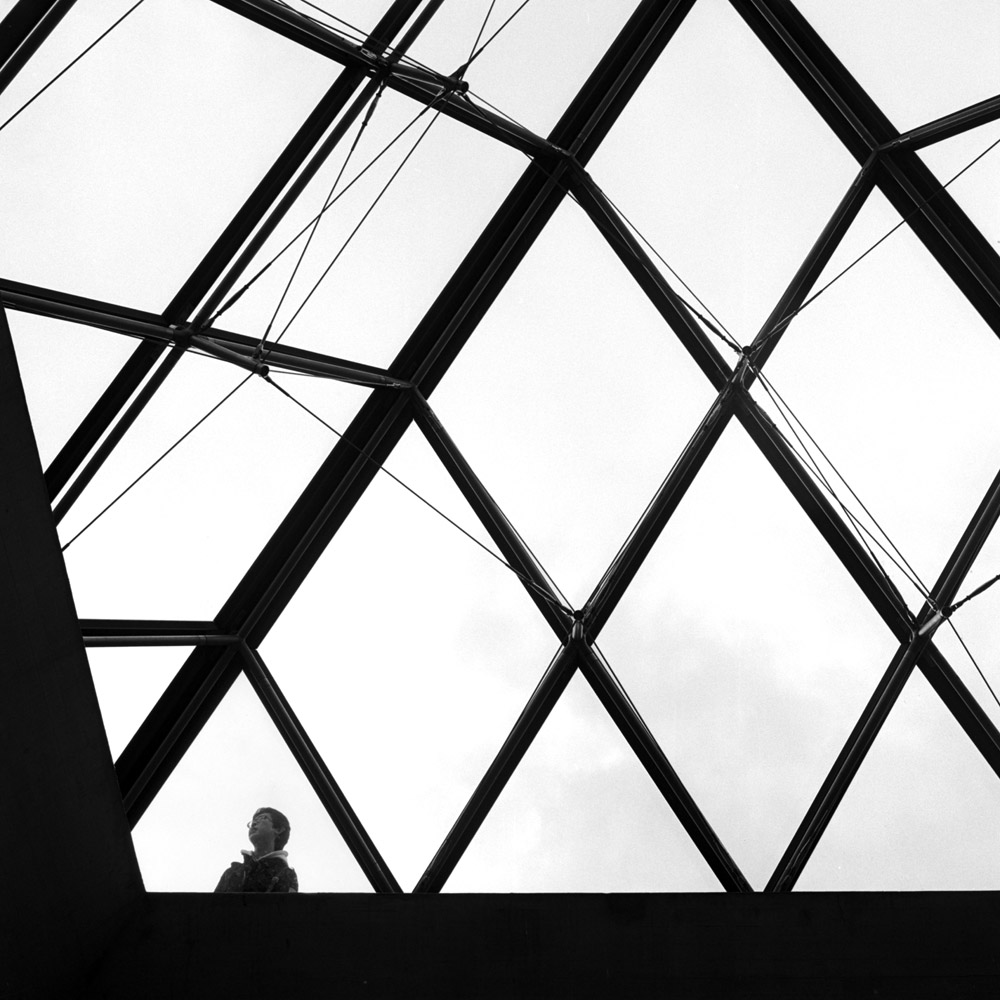
We’ll start with the Louvre museum. Here are some photos of the building itself. The Pyramid, the glass entrance structure that opens to the underground entrance lobby, is fascinating in itself for the geometry it creates and the possibilities for abstraction, and for the clash of modernity against 18th and 19th century architectural sensibilities that hallmark the rest of the building.
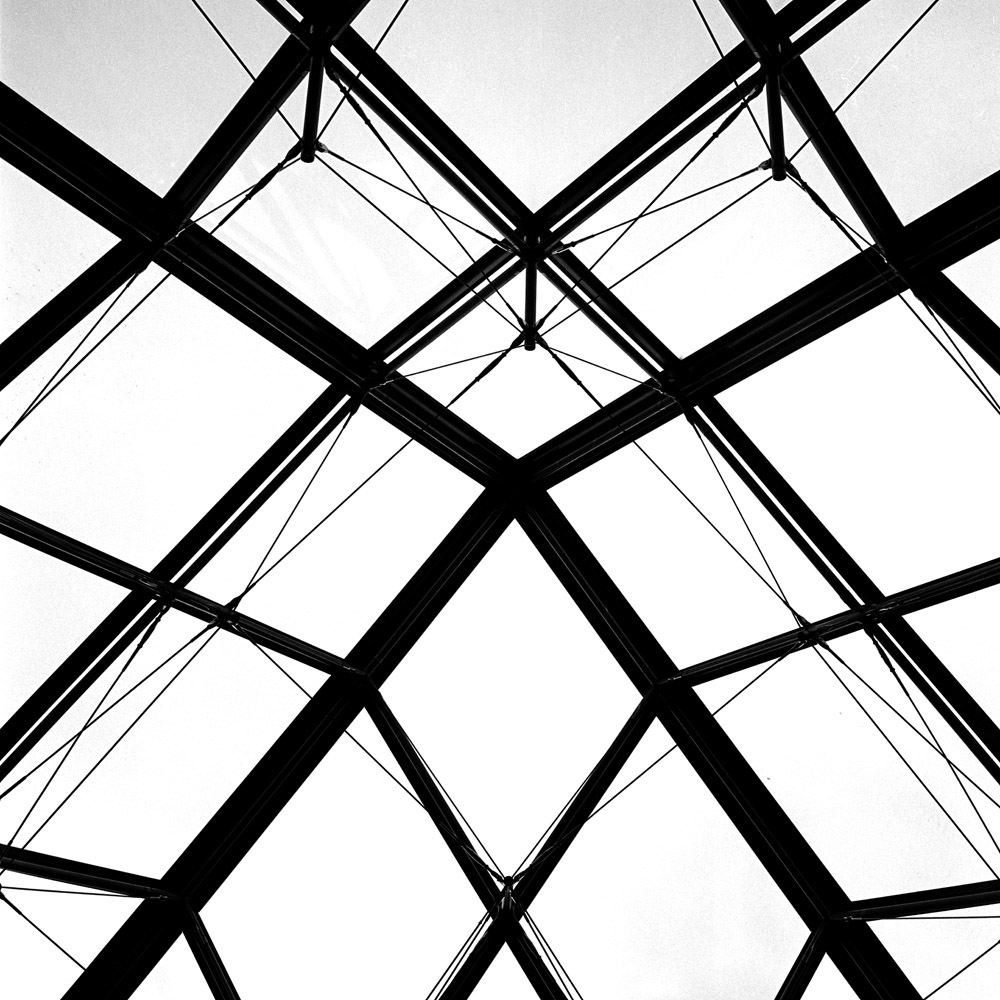
The Pyramid, from below
Pyramid, Boy
Pyramid, Boy

Under the pyramid there is a vast entrance plaza with a huge spiral stairs. In the center of the spiral stairs is the accessibility elevator, a cylinder that rises and falls to transport people to and from the plaza above, and looks like it should be a stage set from 2001: A Space Odyssey.
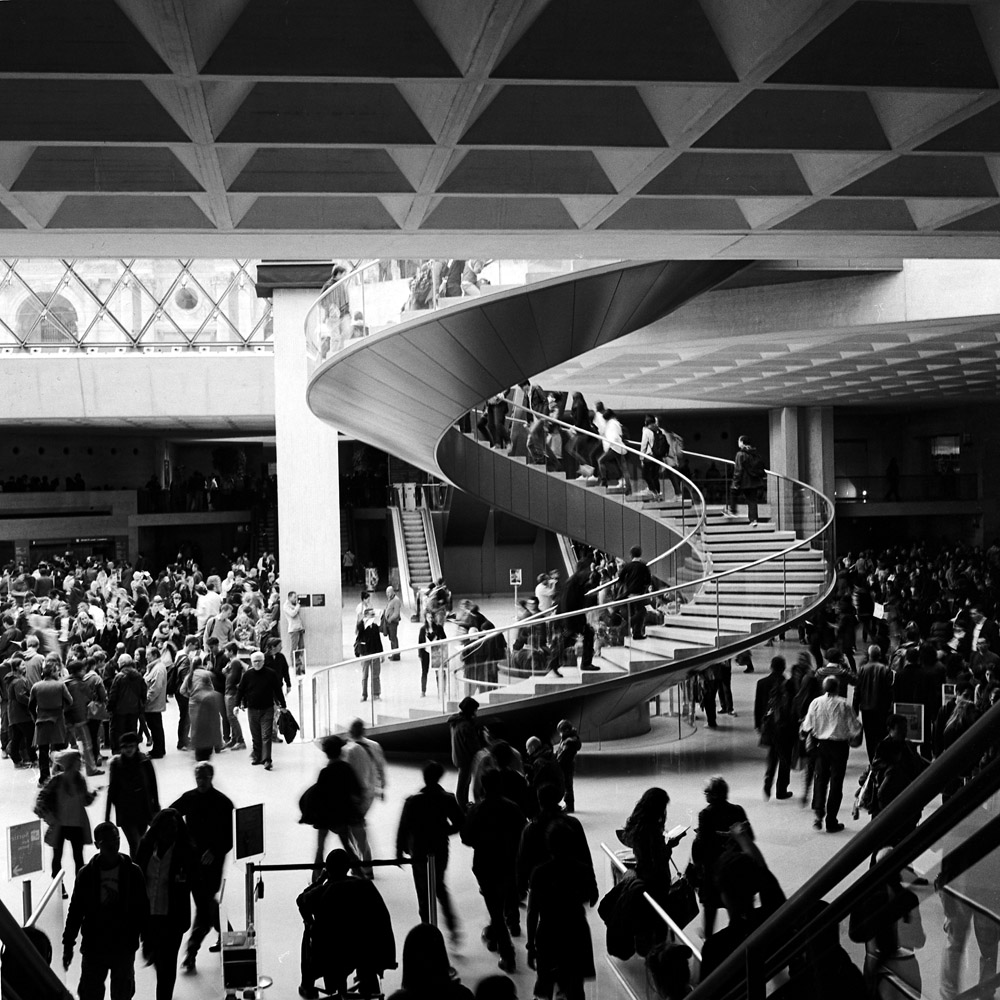
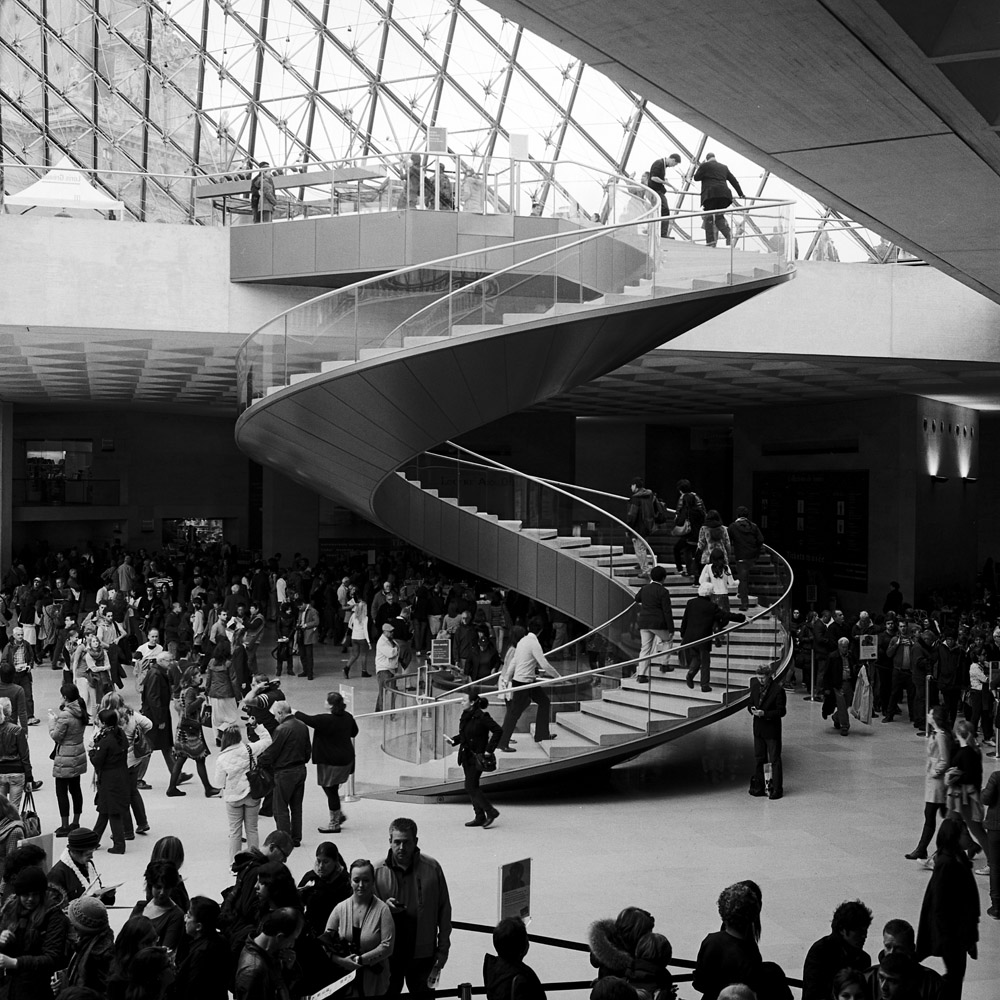
Spiral Stair, Louvre Entrance

Spiral Stair, Under the Pyramid

The contrast, a Napoleonic-era entrance ramp and doors (see the N’s in the frieze above the windows and doors). This is empty because the courtyard is closed to the public and filled with construction equipment.
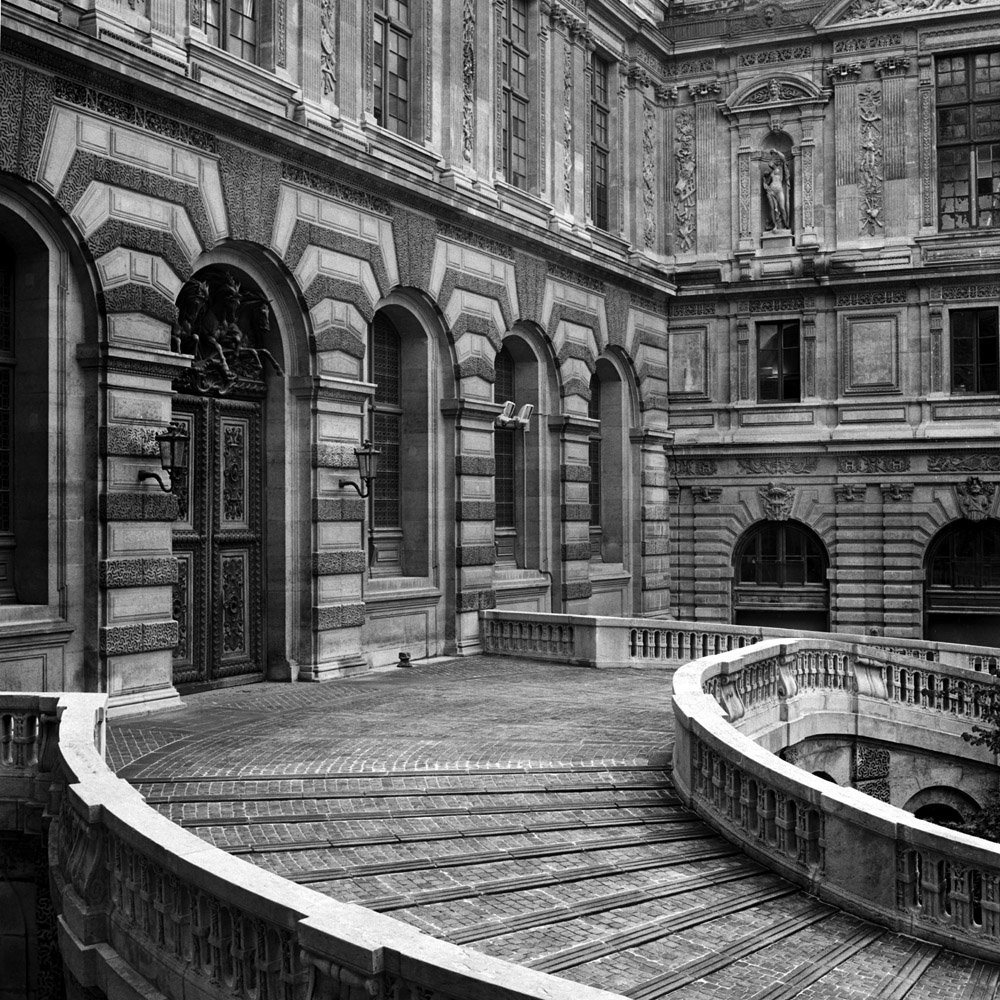
Courtyard, Louvre
Courtyard, Louvre

As you can see, the Louvre is a VERY busy museum. I don’t know if it is the most visited art museum in the world or not (I think it is), but it also has to be one of the largest if not the largest. I really only saw parts of one wing of the museum (there are three), and you could easily spend a half a day in there every day for a month and still not see everything.
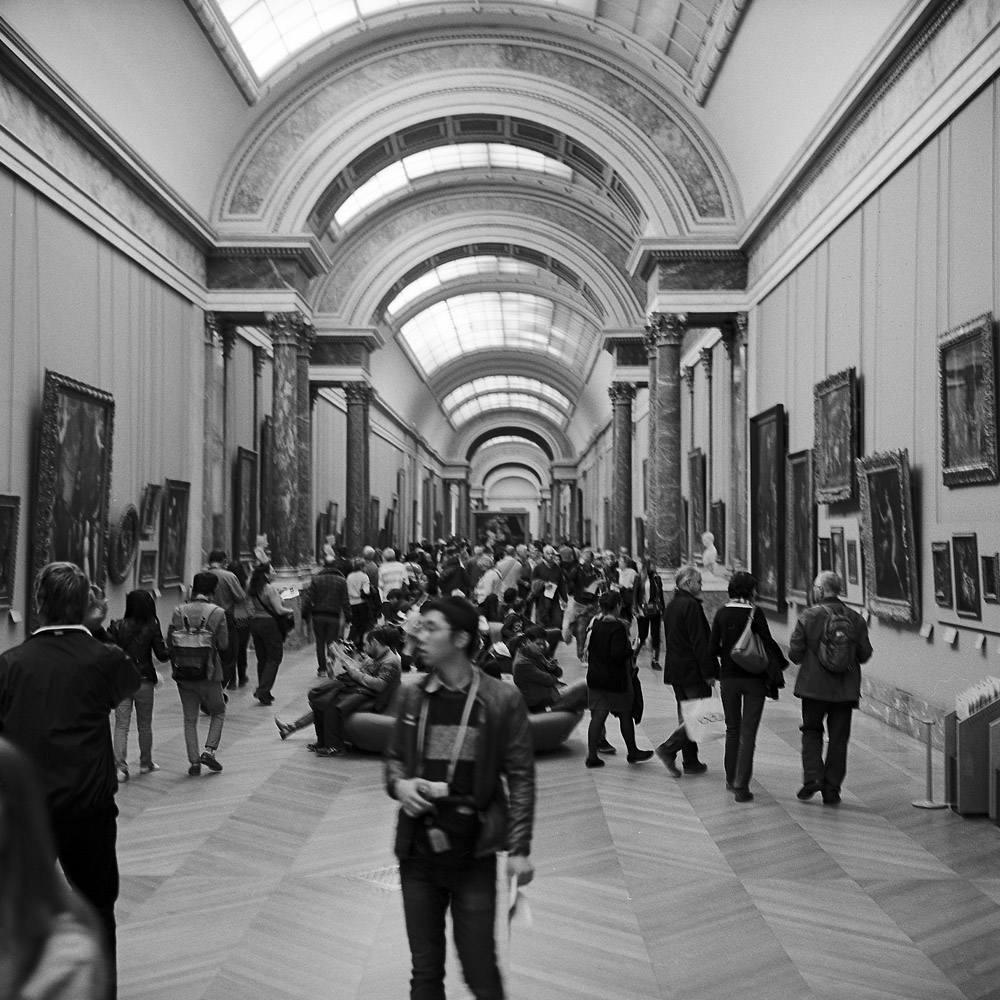
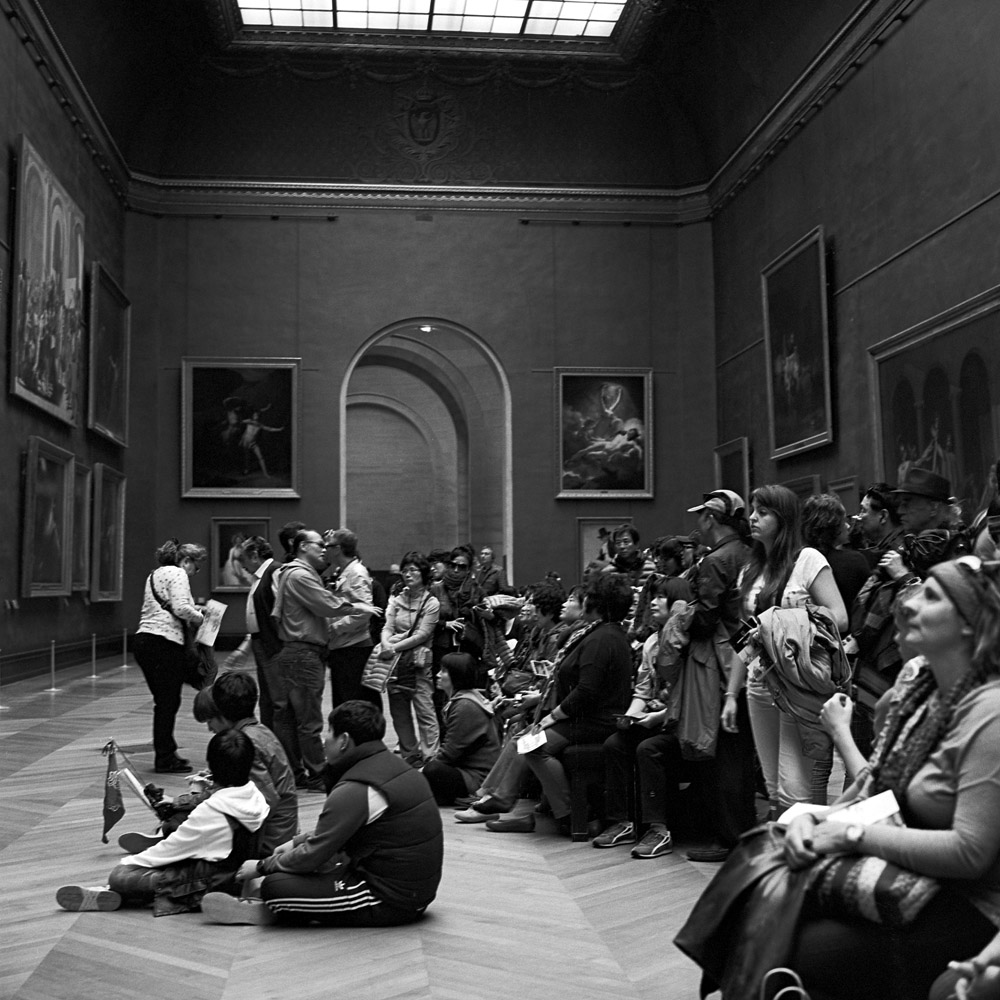
The Grand Gallery
The Grand Gallery
Visitors, Napoleon crowns Josephine

The grand gallery is where the Italian Renaissance masterworks are held – the three non-Mona Lisa DaVincis are here, along with the Caravaggios – highlights of the collection that most interested me.

In the section with the 19th century French paintings, there was a painter with his easel set up, copying the famous painting of the cavalryman in the bearskin hat. I couldn’t resist taking this shot as much because of the “no photography” sign he had on his easel. I’ll justify it by saying that I think it had more to do with not wanting to be disturbed by flashes popping than anything else.
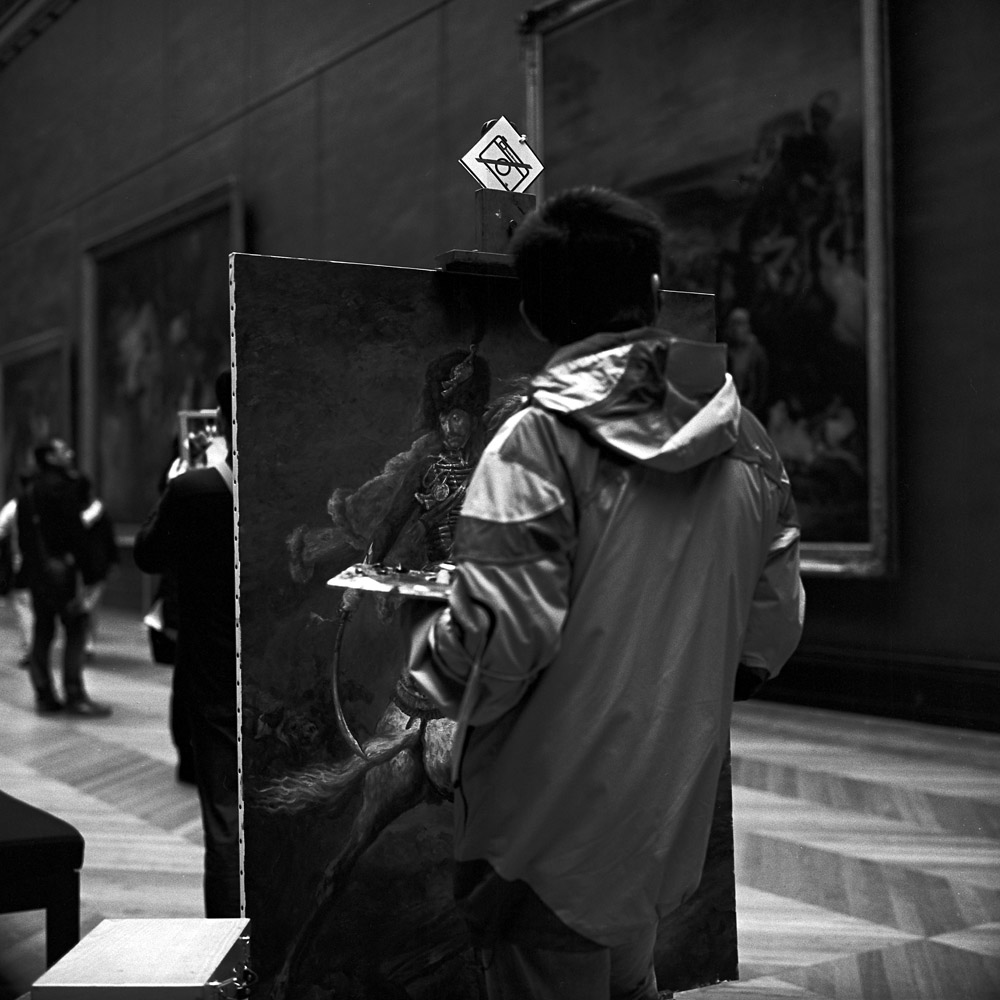
Copyist, Louvre
Copyist, Louvre

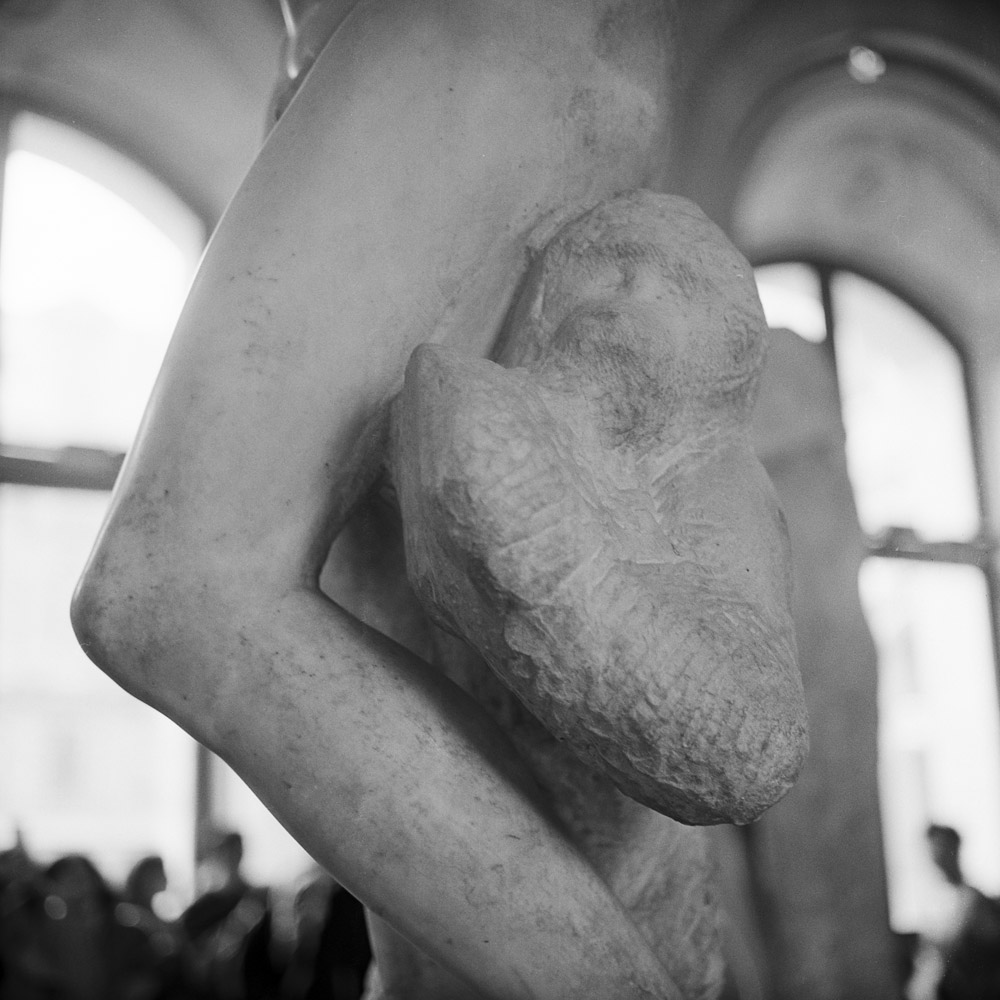
The Louvre has perhaps the very best collection of Michelangelo’s sculpture outside of Italy. Two of the Medici tomb sculptures are in the sculpture gallery, and are of intense interest to me because they are part of the “unfinished” pieces in style. There is still significant debate as to whether the “unfinished” pieces are in fact unfinished or if their appearance is exactly what Michelangelo intended. They are called “unfinished” because they have coarse textures in parts and tool marks are prominent over significant portions of the pieces, to the point that some portions of the pieces are in fact only roughed-in forms without complete features.
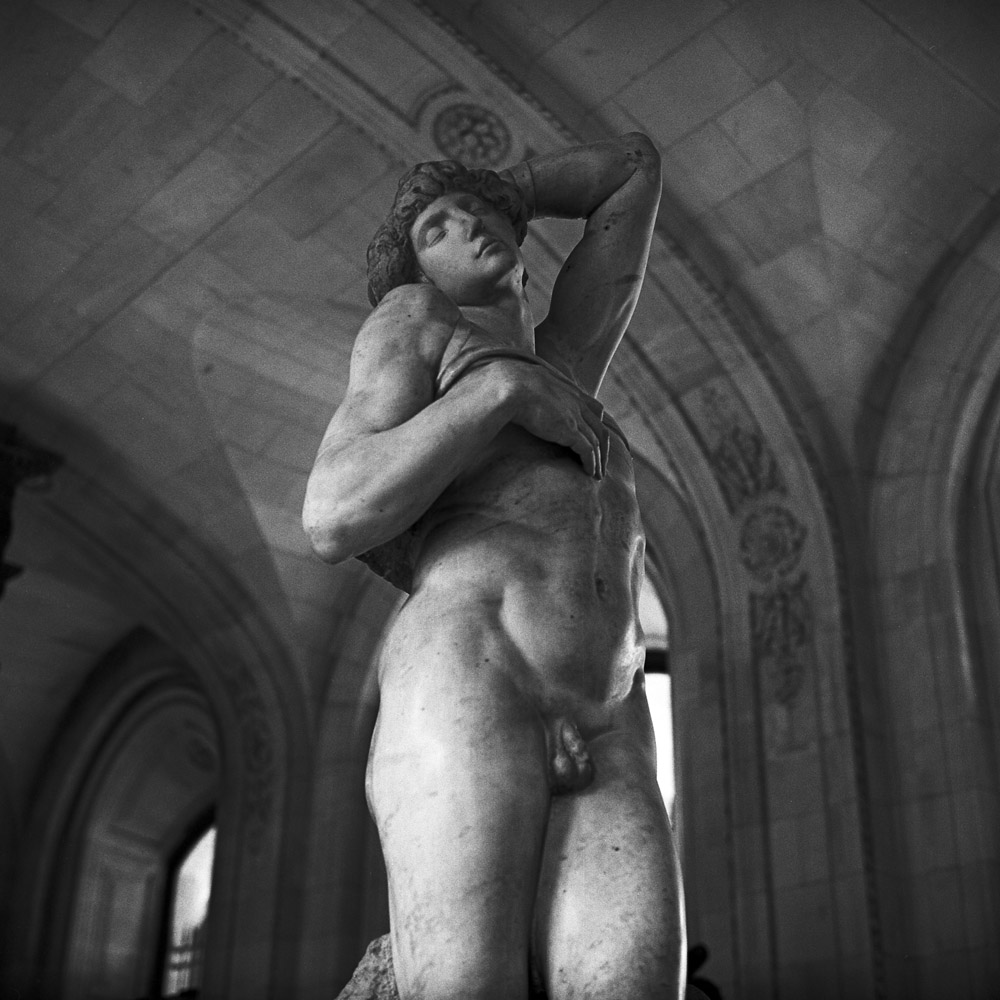
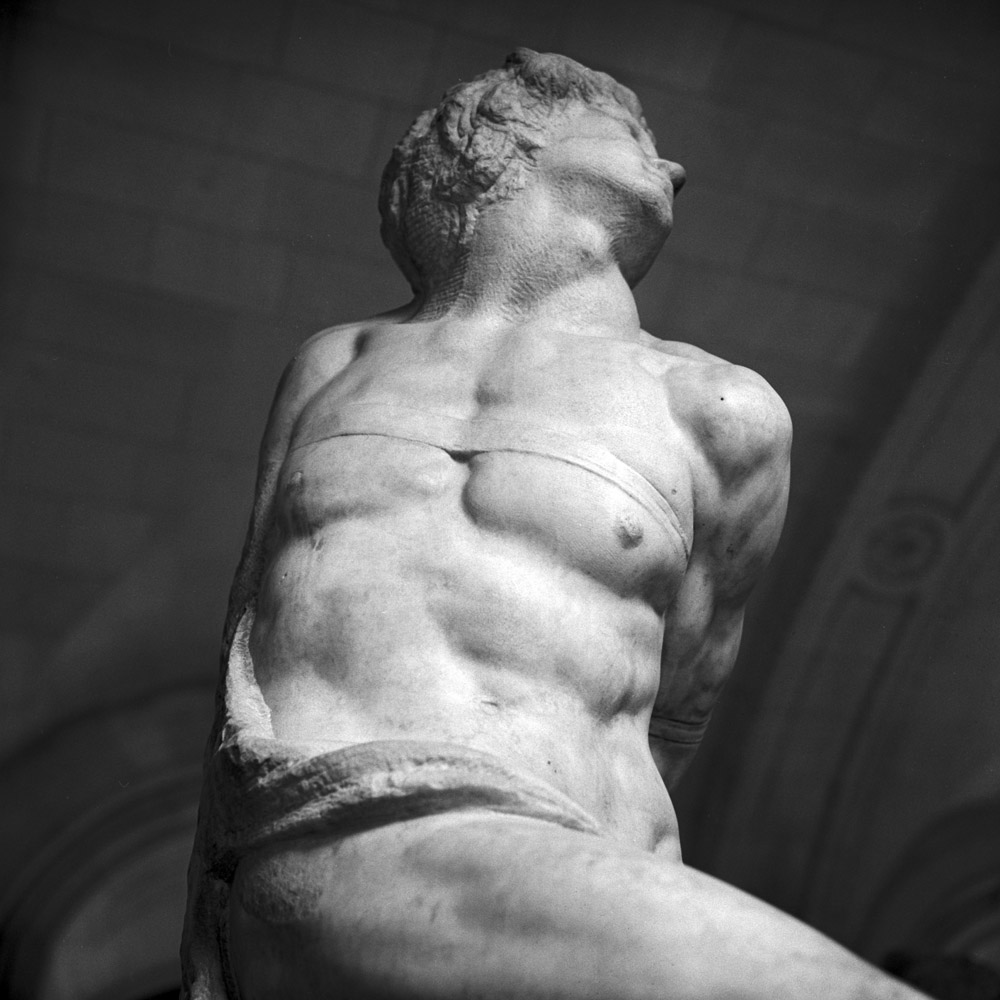
Michelangelo, Dying Slave
Michelangelo, Rebellious Slave
Michelangelo, "Unfinished" figure
Michelangelo, “Unfinished” figure

Finally, we have some other sculptural pieces from the Louvre. The Cupid with Butterfly is actually in a side gallery where touching is allowed.
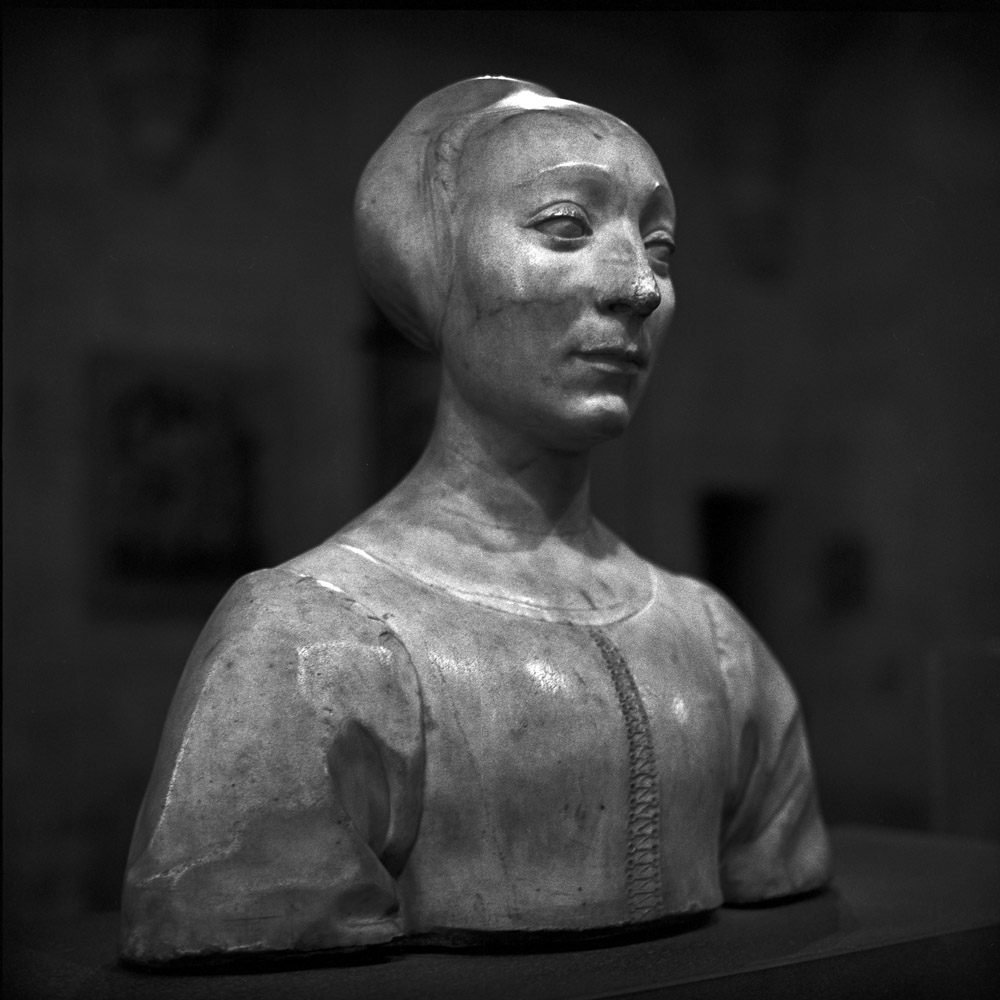
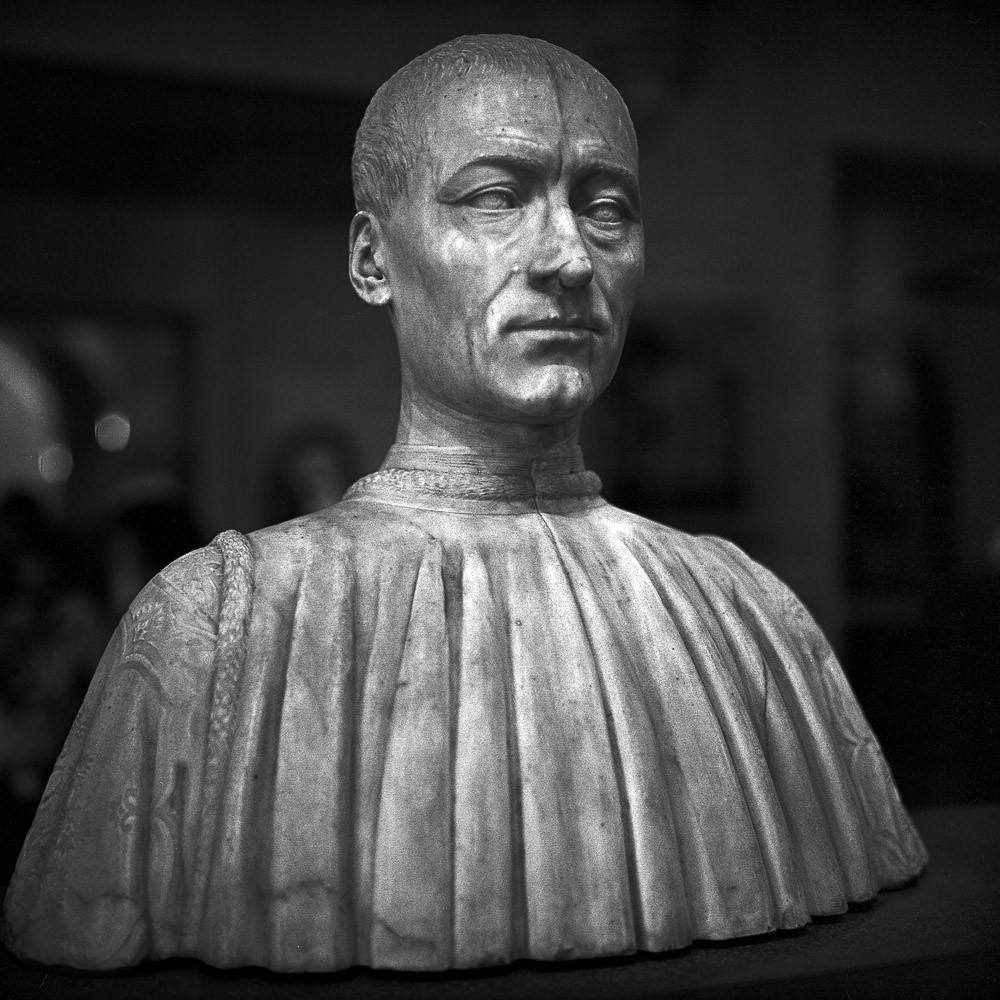
Renaissance Bust, Louvre
Cupid, Butterfly, Louvre
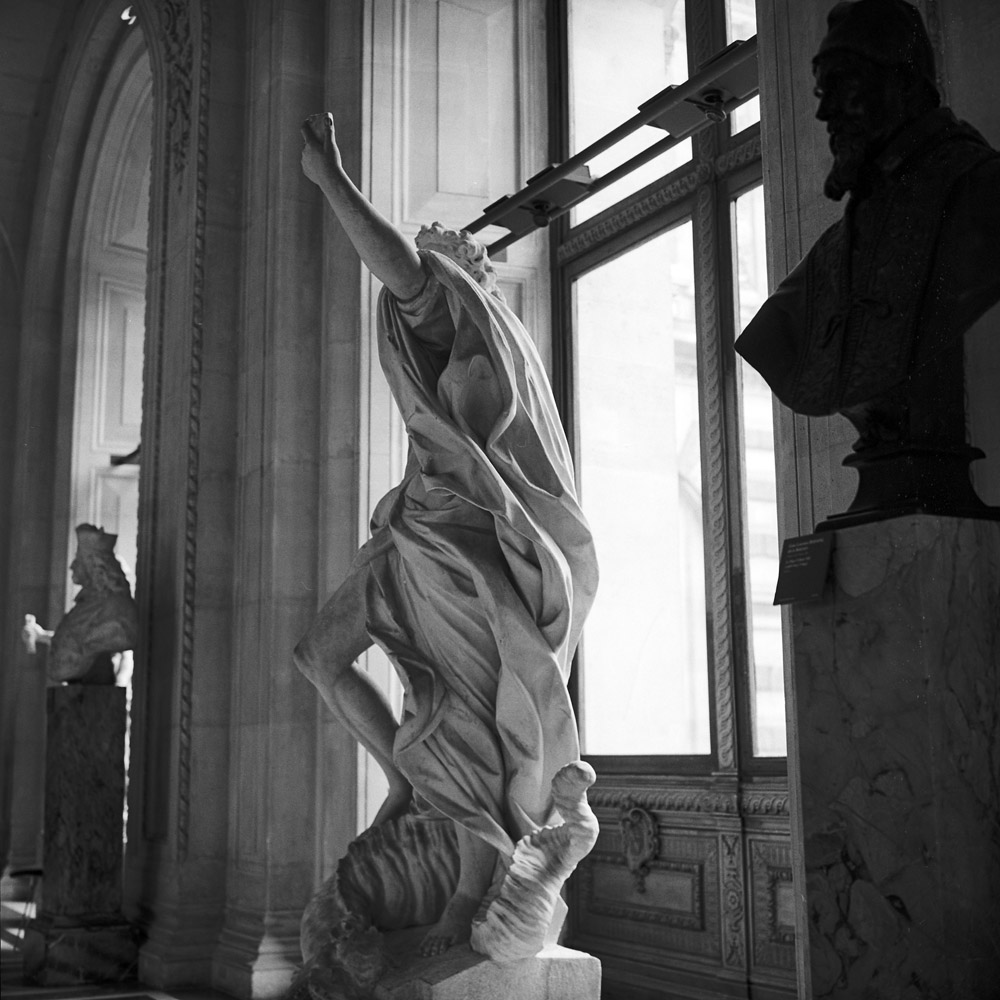
Statue, Sculpture Gallery, Louvre

More Figure Studies (For Juliette)

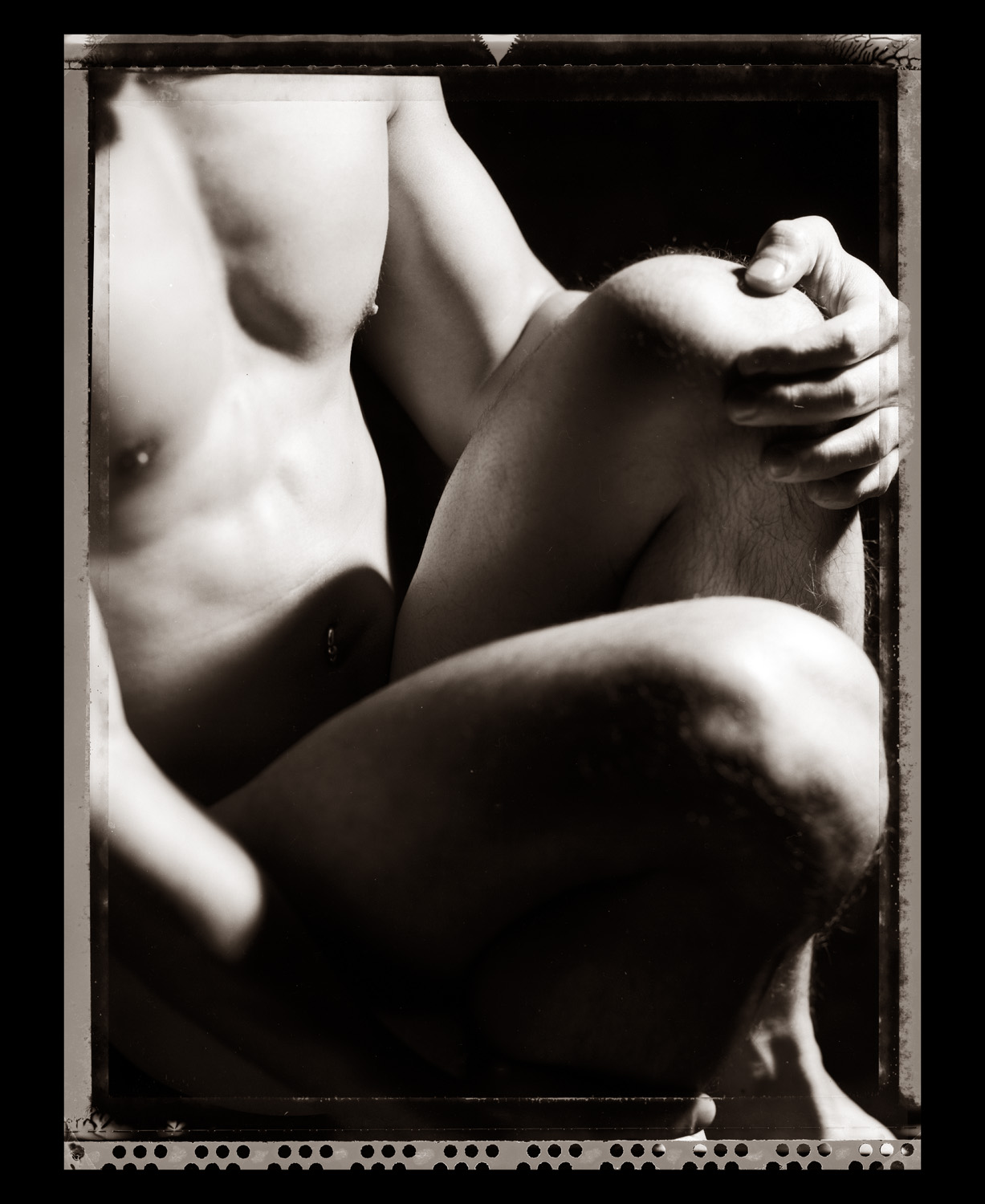
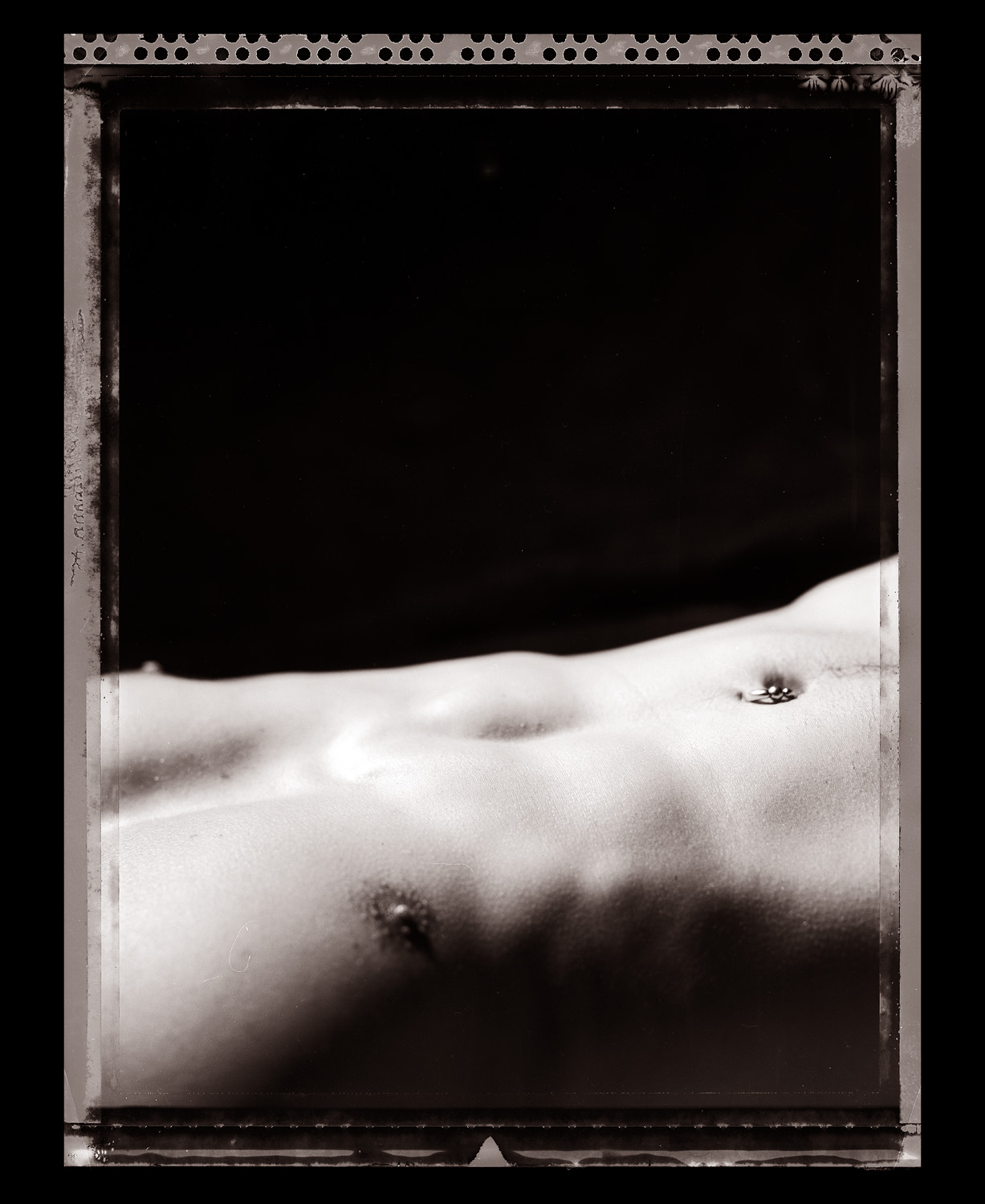
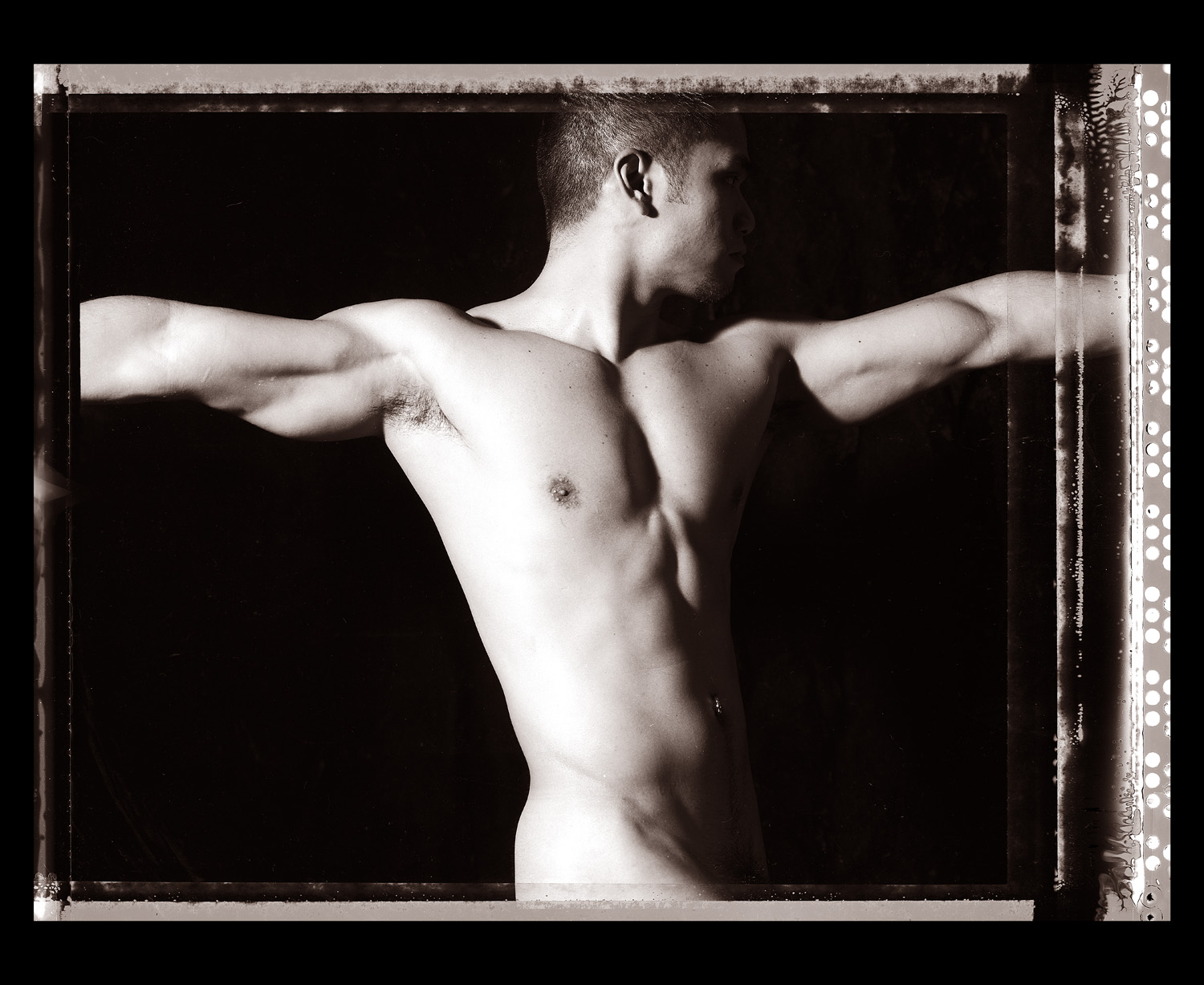
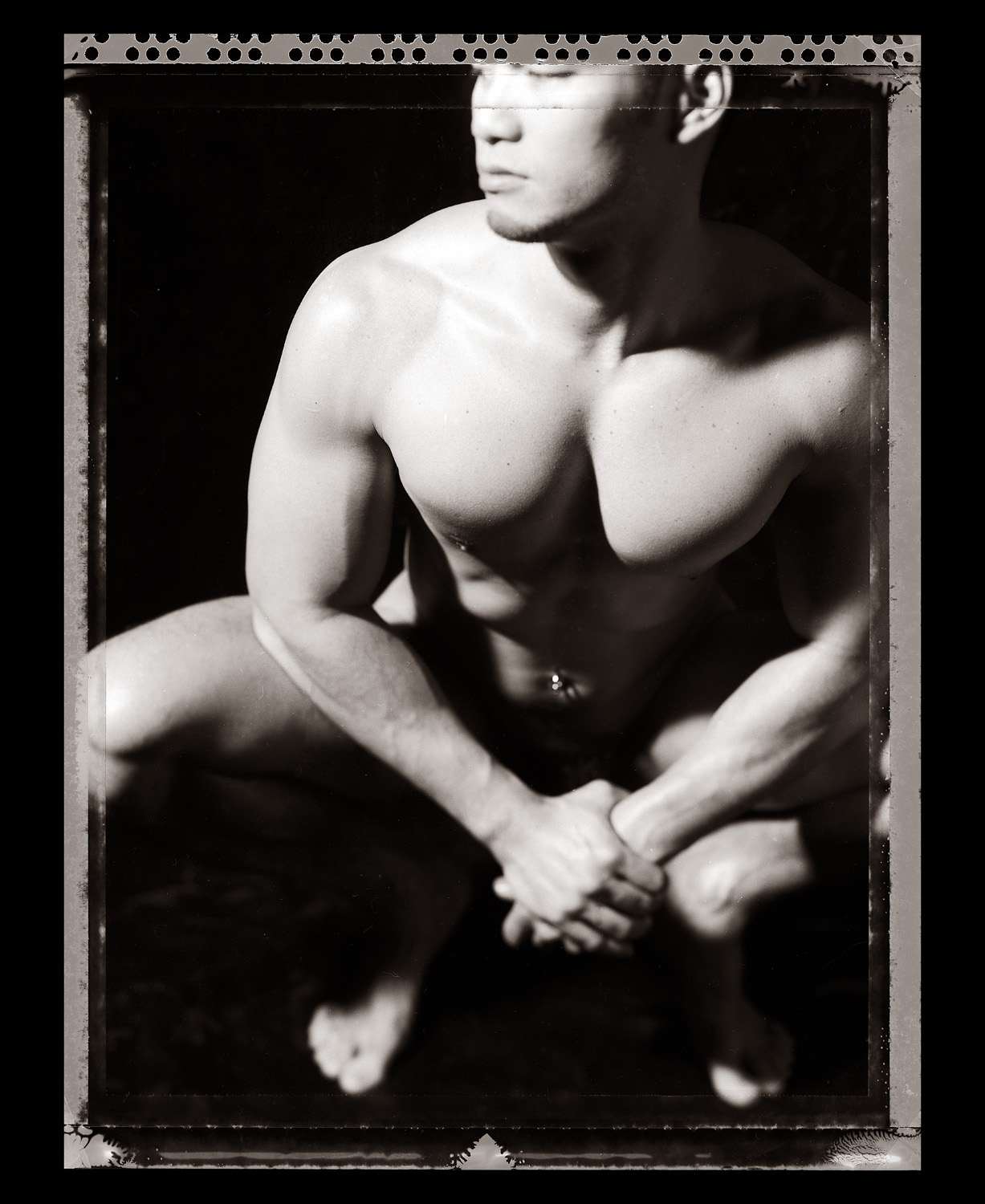
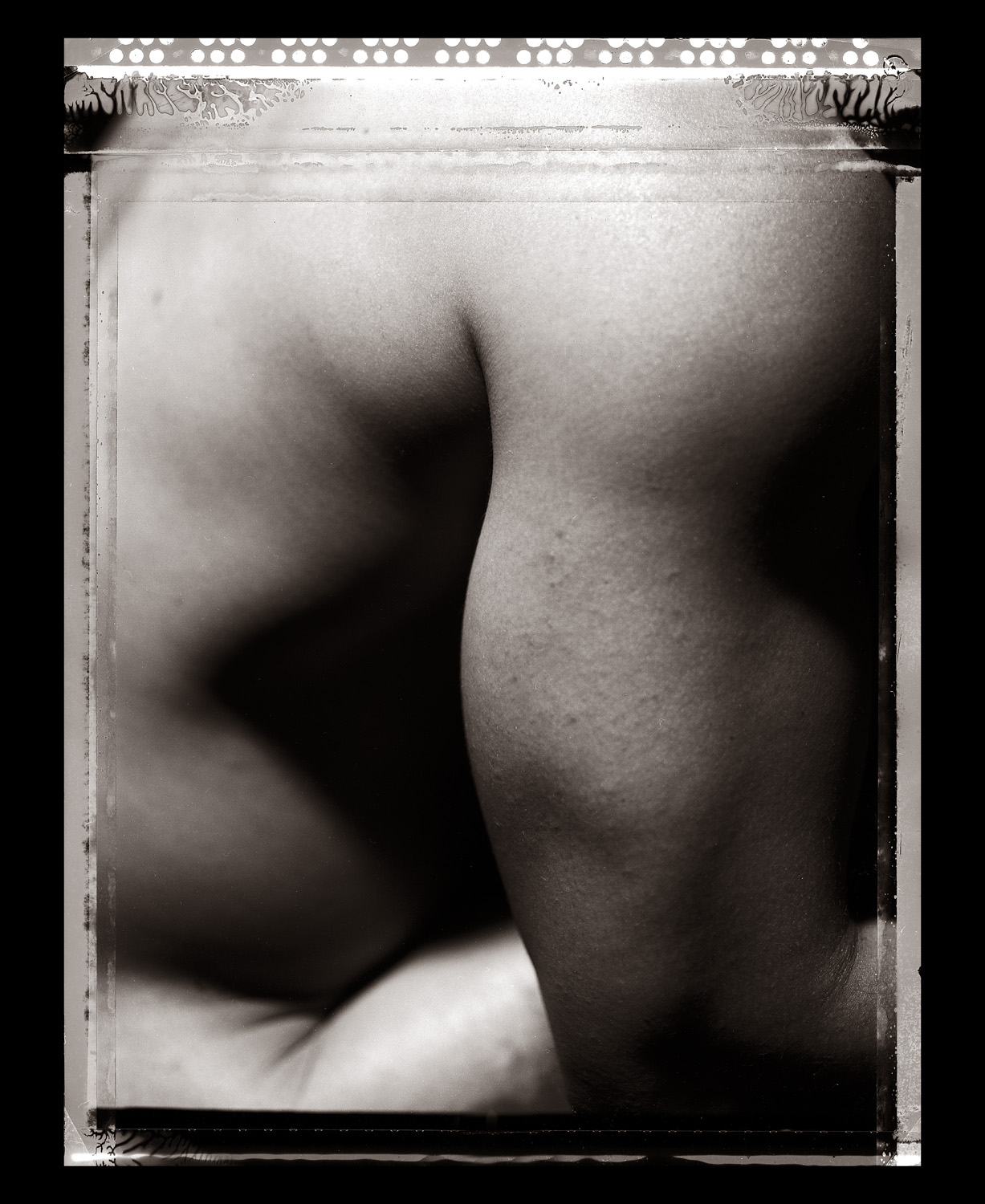
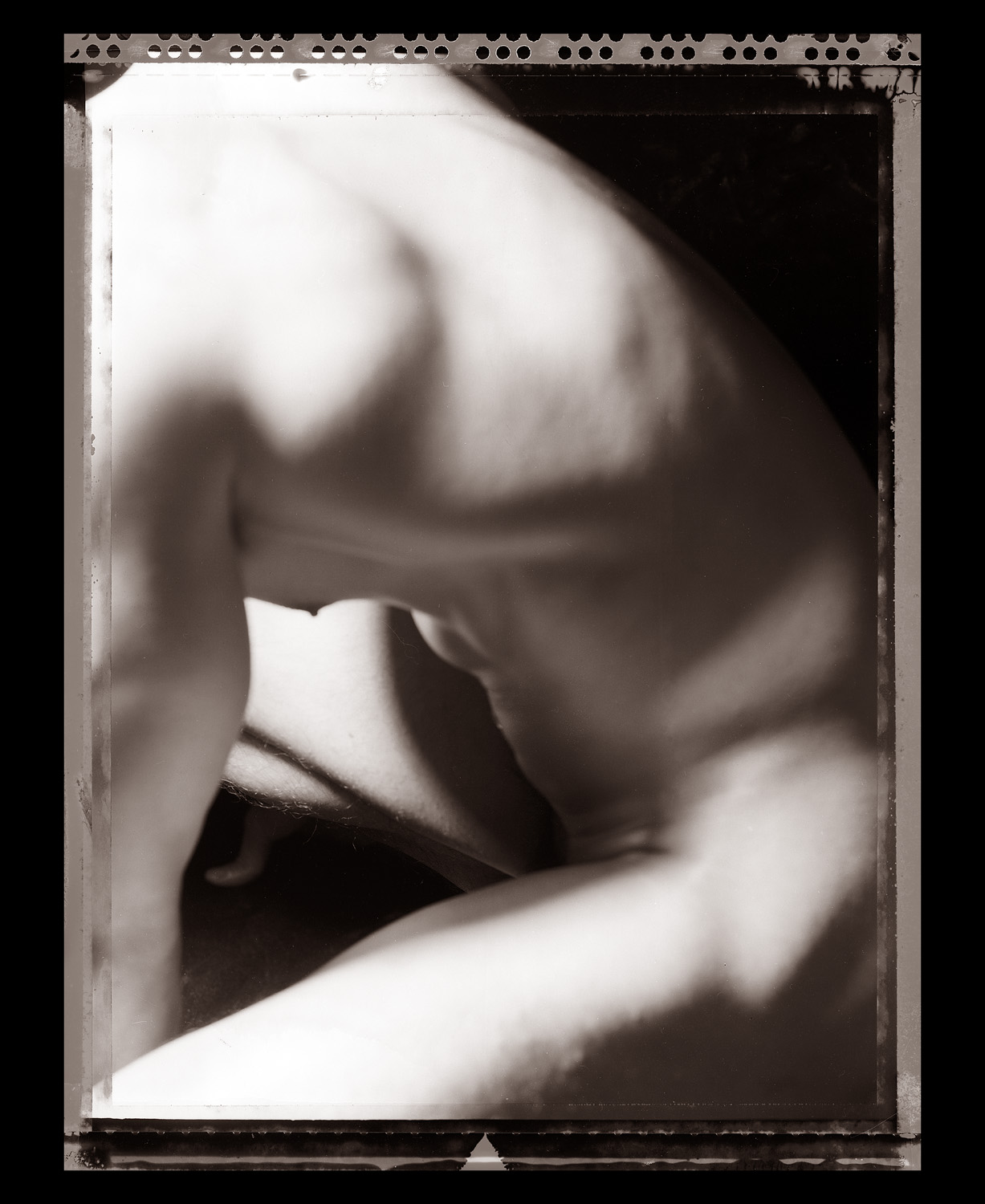
Since I got a request for more of the figure studies, I thought I’d post a few. These were all done on the old Polaroid Type 55 Positive/Negative film. What made Type 55 unique was the fact you could produce both a print and a re-useable negative. The catch always was that you got either a good negative and an overexposed print, or a good print and a thin negative. I think most people opted for the blown-out print, because the stuff was too expensive to throw away the negative.

Jose, Knees, Chest
Jose, Knees, Chest
Jose, Torso, Horizontal
Jose, Arms, Torso
Jose, Arms, Torso
Jose, Crouching
Jose, Crouching
Jose, Arm, Side
Jose, Arm, Side

Submitted work to Onward Compé 2014

Onward Compé 2014 – my work

I submitted three photos to the Onward competition for emerging photographers. Emerging is defined in this case as not having a current ongoing relationship with an art gallery. I’ve had shows, both solo and group, but I’m not represented by any art gallery on an ongoing basis. Perhaps by the time I retire it will happen. In any case, Onward will be good exposure for my work (this time I’m submitting some of my older pieces, male figure studies shot with Polaroid Type 55 back when it was still available).

There are two rounds of judging – the first round, by JPEG only, will be complete and the results announced by December 16. A second round will be judged from actual submitted prints come January, with final results by February 1. The exhibition will take place in March at Project Basho in Philadelphia.

here’s a teaser of one of the images I submitted.
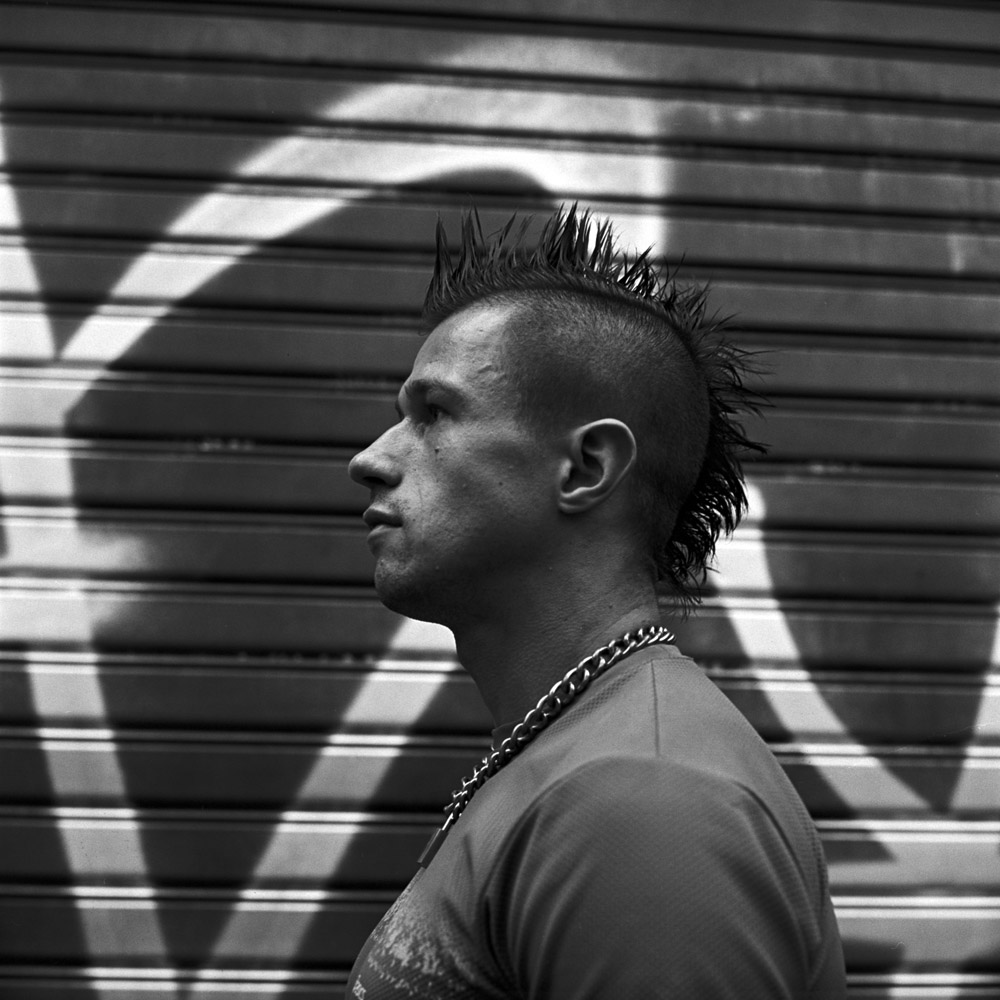
Jose, Torso, Kneeling

Paris in October – part 9 – Chalon-sur-Saone

Well, Chalon-sur-Saone is NOT in Paris, obviously. But I did go there as part of this trip. Chalon is a small city on the banks of the Saone (pronounced Son) river, about 130 kilometers from the Swiss border. The reason for the visit was not to take a river cruise (Chalon is the departure point for many river cruises as the Saone feeds into the Rhone river at Lyons and from there flows to the Mediterranean) but to visit the birthplace of photography. But didn’t Louis Daguerre invent it in Paris in 1839? No. Nicephore Niepce (pronounced Knee-eps) actually discovered the very first viable photographic process in 1822 when he was able to create photogravure etchings. By 1825 he was working with a process he called “heliography” involving coating bitumen of Judea dissolved in lavender oil on pewter plates. It was fine for mechanical reproduction of static subjects but not terribly useful for anything else, as his exposure times ran longer than eight hours. In the early 1830s he collaborated with Daguerre on developing an improved process. Alas, he died in 1833, and was not able to see the fruition of his labors.

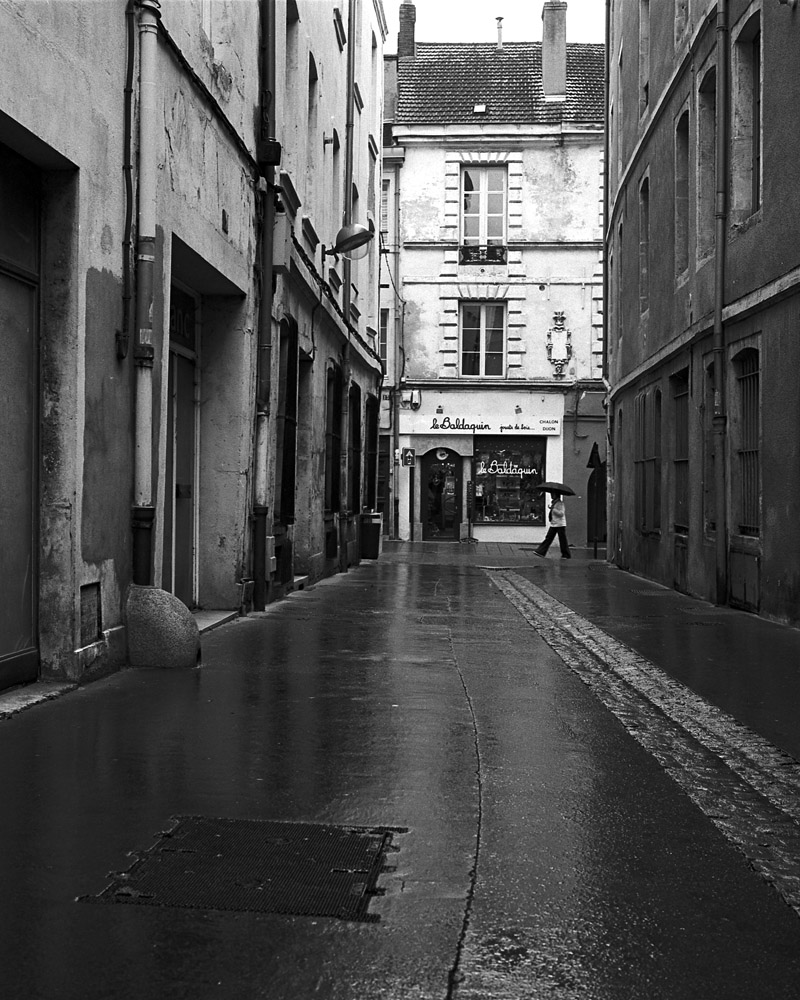
Today’s post from Chalon covers the black-and-white photos I took. Chalon is more than river cruises and dead inventors – the town dates back to Roman times, and although little visible remains of its Roman years, the medieval core of the city is still very visible and accessible. The square in front of the cathedral features half-timbered buildings from the 14th century.

Patron Saint Statue, Chalon

The cathedral in Chalon may look somewhat newer – the facade took heavy damage and was restored in the 19th century, but parts of the structure date back to the 8th.

Chalon Cathedral
Chalon Cathedral
Le Majorelle, Chalon Cathedral Square

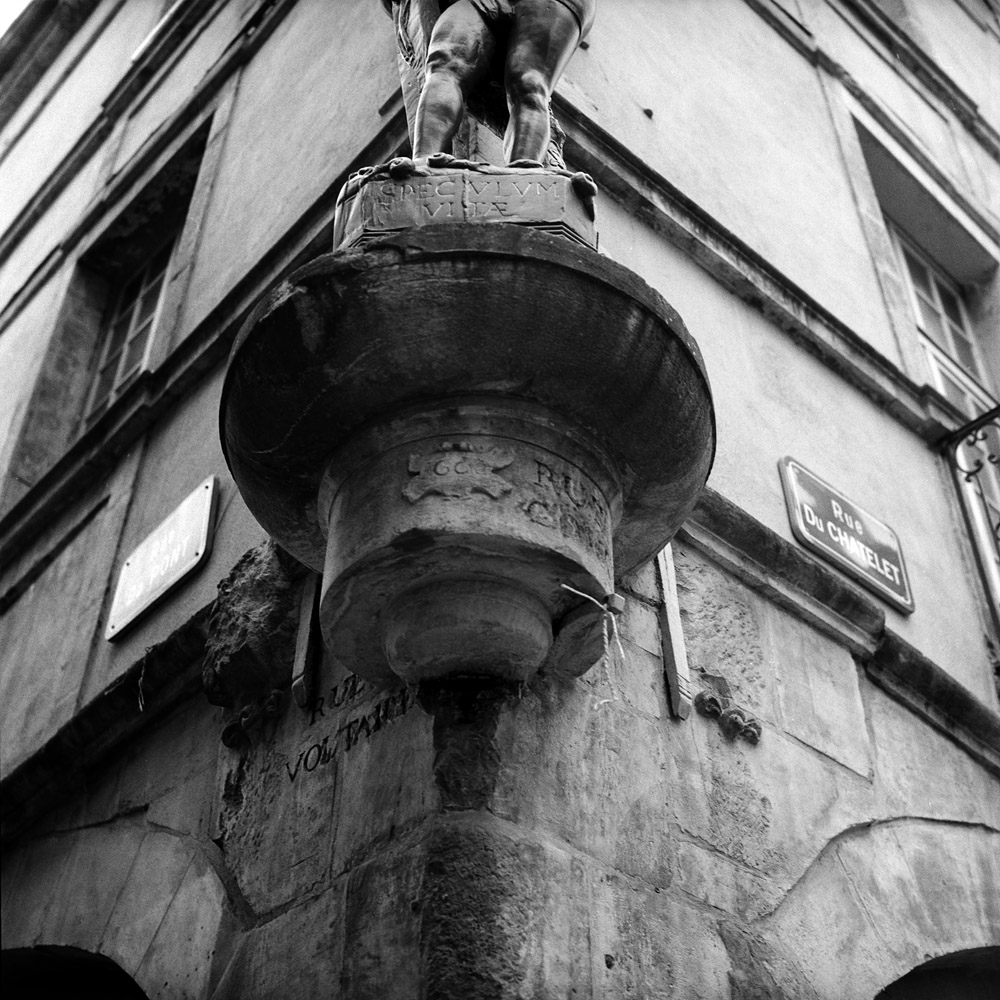
Thinking of how things change, here we have very clear evidence – in the 19th century there was a major reformation of the way street addresses were indicated. Previously, instead of having odd numbered houses on one side of the street and evens on the other, the numbers would go up sequentially on one side of a street and when they reached the end of the street, they’d turn around and keep going up until they got to the beginning, so it was possible to have number 3 in the same block as number 252, which was extremely confusing. Also, with all the turmoil in France from the 1780s until the 1880s, streets were frequently re-named. This intersection shows what were once Rue Voltaire and Rue Comerce are now Rue du Pont and Rue du Chatelet.
Speculum Vitae, Chalon

Number 9 is a good example – I don’t know what the original street number was, but the 9 is a typical blue and white enamel-on-metal plaque from the late 19th/early 20th century. The house, obviously, dates to 1550.

Number 9, circa 1550

Rue de L’Oratorie is another example. This is the street on which Niepce was born; his house is behind me, at modern #15. However, there is a plaque on the wall of the courtyard that leads to Rue de L’Oratorie which says the Niepce birth home is at #9. THe plaque indicating the location of the home was placed before the address reformation, so you can imagine my confusion when looking for #9 and not finding it at all! Fortunately Rue de L’Oratorie is only really 2 blocks long, and there is a second sign in the rue on the house itself. I don’t have photos of the house taken with the Rolleiflex because it’s quite nondescript and the rue itself is rather narrow at that end, making it hard to photograph more than a bit of a wall. I do have photos on my iPhone of the signs that I’ll post with the color images later.

Rue de L'Oratorie, Chalon
Rue de L’Oratorie, Chalon

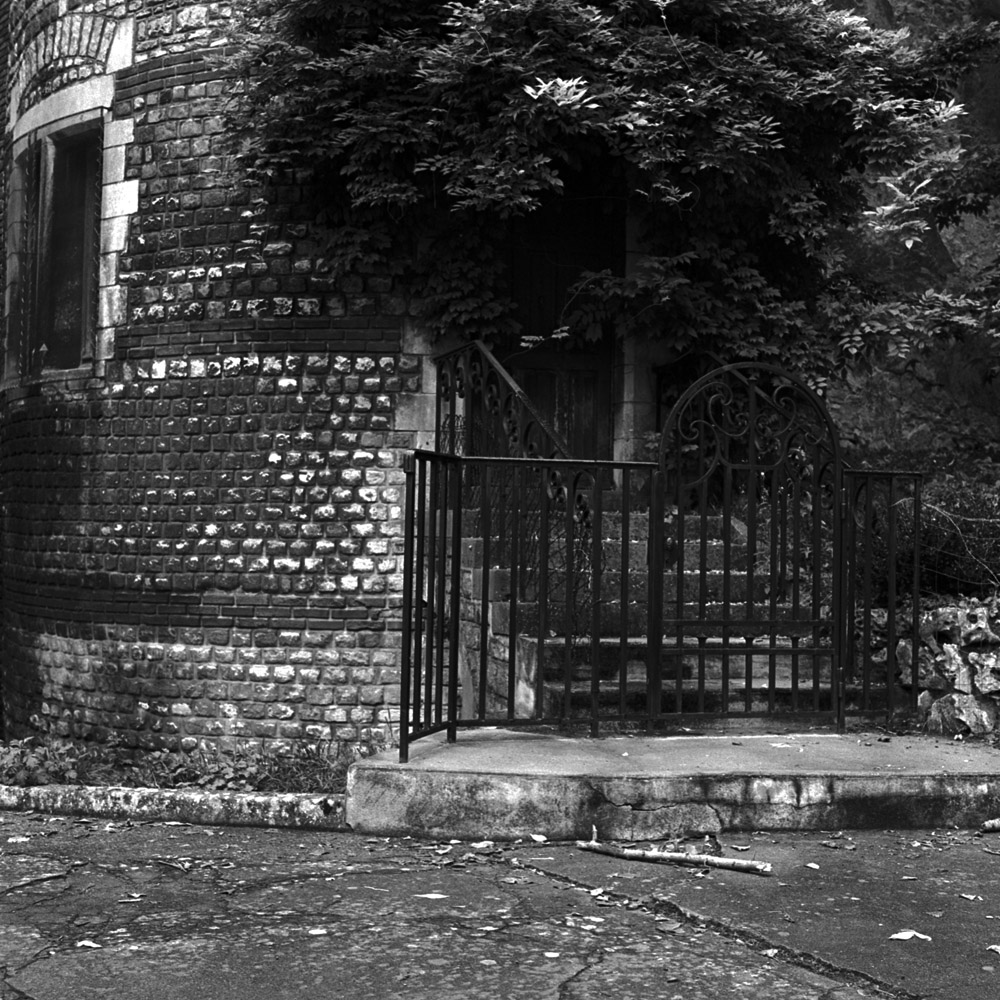
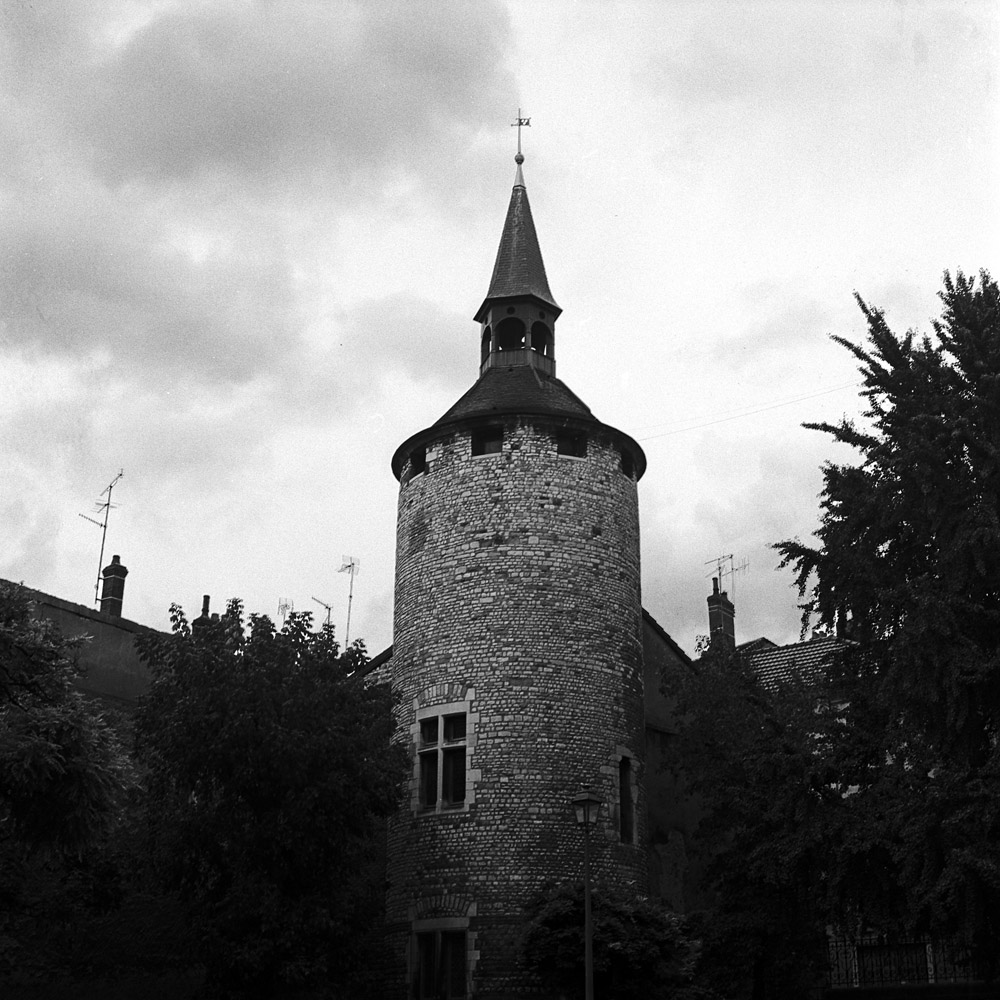
These are views of the Tour Saudon, a 14th century tower house right around the corner from Niepce’s birthplace.

Tour Saudon, Gate
Tour Saudon, Gate
Tour Saudon, Rue de L'Oratorie
Tour Saudon, Rue de L’Oratorie

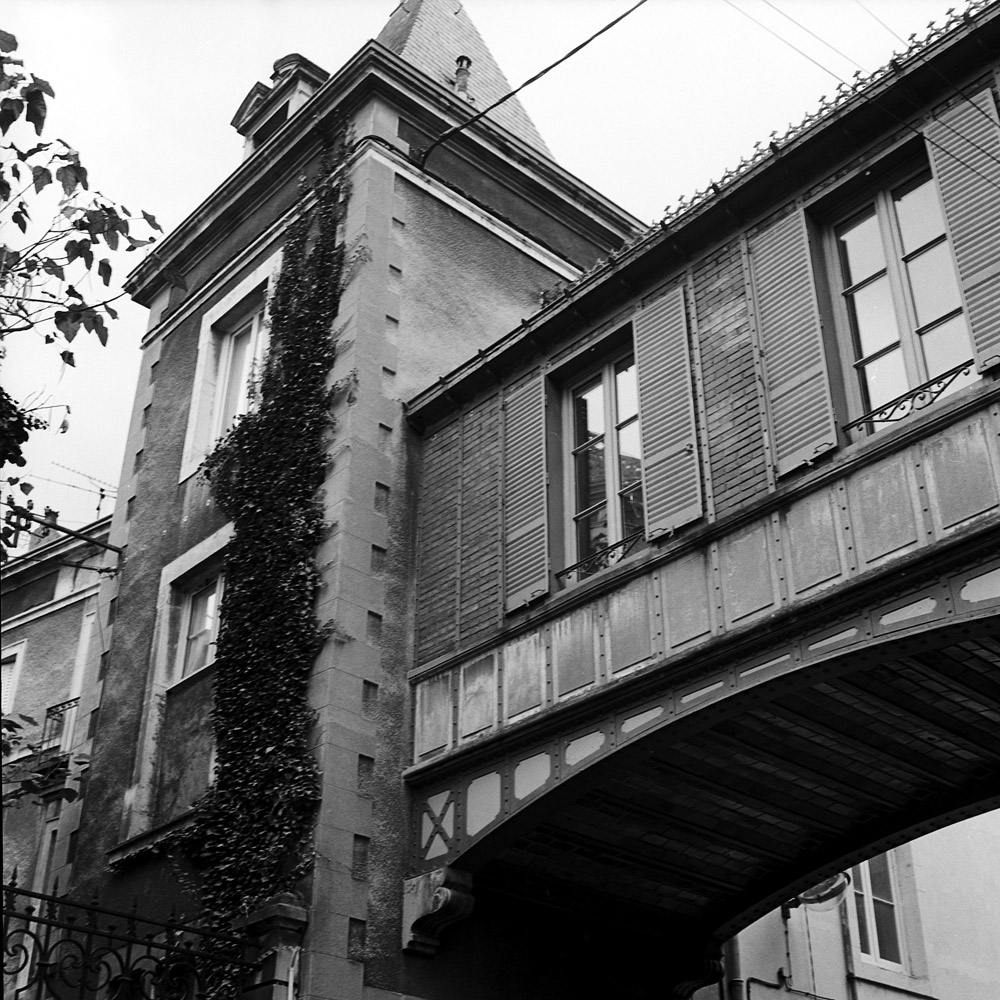
Also on the Rue de L’Oratorie, this house has a bridge connecting its two halves on each side of the street.

Bridge House, Rue de L'Oratorie
Bridge House, Rue de L’Oratorie

Paris in October – part 8 – Versailles in black and white

Here are my takes on the palace of Versailles, in black-and-white. There are actually quieter spaces within the building where you can take photos without a gazillion tourists blocking your view and making appreciation of the space impossible, unlike the state apartments. I’m dividing this post into two sections – architecture and sculpture.

ARCHITECTURE

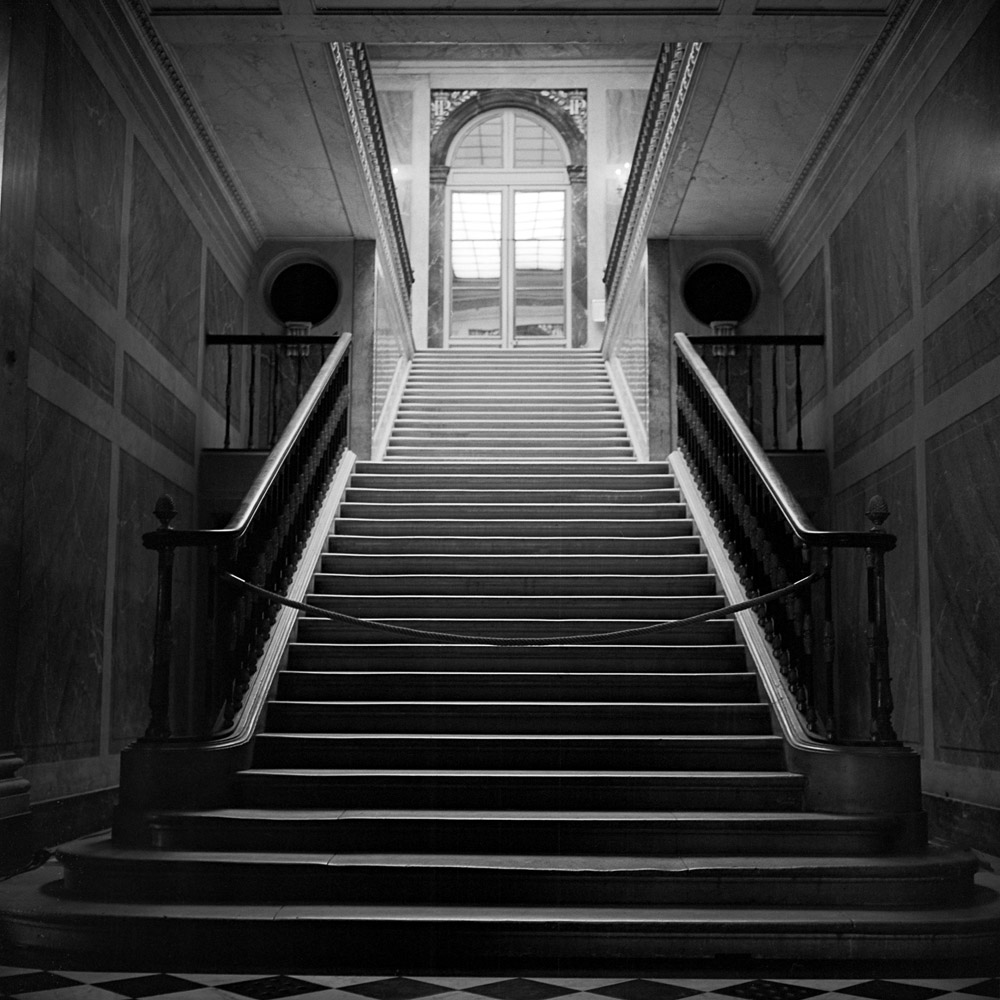
Here’s a side staircase. Not the grand stairs that led to the queen’s apartments, but nonetheless, a magnificent entry.

Side Stairs, Versailles

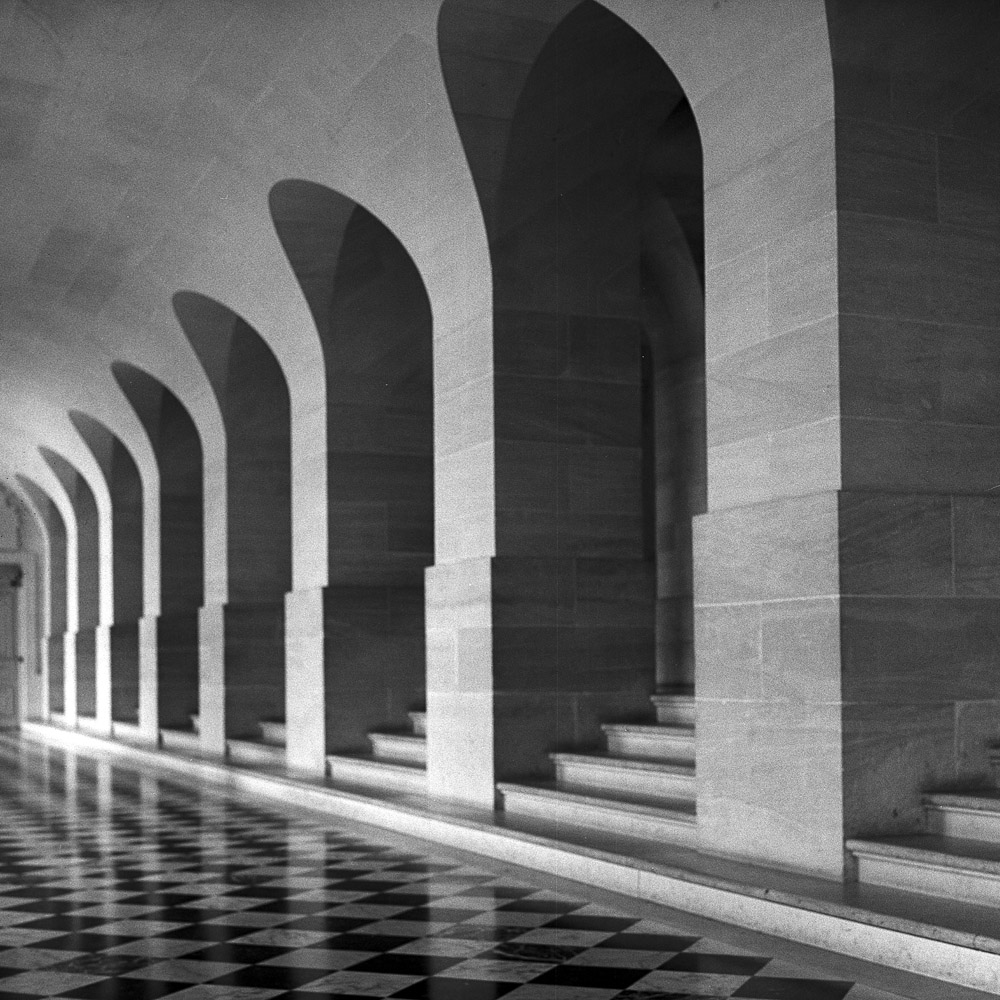
This hall is behind and beneath the state apartments, looking out to the gardens to the west.

Hall, Arches, Versailles

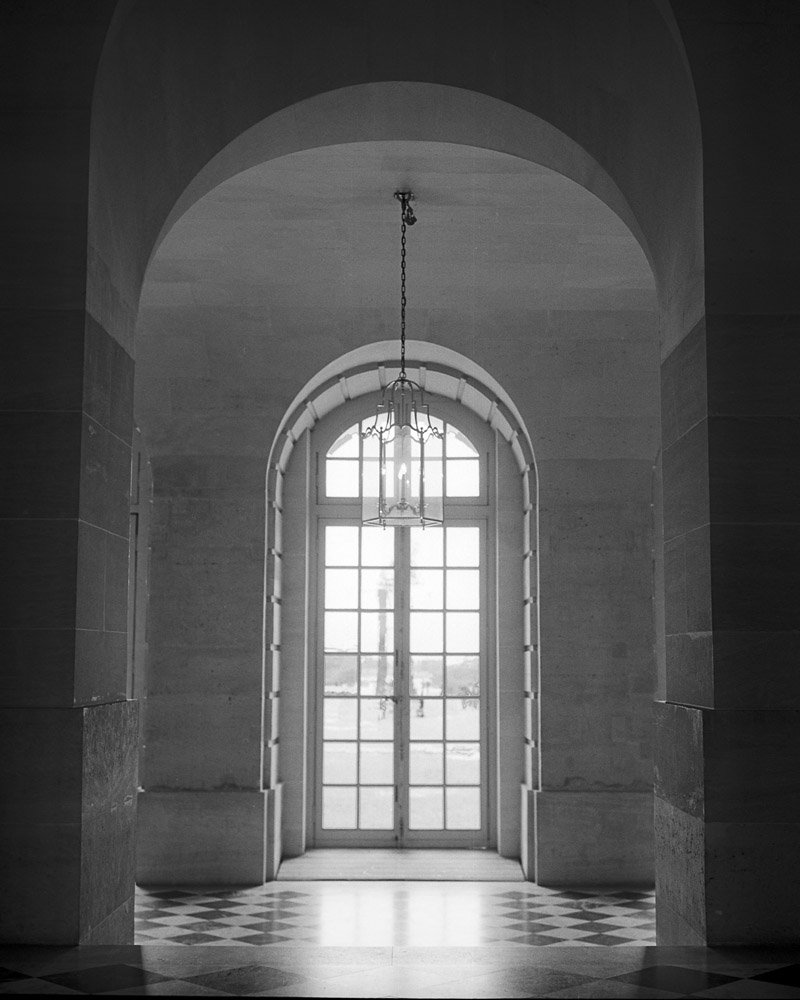
This doorway is the central door leading out from the hall above to the gardens.

Versailles Doorway
Versailles Doorway

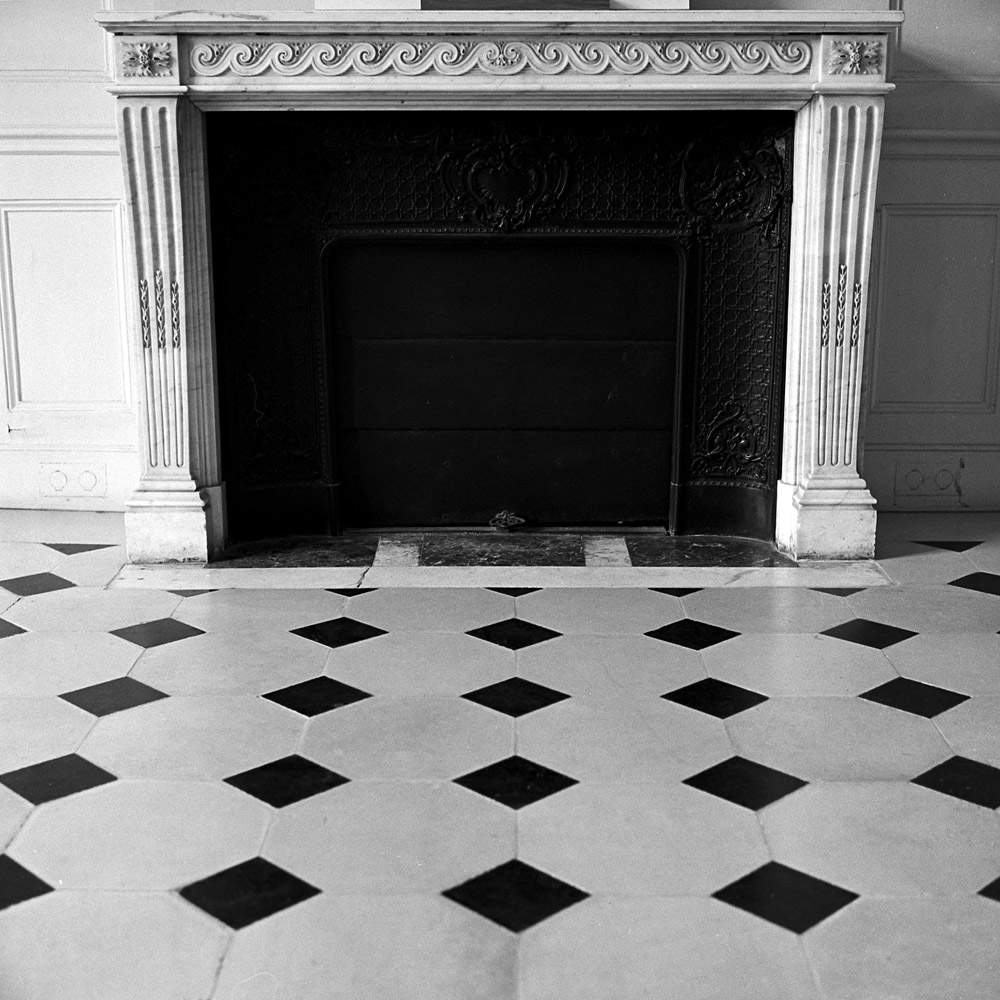
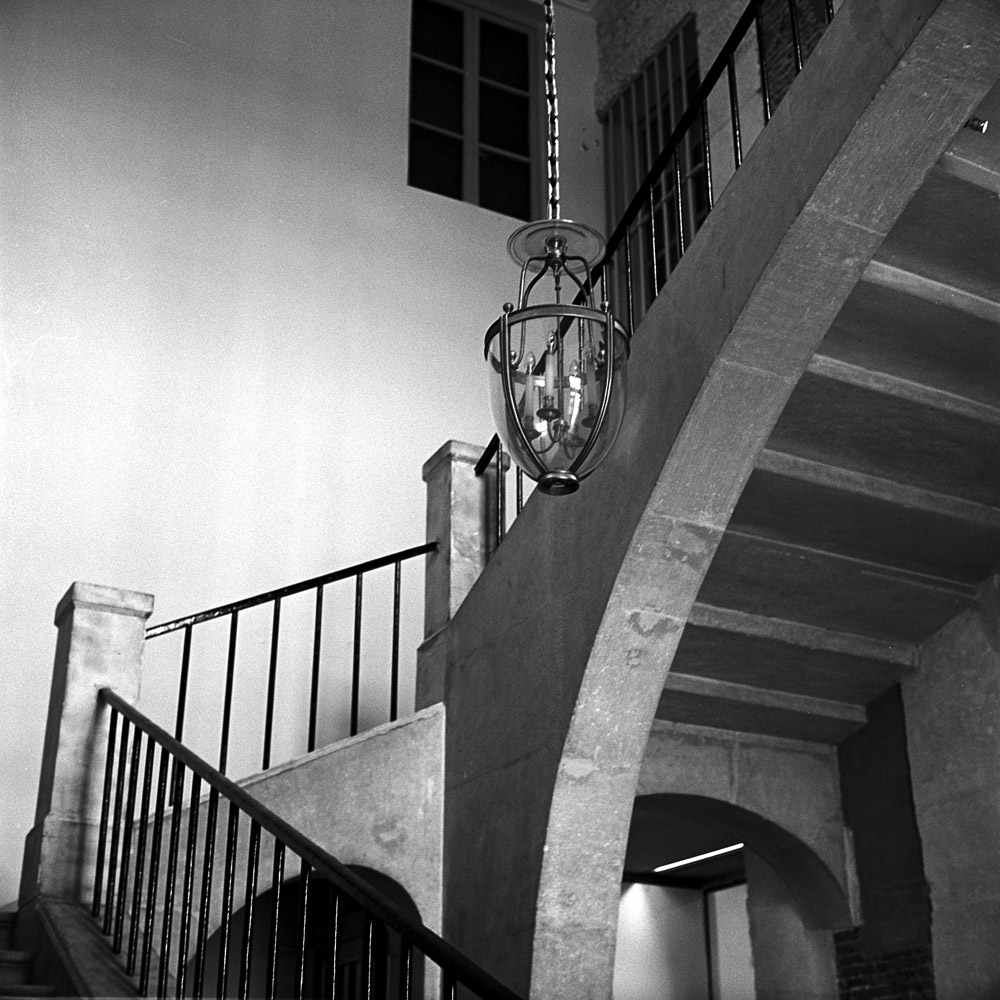
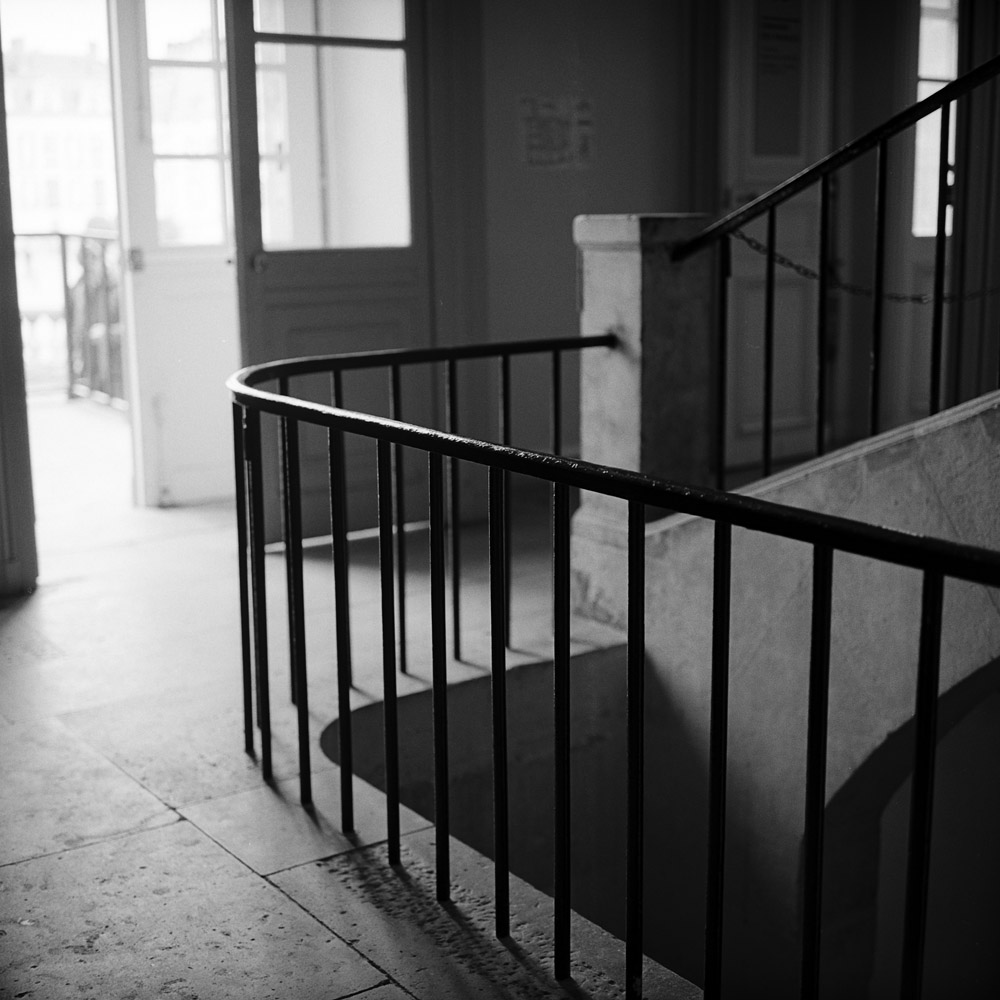
These three are from one of the side buildings outside the palace proper, where the gift shop and ticket office are located today. Anywhere else they would be special, but at Versailles, they are relegated to the service space.

Fireplace, Outbuilding, Versailles
Stairs, Chandelier, Versailles
Staircase, Outbuilding, Versailles

SCULPTURE

Sculpture is everywhere at Versailles, from the entrance gates to the halls in the basement.

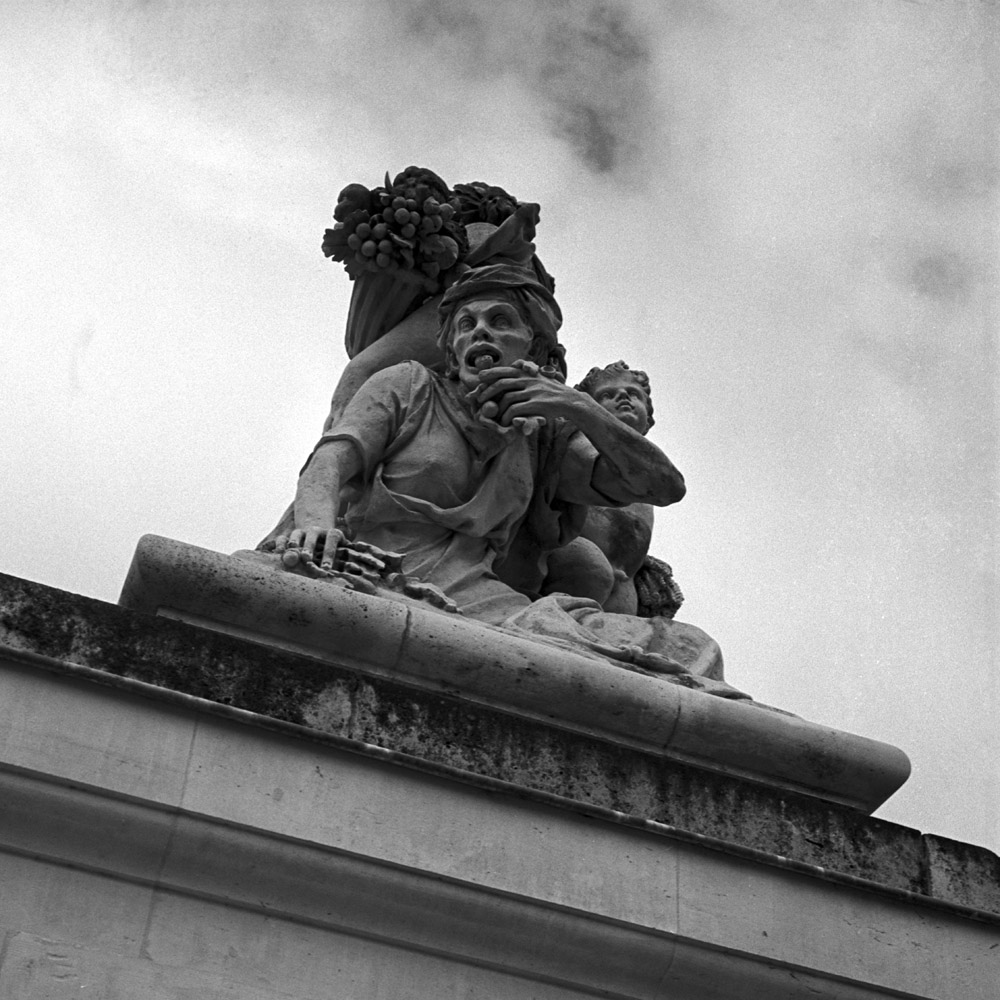
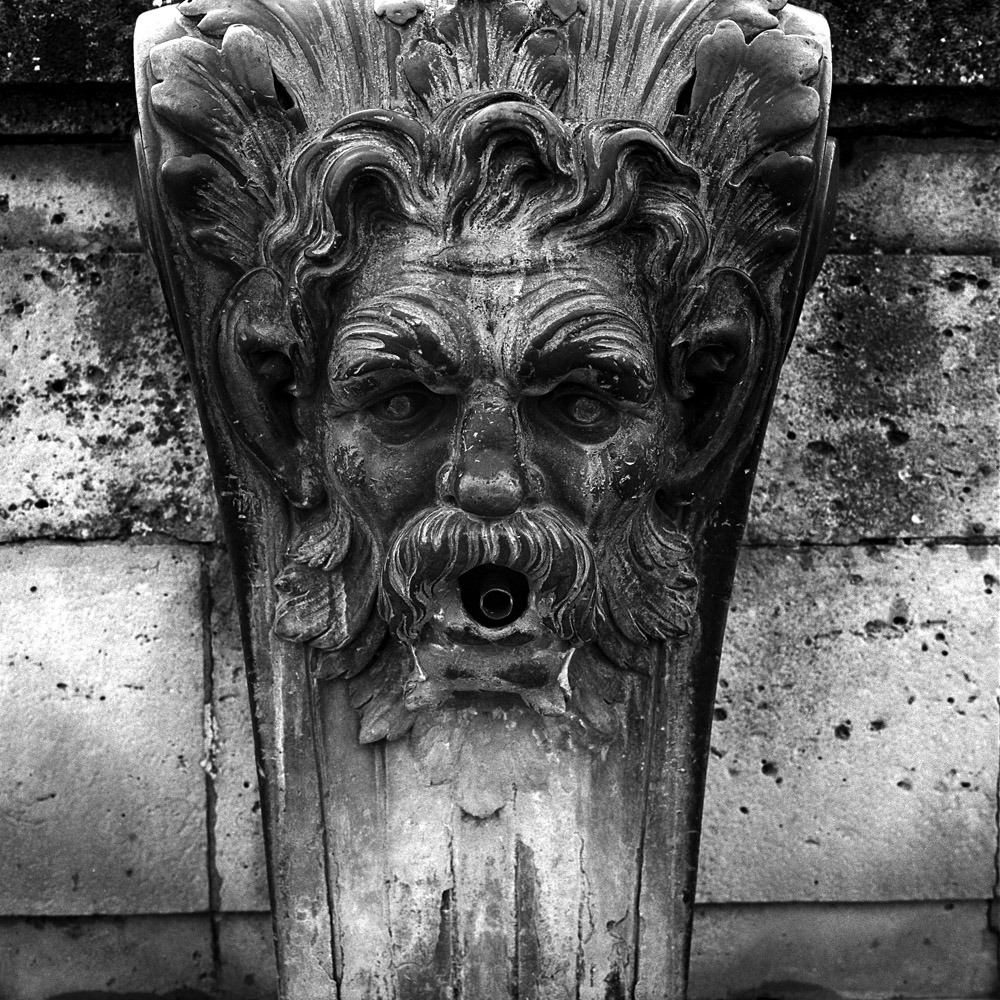
This grotesque is on the back side of one of the heroic female “virtues” at the entrance gates to the palace. Seeing this, it’s not hard to see how the peasant classes who were starving would see it as emblematic of how the nobles viewed them and took umbrage accordingly.

Grotesque, Versailles

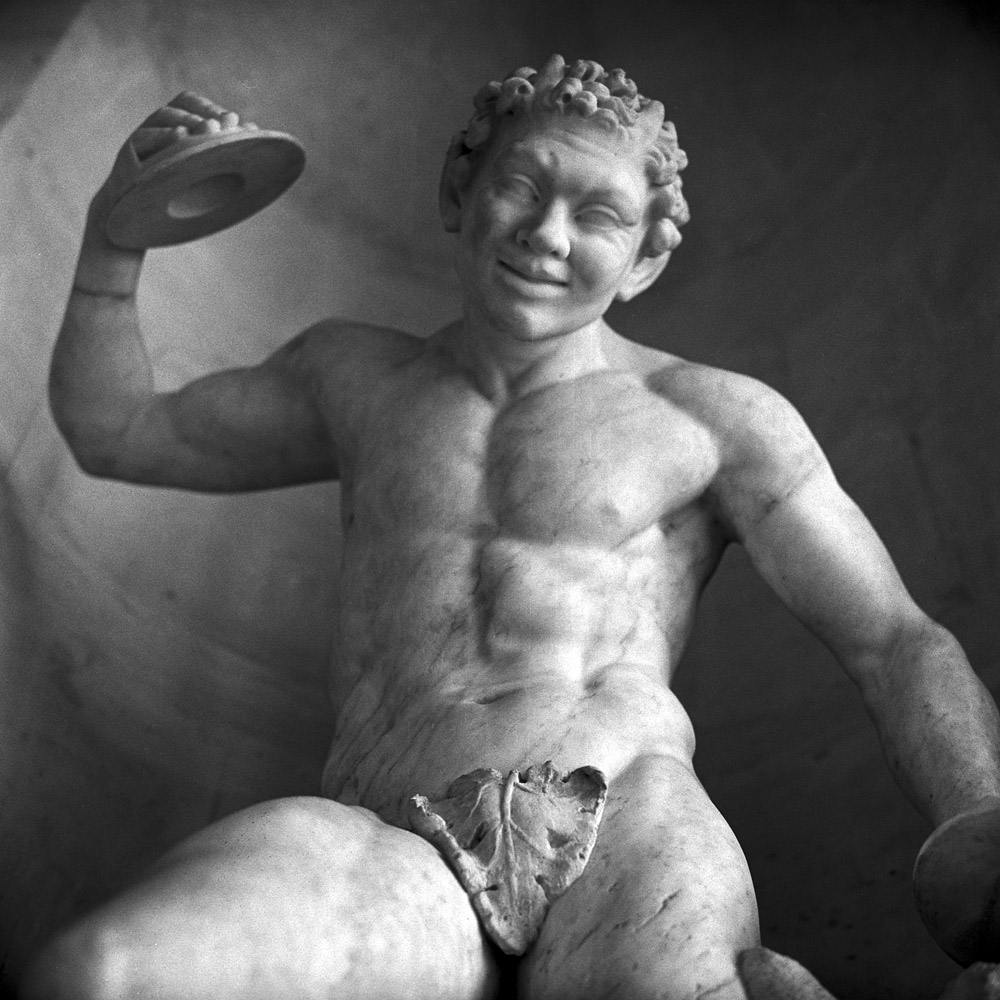
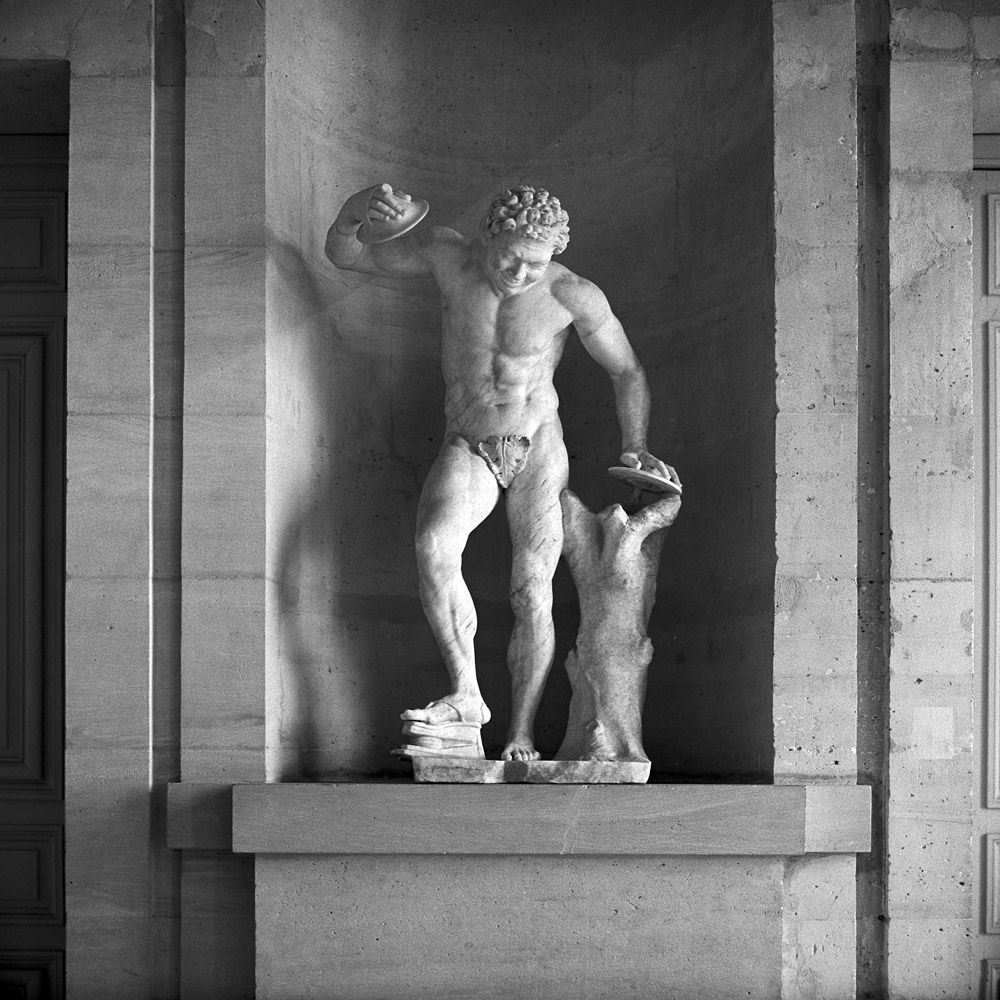
This Satyr is in one of the halls of the ground floor of the palace, relegated to a corner where few tourists venture. I suspect his fig-leaf is a Victorian-era excess, as it appears to be glued on much after the fact.

Satyr, Versailles
Satyr, Versailles
Satyr, Versailles
Satyr, Versailles

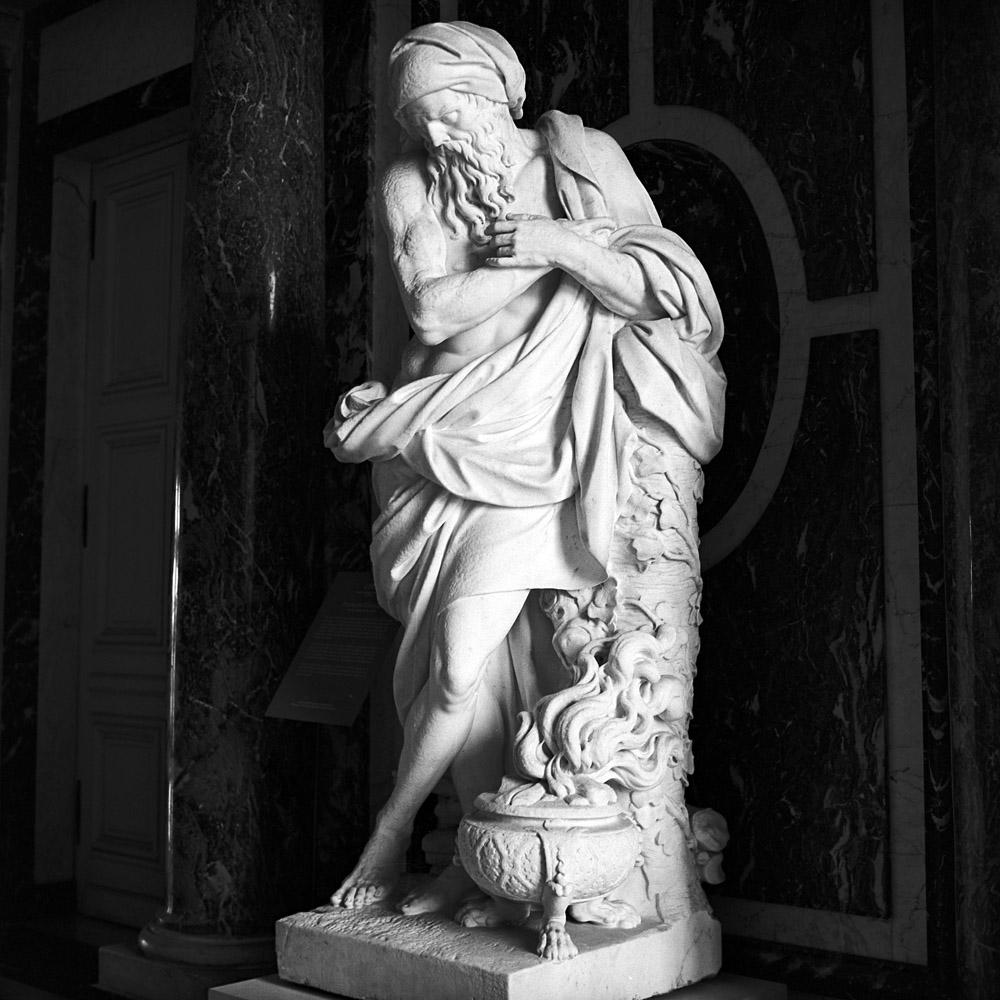
I’m not sure who/what this statue represents, but it appears to be some kind of hermit/mystic, judging from his attire and the smoking pot at his feet.

Hermit, Versailles
Hermit, Versailles

Here is a water fountain outside the palace in the main forecourt.

Fountain, Versailles

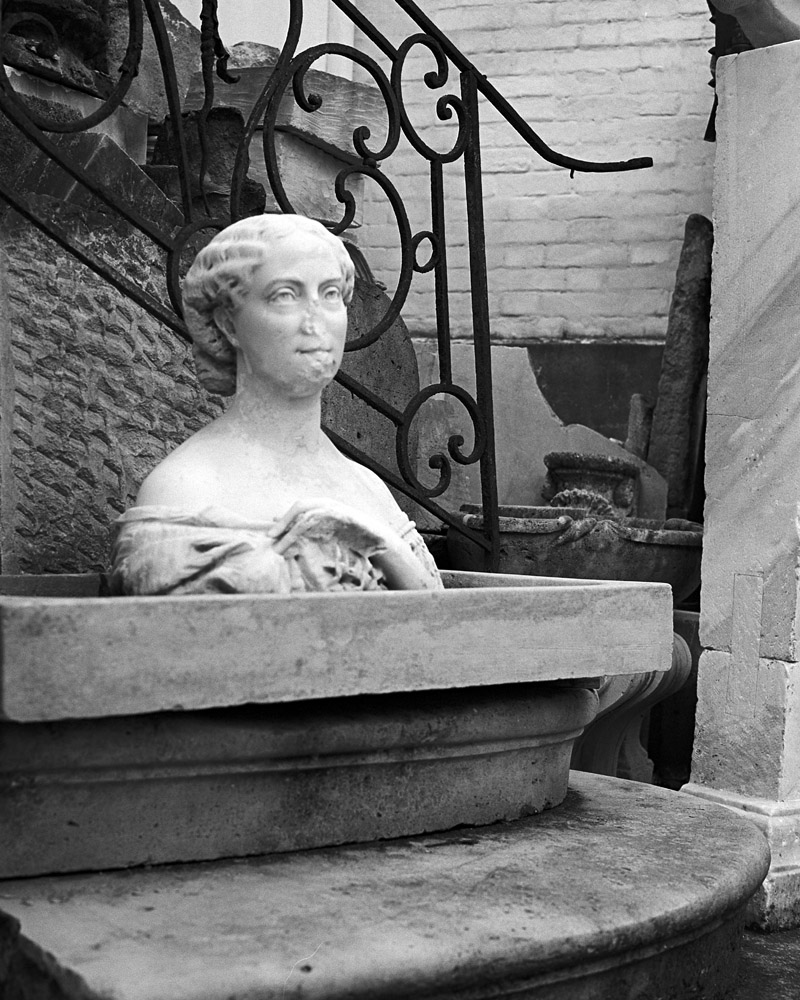
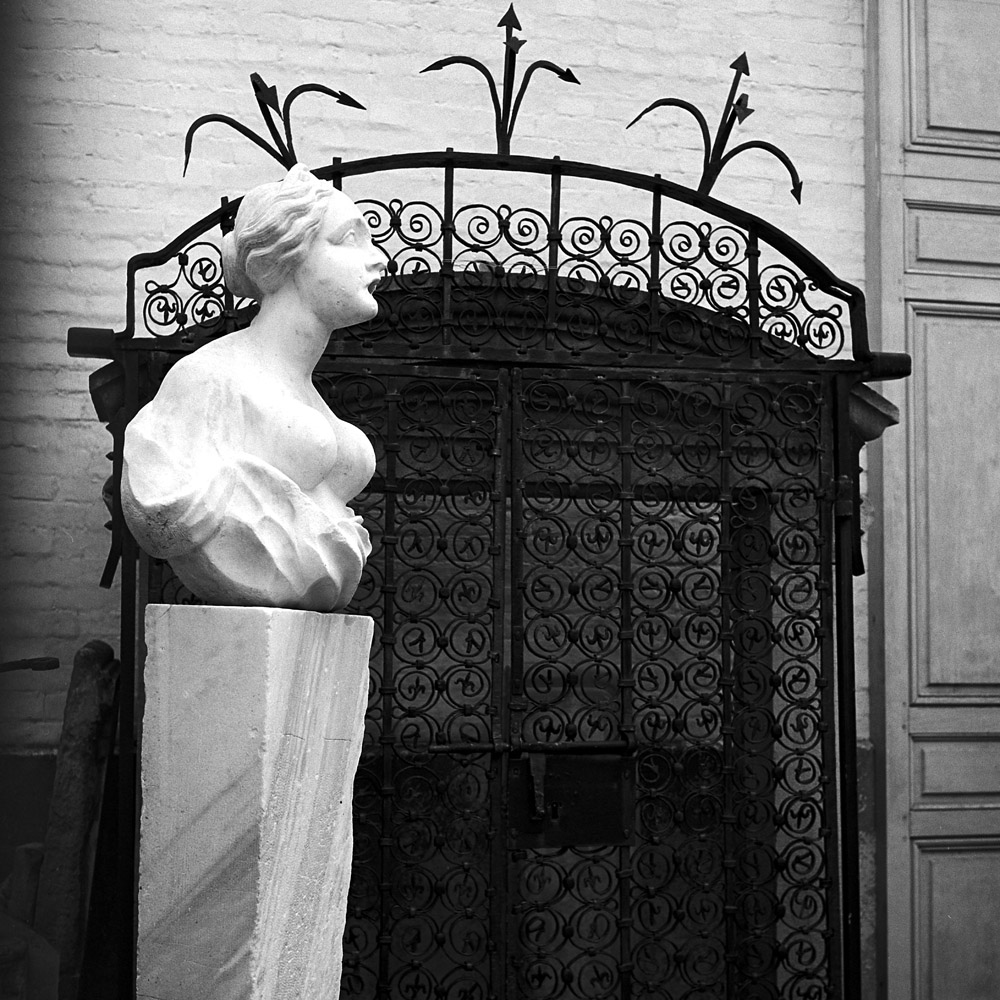
These last two were found in the town of Versailles in the outdoor courtyard of an architectural antiques dealer. A different take and a contrast to the exquisite statuary in the palace, they nonetheless have their own beauty and dignity.

Marble Bust, Versailles
Marble Lady, Versailles

Paris in October – Part 1

My apologies for the very long delay in writing. Did you all miss me? Part of it was just a general busy-ness and part of it was that I was traveling to Paris for ten days, then waiting for my color film to come back from the lab, and processing and scanning my black-and-white work. Paris was a blast – I have to say it was an orgy of great food – I did not have a single bad meal, or even a humdrum one, in the entire 10 days. Well, ok, the breakfast at the airport on the day of the return flight was, well, airport food, but that doesn’t really count. I’d say the meals on Air France made up for it. I’ll save the rest of the food chat for another post – I took pictures of most of my meals.

I took only one camera with me on this trip, the Rolleiflex. It has only one focal length, and is entirely manual. I know to some folks, shooting their entire vacation with a normal lens would be heresy. I found that in actuality, there were perhaps a half-dozen photos that I took that in retrospect would have been better with a different focal length, and another half-dozen to ten that I didn’t take because they wouldn’t work with the focal length I had. This out of almost 400 frames (33 rolls of 120, 12 frames/roll). I kept my film palette largely restricted to two films – Kodak Ektar 100 for color (with two exceptions) and Tri-X for black-and-white. I did make the mistake of dragging along with me a whole bunch of additional film that I didn’t need to bring (way too much alternative black-and-white film, like some Ilford Pan-F and FP4+). The color exceptions were some Portra 160 for long night-time exposures and some Portra 800 for low-light where I could only hand-hold the camera.

I’ll start this series of posts off with a pair of highlights: the Eiffel Tower and Notre Dame Cathedral.

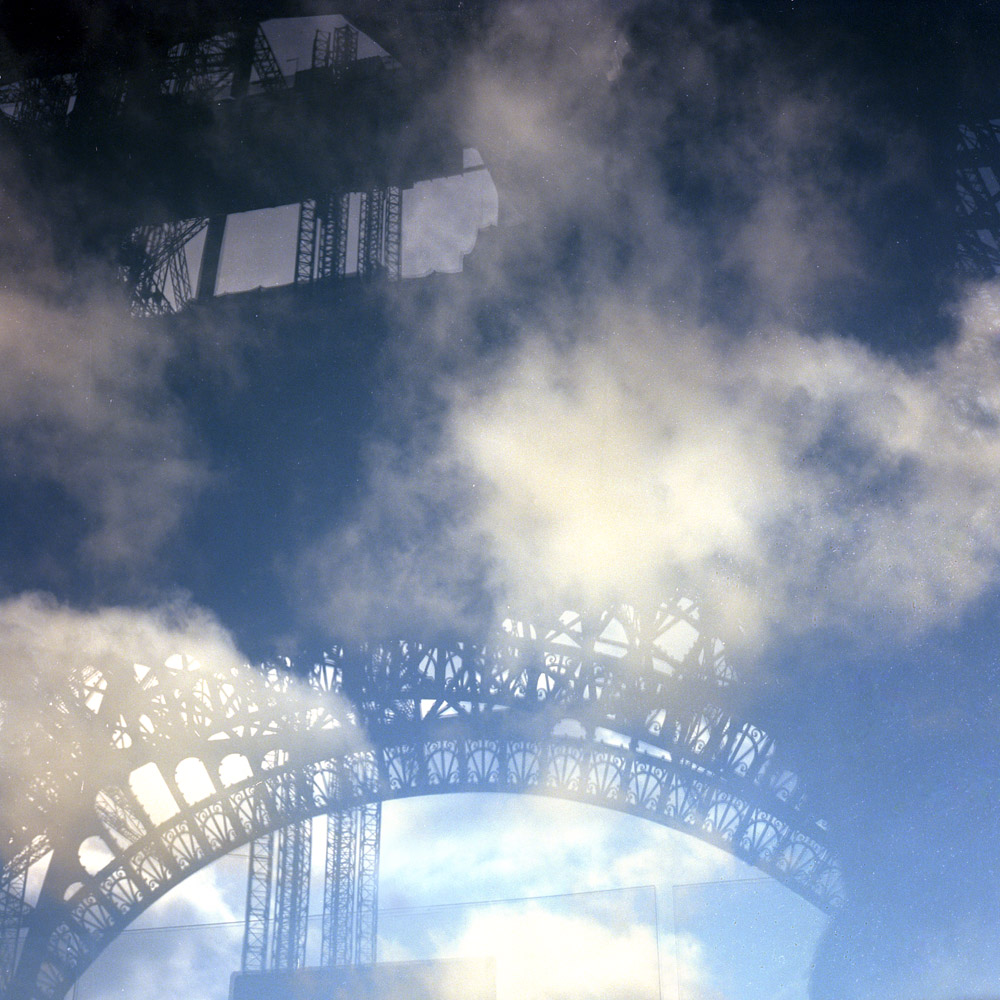
The Eiffel Tower:

Eiffel Tower Shadow, Clouds

This was a happy catch. I saw the shadow of the tower and the clouds passing overhead reflected in the glass of the security partition for the queue to enter the Eiffel Tower. I took a chance that it would work, and voila! (Tish, that’s French!!!) I was afraid that it would come out fuzzy because I was trying to focus on two different things that were not actually on the plane where they appeared (the security glass partition) and the color balance would be impossible to get right because the anti-shatter coatings on the glass created a bit of a prismatic effect. There’s still a touch of yellow in the clouds I couldn’t eliminate but otherwise it wasn’t too bad.

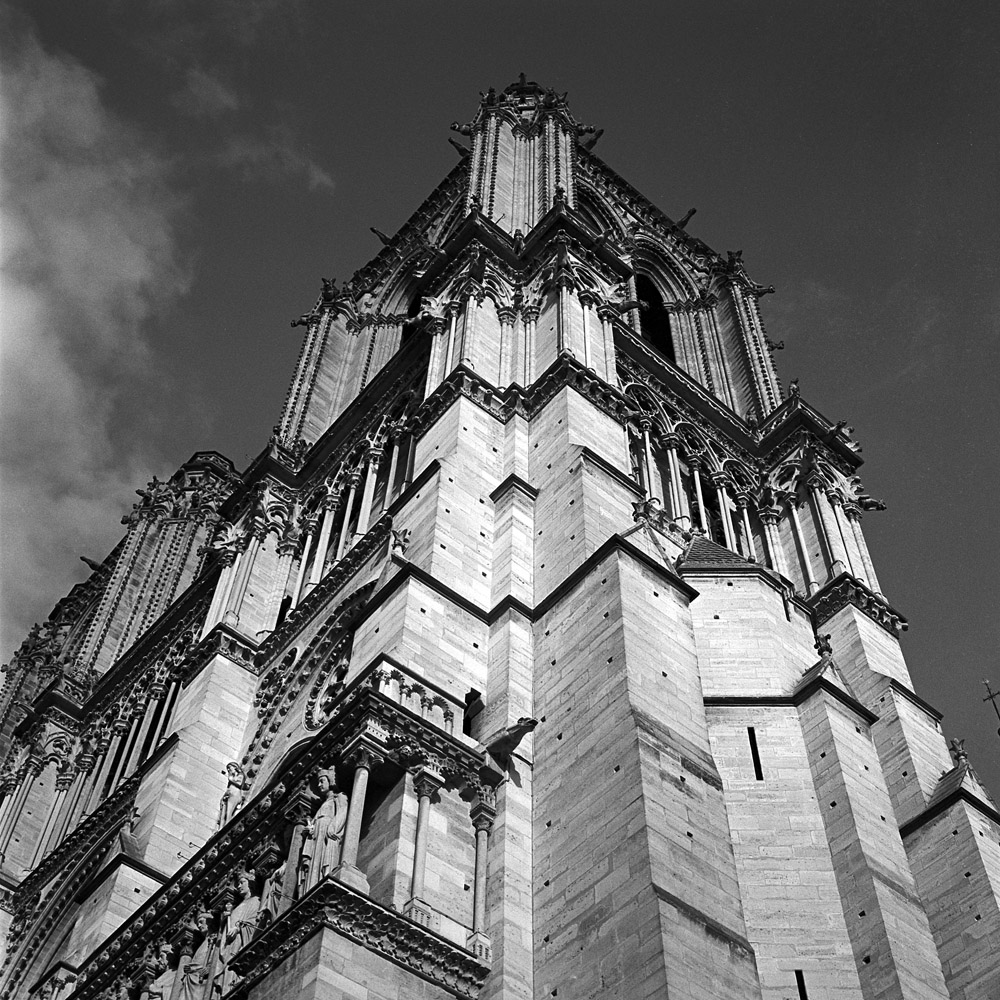
Here’s a shot of Notre Dame Cathedral, taken from a different perspective.

Towers, Notre Dame Cathedral

Notre Dame is actually a challenge to photograph because it has a very direct east-west orientation, so for much of the day, the facade that you want to see represented is facing west and in shadow/backlit. I was able to time this photo in the late afternoon so it was well illuminated.

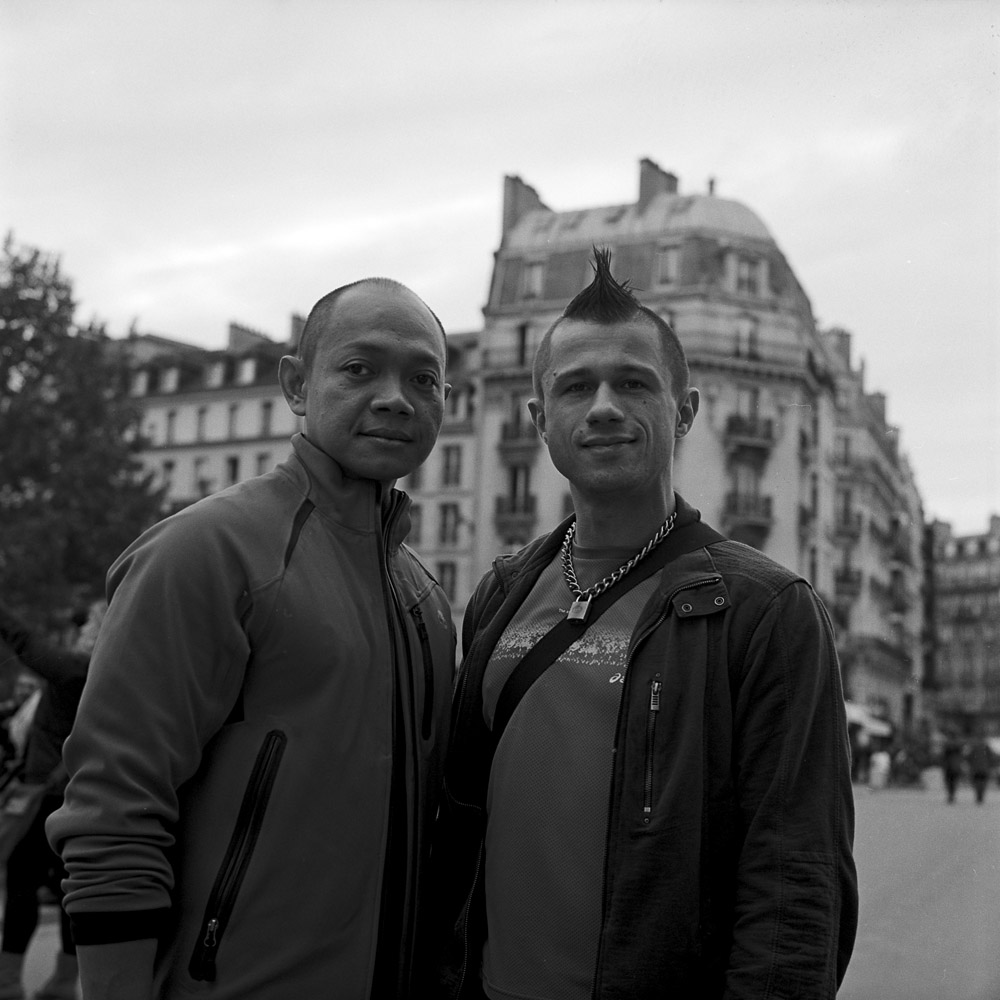
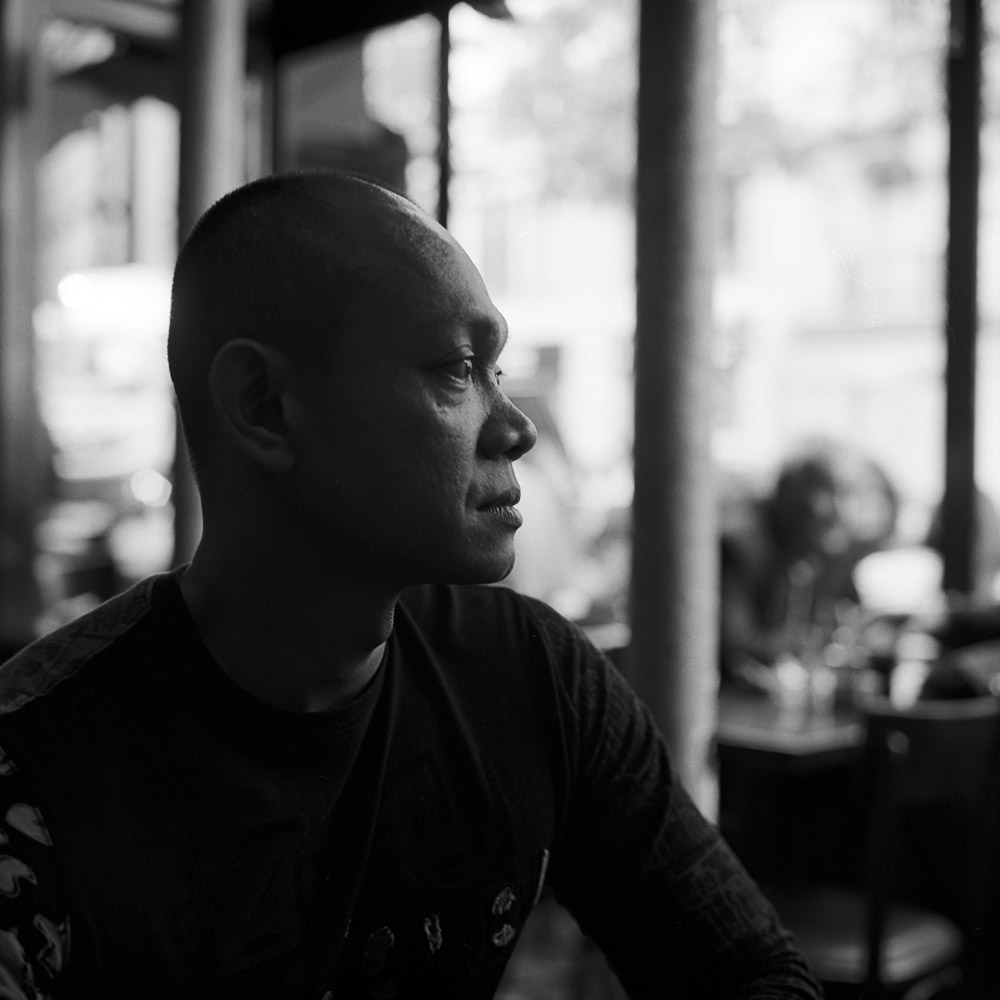
The Rollei made for a perfect travel camera – phenomenal image quality, very easy to handle, and because it is so quiet (no mirror slap, the leaf shutter just makes a little ‘snick’ when it fires) it is great for candids. Thinking of which, I did grab a couple portraits of friends of mine who came over from London to visit. They recently moved there from Singapore. The last time we saw each other in person was 2003, so almost exactly a decade apart. Gosh have we all changed, but it was so great to see them again.

Mirza and Peter
Mirza and Peter
Mirza, Cafe Le Progrès
Peter, Profile, Blvd St. Martin

Street Scenes – 14th Street after work

A couple quick snapshots from a street ramble after work.

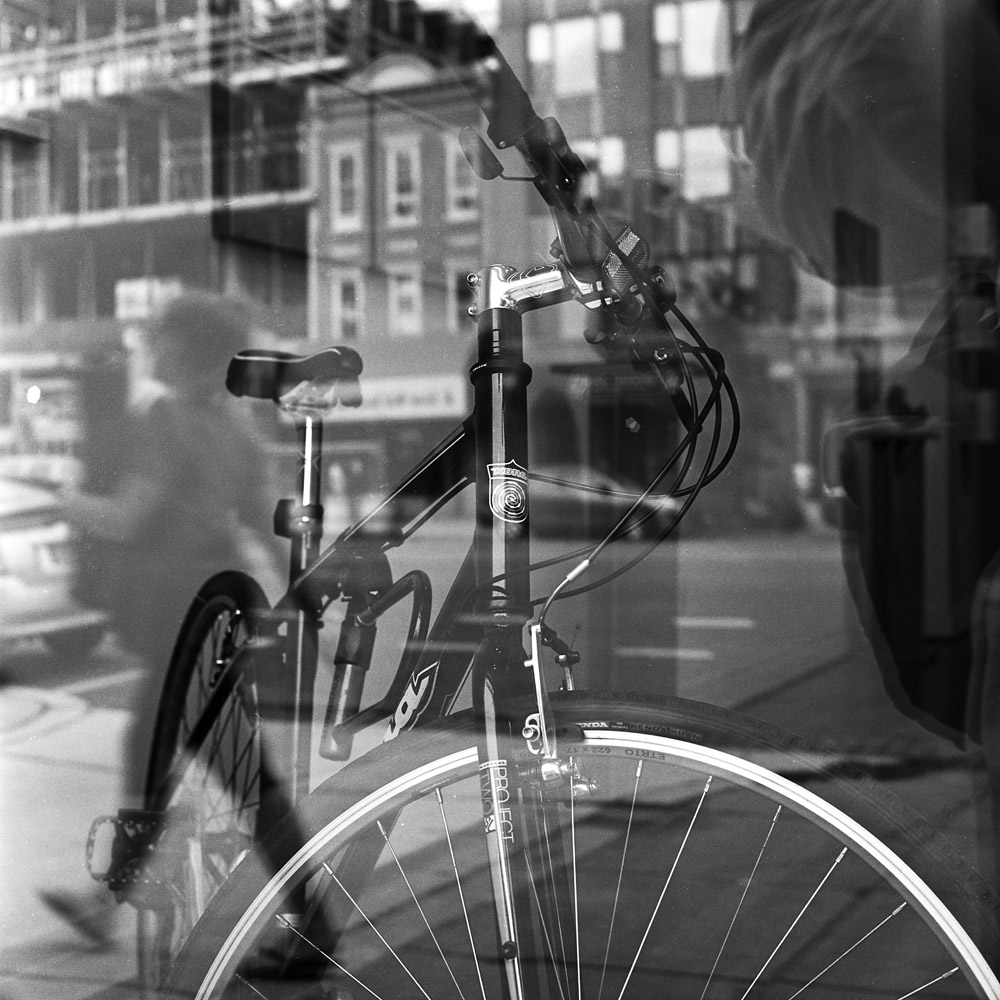
Bicycle, Pedestrian, Gallery Window, Self-Portrait

I happened upon this scene on my walk home from work the other day. I’ve developed a thing for photographing bikes and other means of transport, thanks to seeing the bikeshare stations all over and watching people riding them. I like the multiple layers happening in the scene with the contents of the gallery merging with the scene behind. The bike is still the main emphasis, but you have the cars, the pedestrian, the interior volume of the gallery with art on the walls, and then the fractional self-portrait of me on the right side (mostly just camera bag in the reflection, but I’m still in the picture).

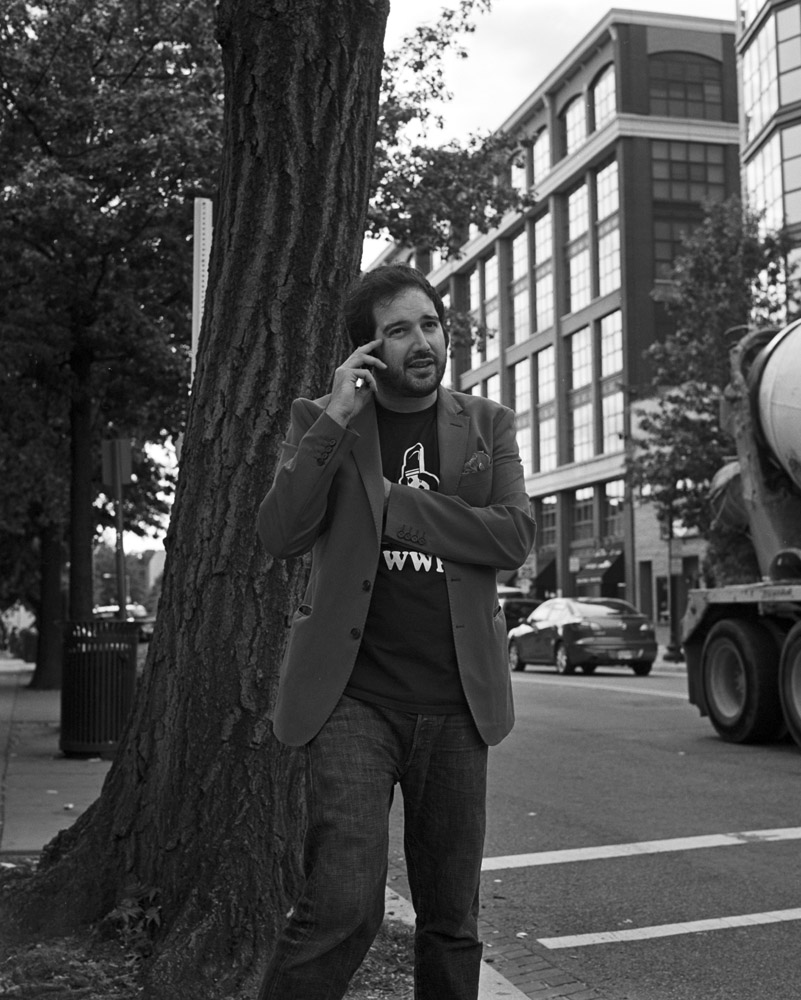
Hipster on his cellphone
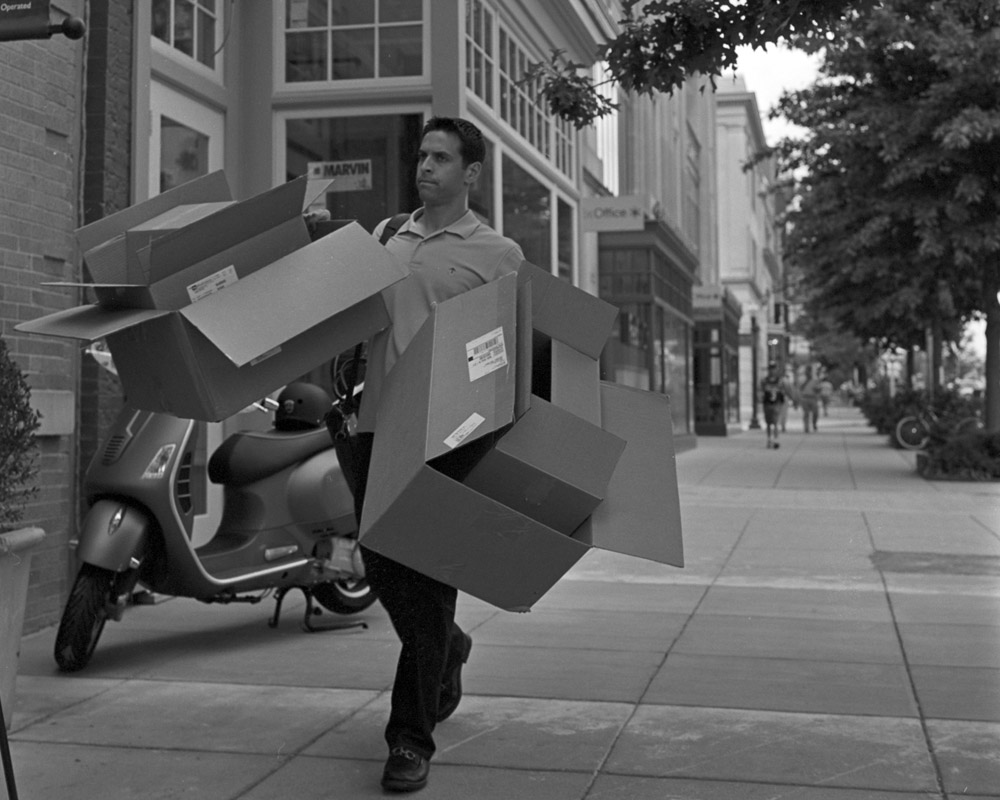
Man with boxes
Man with boxes

These two were just practice shots, really, trying to get better at people photography on the street. They’re part of the mood of 14th Street, though- emblematic of the energy of the place.

Konica Infrared

Apologies all for the long pause from my last posting – I just needed a little break, and to recharge my creative juices after getting the show up on the wall. Perhaps this weekend I’ll post the pictures from the opening reception.

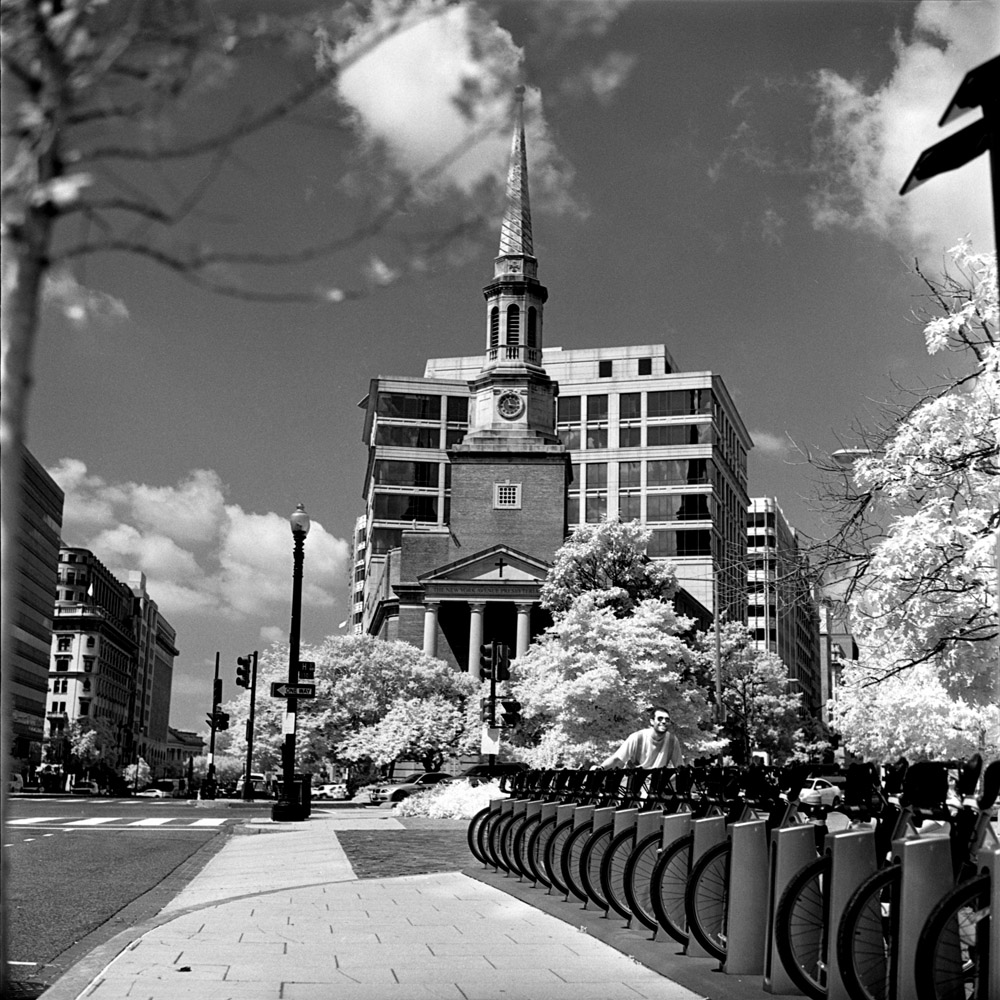
Anyway, here’s some stuff I shot last weekend and earlier this week. I lucked into a modest stash of Konica Infrared film, which hasn’t been made in probably 8-10 years. The stuff I have is older than that. I needed to find out how well it had kept in the meantime – IR films in general seem to age much faster than regular b/w film, and for all I knew, the IR-sensitizing dyes had faded and it would be just another slow b/w emulsion with tons of base fog, but grainy from the degradation (I shot some Kodak HIE 35mm that was from the last batch they did, and it had degraded to horribly foggy and grainy, despite the fact that it was only perhaps 4-5 years out of date). The results are in – while they do have noticeable base fog, the negatives are still quite fine-grained and do exhibit the infrared effect nicely, with very little overall degradation.

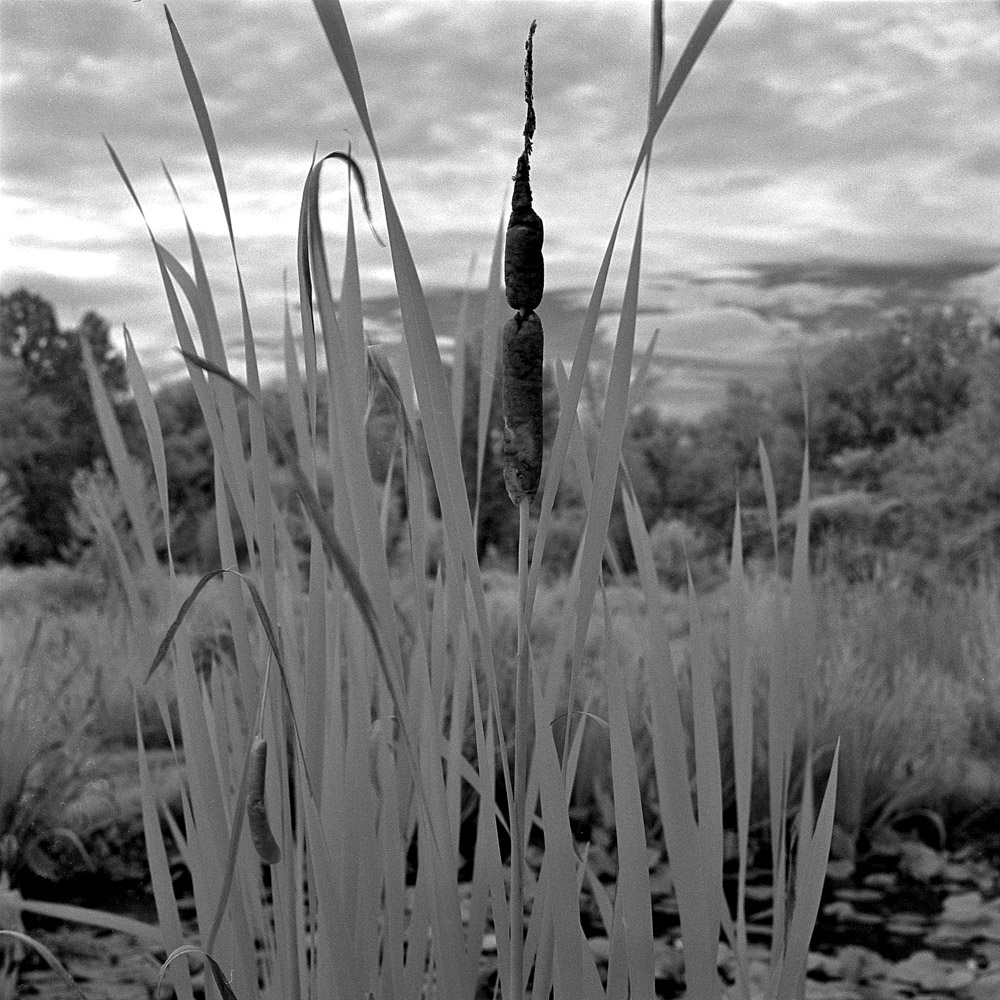
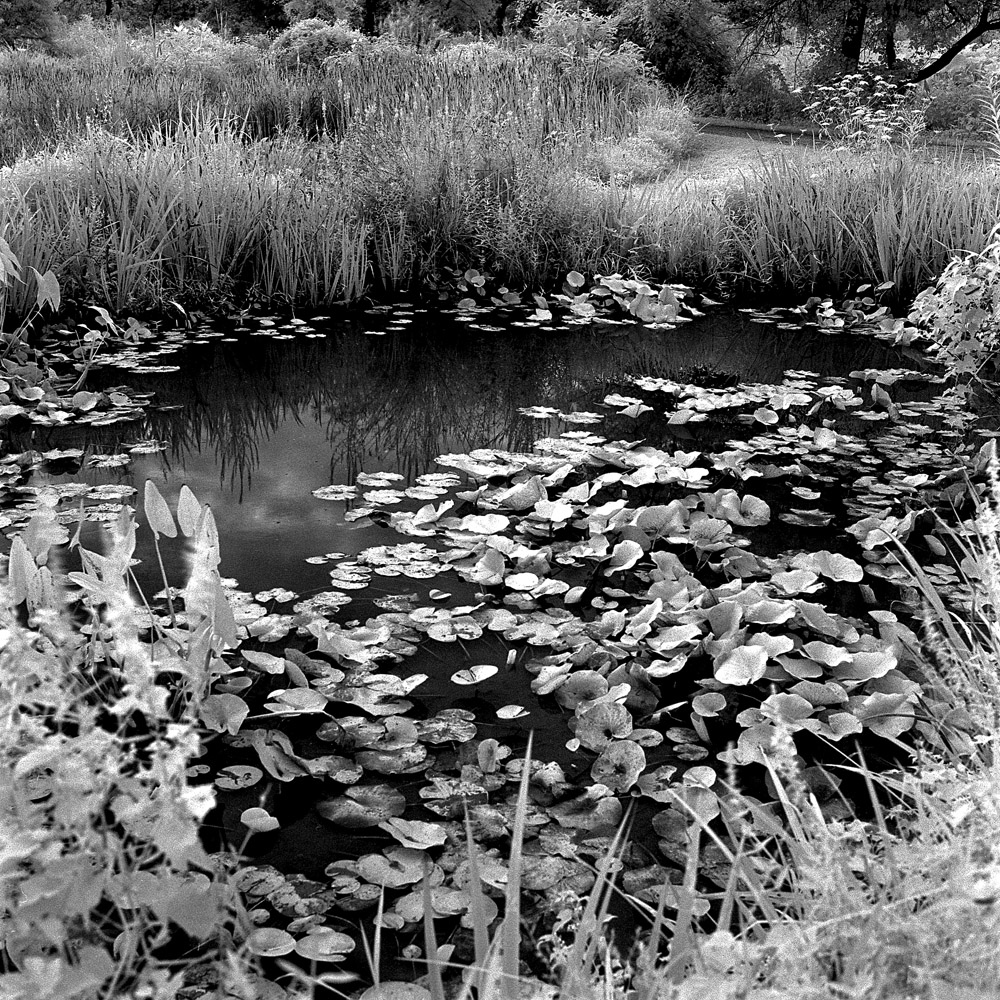
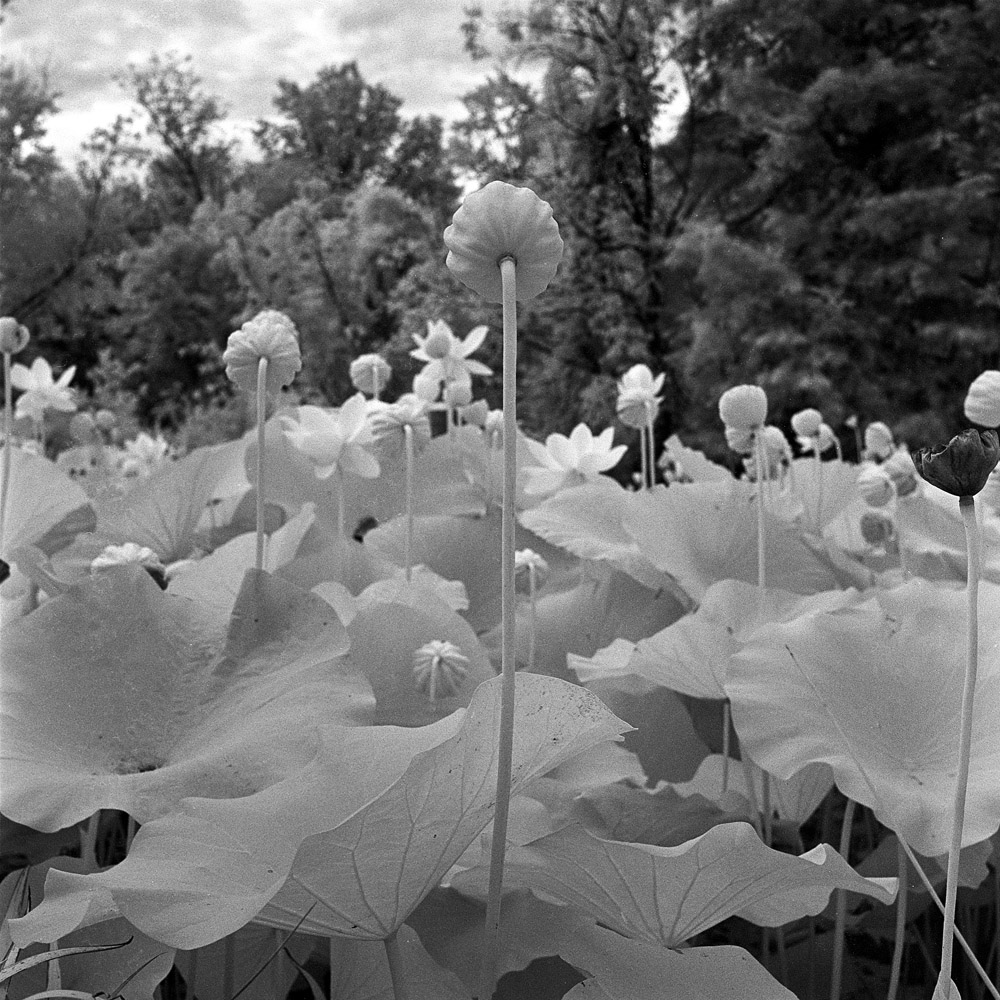
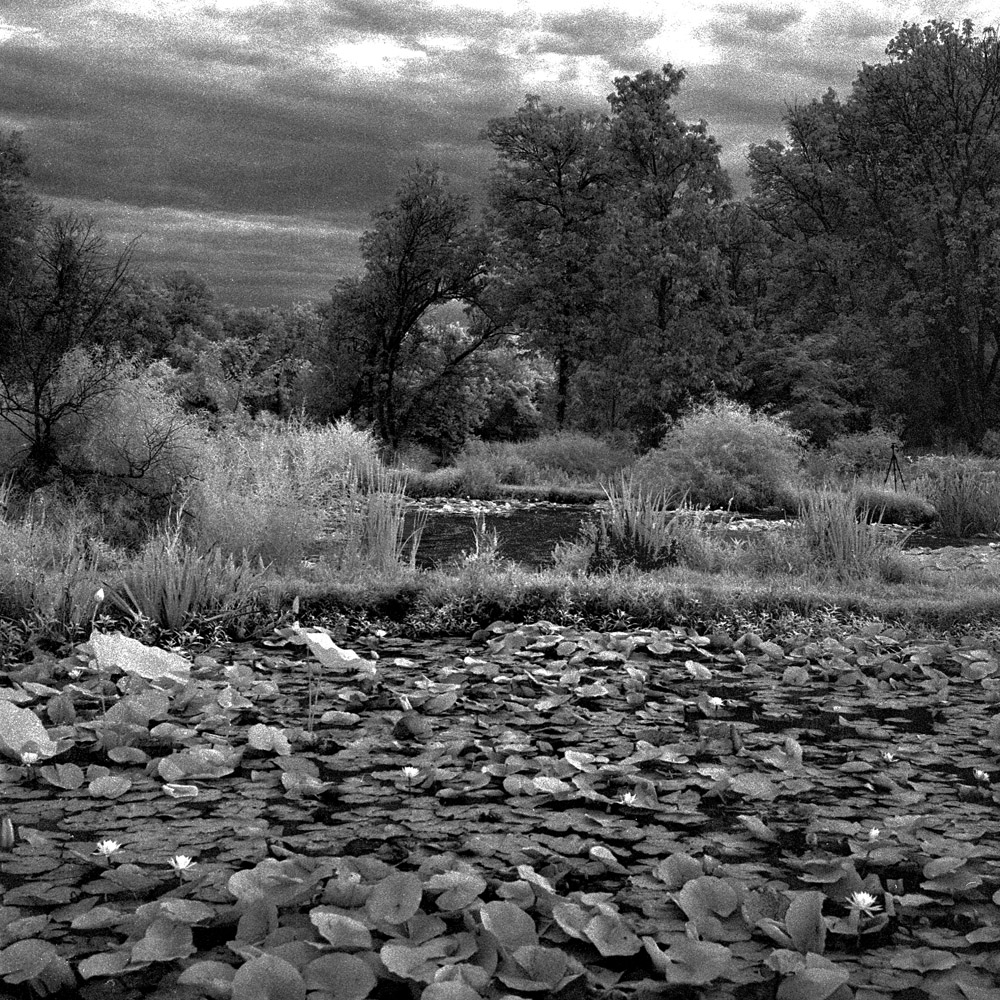
Here are results from two rolls worth, shot on a lunchtime walkabout near my office, and on an early saturday morning excursion to Kenilworth Aquatic Gardens.

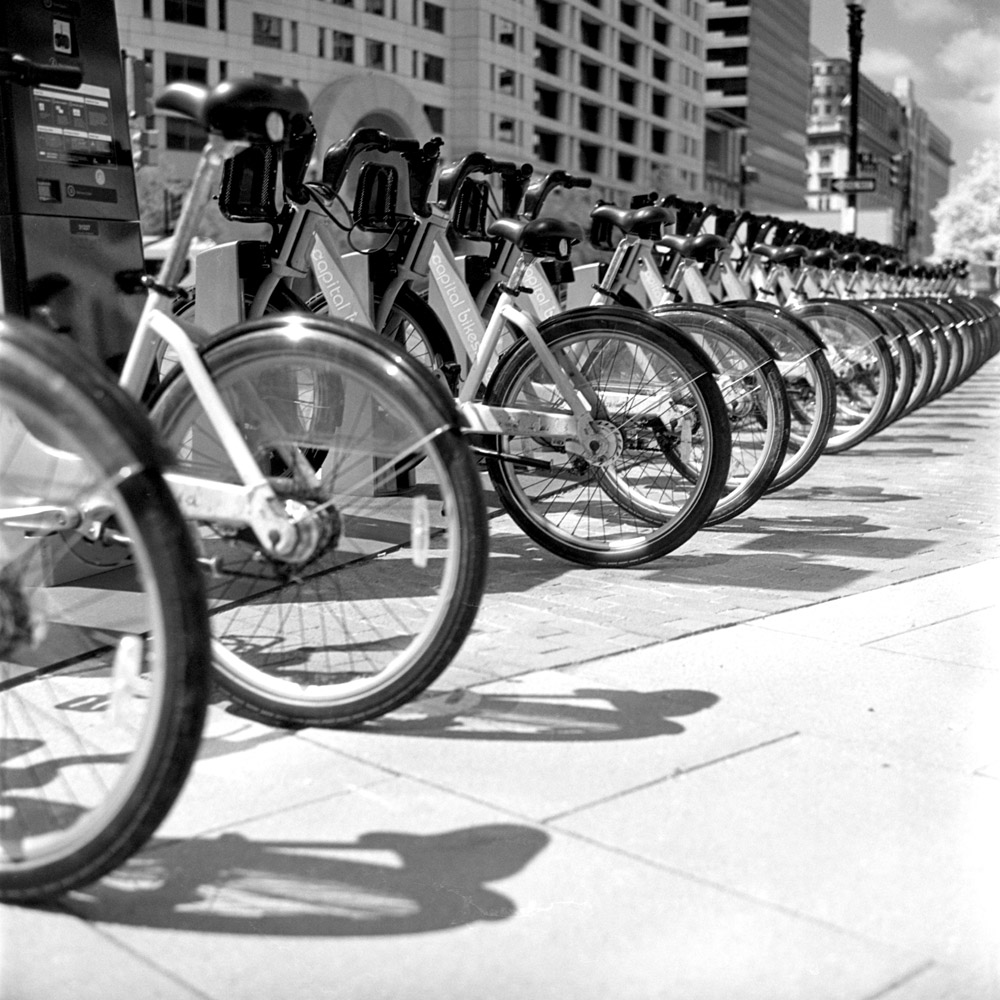
Capital Bikeshare - Konica Infrared
Capital Bikeshare – Konica Infrared
New York Avenue Baptist - Konica Infrared
New York Avenue Baptist – Konica Infrared

The infrared effect is somewhat subtle in these first two – the foliage is white, but the sky is not particularly black or contrasty. The red bikeshare bikes though are much lighter than they appear on regular b/w or color film. Also the wheel guards on the back wheels are completely translucent, but in real life they are dark smoked and/or black plastic.

Cattails, Kenilworth Gardens
Lily Pond, Kenilworth Gardens
Lotus Flower "Showerheads", Kenilworth Gardens
Lotus Flower “Showerheads”, Kenilworth Gardens
Lily Ponds, Kenilworth Gardens
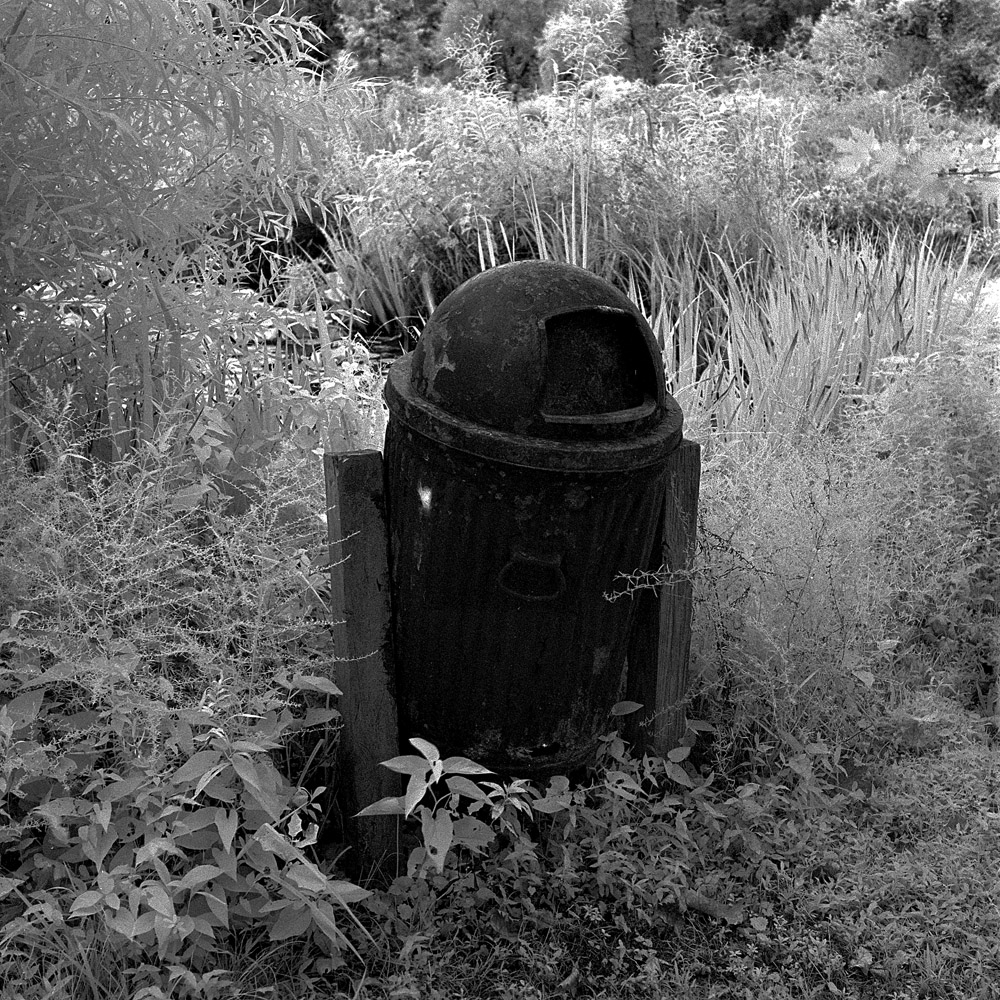
Trashcan, Kenilworth Gardens

The Rollei is a perfect camera for Infrared photography because you can focus and compose your images with the unfiltered viewing lens, so you don’t have to keep taking the filter on and off (the strong infrared filters like the Hoya RM72 I used are anywhere from nearly to completely opaque to the visible spectrum, making it very difficult at best to operate the camera with the filter installed on a single lens reflex camera).

Kenilworth Aquatic Gardens is a 37 acre plot on the east/south bank of the Anacostia River which runs through Washington DC. Owned and operated by the US Park Service, it is one of the hidden gems of Washington DC. The neighborhood around it is still quite rough, which deters casual visitors not familiar with the area. I went looking for the giant lily pads they usually have, but they were nowhere to be found. One of the park rangers informed me that they had to skip the Victoria Lily pads this year due to budget cuts – they normally import them from the Amazon fresh each year.

The Difference Between Color and Black and White

Here are two images of the same scene, one in color, one in black and white. I’m sharing them together to demonstrate how the change from one to the other totally changes the way we feel about the image.

First, the black and white:

Black Boy, Garuda, B/W

Notice the visual emphasis – how the tones draw your eye to specific parts of the scene. What do you find yourself looking at, and relating to? What compels you? What emotions does this evoke?

Now the color:

Black Boy, Garuda, Color

This has a very different balance. The colors change the emotional timbre of the image, as well as the focus point for the viewer, even though both photos were taken from essentially the same vantage point. I think it’s fair to say that in the black and white version, your eye and attention keep coming back to the boy. The image has a more stark, somber feel to it whereas the color image is much more lively, and balanced – it’s easier to view both sides equally. To be entirely fair, some of the impact of the black and white version is due to the way in which it was exposed and processed. This version is fairly high contrast, which makes the dark areas very rich and the whites very pure white. Were it done differently, there would be a greater balance between the boy and the garuda in terms of tones, and it would have a different resonance.

Platinum-Palladium Printing Master Class: Making Negatives

I should have been doing this all along through the class, but we’ve had bad luck with scheduling and are as of now still three weeks behind schedule because of holidays, work schedule conflicts and the like.

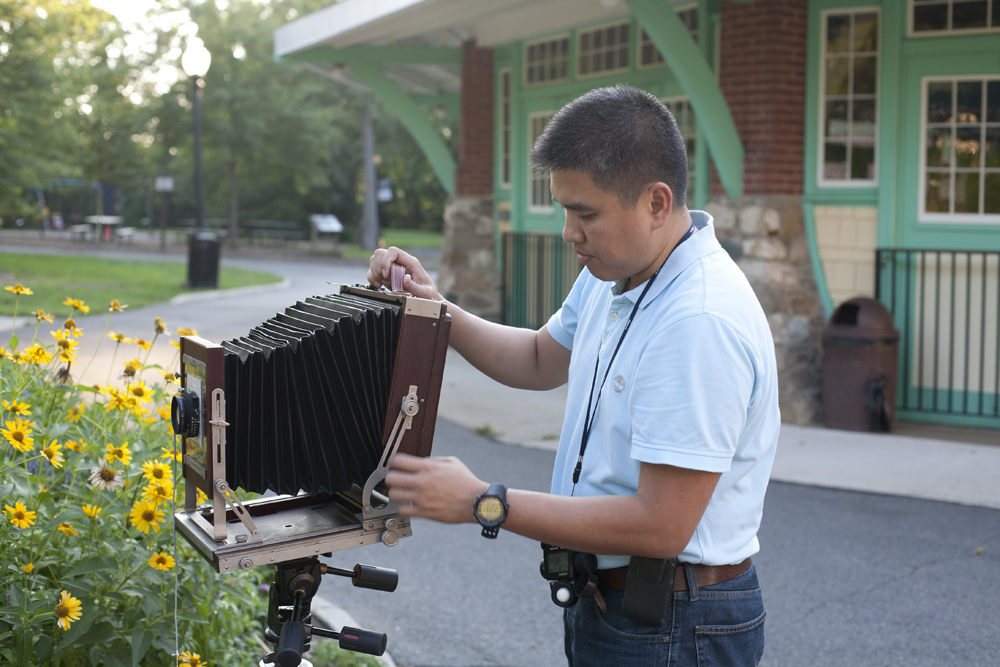
My student brought his 8×10 Deardorff to class, and we went out and shot a few frames around the park. Here he is with the ‘Dorff. Isn’t it a beautiful camera?

Shooting with the Deardorff

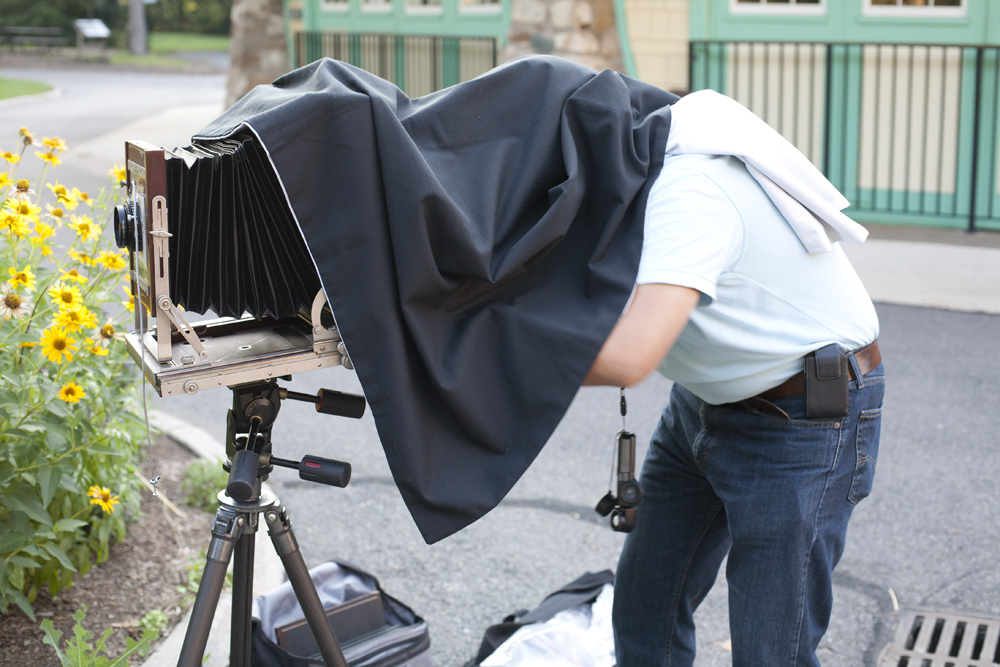
And here he is under the darkcloth. I don’t know why he used it white side in, but it’s his camera, he knows how to use it, so as long as he can focus, I’m not complaining.

Under the Darkcloth
Under the Darkcloth

Here he is pouring a water stop bath into the Jobo drum I brought. We used the Jobo free-standing and not on a processor or roller base – I just ran a water bath for it in a regular developing tray and rolled it by hand. This technique works, but it’s much easier on a proper roller system, and infinitely better on the Jobo processor.

Developing Film
Developing Film

Despite the challenges of processing the film with the Jobo tank by hand, we were able to produce some useable frames. Here he is holding one of the negatives, a portrait of me. Every year he goes back to Vietnam for vacation, and while there he does a fundraising project with photography for a charitable organization. This year, his project is to take portraits of the clients of a clinic that provides healthcare to people exposed to Agent Orange, and sell the prints to raise money for the clinic. It feels really good to me to know I’m having a small part in helping his project.

Finished Negative
Finished Negative