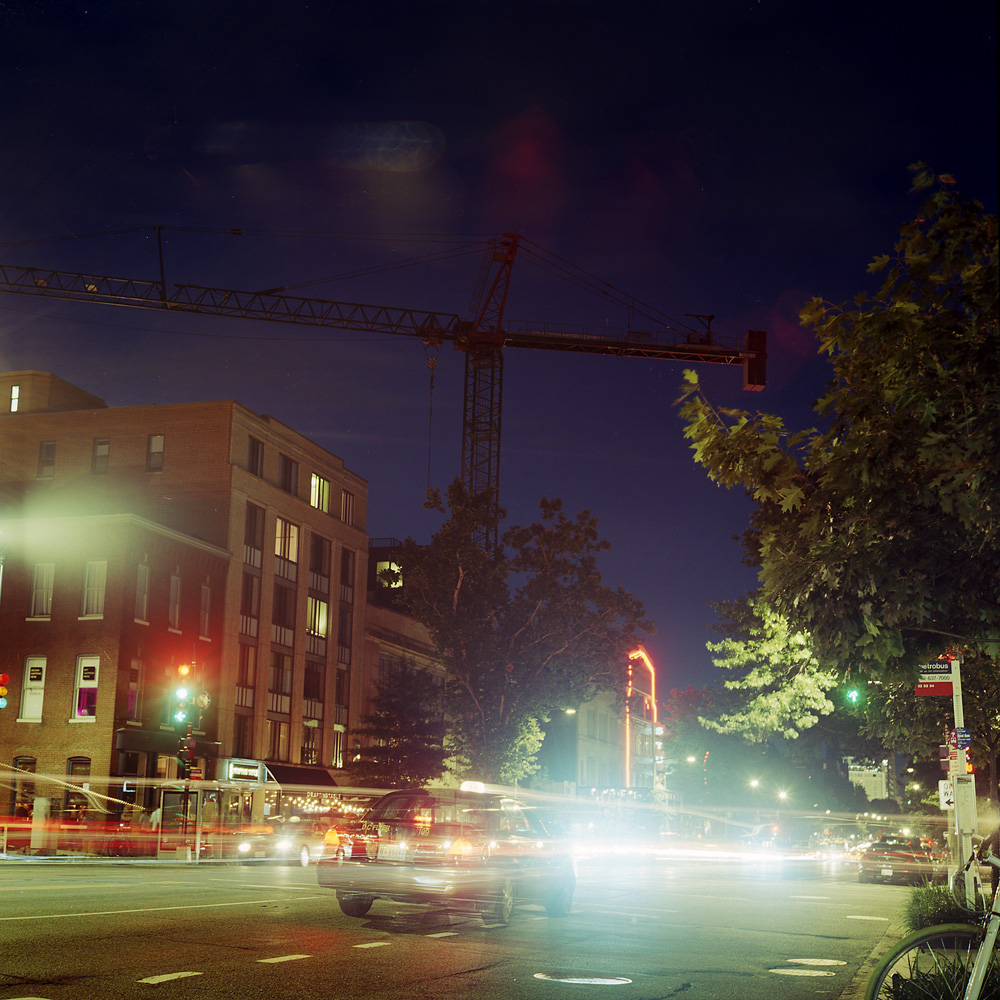
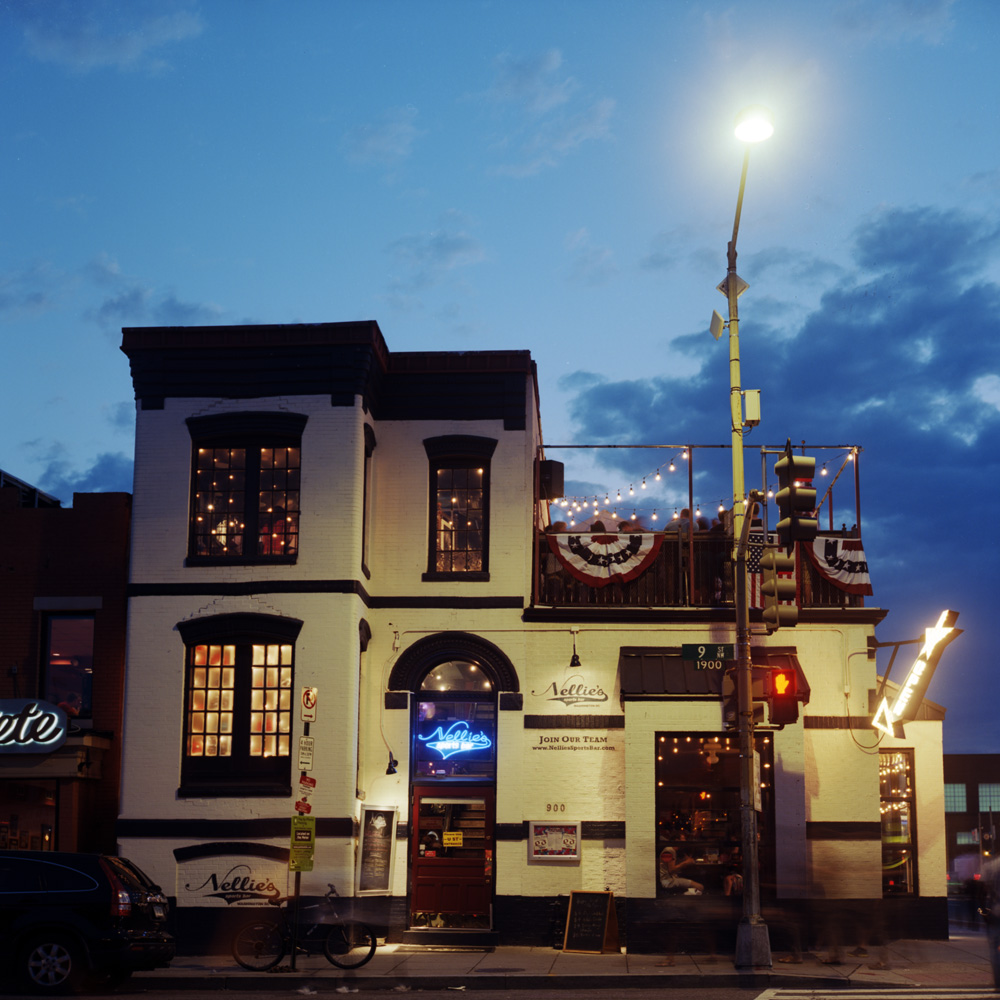
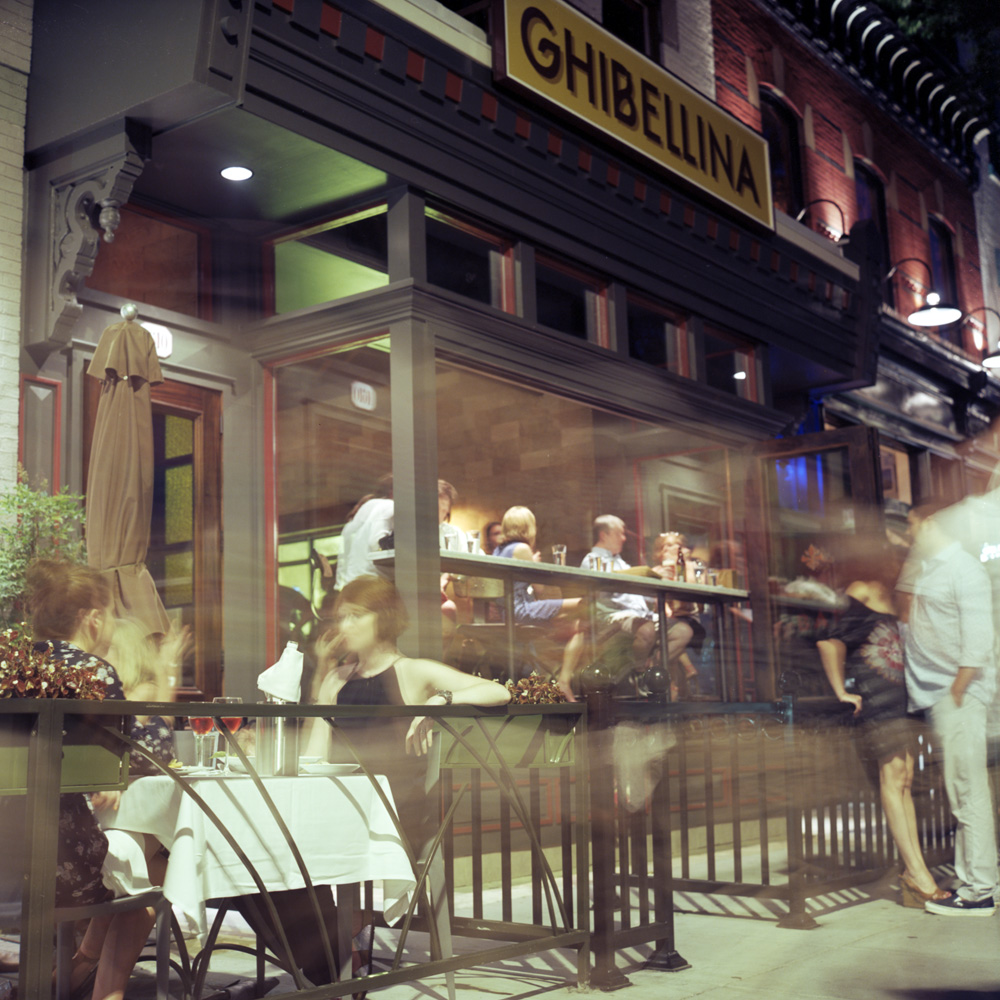
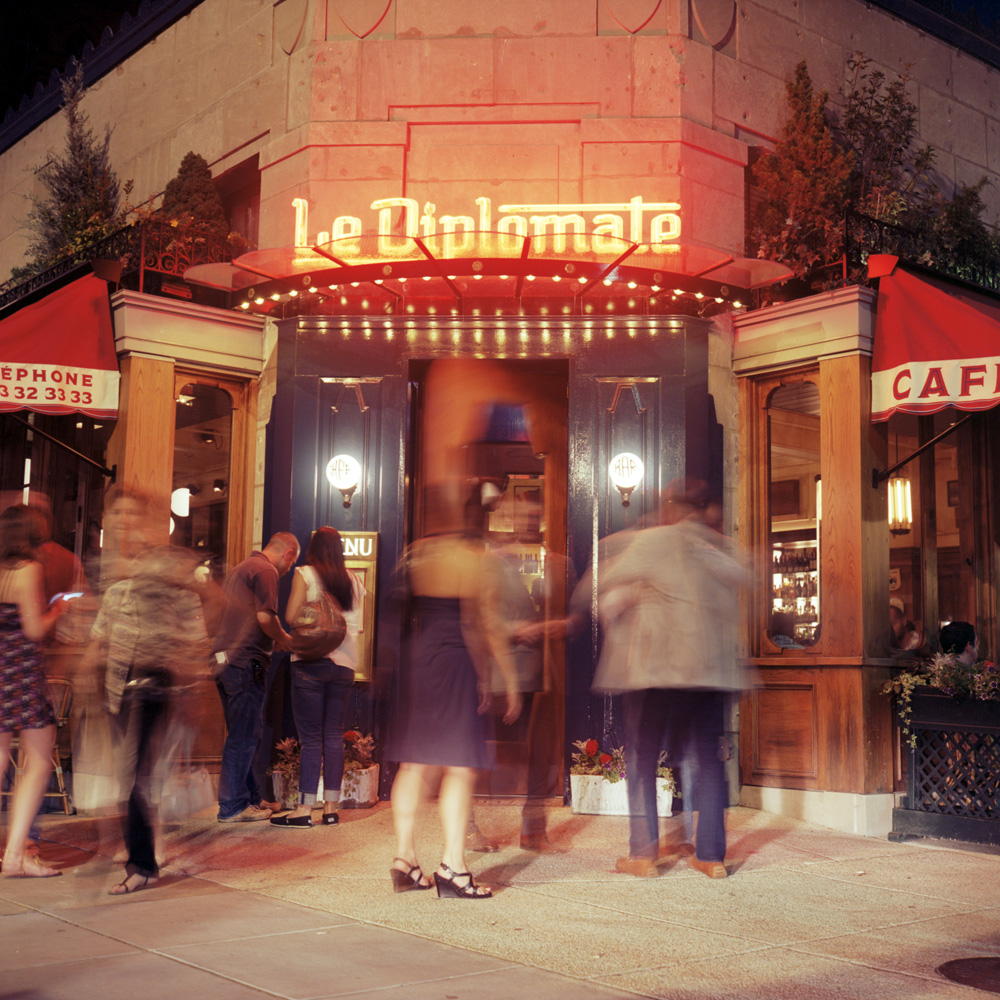
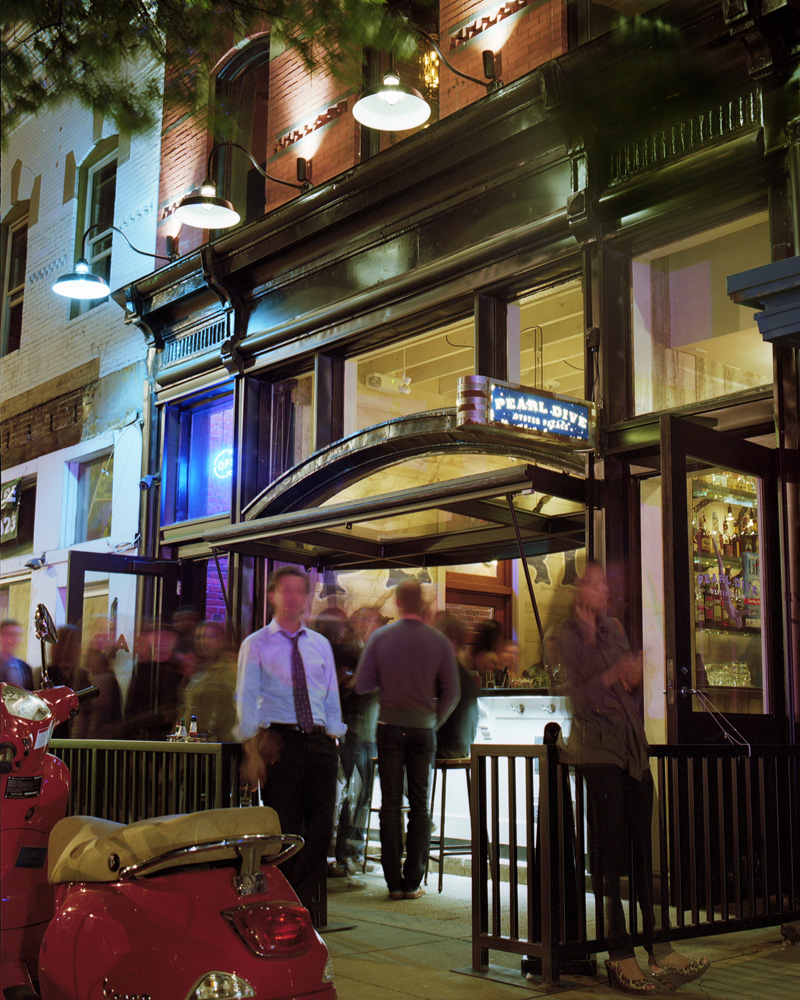
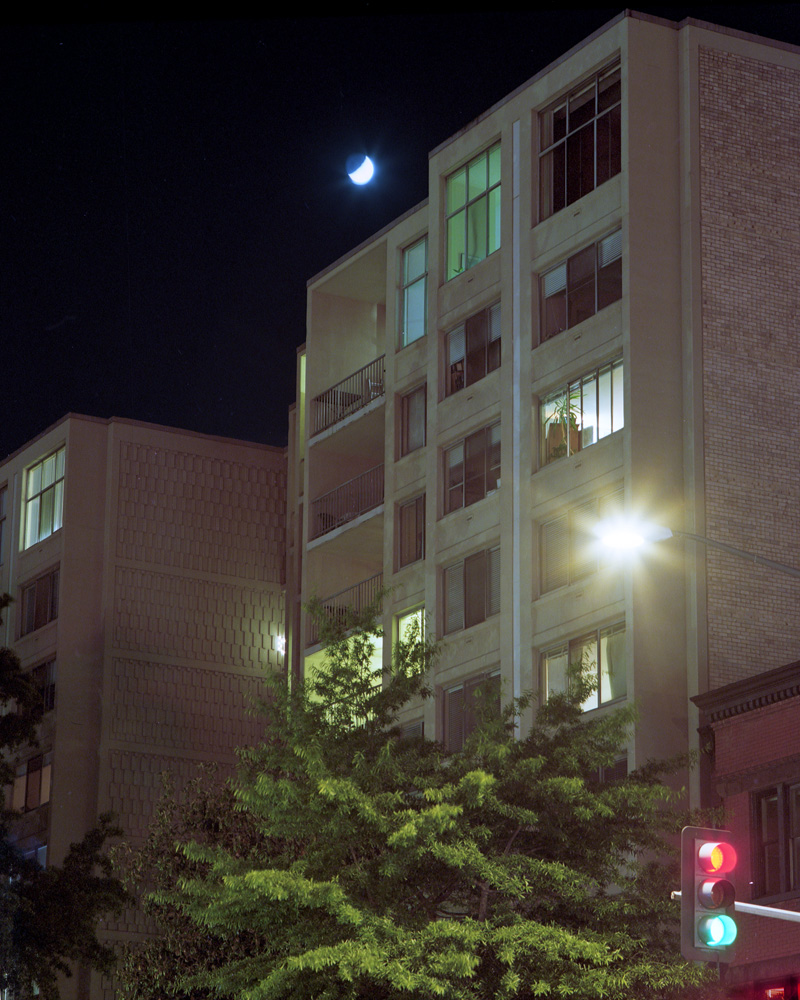
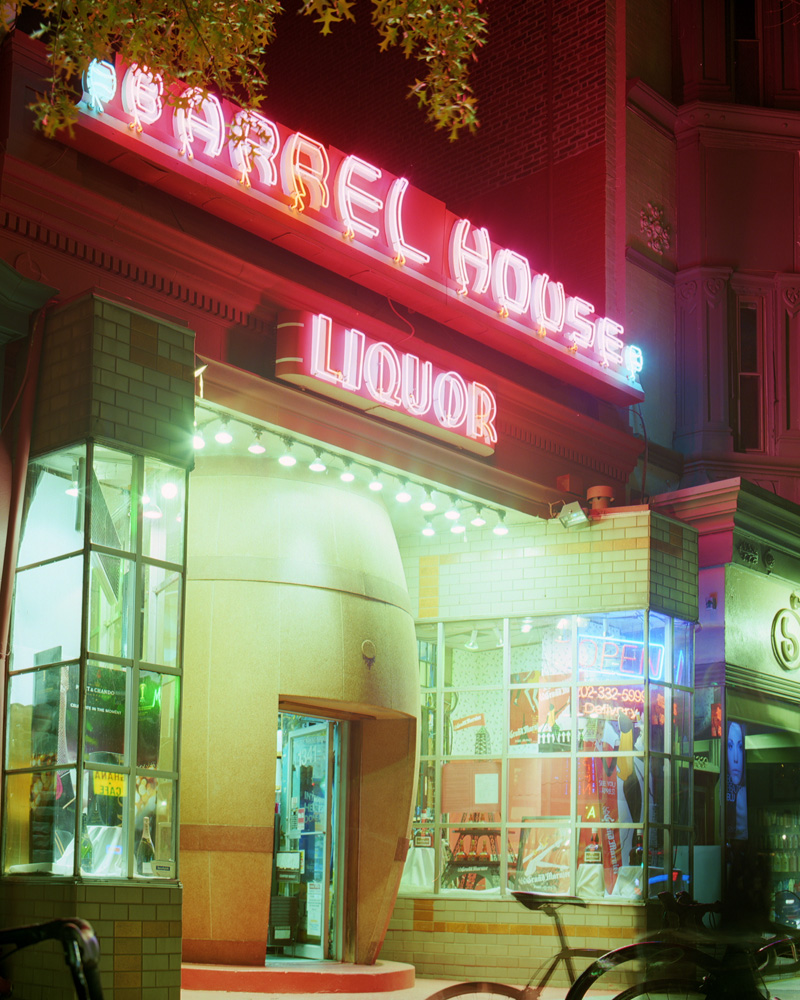
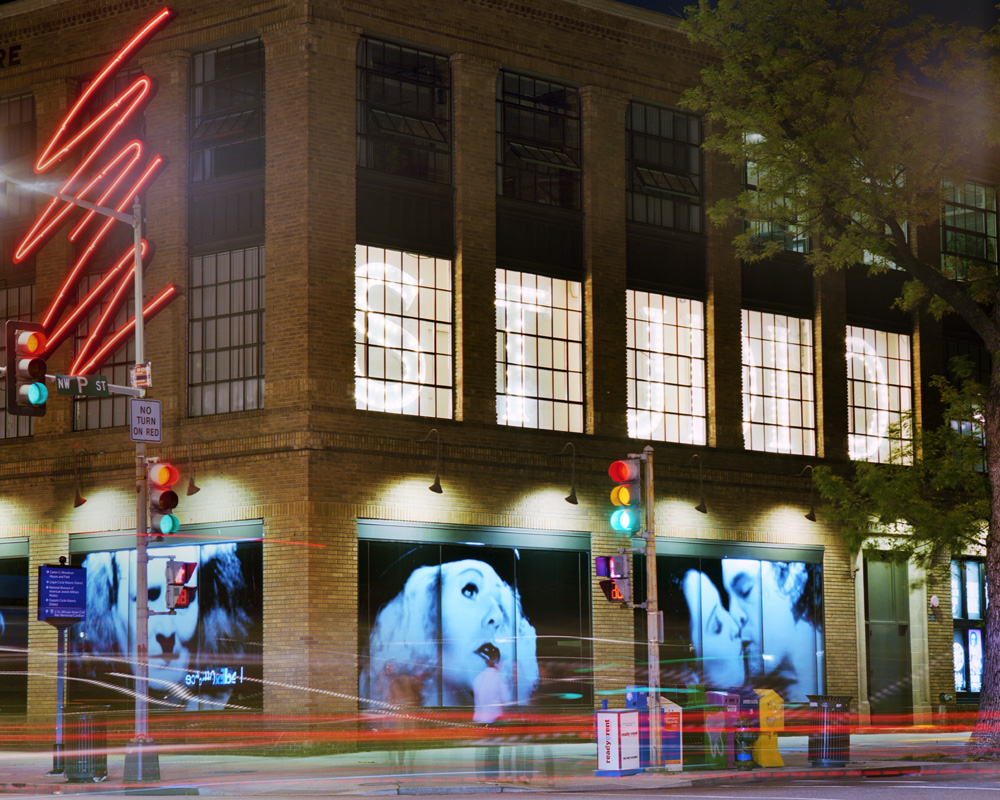
After a LOONG weekend of playing with my printer to get it to cooperate (running out of four different inks @ $60/cartridge, figuring out how to solve problems with head strikes on my prints, running out of paper at $115/box thanks to the aforementioned ink shortages and head strikes), I now have my show completely printed. Eight prints are already framed and ready to go, the remaining 12 are going to be framed tomorrow, and the show hung on Tuesday after work. I’ve done shows before, and of course it’s always hard work, but this is the biggest show I’ve done in terms of volume. Even my biggest past Artomatic was probably 12 prints. I’m very psyched about the show. Here’s a recap for those who can’t make it to the opening (REMINDER: August 2, 7-10 PM, Mad Momos Restaurant, 3605 14th Street NW, Washington DC). This exhibit pays tribute to the parts of Washington I pass through on a regular if not daily basis. I want to show what this town looks like to a resident, as well as showing it in an unfamiliar way even to those folks who do see these things all the time. As I mentioned in my blurb about the reception, I love the way color distorts and transforms at night because we no longer have a single, unidirectional light source of uniform color and quality. I’ve started these photos with late evening/sunset/twilight and progress into deep night to capture the feeling of that time of day. I hope these photos express that sense of drawn out time and transformed space, be it through blurred motion or the interplay of lights.
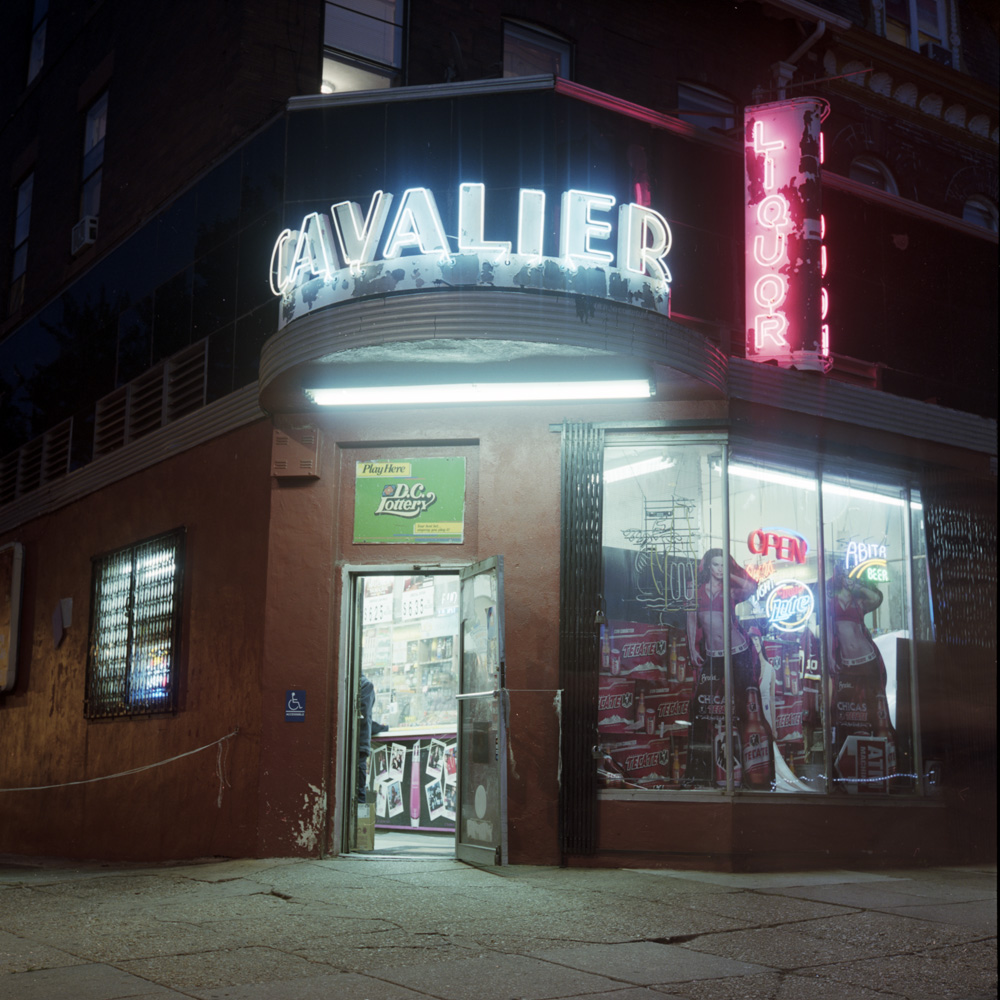
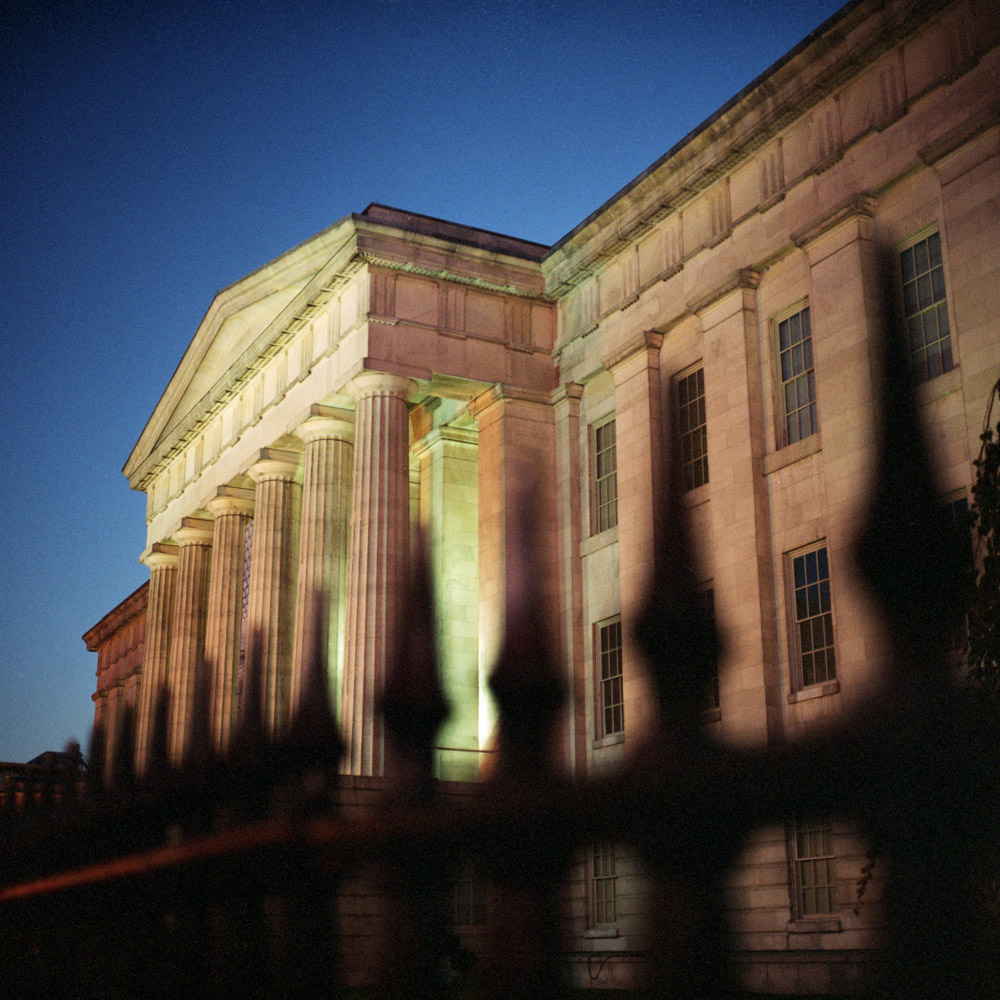
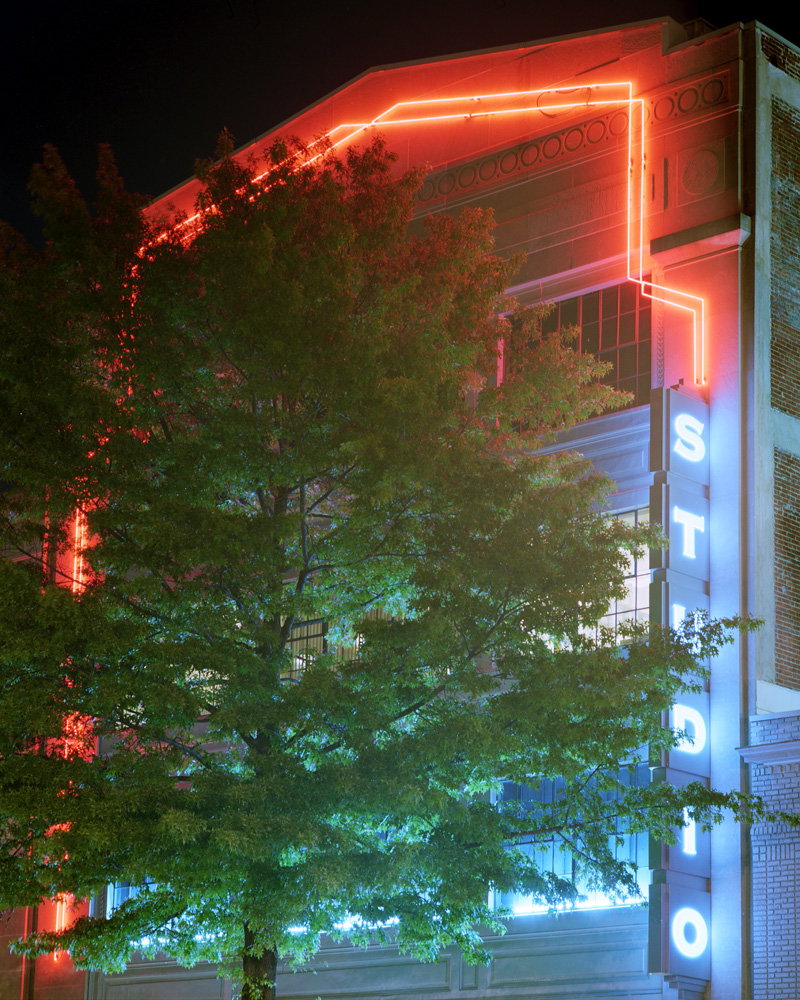
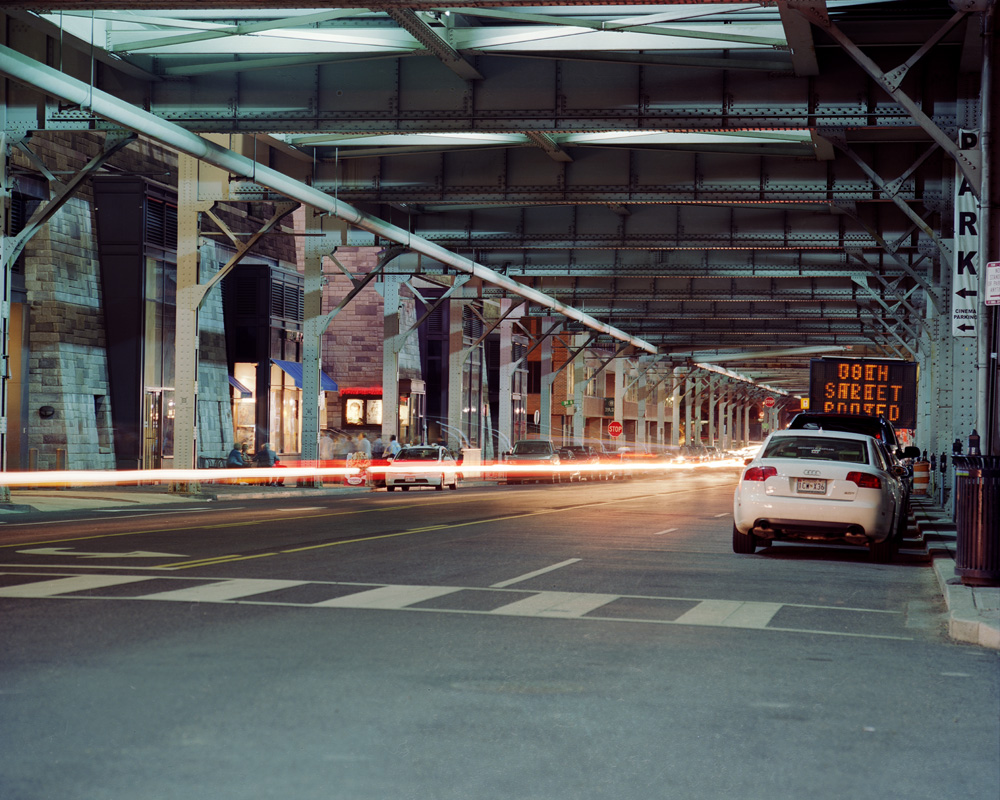
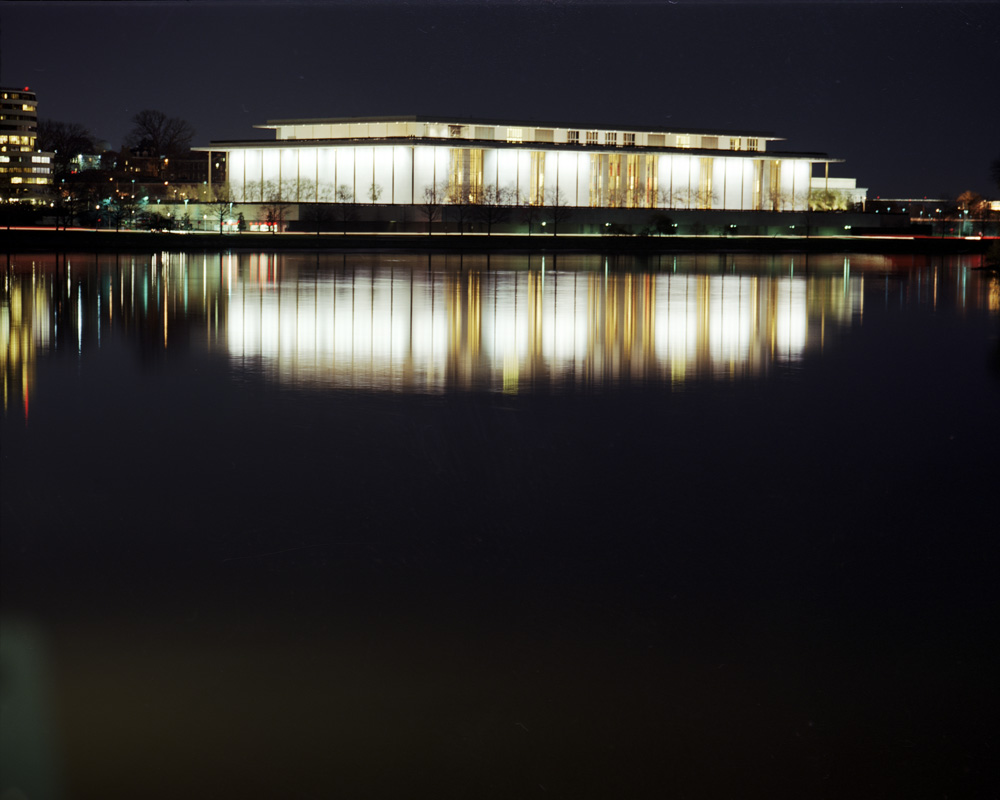
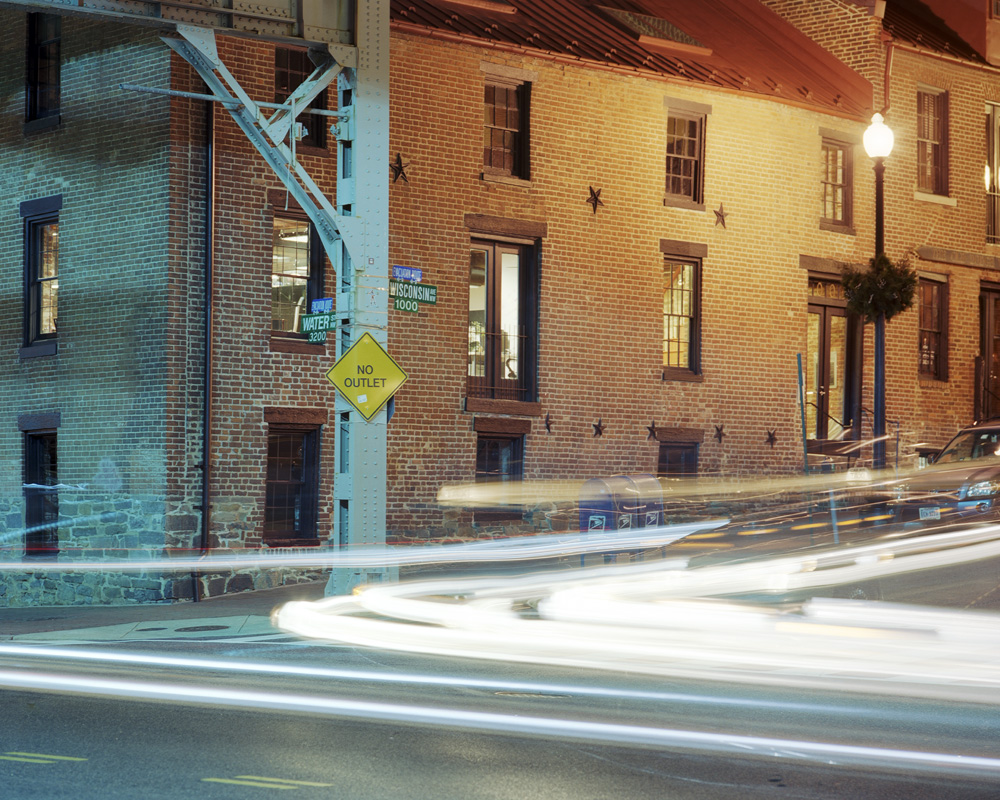
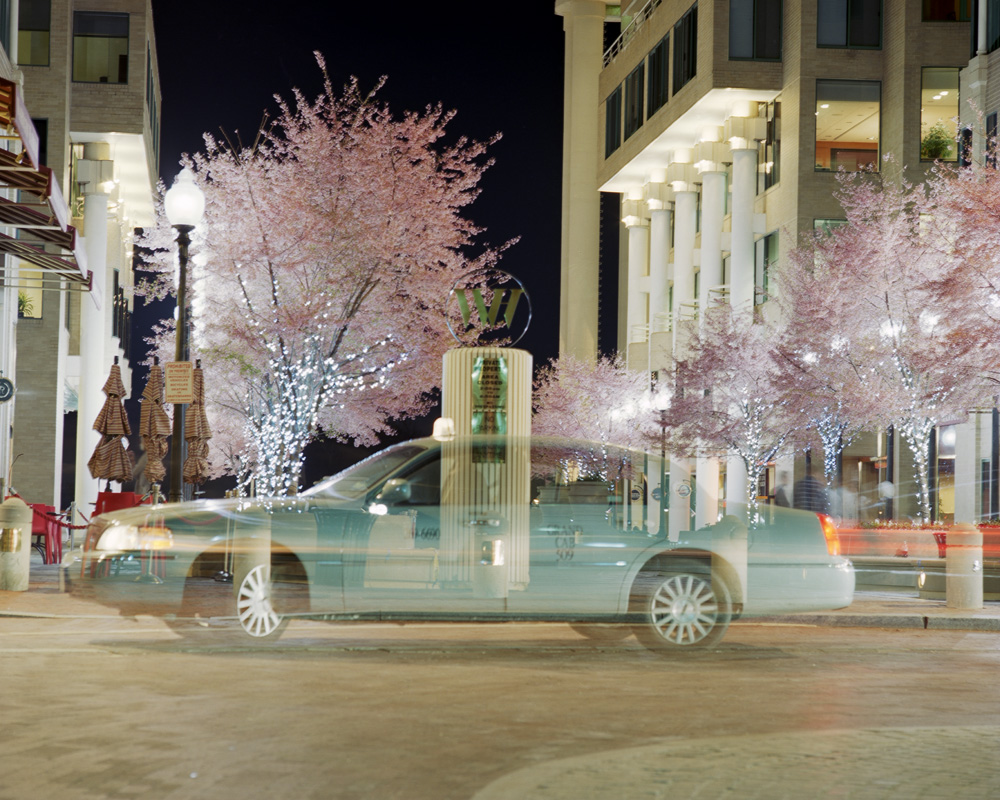
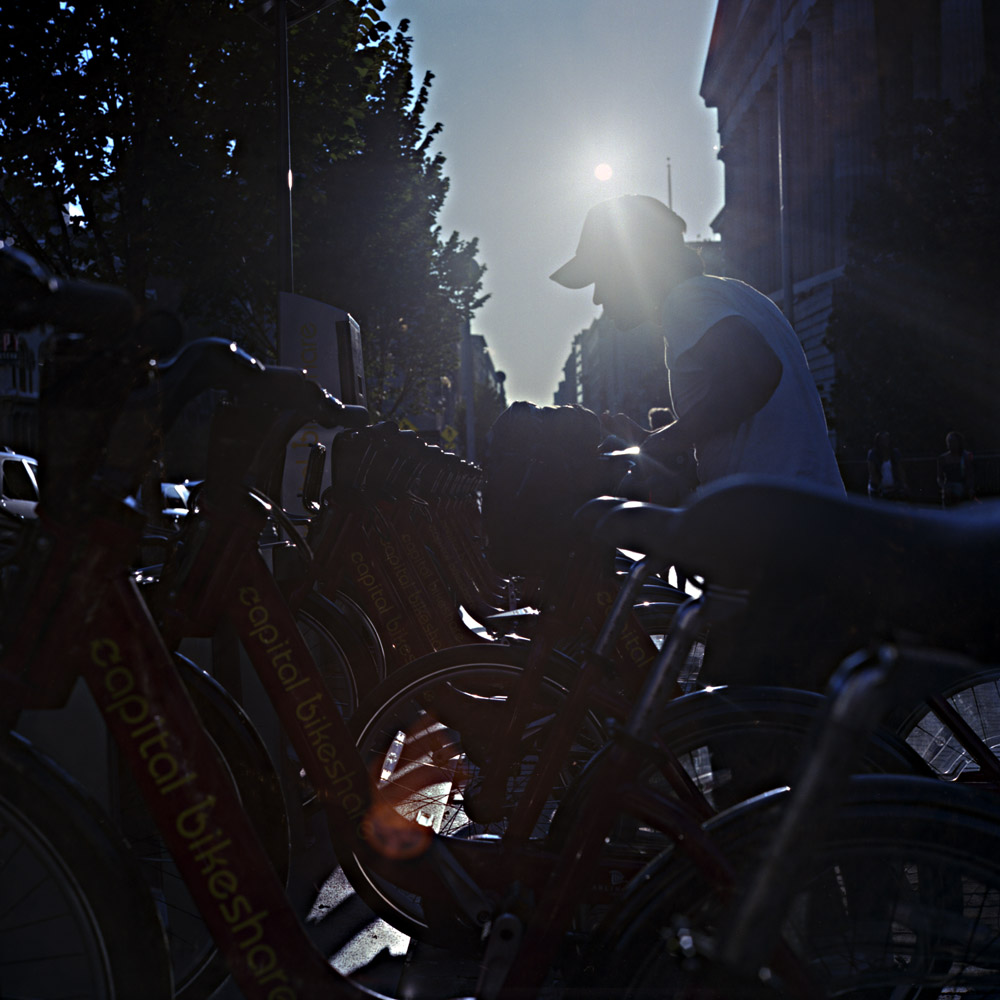
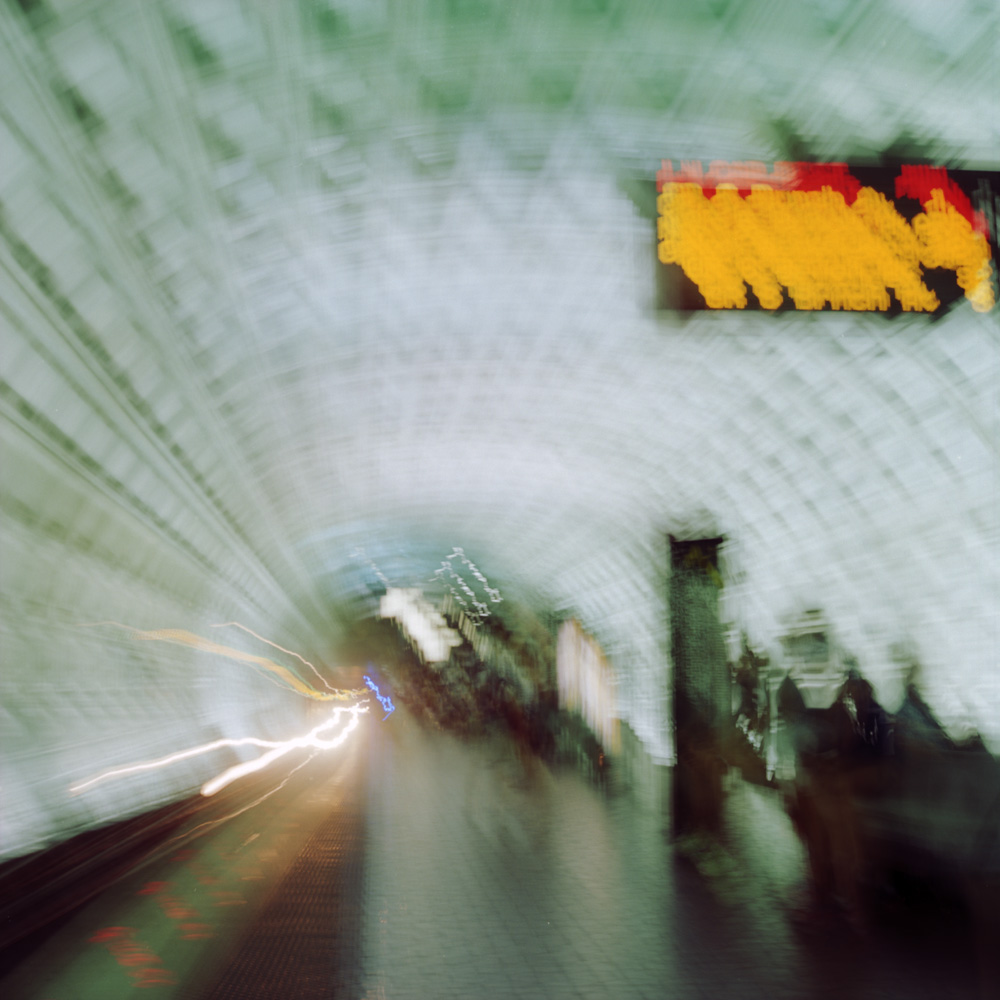
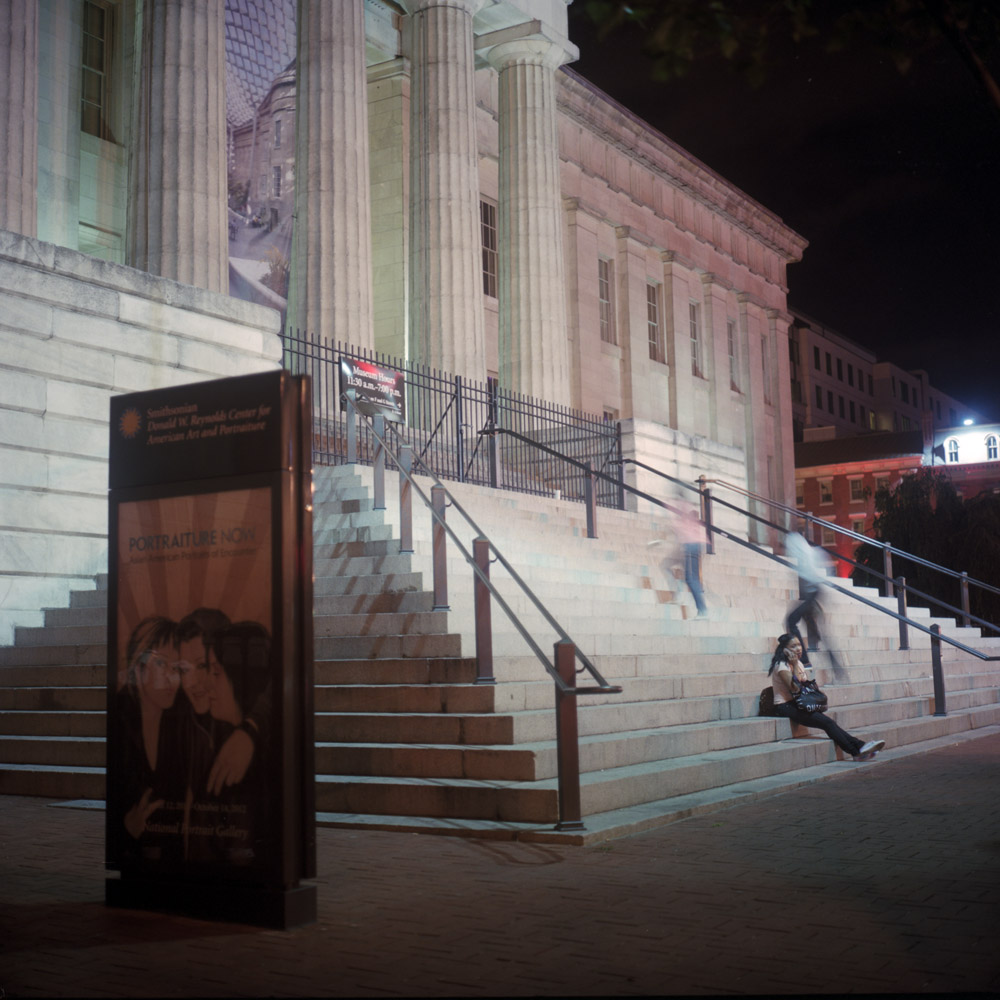
Crane, Traffic, 14th Street, DuskNellies Sports Bar, From 9th StreetGhibellinaLe DiplomatePan Lourdes, in colorCavalier LiquorU Street EveningNational Portrait Gallery, TwilightPearl Dive Oyster Palace, Vespa, 14th Street14th & Rhode Island Avenue, MoonBarrel House LiquorsStudio Theater, from P StreetStudio Theater, from 14th StreetUnder the Whitehurst FreewayKennedy Center, Potomac River, NightWater Street, GeorgetownWashington Harbor, Cherry Blossoms, TaxiCyclist returning his Bikeshare, National Portrait Gallery, SunsetU Street Platform, Oncoming TrainSteps, National Portrait Gallery
If any of you have ever produced a photography exhibit, or any other art exhibit for that matter, you’ll have an understanding of just how complicated an effort this is. I’m lucky in that I am able to do my promotional work online for the most part (this blog, email blasts, internet forums, etc), and I already have promotional postcards printed from the last time I exhibited some of this work. It would not surprise me if I did a truly serious accounting of what it cost to put this show up on the wall and the bill came in somewhere north of $2500. I know the framing bill alone is in the region of $1100-$1200. Postcards? about $200 for good quality printing from Modern Postcard. Paper and ink? $300. And that’s just the obvious, not counting the two years it took to shoot the images, the film and processing, the editing process, the dinner bribe for my friend who helped with the editing, and all the hardware and software (21.5″ iMac, Epson V750 scanner, Epson 3880 printer, Photoshop CS5, SilverFast AI 8, Gretag-Macbeth EyeOne calibration software and hockey-puck). To say nothing of 20 years of accumulated experience required to produce images like these.
I’m having an opening reception for my exhibit, “The Colors of Night” on Friday, August 2, from 7-10pm at Mad Momos Restaurant, 3605 14th Street NW. The exhibit runs from August 2 to the end of October.
From the Mad Momos invite:
Mad Momos is proud to present photographs by DC area photographer, Scott Davis. Please join us for the opening reception to enjoy the photos, meet the photogrpaher and sip on complimentary California Champagne.
What is the color of night? It is indigo, it is fluorescent cyan, it is neon reds, yellows and blues. It is sodium-vapor pink, and glowing incandescent orange. It is all of the above, filled in with the colors of your imagination. It is the color of time slowed down, motion blurred, things and people half-seen through their background, perceptions distorted.
Le Diplomate
I have been shooting a lot of night-time work both in black-and-white and color, for several years now. Photographing long exposures at night gives you a creative freedom to accept serendipitous happenstance in your work that you would reject if caught in 1/60th of a second. Blurred motion becomes a good thing. People become icons. Cars are ghostly, their tail lights and headlights reduced to abstractions and records of things that were, like handwriting on paper. Colors become incredibly rich and even more important, since sometimes it is only by color that you can define and understand an object. The mixed lighting you find in a photograph of a night scene changes our perception of mood in a way you aren’t aware of when you are there – your brain color-corrects light sources automatically so things look “right”, but capturing them on film, which can only record what’s actually there without interpretation, reminds us that we do in a manner of fashion walk through the world with rose-colored glasses.
I should have been doing this all along through the class, but we’ve had bad luck with scheduling and are as of now still three weeks behind schedule because of holidays, work schedule conflicts and the like.
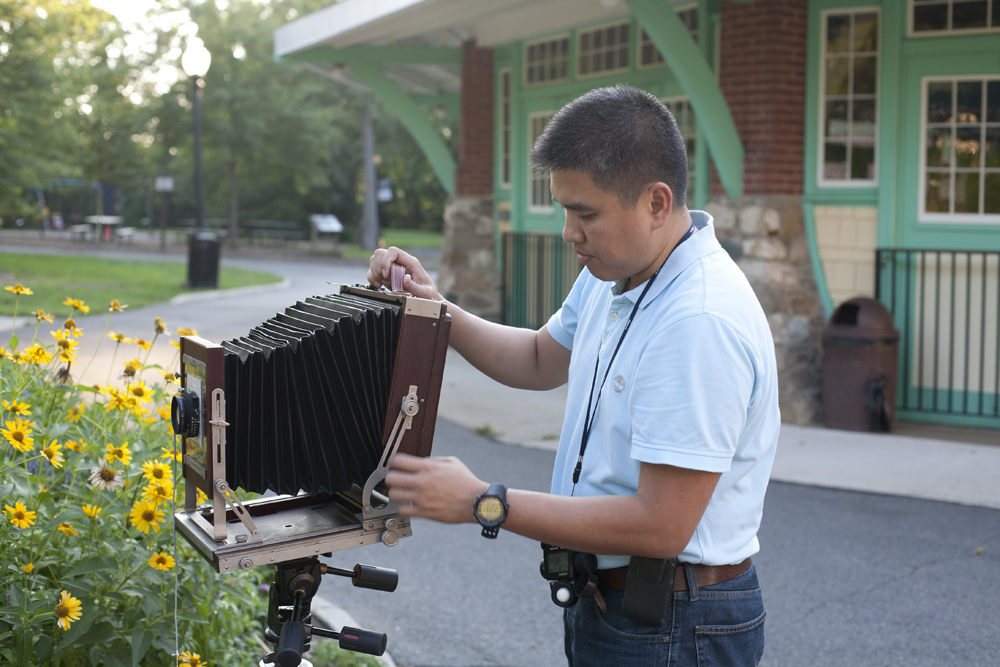
My student brought his 8×10 Deardorff to class, and we went out and shot a few frames around the park. Here he is with the ‘Dorff. Isn’t it a beautiful camera?
Shooting with the Deardorff
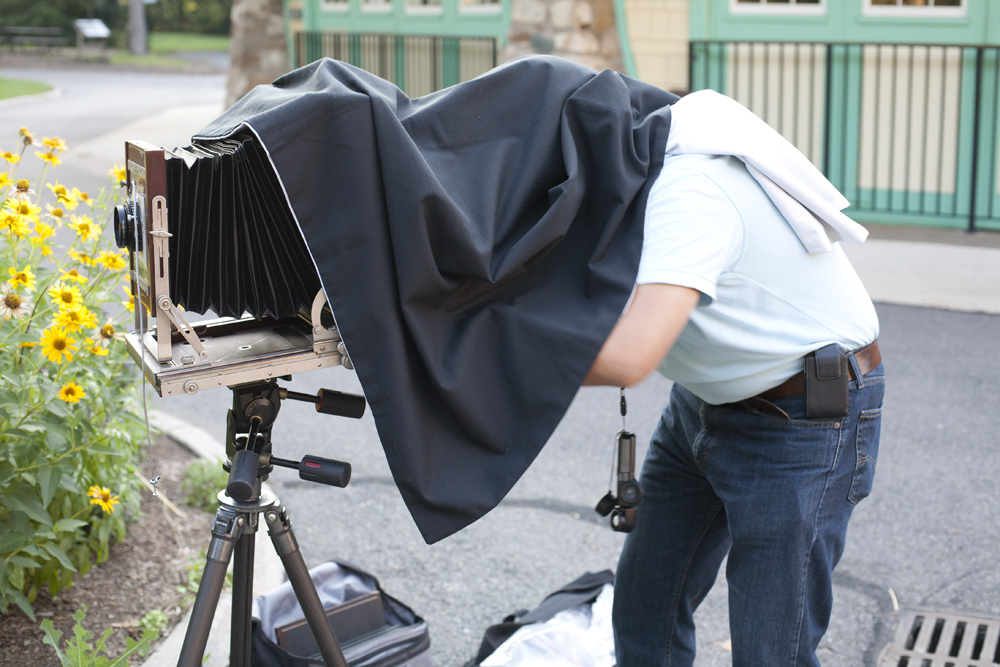
And here he is under the darkcloth. I don’t know why he used it white side in, but it’s his camera, he knows how to use it, so as long as he can focus, I’m not complaining.
Under the Darkcloth
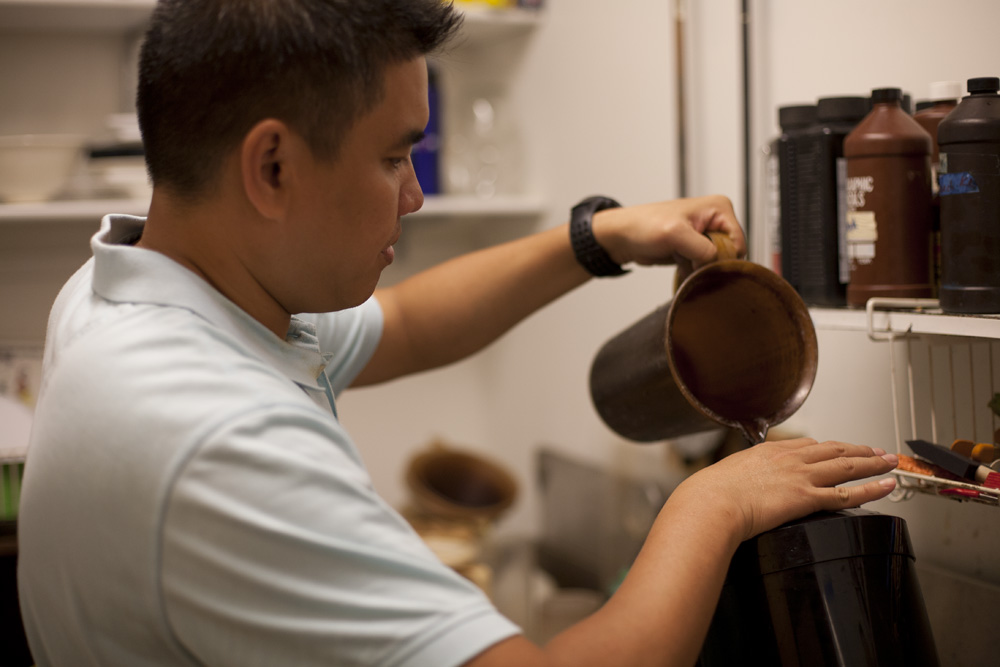
Here he is pouring a water stop bath into the Jobo drum I brought. We used the Jobo free-standing and not on a processor or roller base – I just ran a water bath for it in a regular developing tray and rolled it by hand. This technique works, but it’s much easier on a proper roller system, and infinitely better on the Jobo processor.
Developing Film
Despite the challenges of processing the film with the Jobo tank by hand, we were able to produce some useable frames. Here he is holding one of the negatives, a portrait of me. Every year he goes back to Vietnam for vacation, and while there he does a fundraising project with photography for a charitable organization. This year, his project is to take portraits of the clients of a clinic that provides healthcare to people exposed to Agent Orange, and sell the prints to raise money for the clinic. It feels really good to me to know I’m having a small part in helping his project.
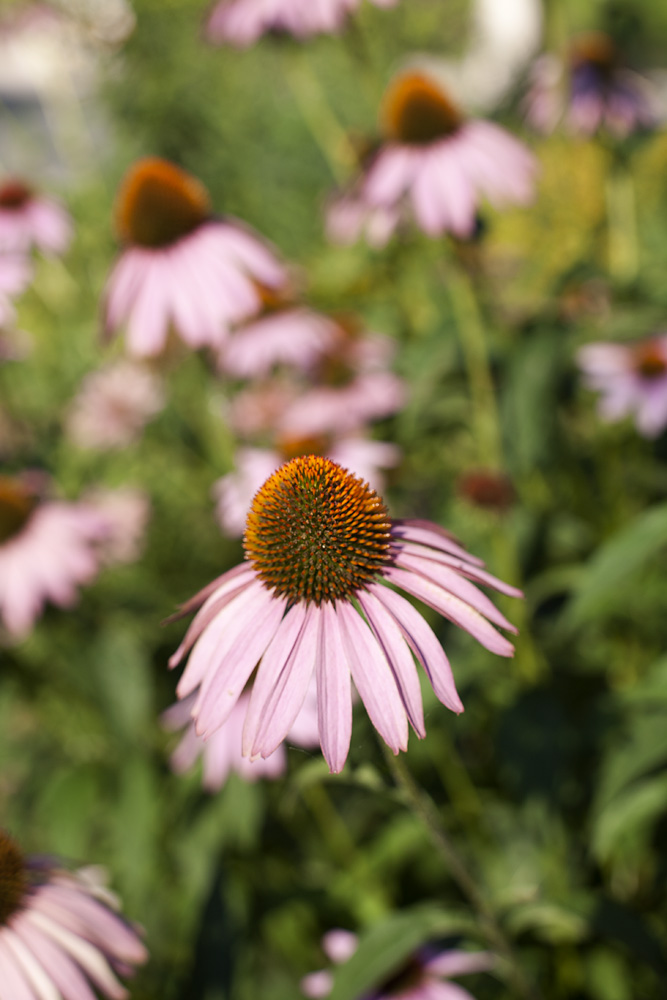
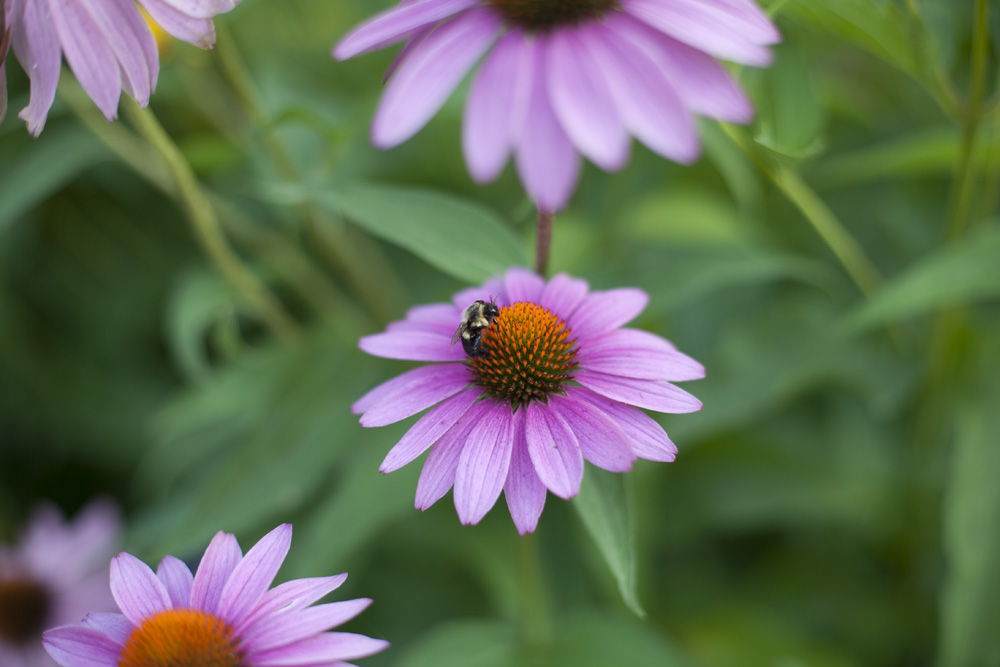
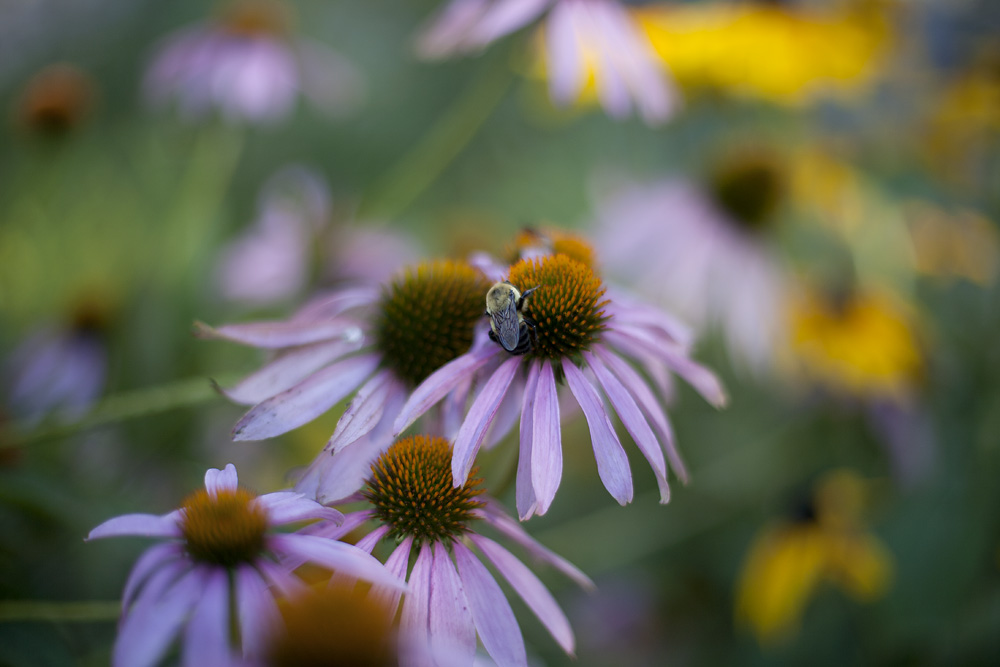
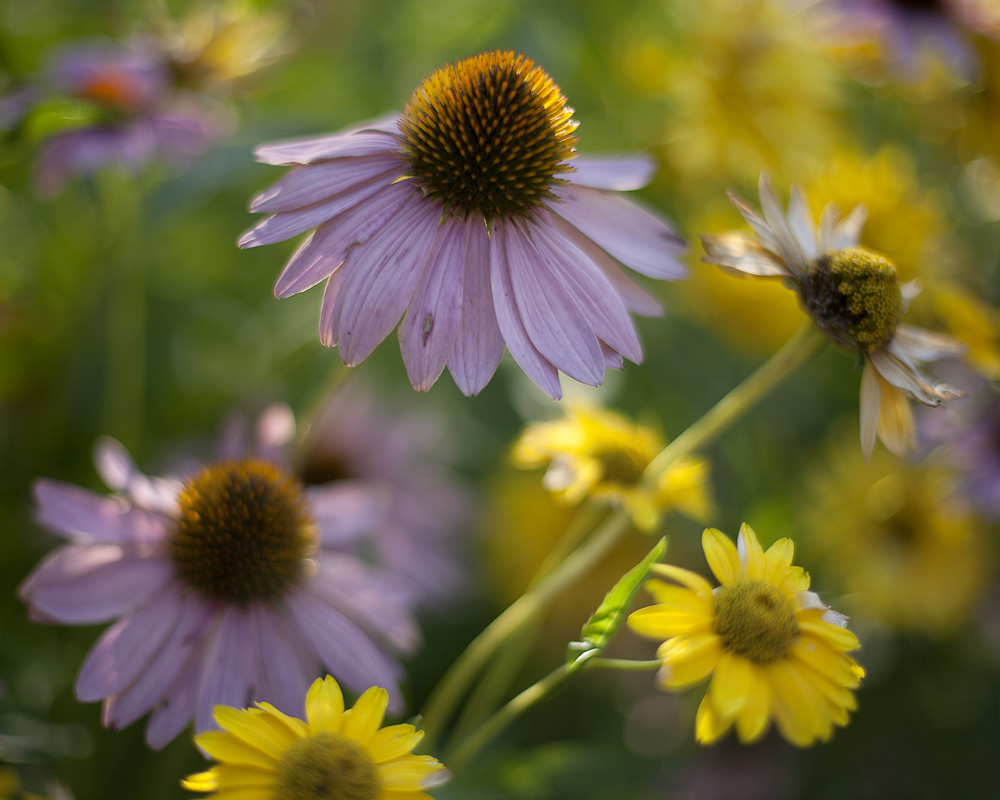
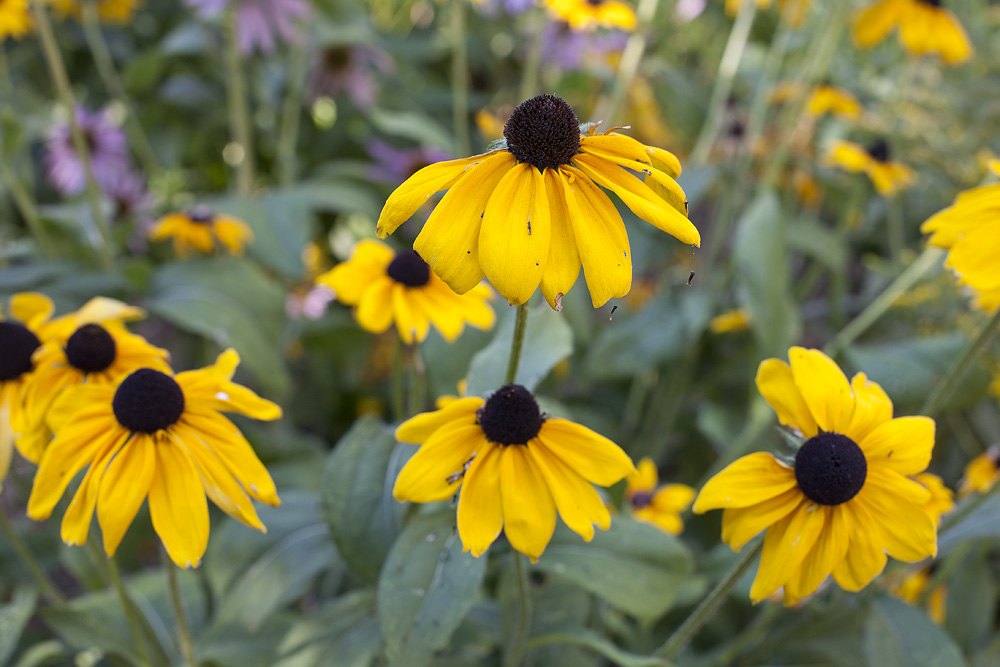
There are some really great flower beds at Glen Echo, and the US Park Service does a terrific job of maintaining them. While waiting around for my student to arrive, I wandered about and took some close-up shots of the cone flowers and Black-Eyed Susans.
Cone FlowersBee, Cone FlowerBee, Cone Flowers
These were all shot with my regular 50mm f1.4 lens on my Canon 5D, not a special macro lens. I’m impressed with the close-focus capability, considering it ISN’T a macro lens. But I would love to try one of the L-series tele-macros for doing insects and the like. Bees get rather skittish, as do butterflies.
Cone Flower, BacklitBlack-Eyed Susans
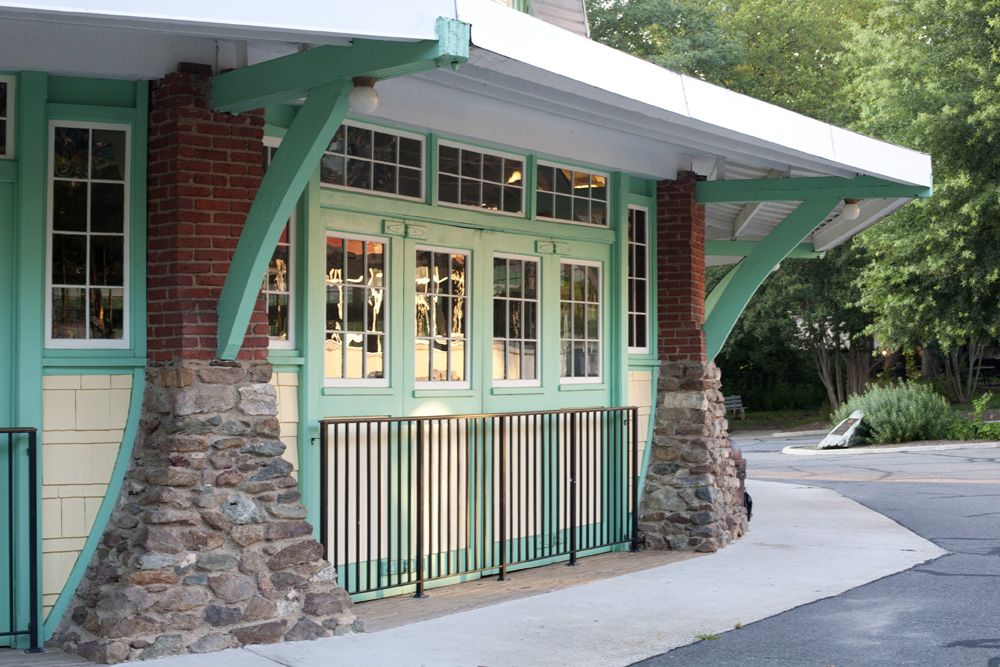
Zooming out, metaphorically speaking, here are some shots of the buildings around Glen Echo, which you’ve seen variations of before here on my blog.
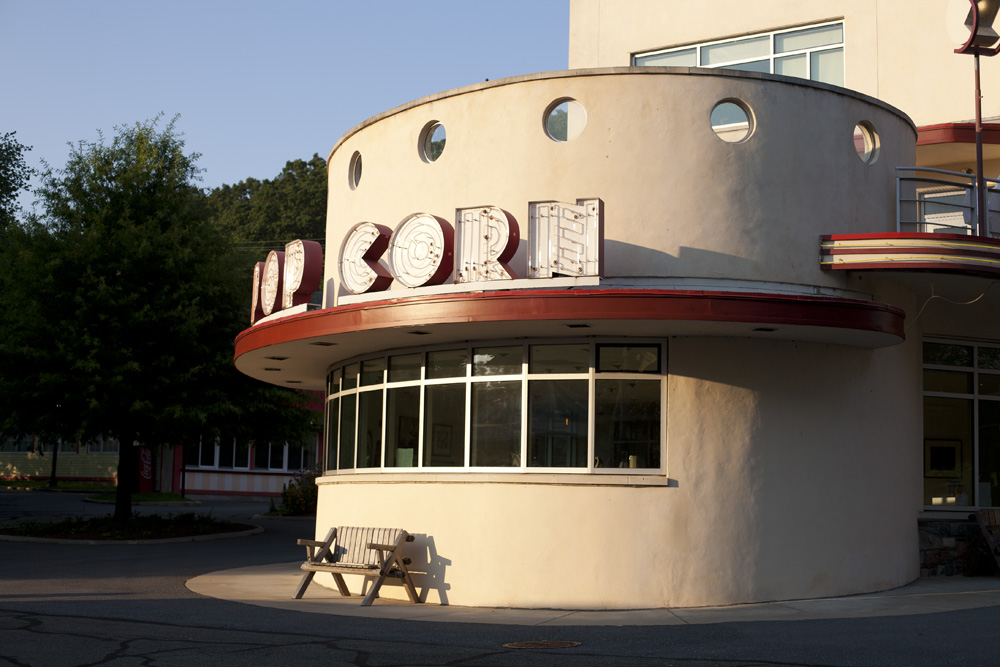
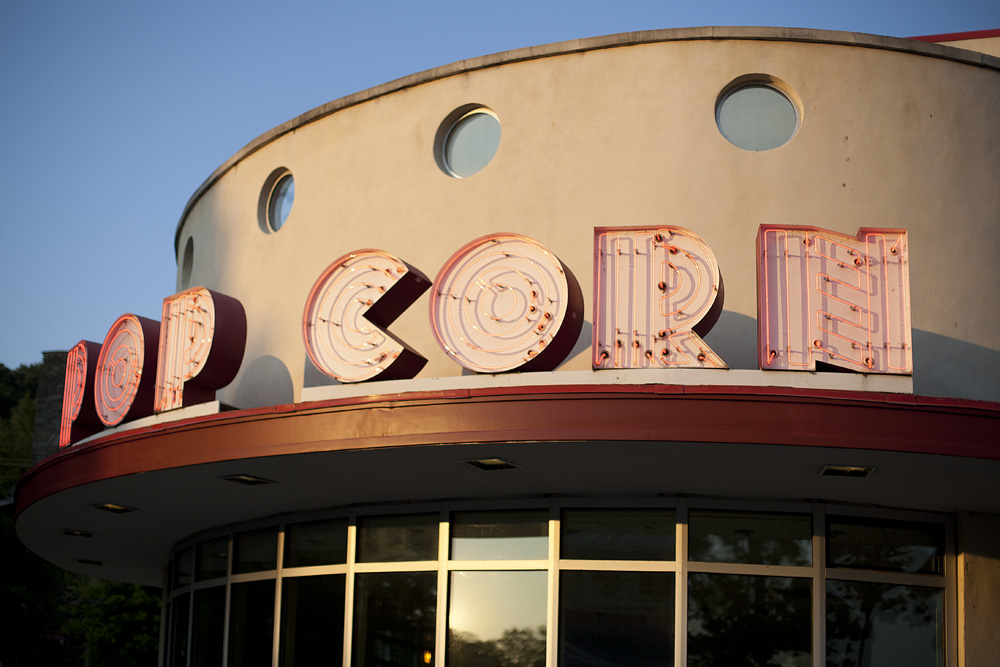
The light was changing as my student and I were out for him to take photos with his 8×10 to use as practice negatives for platinum/palladium printing. While he was shooting his 8×10, I had the Canon with me and caught the Popcorn sign and the reflections on the windows of the carousel as the light was dropping and the neon came on.
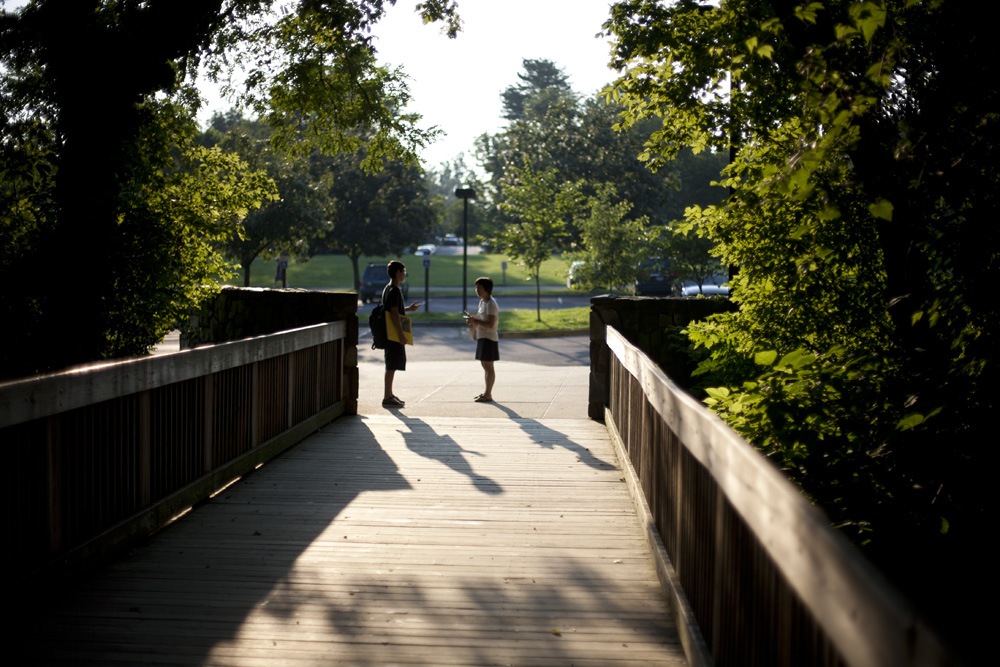
Glen Echo Bridge, Evening
The bridge that leads over the stream to the parking lot had beautiful slanting sidelight on it, and framed these two people perfectly, casting long shadows.
Glen Echo Sign, From the Parking LotGlen Echo Sign, Moon
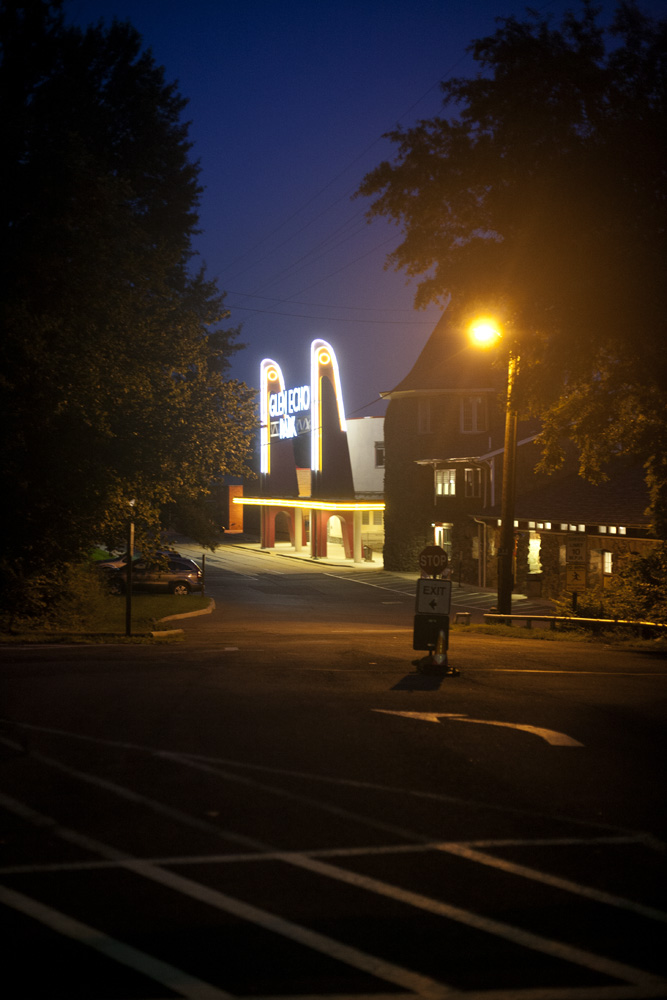
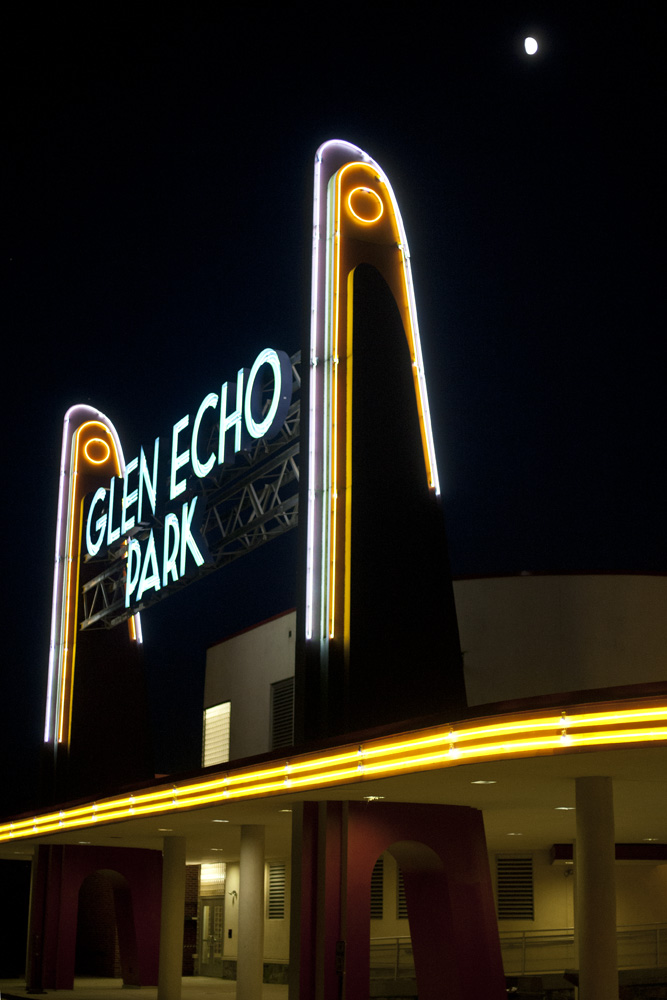
This is what I saw on my way out, after class was all done and I was walking back to the car. The Glen Echo sign is particularly magnificent and at the same time haunting after dark, because of the emptiness, especially on a weeknight.
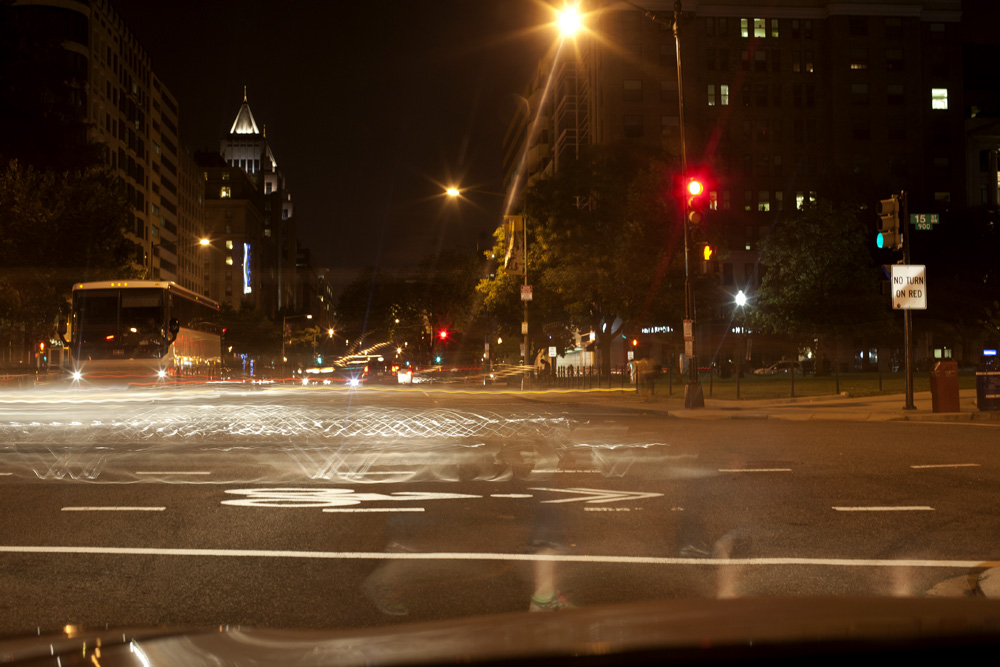
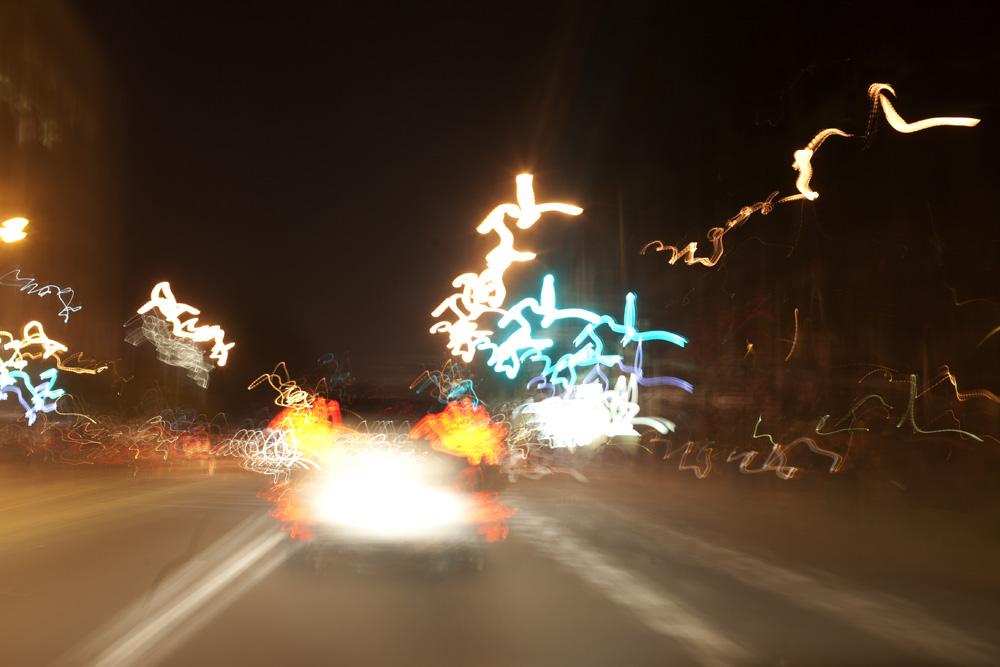
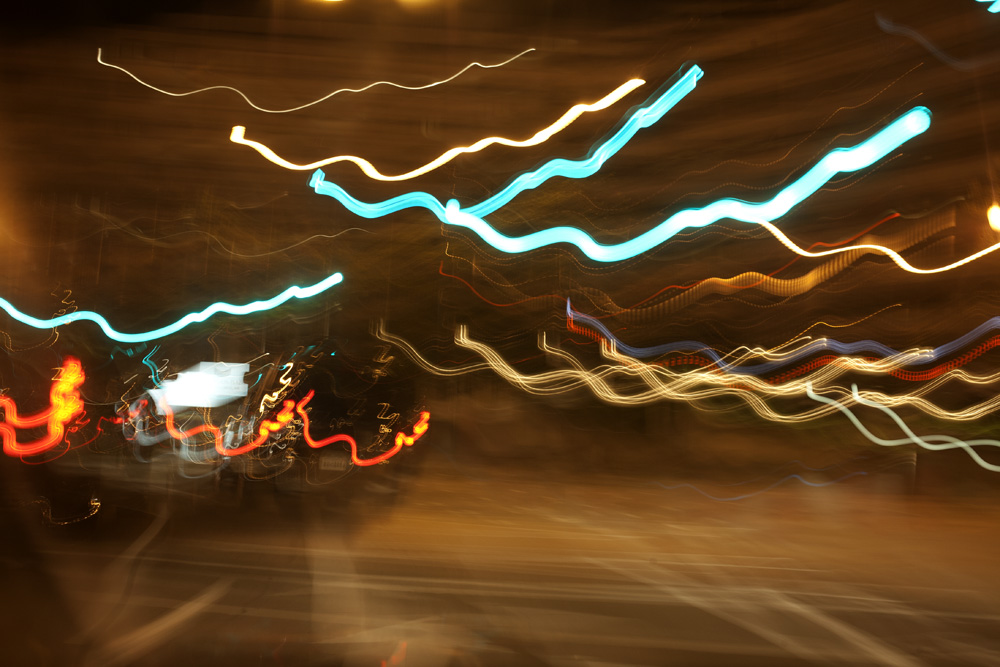
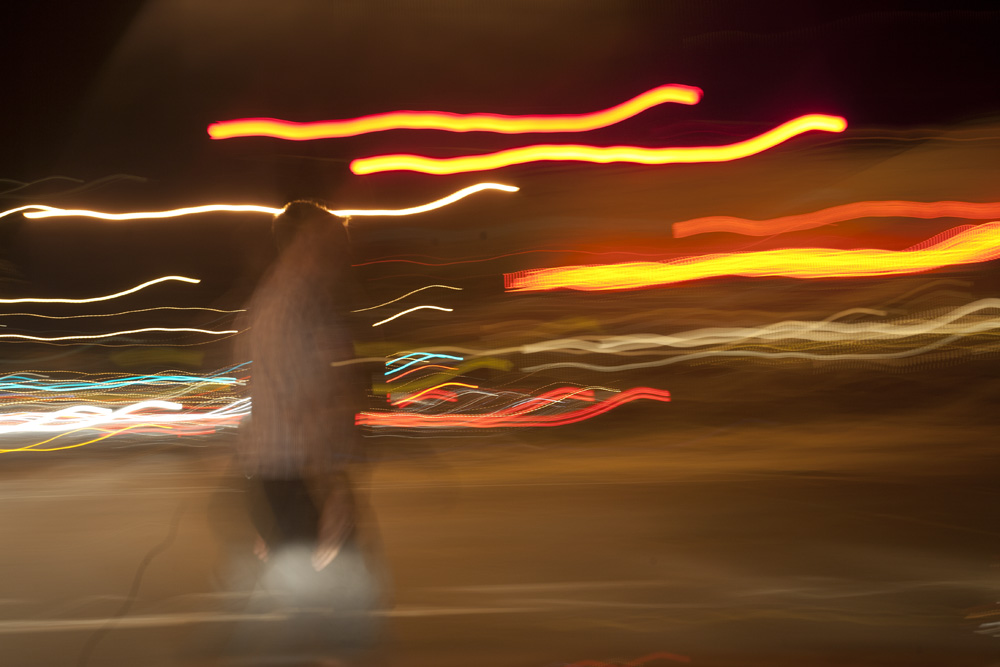
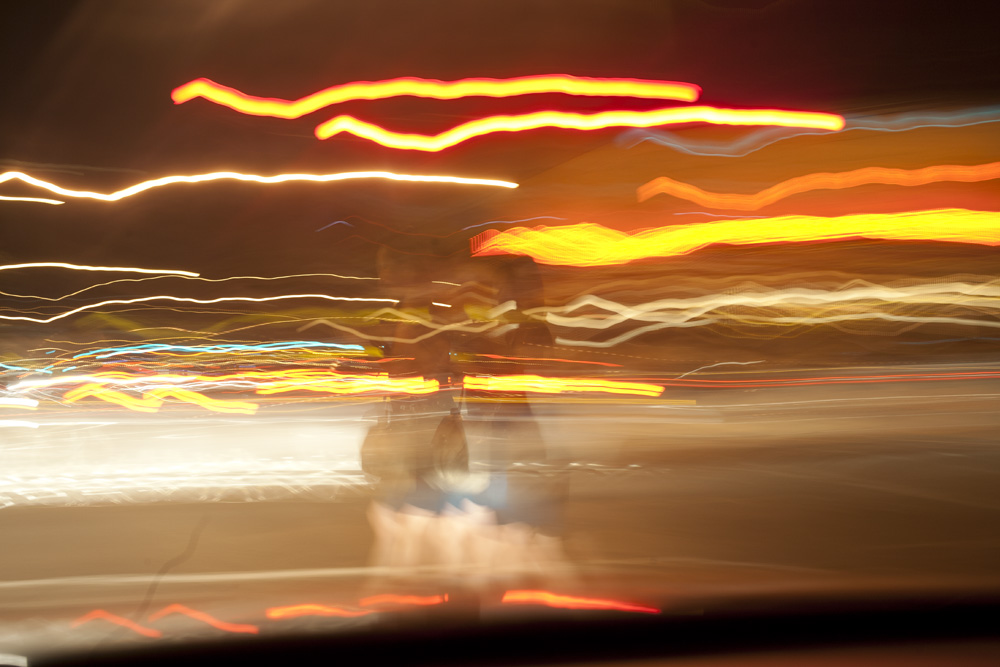
I was coming home from class out at Glen Echo, and had the 5D in the front seat with me. I was feeling bored sitting at traffic lights, and decided to play with long time exposures.
Street Crossing – At the Light
This first one was hand-held, balanced on the steering wheel, while waiting at the light. The exposure is long enough that only the reflectors in the bike wheels, lit by my headlights, and the legs of pedestrians who passed through their beams, recorded.
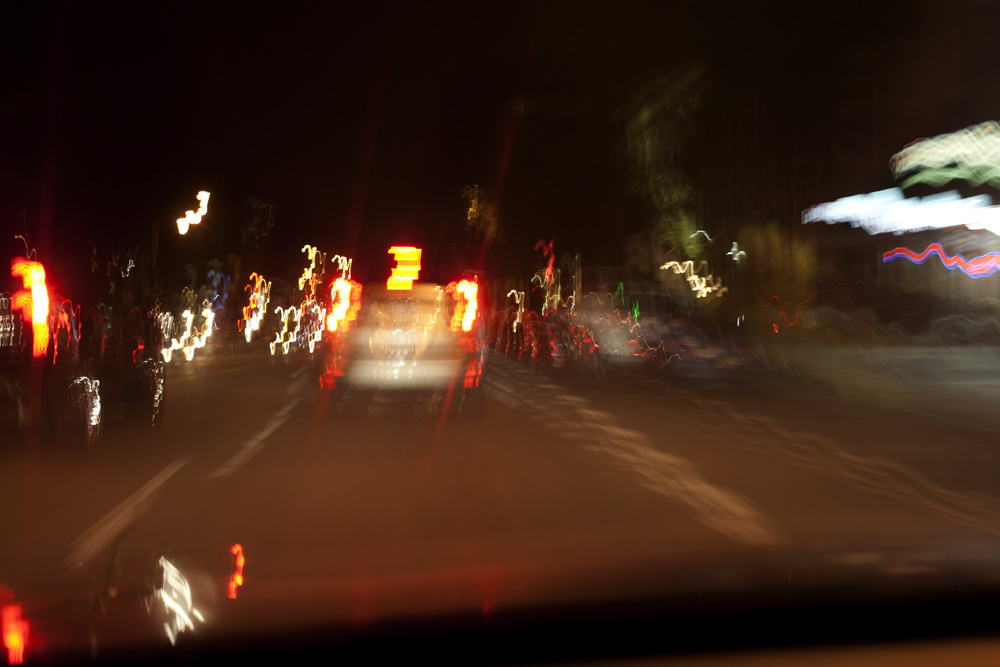
Following Traffic #1Following Traffic #2Following Traffic #3 – Traffic Circle
I realize taking these shots was a bit insane, but I wanted to see what I could get with motion blur of the buildings and oncoming lights, while keeping the vehicle I was following sharp. The following bit didn’t work so well (for that I need some kind of brace I can clamp to the center console), but I think the results are pretty darned cool anyway.
Two more shots from stoplights, watching pedestrians cross. In these cases, though, I was aiming for following the pedestrians. These would have been good candidates for second-curtain flash, but I was in the car, driving, and I don’t have a convertible to hold the flash out the top. So more cool experiments result. And all the more justification for getting a convertible!
Here are some color shots I took on my neighborhood walk around, last weekend. I noticed a theme of small businesses in the shots I was taking, so I decided to make a grouping out of them for this post. The areas I was photographing are actually very bustling and vibrant, but A: this was on a Sunday afternoon, and B: it was about 93 degrees Farenheit outside, so it looks far more desolate than it actually is, but that allowed me to focus on the appearances of the businesses themselves. My interest in photographing them without people is not to portray an economic state that may or may not be true, but rather the overall feel of small businesses that are in a neighborhood in transition – these are businesses, mostly minority-owned, that have not yet been gentrified in an area experiencing rapid gentrification.
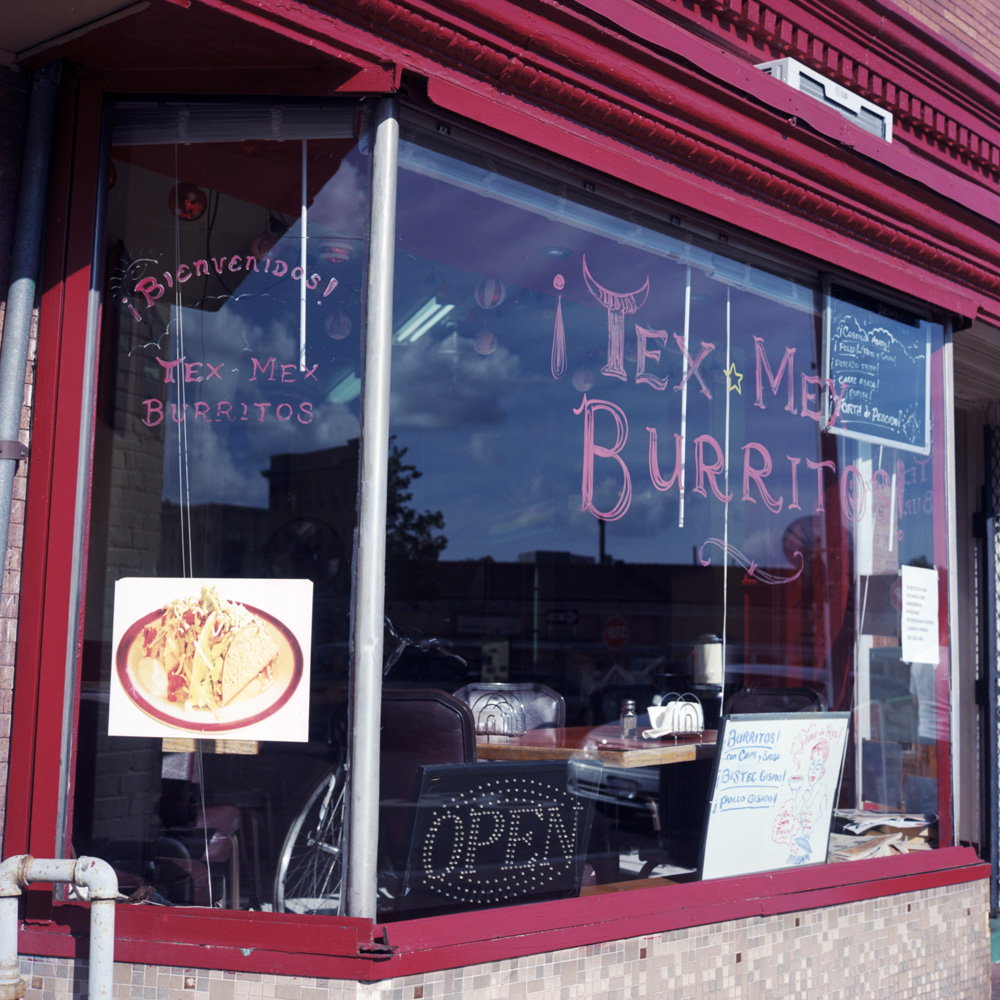
To me, the loss of these businesses to gentrification is the biggest downside to the process. They are what makes up the character of the neighborhood, and why all those gentrifiers moved there in the first place. I will be very sad when Tex-Mex Burritos is displaced for yet another Chipotle.
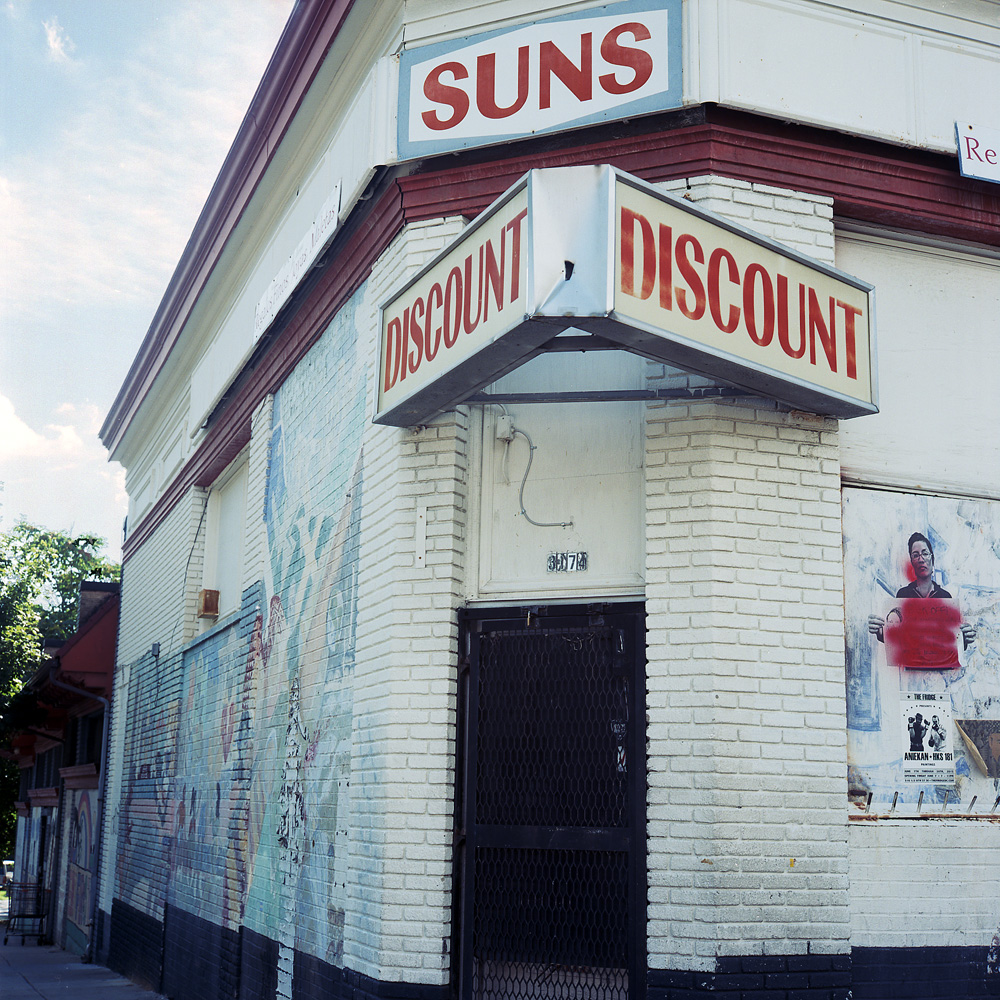
Suns Discount
Sun’s Discount is obviously shuttered. I don’t know how big a space it is on the inside, or what kind of (probably insane) rent the landlord is asking for, but I love the murals on the wall and the protest/message posters plastered on the whitewashed windows. It reflects the character of the neighborhood, and particularly its past – the small ethnic “discount” store that would have carried a hodge-podge of inexpensive products, primarily catering to the Latino community, which has adopted the small business strip along Mount Pleasant Street. Historically a mixed race, upper-middle class neighborhood, after the 1968 Martin Luther King riots, the neighborhood experienced a significant turnover and transformed into a poor Latino barrio in the 1970s. It is in the process of changing back into a largely white, upper-middle class neighborhood, as the housing stock off the business district consists of large, elegant rowhomes and single familys that are being snatched up, fixed up and turned into two and three unit condos.
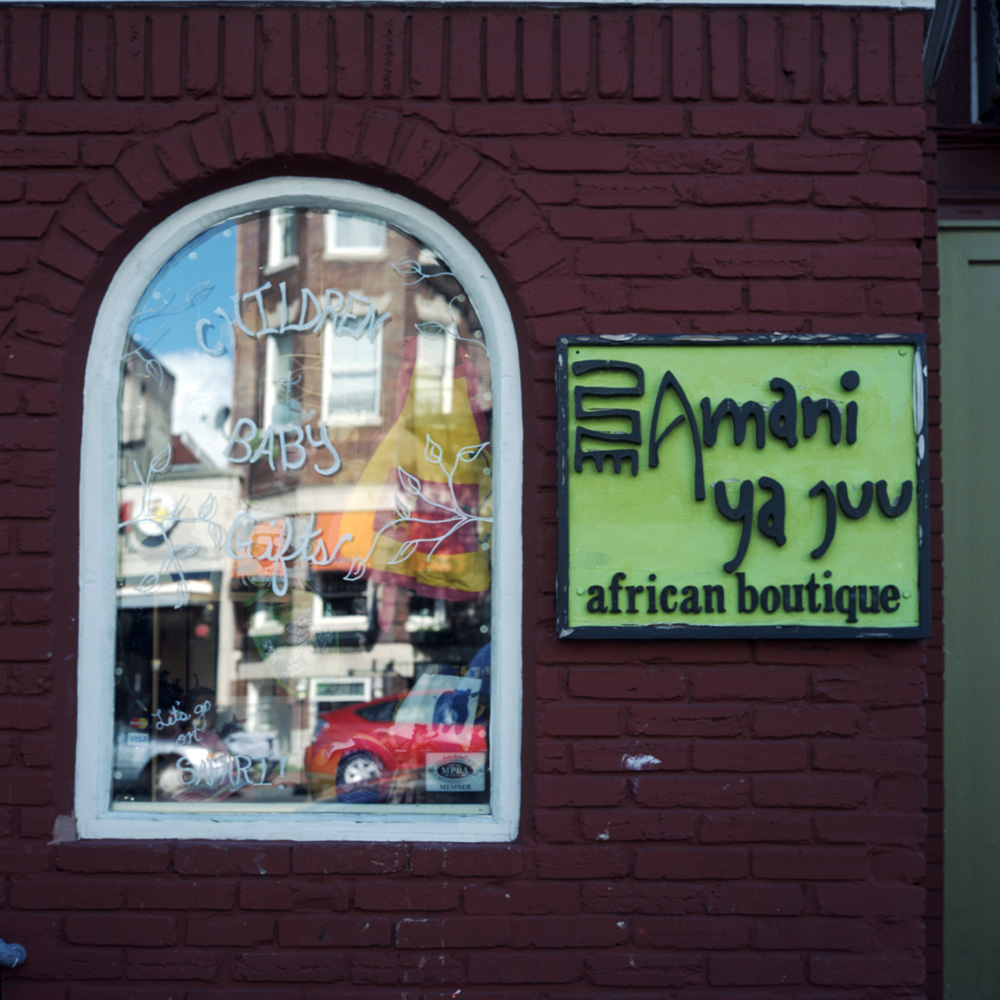
Amani African Boutique
There is still an African-American presence in the neighborhood – a touch of soul remains amidst the sazón. The neighborhood was always multi-ethnic, but the blend has changed over the years.
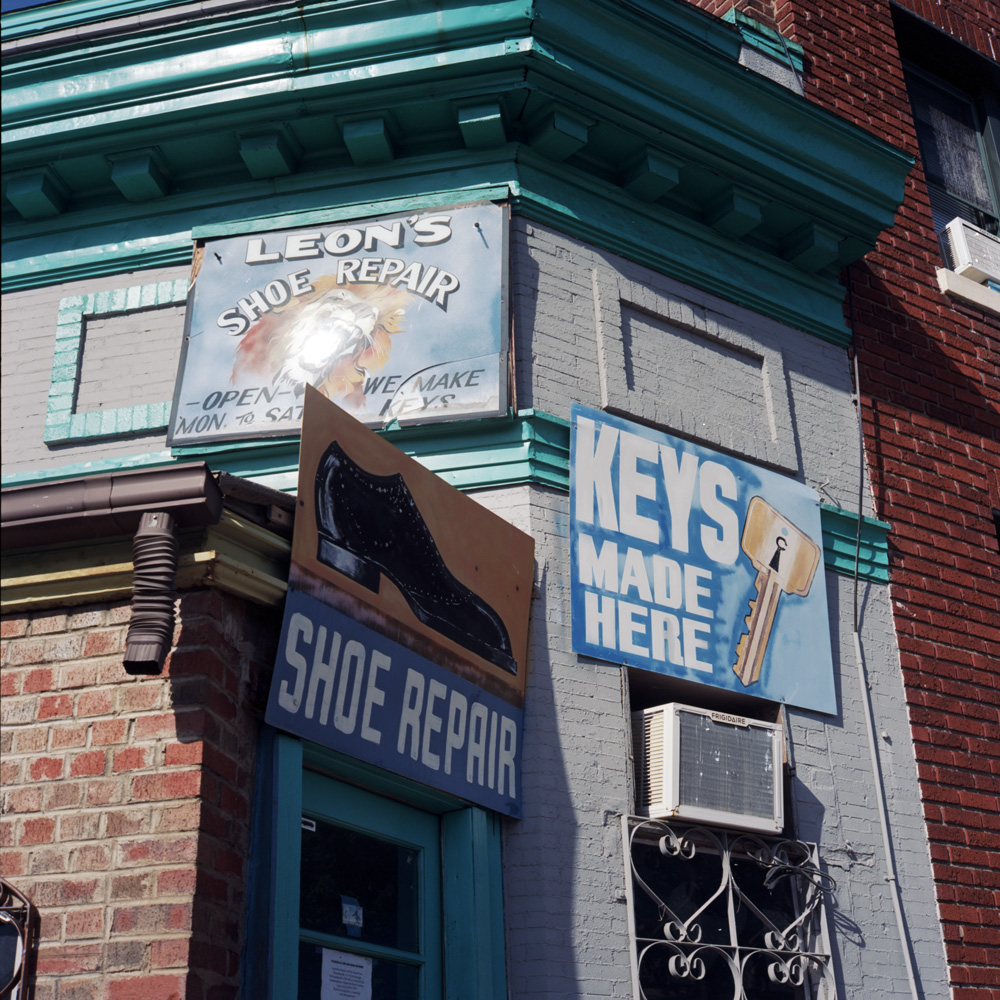
Leons Shoe Repair
Another one of those small businesses that when a real estate developer sets their sights on the block will be one of the first to go. Leon’s operates out of a space not much bigger than a coat closet. In the land of big-box stores and franchises, there’s no room for a 200-sq ft retail operation. And signage like that would never fly in a homogenized shopping mall.
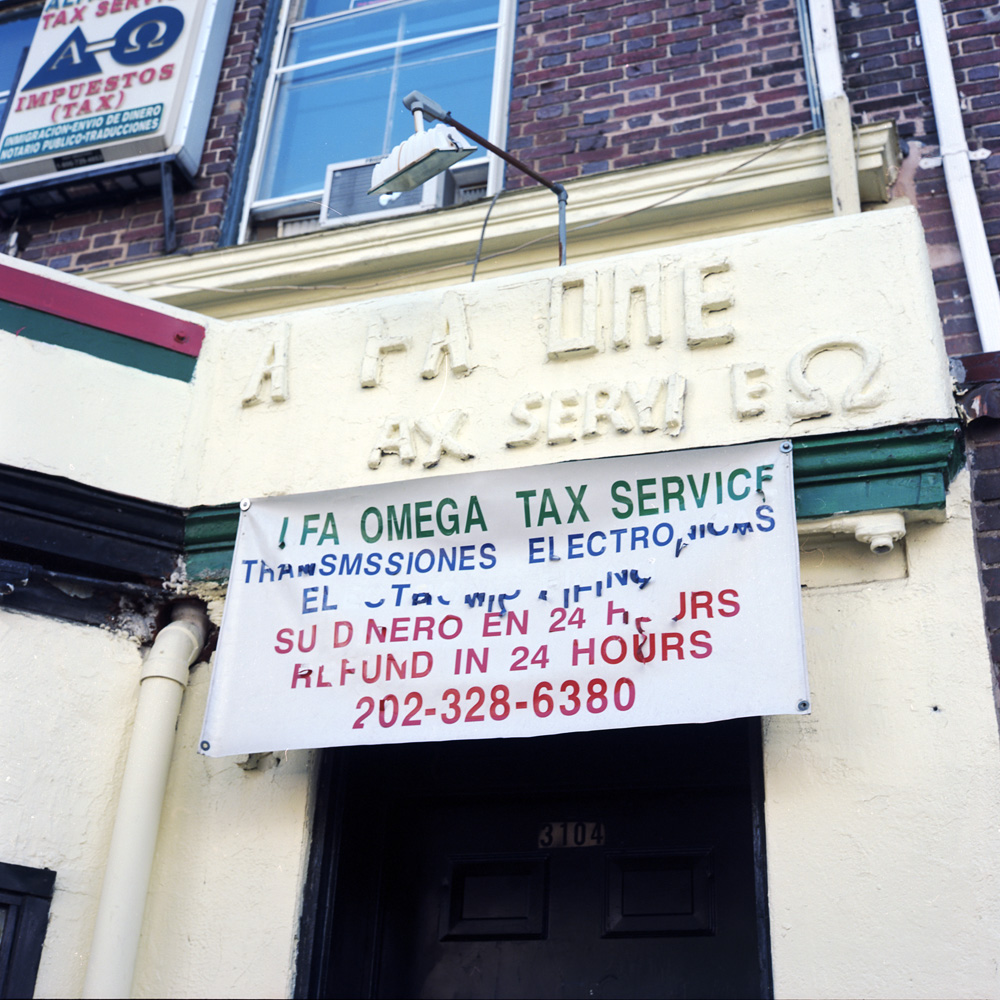
Alfa Omega Tax Services
Here’s one that has been around for decades – witness the missing letters and the layers of paint applied to the original Alfa Omega Tax Service on the wall. Having them there in the 1970s and 80s when this was one of the police patrol beats officers dreaded to be assigned would have been a huge deal to the residents, as there would have been few legitimate businesses willing to provide quality services of any kind in the area.
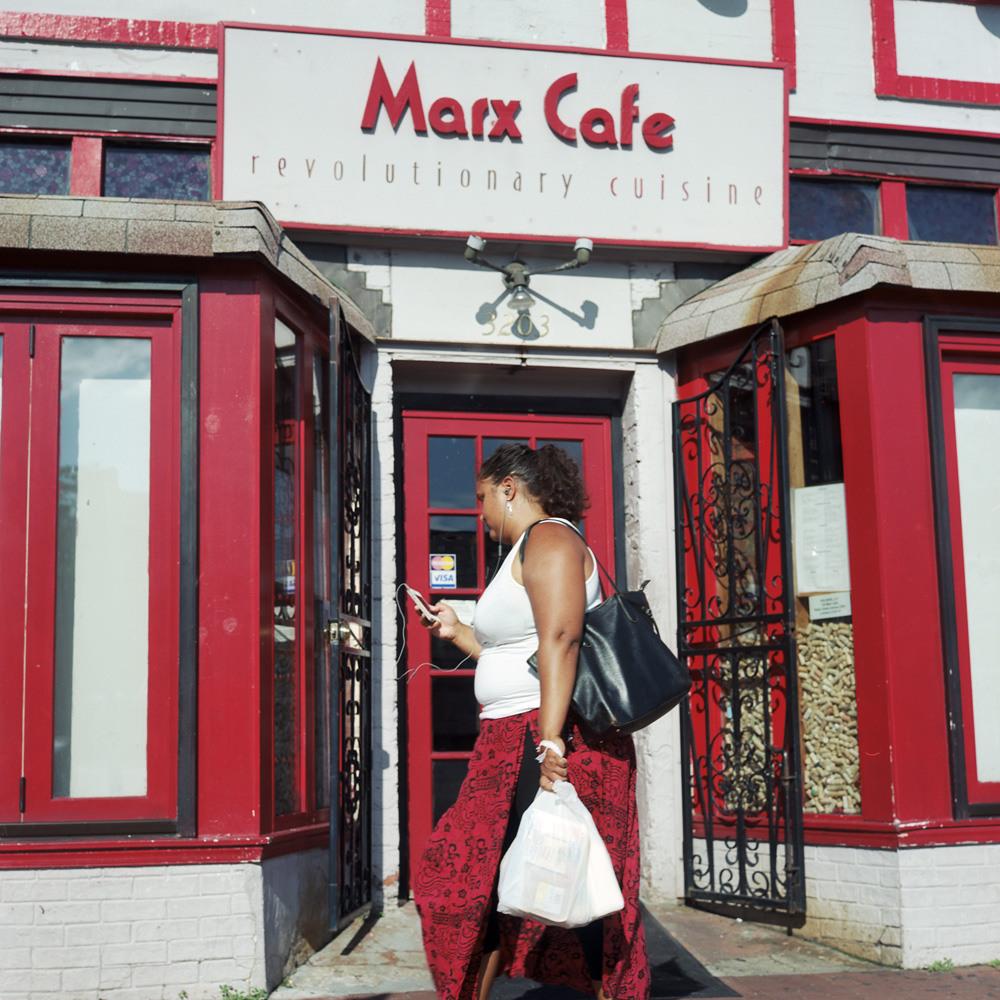
Marx Cafe
The bohemian precursor to gentrification – Marx Cafe (“Revolutionary Cuisine”) brought a little touch of culture and chic.
Tex-Mex Burritos
A typical neighborhood mom-and-pop eatery. This one is newer, keeping within the theme of the neighborhood but brightened up and appealing to the incoming Anglos as well as the long-time residents.
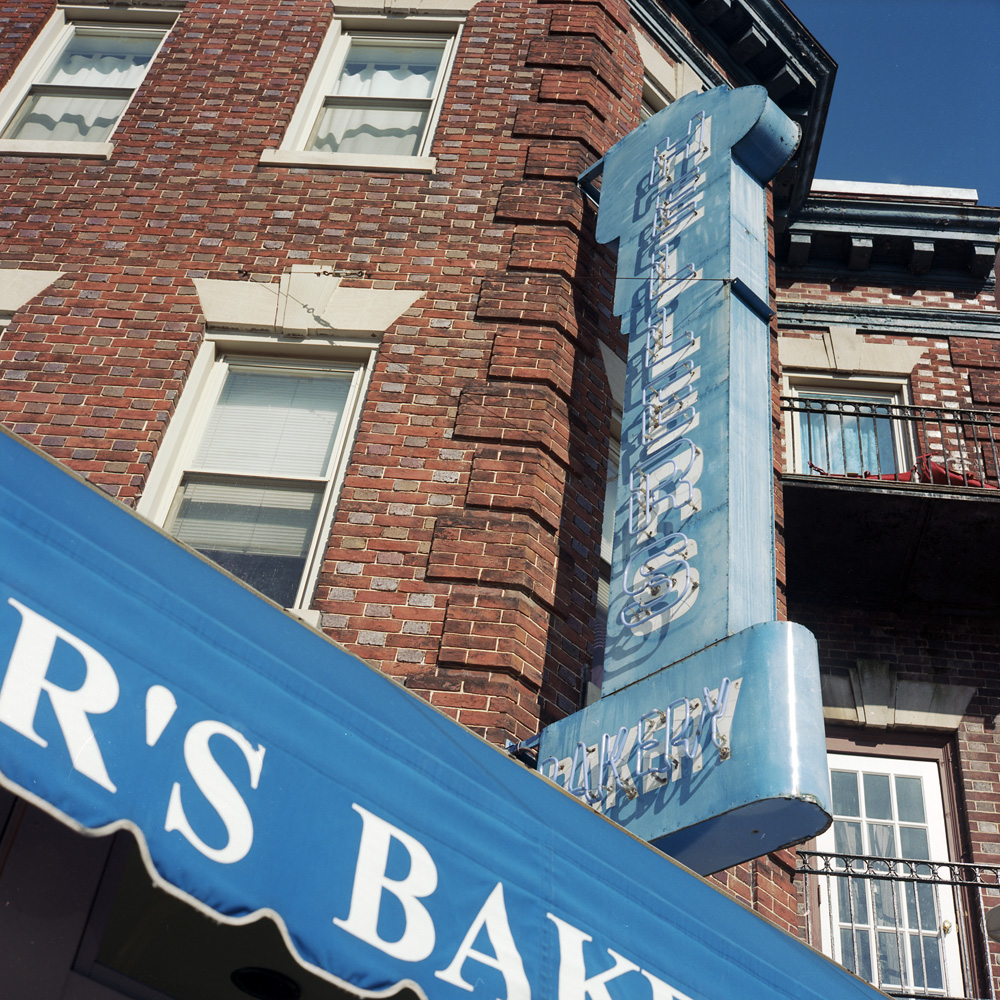
Hellers Bakery
Heller’s Bakery has been here forever, witness the neon sign, from back when the neighborhood was originally an upper-middle-class, white/jewish/African-American neighborhood. It stuck around through the hard times. If you saw the movie, State of Play, starring Russell Crowe, you’ll recognize this as being from outside his apartment.
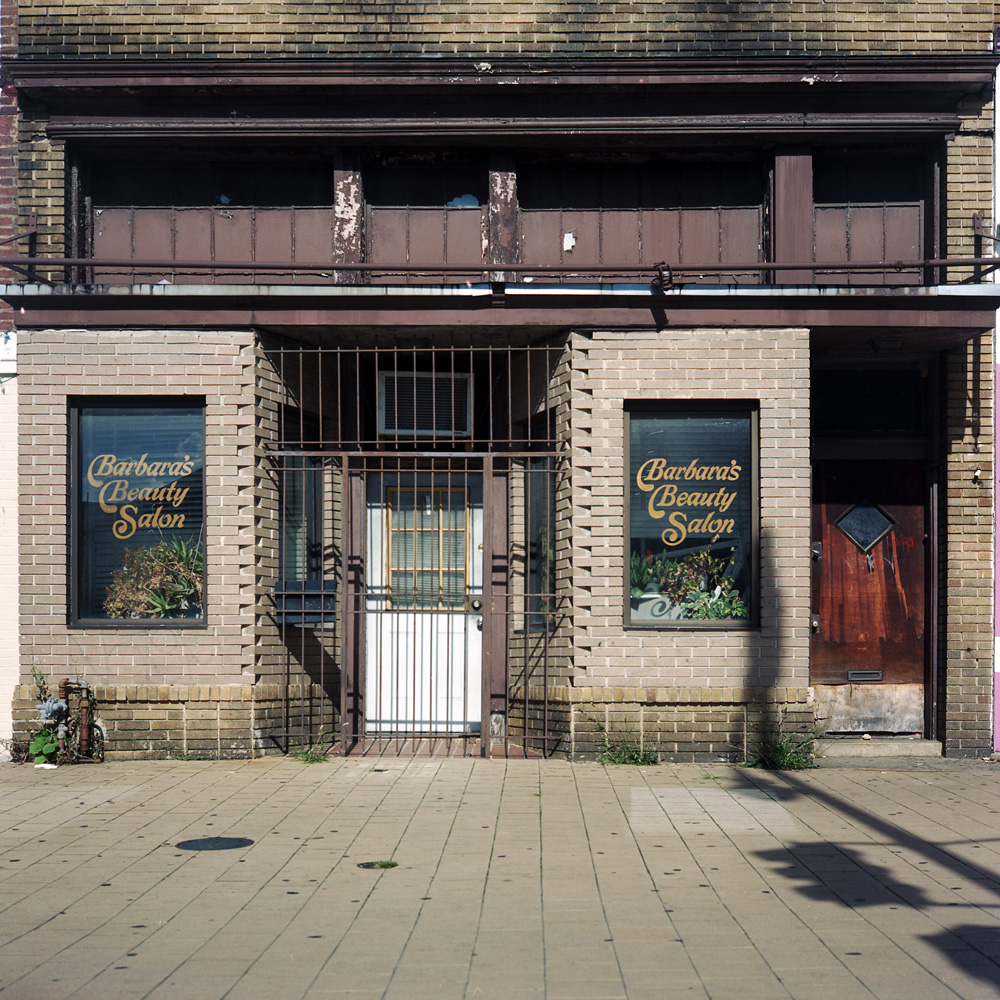
Barbaras Beauty Salon
I’m not sure Barbara’s is still in business – granted I usually never walk by it during the work day mid-week, so it might in fact operate then, but whenever I see it, it’s shuttered, blinds pulled, and half-dead plants in the window. I don’t know if they were a victim of shifting demographics, or just sloppy management – I don’t know that I’d want to trust what little hair I have left to someone whose plants look like that!
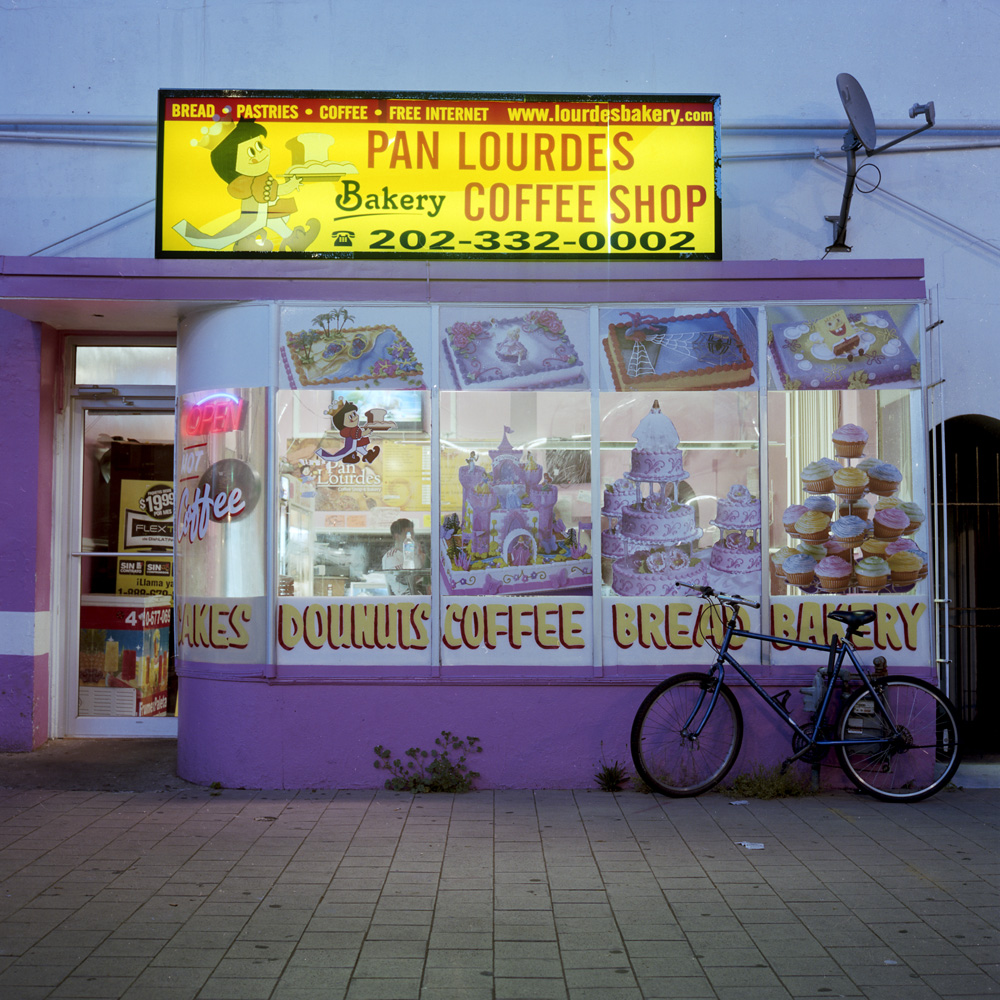
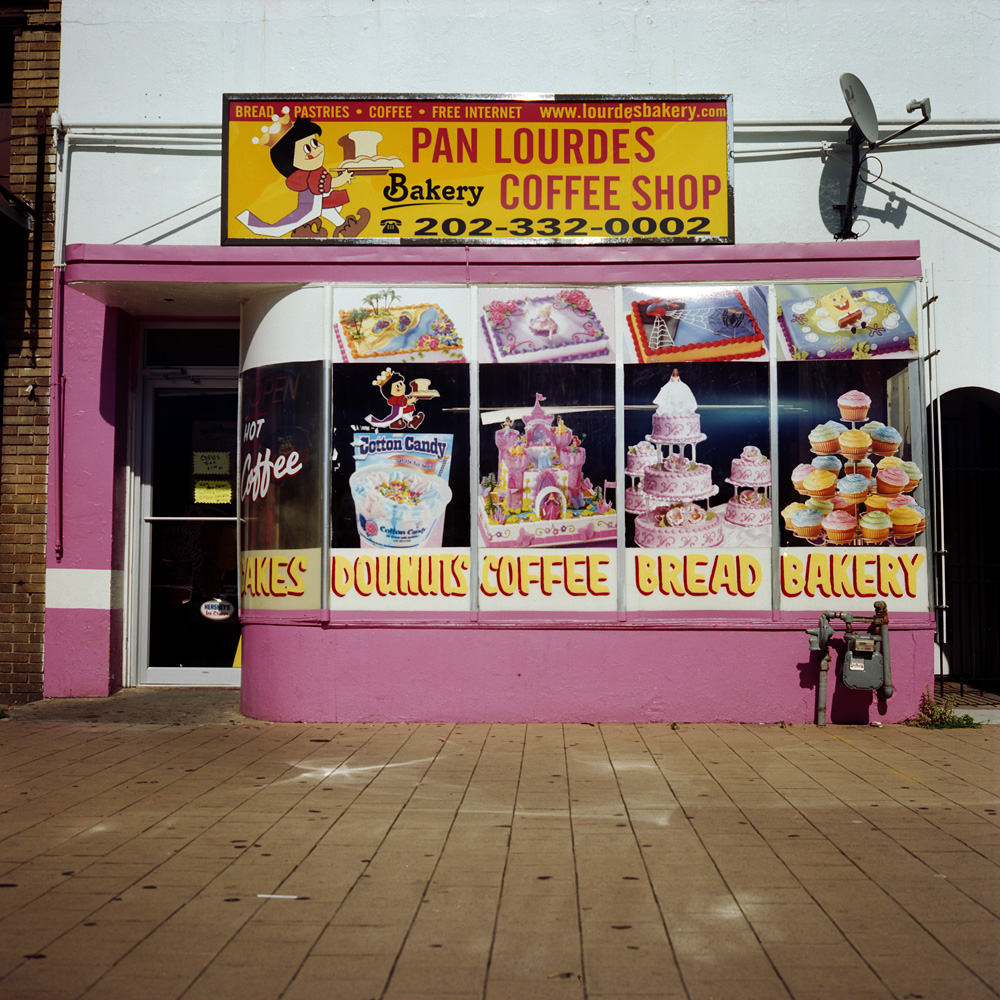
Pan Lourdes, Afternoon
Another small business that will probably be driven out by gentrification in the next ten years. Massive re-development of the neighborhood has happened a few short blocks down the street, with upscale restaurants and pubs, a shopping center with Target, Best Buy, Marshalls, Staples, Radio Shack, GNC, a Washington Sports Club gym, and across the street is Chipotle, a wine store (not a liquor store, but a WINE store), and a FedEx outlet. Like I said earlier, no room in that for a riot of pink selling Central American baked goods. And the neighborhood will be poorer for it.
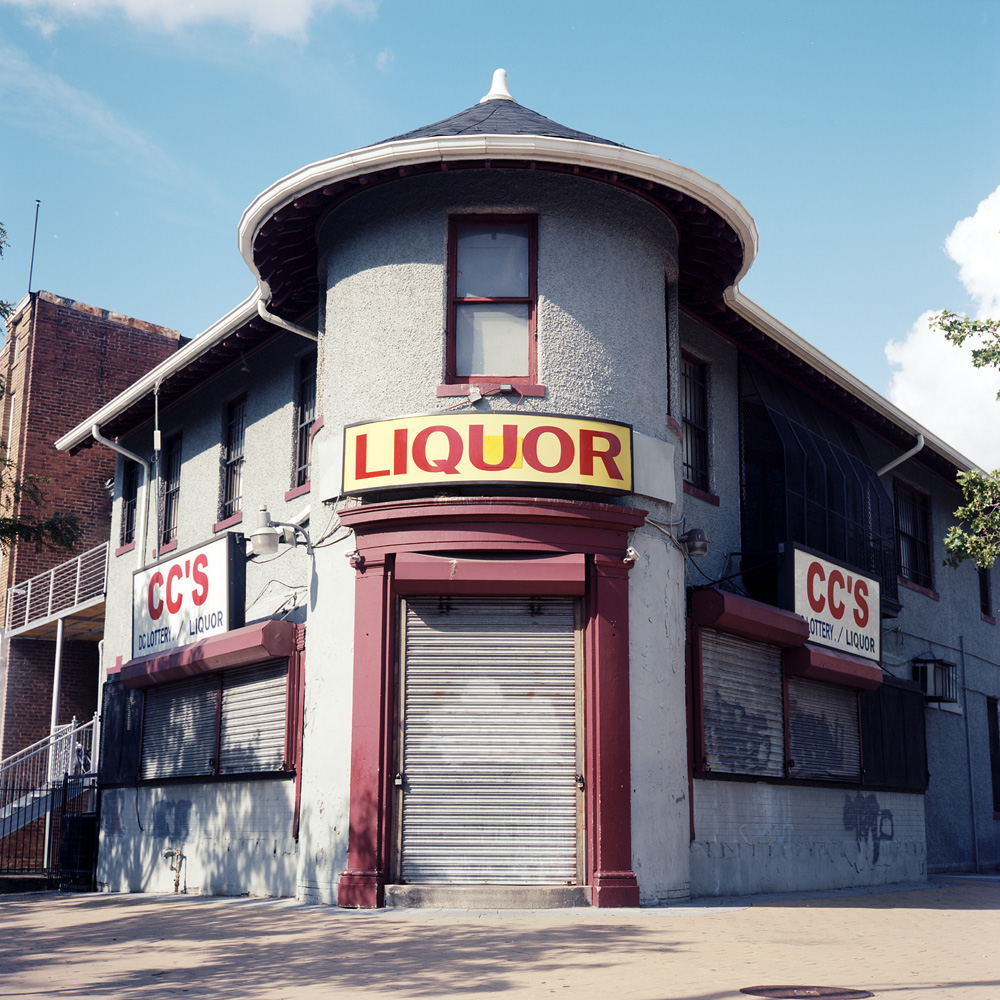
CCs Liquor
In contrast to the wine store down the street, this is a good old-fashioned ghetto liquor store. This one, I could let go, but the Colony Liquor up the street I’d like to see stay around if for no other reason than the fantastic Deco facade and neon sign (see previous posts of mine for pictures).
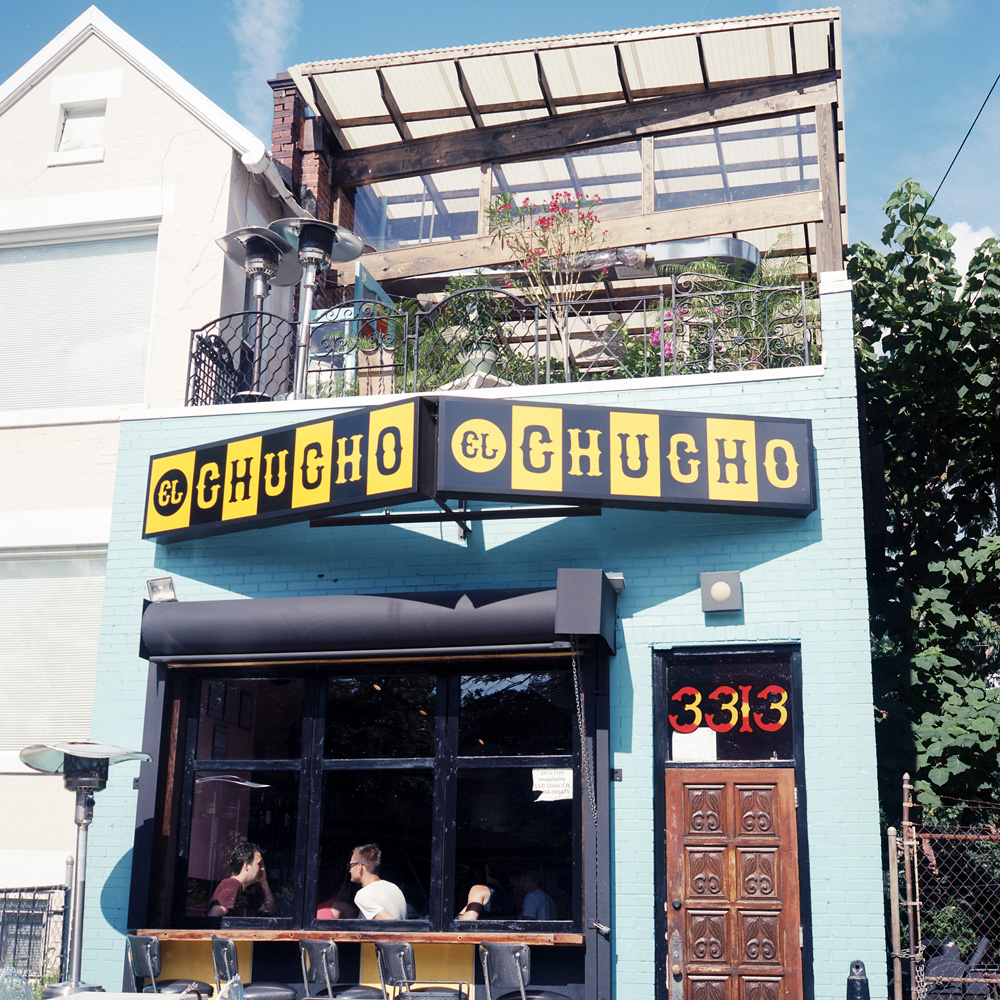
El Chucho Roof Deck
Part of the gentrification wave in my own segment of the neighborhood- its ethnic cuisine by hipsters. Don’t get me wrong, they have very delicious and authentic tacos (and insanely cheap happy hour prices – you can get three tacos and a beer for $10-11!!!), but the truly authentic taquerias don’t have roof decks, bar seating reclaimed from former diners, and waiters wearing plaid flannel, sporting a well-maintained three-days stubble.
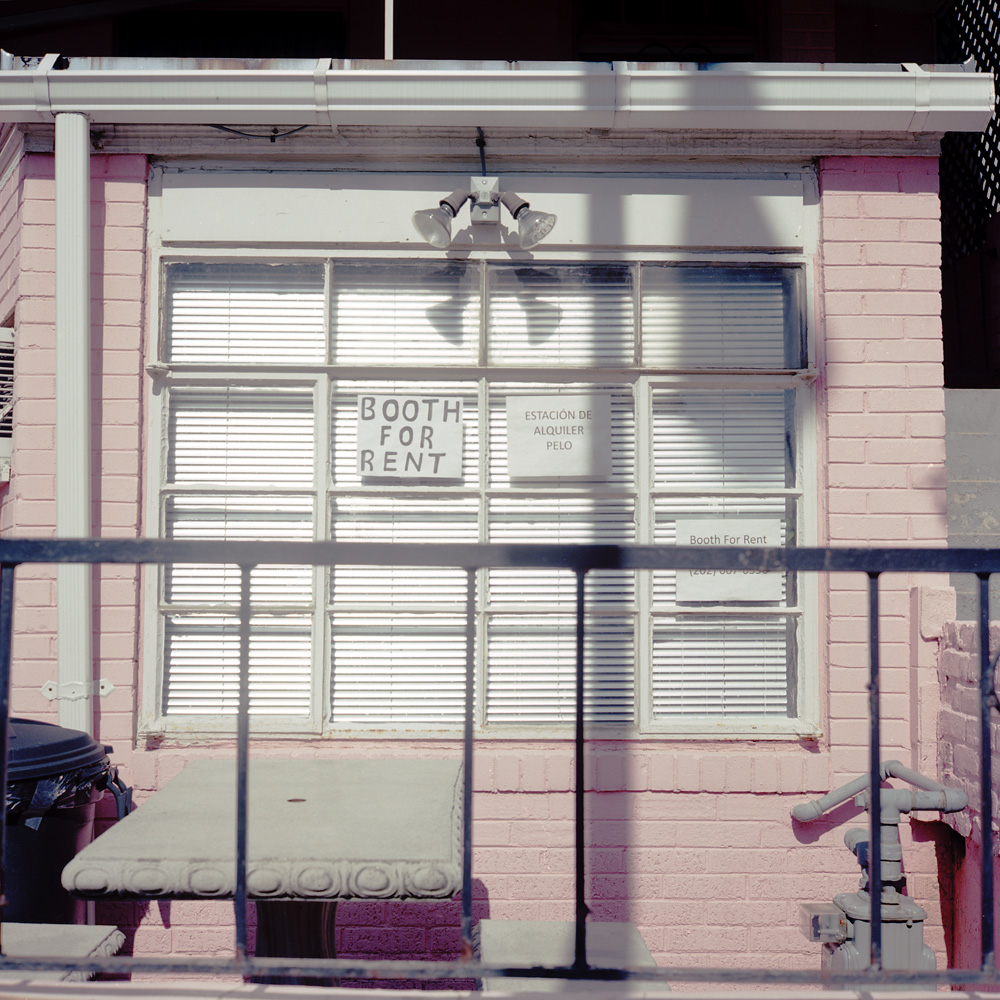
Booth For Rent
Alongside the hipster taqueria you have the basement beauty parlor, which you’d never know was a beauty parlor if not for the booth for rent sign in the window.
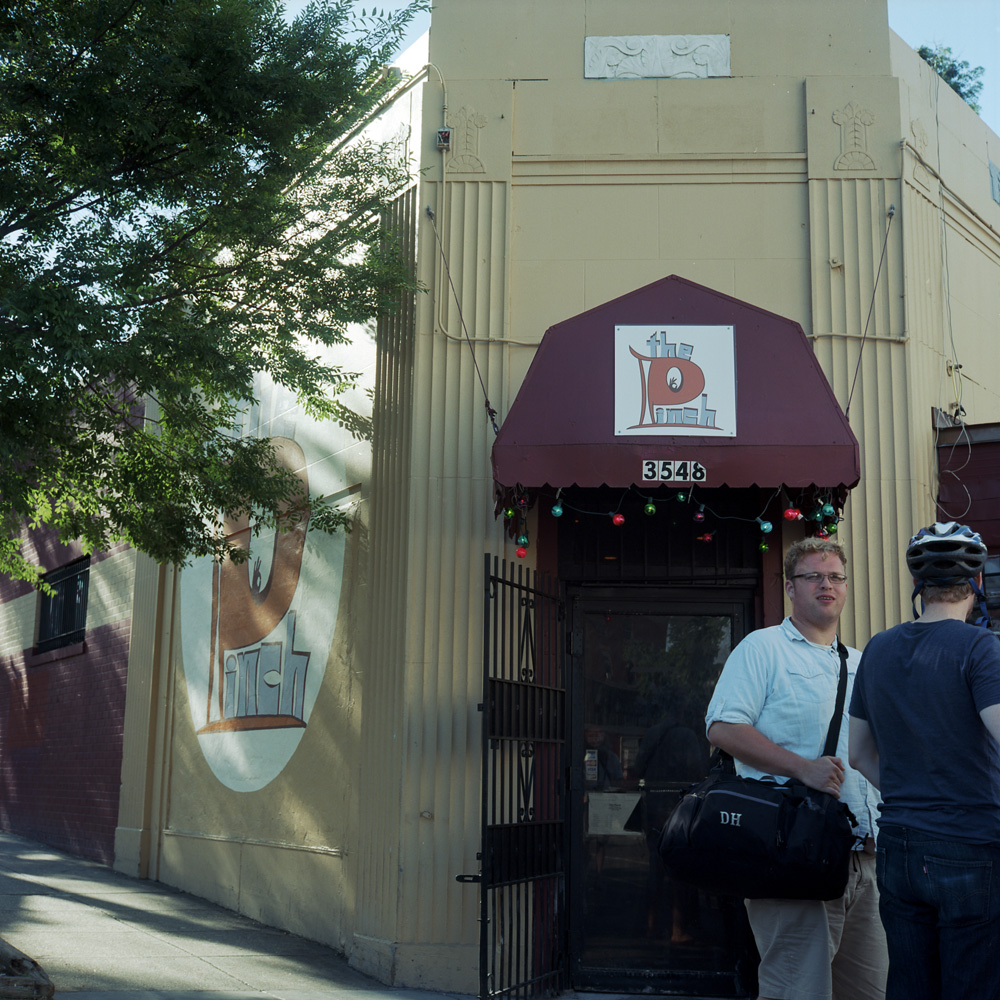
The Pinch Front Door
The Pinch is a neighborhood dive bar featuring live music on the lower level. The graphics outside scream 1970s blaxploitation movie, the patrons now scream suburban white kids who moved to the city to have an “authentic” experience. But it’s good to have a venue that provides space for local live music, where up-and-coming bands needing a break can perform, as there are definitely not enough performance spaces in this town to adequately support the creative talent here.
For wont of anything better to do on Sunday afternoon, I went out for a stroll in the 90+ degree heat (what was I thinking!!!) with the Rolleis for company. I wanted to do a little film and development test to see how well my results would come out. I’d say I nailed it based on these shots. The film I was testing is Ilford PanF, a very slow, fine-grained emulsion. The film speed Ilford recommends for this film is ISO 50. Quite a few folks I know recommend giving it a more generous exposure and rating it at EI 12. I shot some before at EI 25 and got good but not knock-your-socks-off results, so I thought I’d try the 12 and see what difference it makes. I took a risk and changed two variables at once – film speed and development technique. Normally I use Rodinal at a 1:50 dilution and develop for 14 minutes, agitating the chemistry for five seconds out of every 30 seconds. This time, I used Pyrocat HD for my developer, gave it twice the normal dilution (I usually use it diluted 1:1:100, but this time I used 1:1:200) for 45 minutes, with 5 seconds of agitation every 15 minutes.
This development technique is known as semi-stand development. Semi-stand uses highly dilute developers for greatly extended periods of time, with minimal agitation. What this does is it allows micro-contrast areas to form on the film where byproducts of the development process accumulate on the edges of light and shadow. These byproducts serve as a mask and lead to a boost in contrast at that edge, increasing the appearance of sharpness. If you look at the emulsion side of a negative that was developed using semi-stand, stand, or extreme minimal agitation technique (variations on a theme), the emulsion will actually appear in relief as if it had been etched.
This technique is also useful for managing high contrast situations because it allows for greater adjustment of the length of development to manage highlights. When you develop a roll of film, the shadow areas develop first, and once they have reached their maximum recorded density, they stop. Highlights will continue to develop long after the shadows have finished. This is one of the primary means for controlling contrast in an image- if the highlights are known to be too bright before developing the film, you can simply reduce total development time to keep the highlights from becoming unprintable.
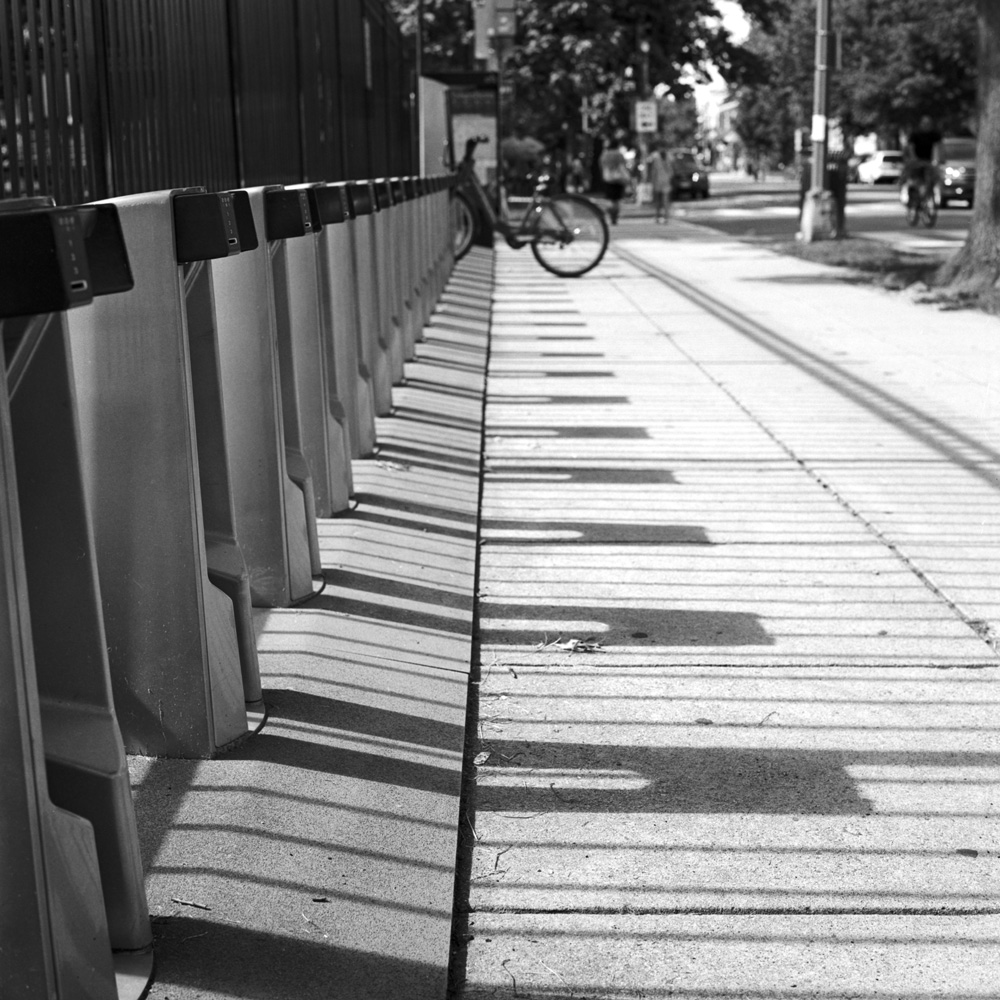
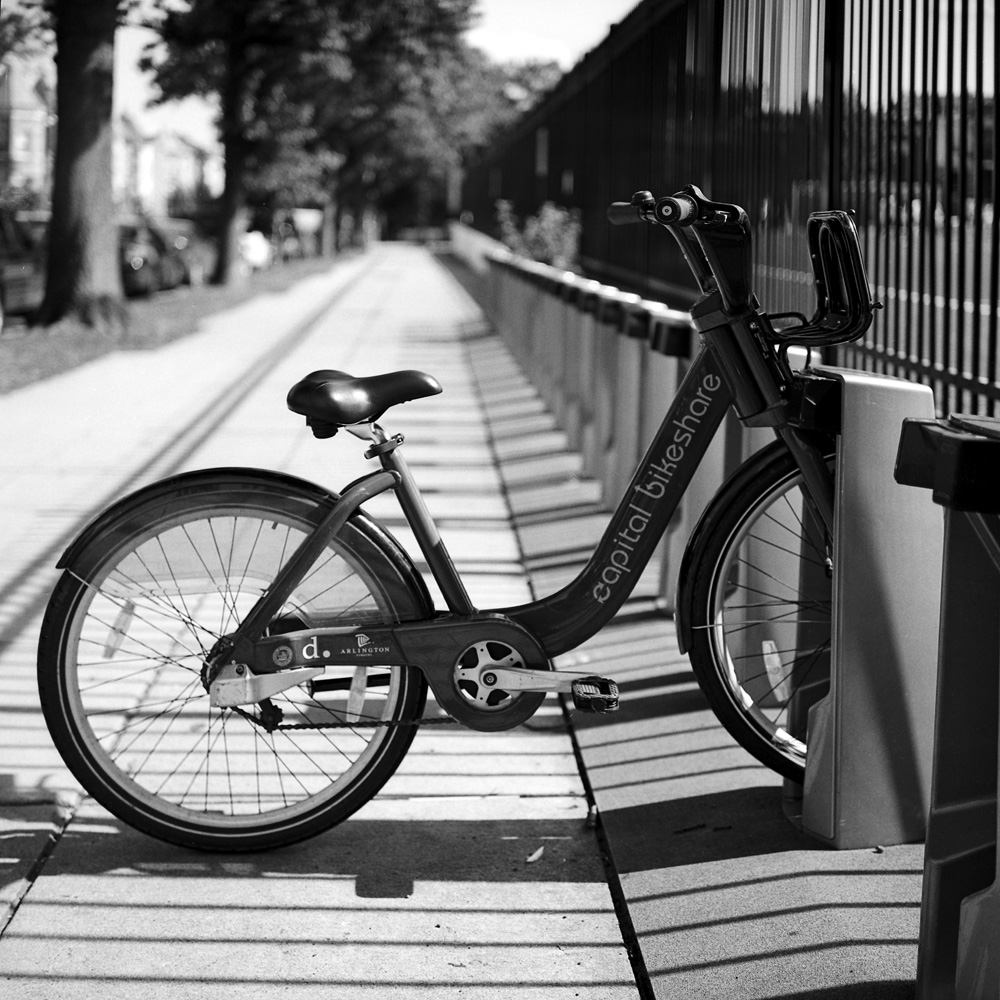
Bike Rack, 11th St. NorthboundBike Share Rack, 11th Street
These first two images are of the Capitol Bikeshare rental rack near my house. I’ve photographed the Bikeshare racks before, with full racks of bikes, to capture the receding perspective of the bike wheels. This time, I shot the bike rack with only one bike in it, to work with the late afternoon shadows created by the rack itself, and also to demonstrate the popularity of the Bikeshare, at least in my neighborhood. As you can see, on a Sunday afternoon, with the heat rising to over 90 degrees F, all but one of the bikes from this rack are in use.
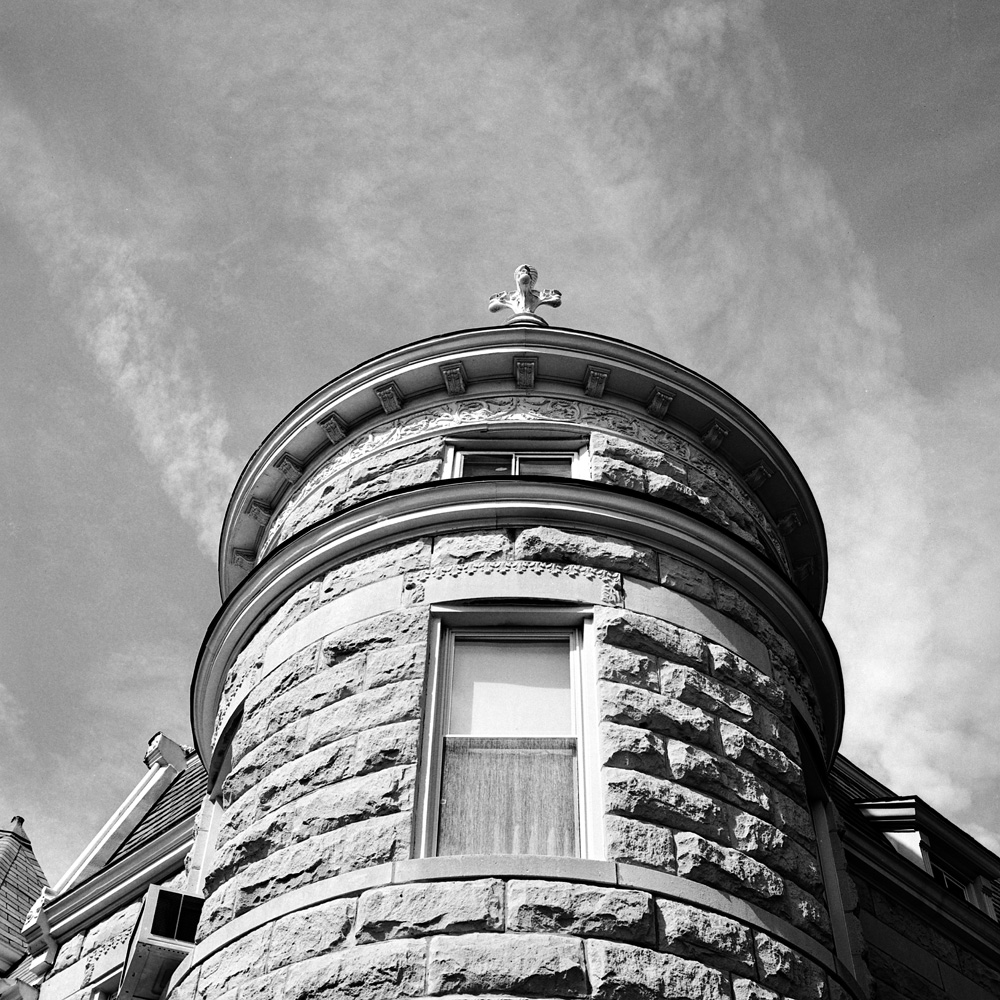
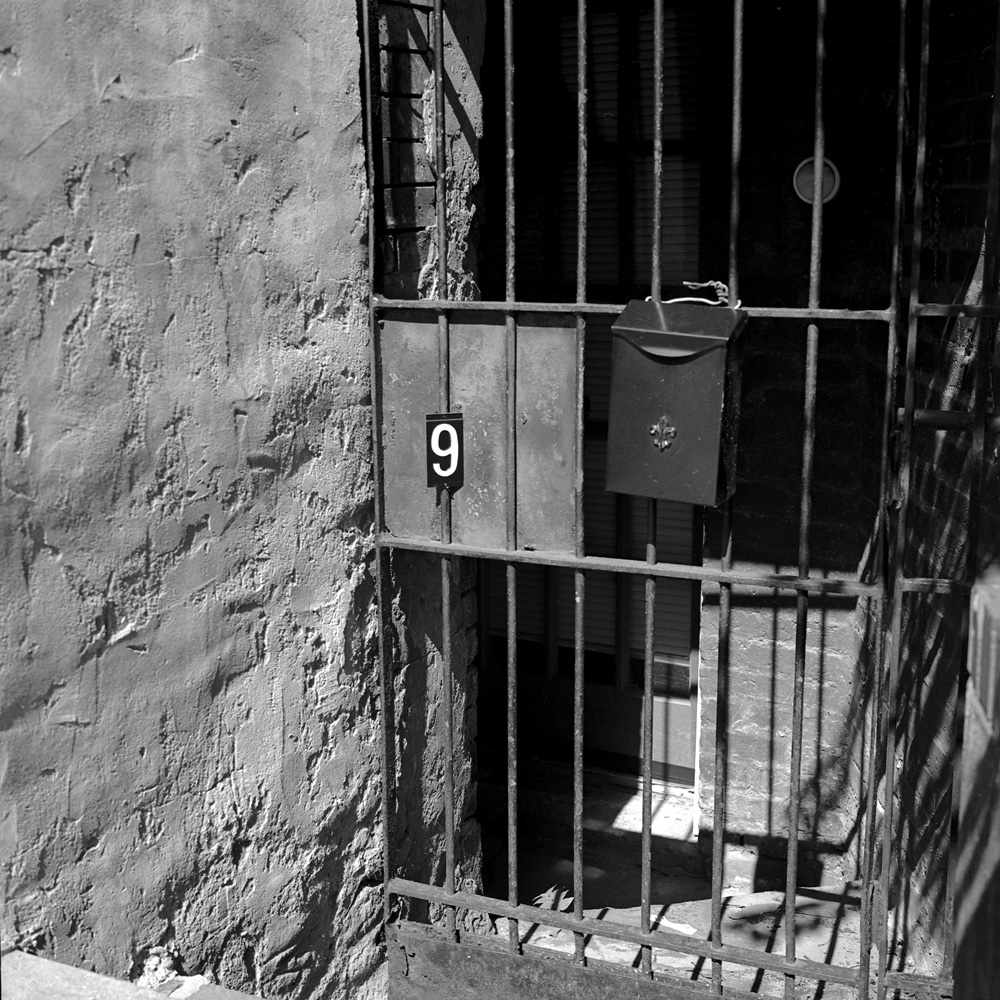
Stone Turret, 11th StreetNumber 9, Basement Door
Very much in the same stretch of 11th Street as the bike rack is where these two scenes can be found. The stone house is a bit of a neighborhood landmark – there are maybe half a dozen or less in the neighborhood with similar facades, and the rest (hundreds of houses) are varying types of brick or stucco over brick. The basement door photo was taken as part of this exercise, not only because I like wrought iron, but because the scene had extremes of contrast that I wanted to see if I could tame with the semi-stand development.
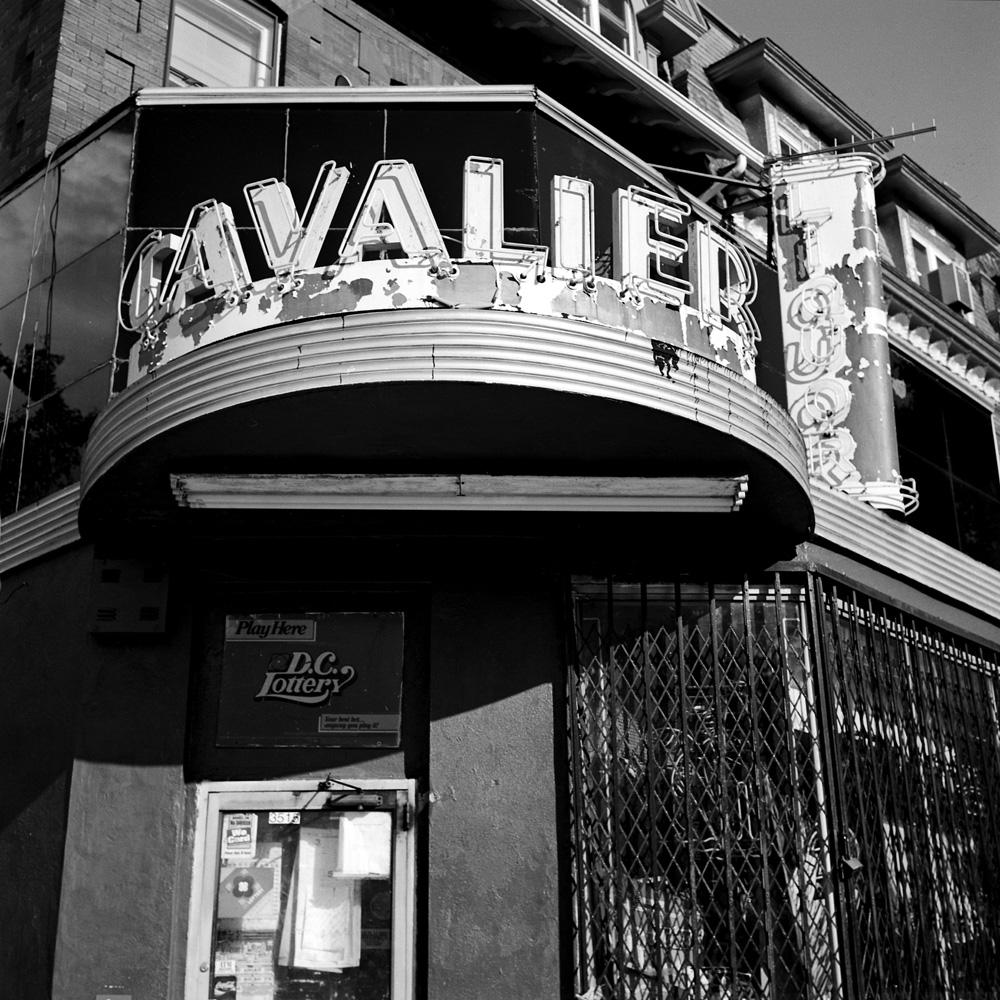
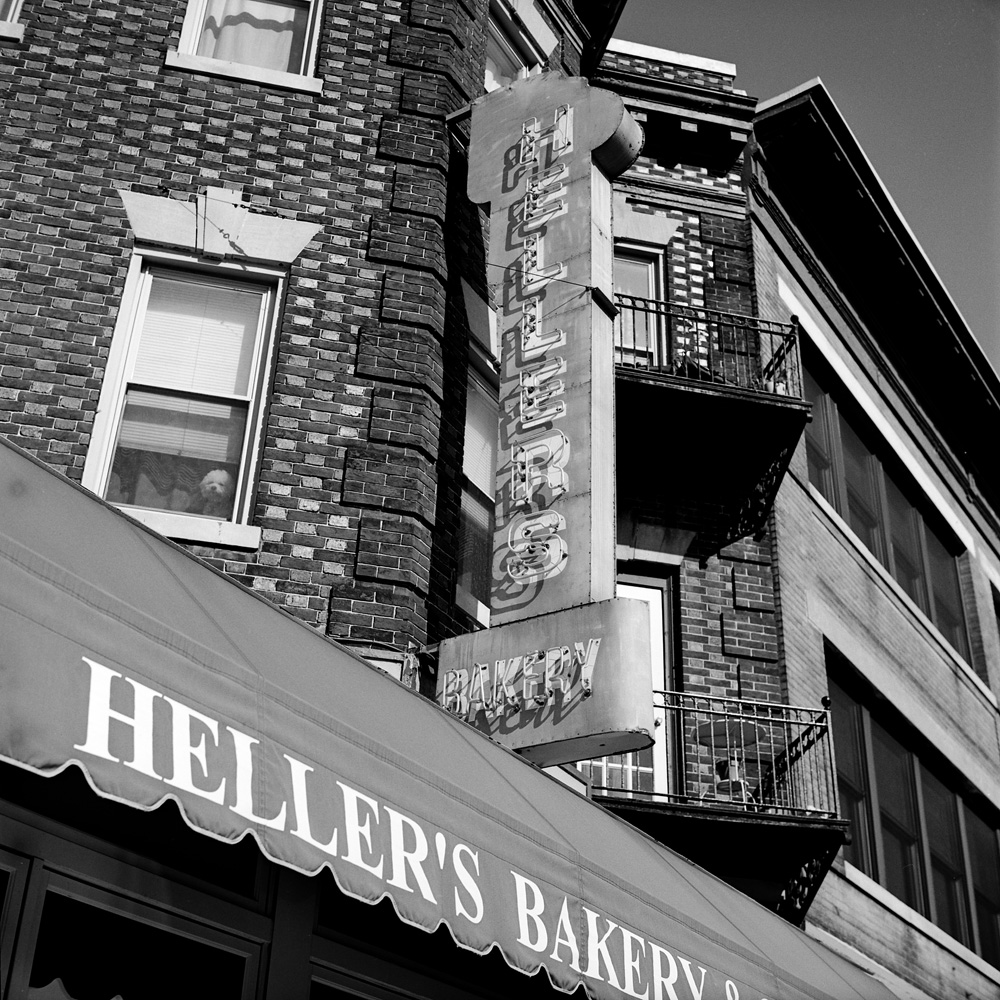
Cavalier Liquor Sunday AfternoonHellers Bakery
These two photos are of neighborhood icons – you’ve seen my color photo of Cavalier Liquor at night before. It has been the subject of many a photograph by fans of urban texture, neon, and Deco architecture. Hellers Bakery has been in their current location for many many years, and if you saw the movie “State of Play” starring Russell Crowe as Cal McAffery, a hard-luck, hard-boiled reporter who uncovers a Washington conspiracy, you’ll recognize their neon sign from below his apartment window. I’m very annoyed with Hellers that they don’t illuminate their sign very often, so it makes it very hard to get a good photo of it after dark!
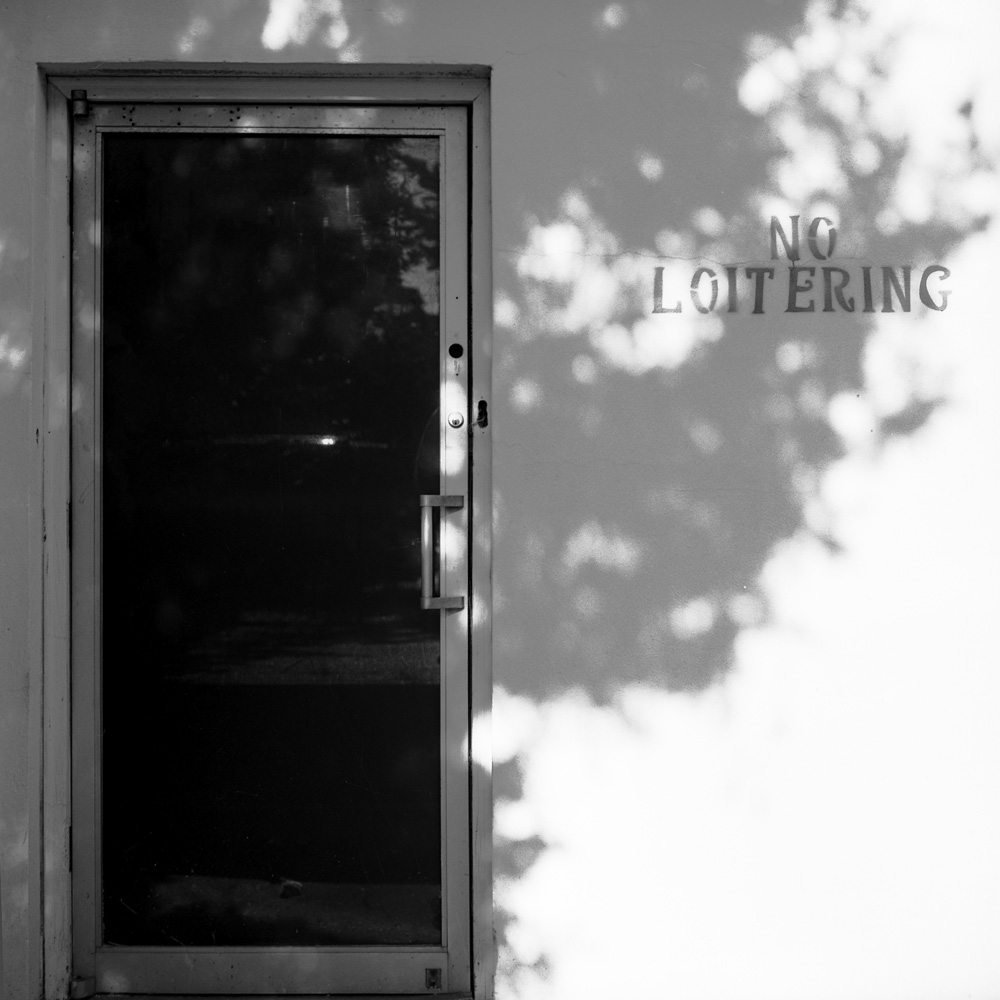
And last but not least, an appropriate sign to end the post with:
Here are the outside shots of Mad Momos Restaurant and Beer Deck.
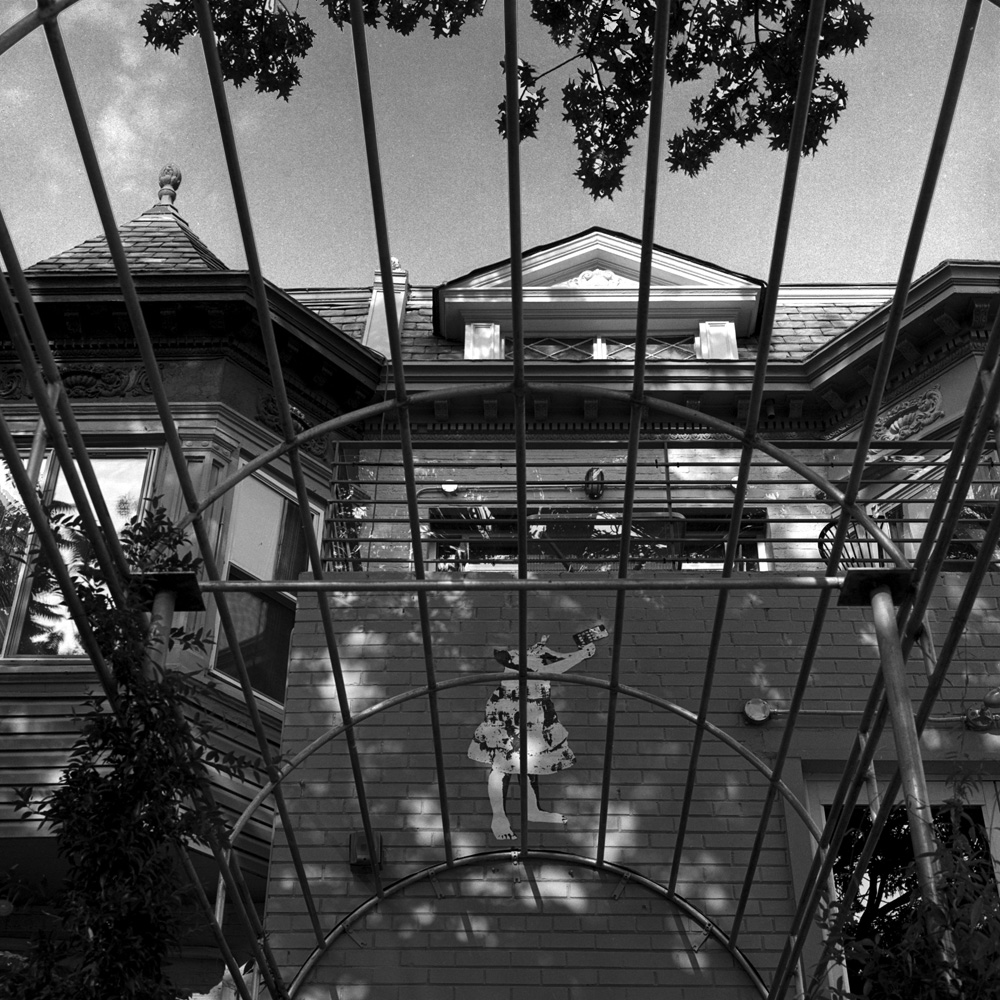
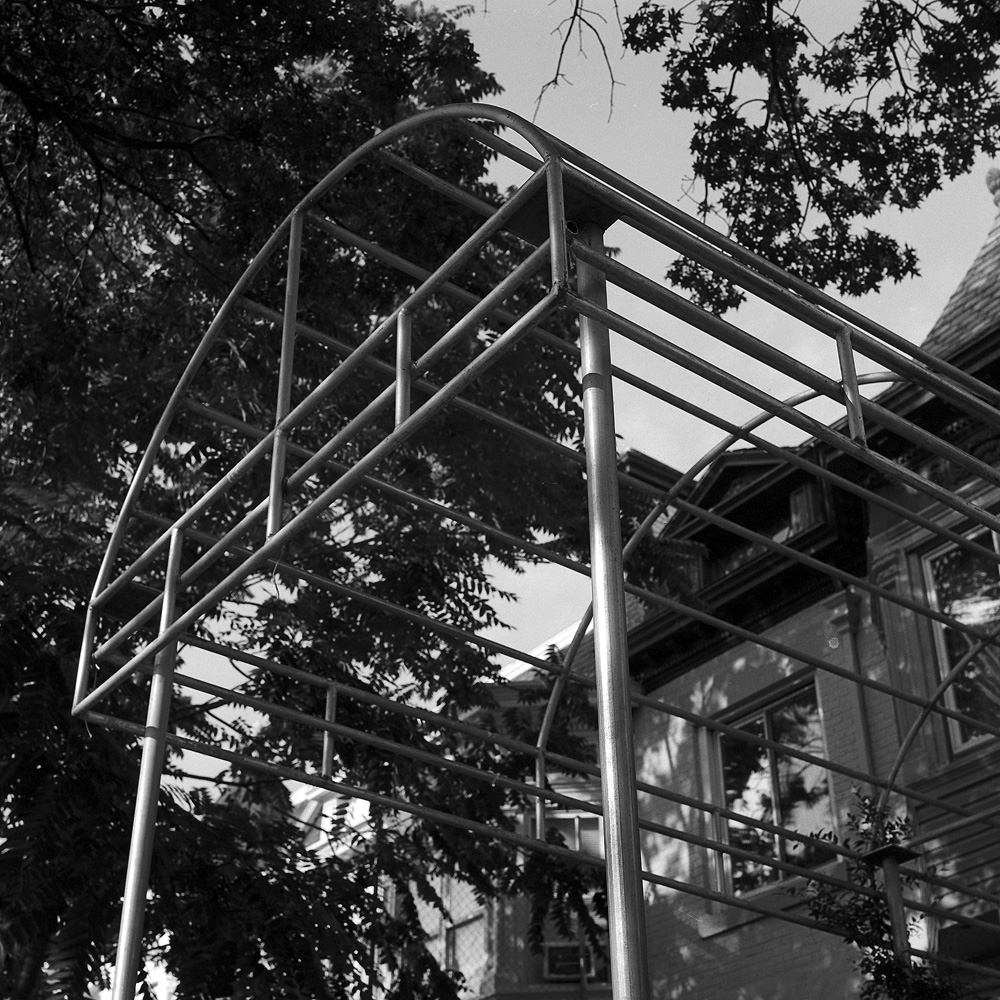
This is the entrance, as viewed from under the awning. When they bought the building, the structure was partially renovated with the intent to turn it into a restaurant. They followed through and finished it out, leaving the awning frame up but not getting a canvas/vinyl cover. Instead, they are training a vining plant in barrels, which will take a couple years to fill in (visible in the second photo of the awning). I just liked the structure of the awning and thought it would be an interesting frame to contrast its geometric structure against the decoration of the building behind it.
Mad Momos Entrance
I don’t recall if the paper cutout figure over the door ever had a head or not, but in any case, it’s a little girl holding an iPhone like a handgun.
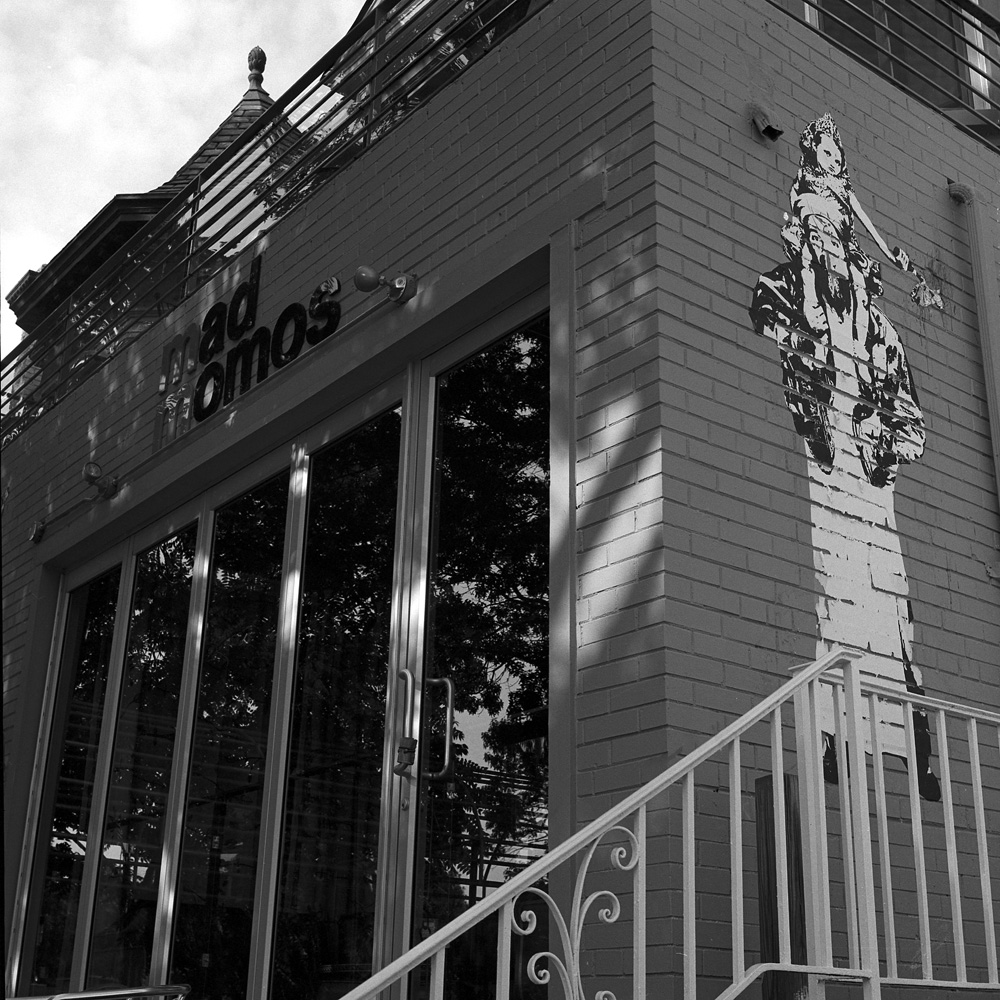
Here is the facade of the building. In case you’re wondering, the paper figures plastered to the wall are Osama Bin Laden giving Honey Boo-Boo a piggy back ride, whilst she’s holding a molotov cocktail. Yeah, the guys have a quirky sense of humor.
Mad Momos
Another view of the awning structure, dappled with sunlight filtered through the tree above.
Awning, Mad Momos
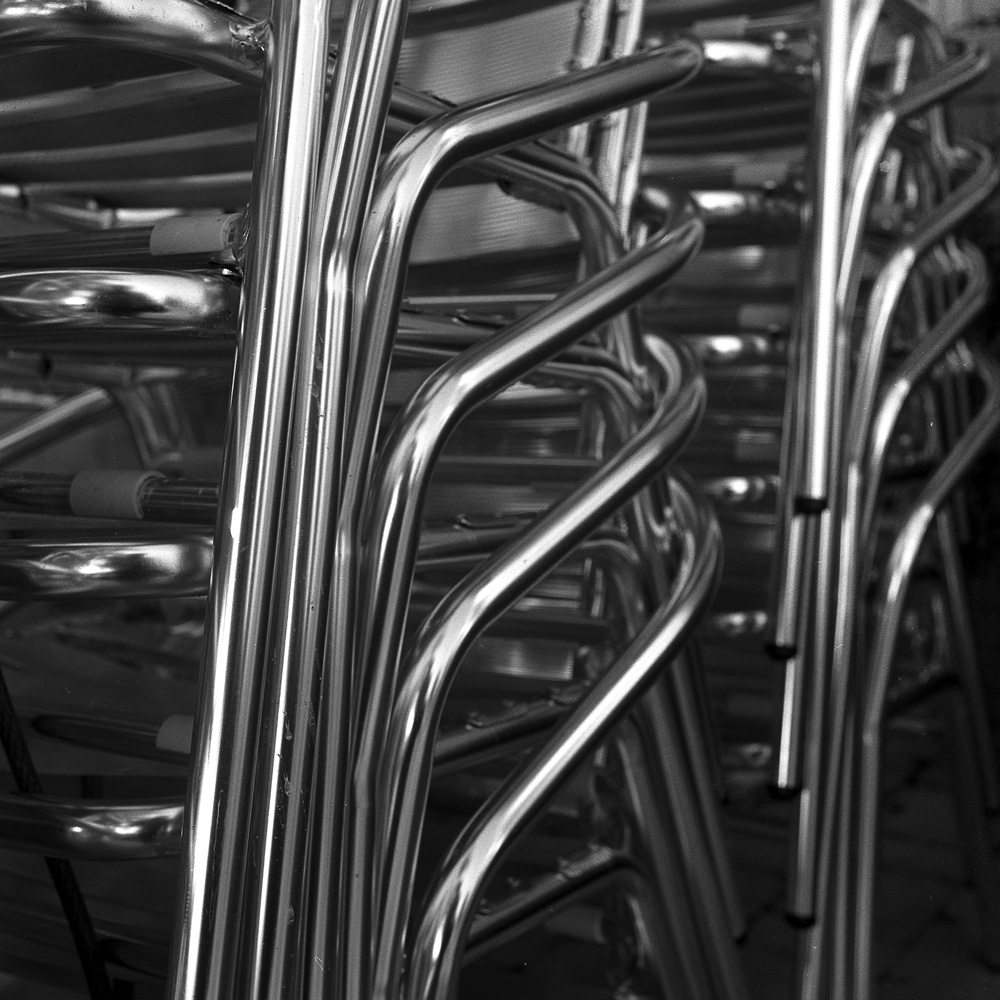
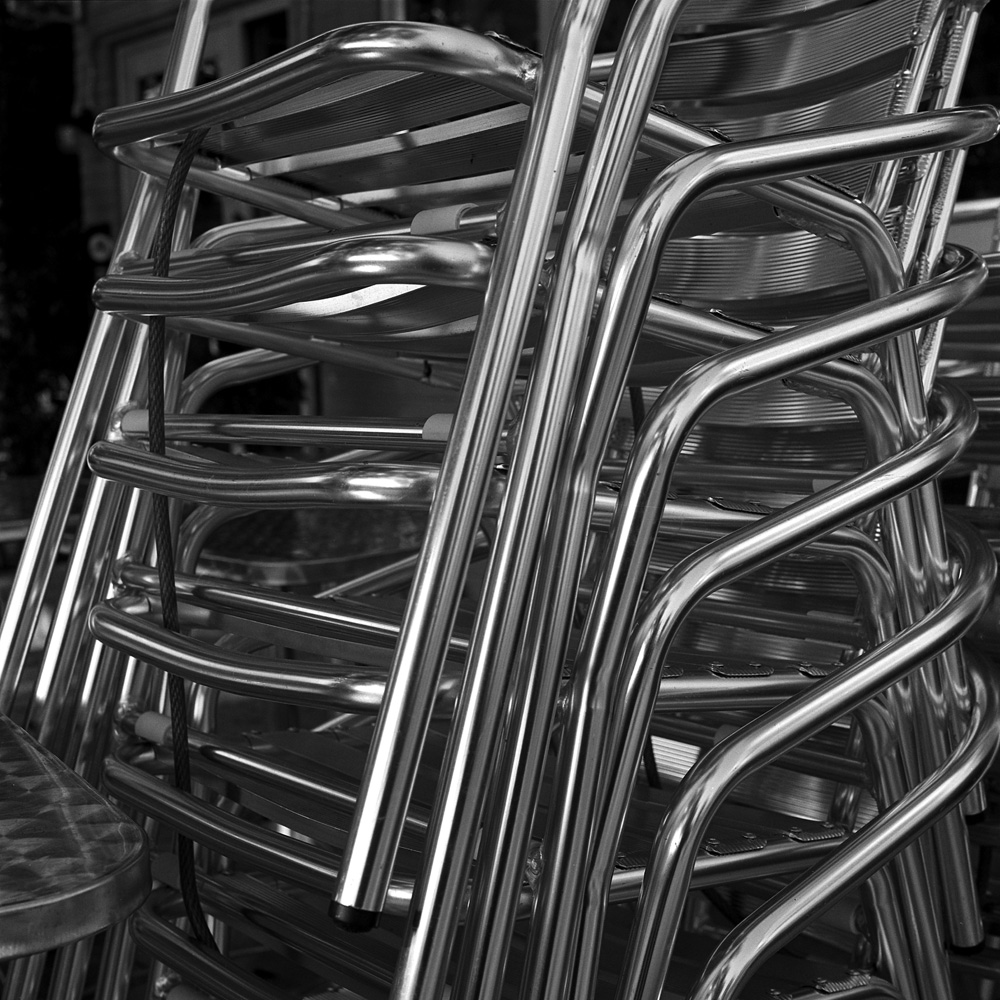
Chrome chairs on the patio at Mad Momos:
Patio Chairs, Mad MomosPatio Chairs #2
The chairs were still stacked from having been stored the night before. I loved the repetition of the shapes of the chairs.
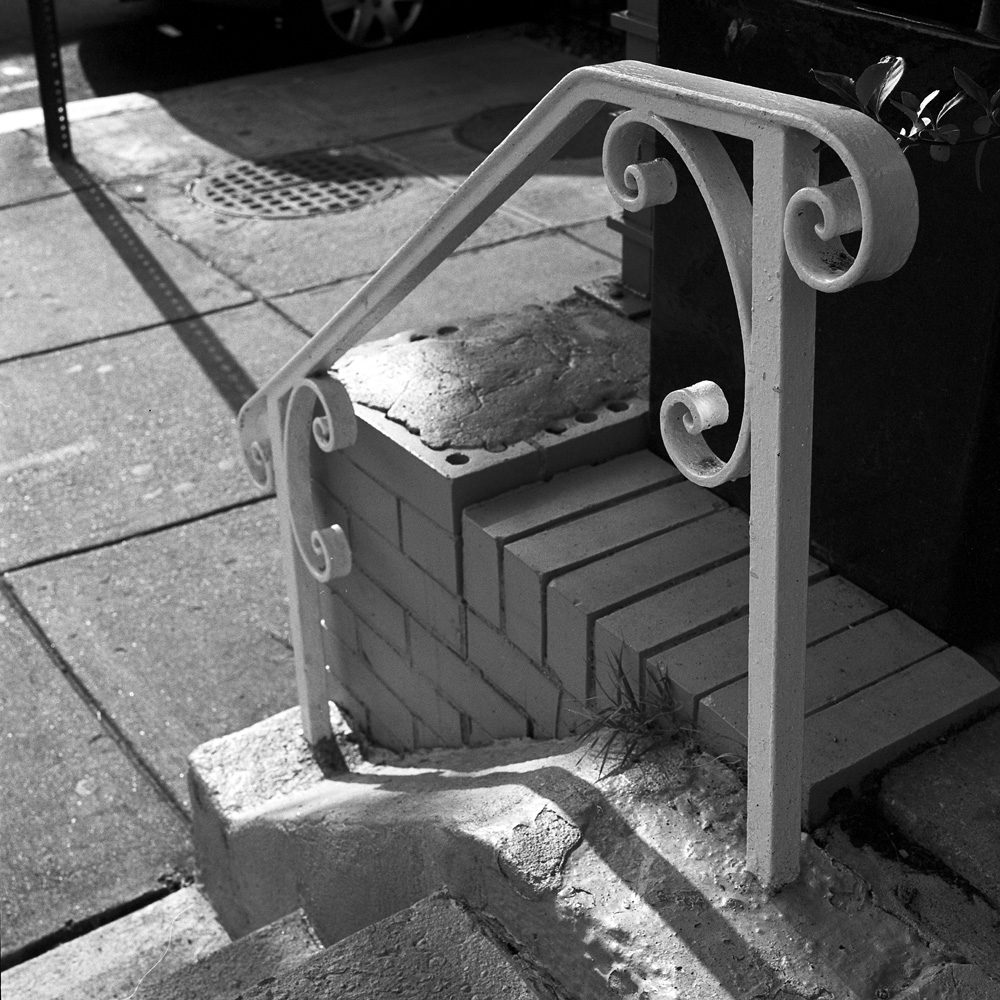
In contrast to the modern awning frame and handrail around the front patio, this 1910s/20s wrought iron hand rail frames the steps on the house next door to their building.
All these photos were taken on a Tuesday – the slowest day of the week, thus the absence of customers. I’m going back there tomorrow after work with some color film to take some night shots – the place gets packed!
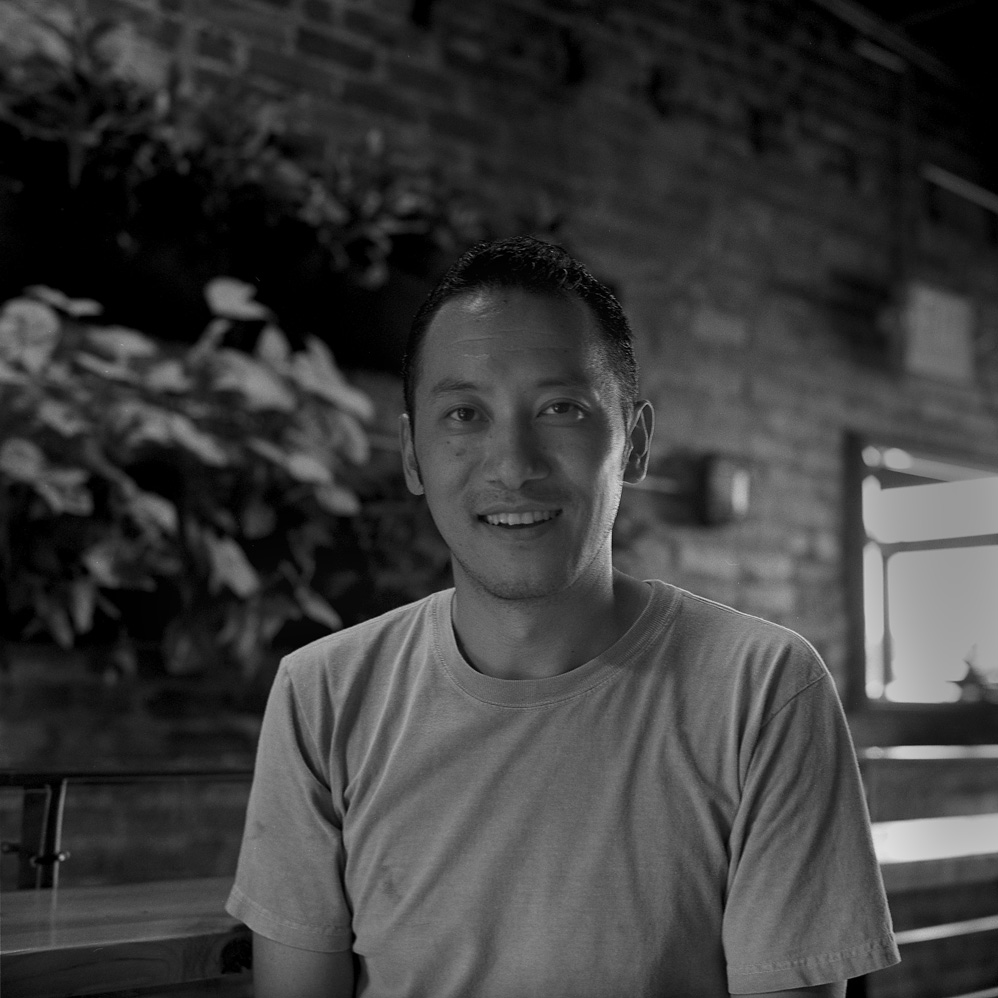
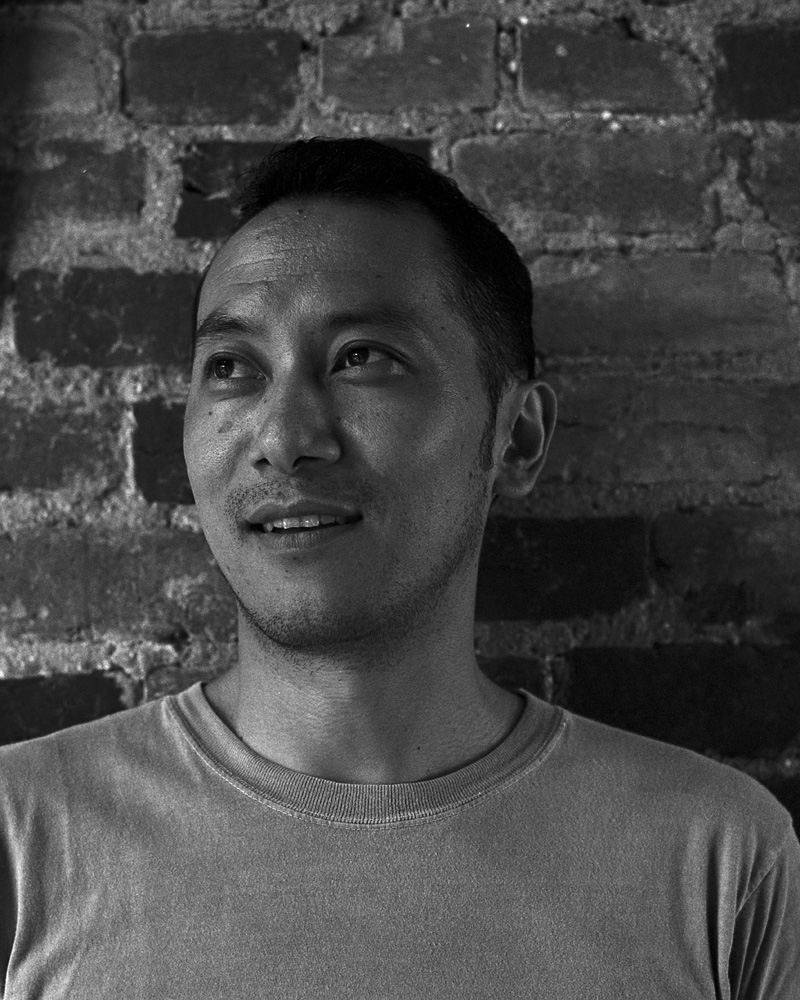
Here are two portraits I took of my friend Wanchuk, who is co-owner with Sam Huang (photo posted previously) of Mad Momos Restaurant & Beer Deck. I’ve known Wanchuk for nearly a decade. He’s from Sikkim, which is now a province of India in the Himalayas between Nepal and Bhutan, but used to be an independent kingdom with close ties to Bhutan.
Wanchuk T., at Mad MomosWanchuk T., Close-up
We met through a common love of photography – at the time he was still in post-college bum-around-the-world mode, and wanted advice on how to take better pictures in the places he was going. Now he’s running a restaurant and giving me a show of my photos. The exhibit will open on August 2nd and run through the end of October. Details about the opening reception will be posted separately.
I took those photos of him after we finished a meeting about the exhibit, then went for a 15 minute walkabout in the neighborhood around the restaurant to see what I could find. There’s an old bar/club across the street called “The Pinch” – I so want to photograph the front door because it has cool architectural detailing and some nifty graffiti, but from the looks of the folks hanging out by the front door, I may have to come back and shoot that early in the morning when they’re closed -their patrons may not take too kindly to being photographed.
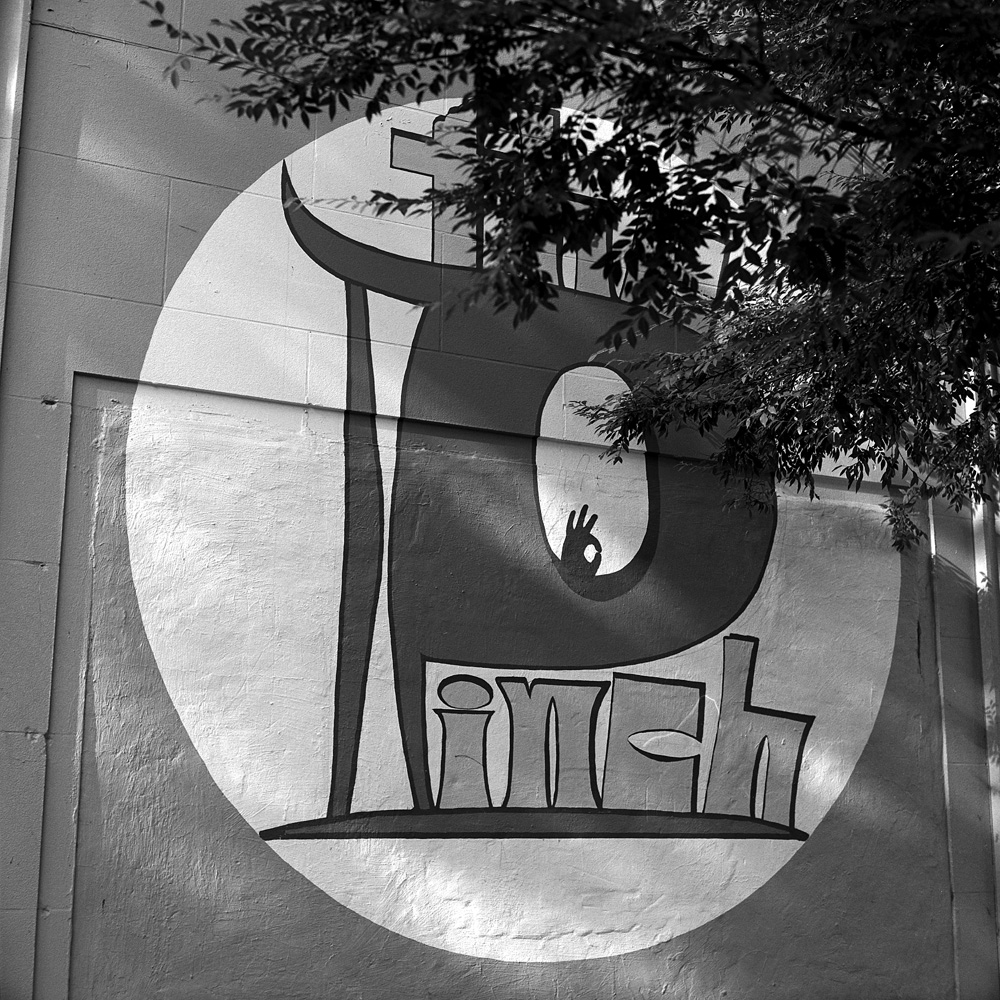
Here’s their logo on the wall facing the side street – it has a very 70’s look to it, but the paint seems very recent.
The Pinch
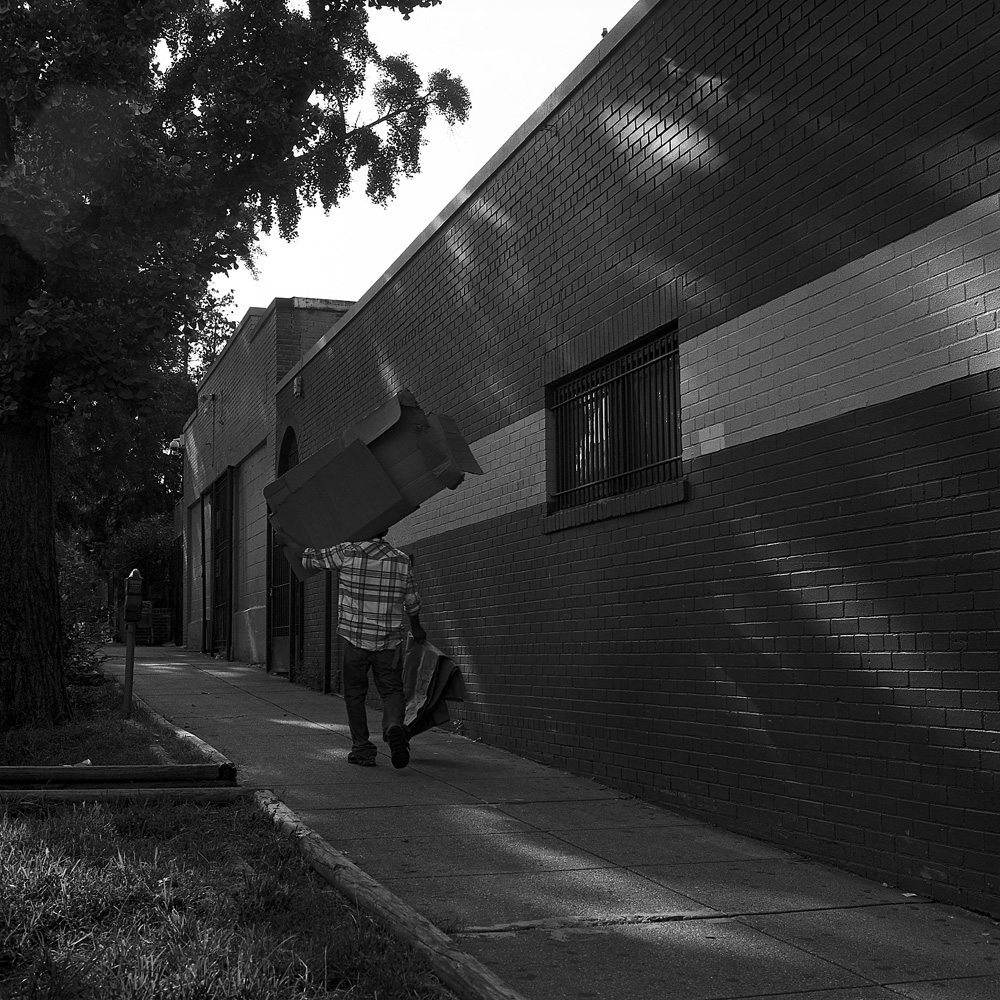
Pivoting to the left of the Pinch logo, I saw this lovely vanishing-point perspective of the building walls, dappled in evening sunlight. As I was composing the shot, this man hauling a gigantic cardboard box over his shoulder walked into the frame. Taking advantage of the serendipitous perspective-giving presence of the man, I waited until he was about 2/3 of the way in the frame before shooting.

 dcphotoartist