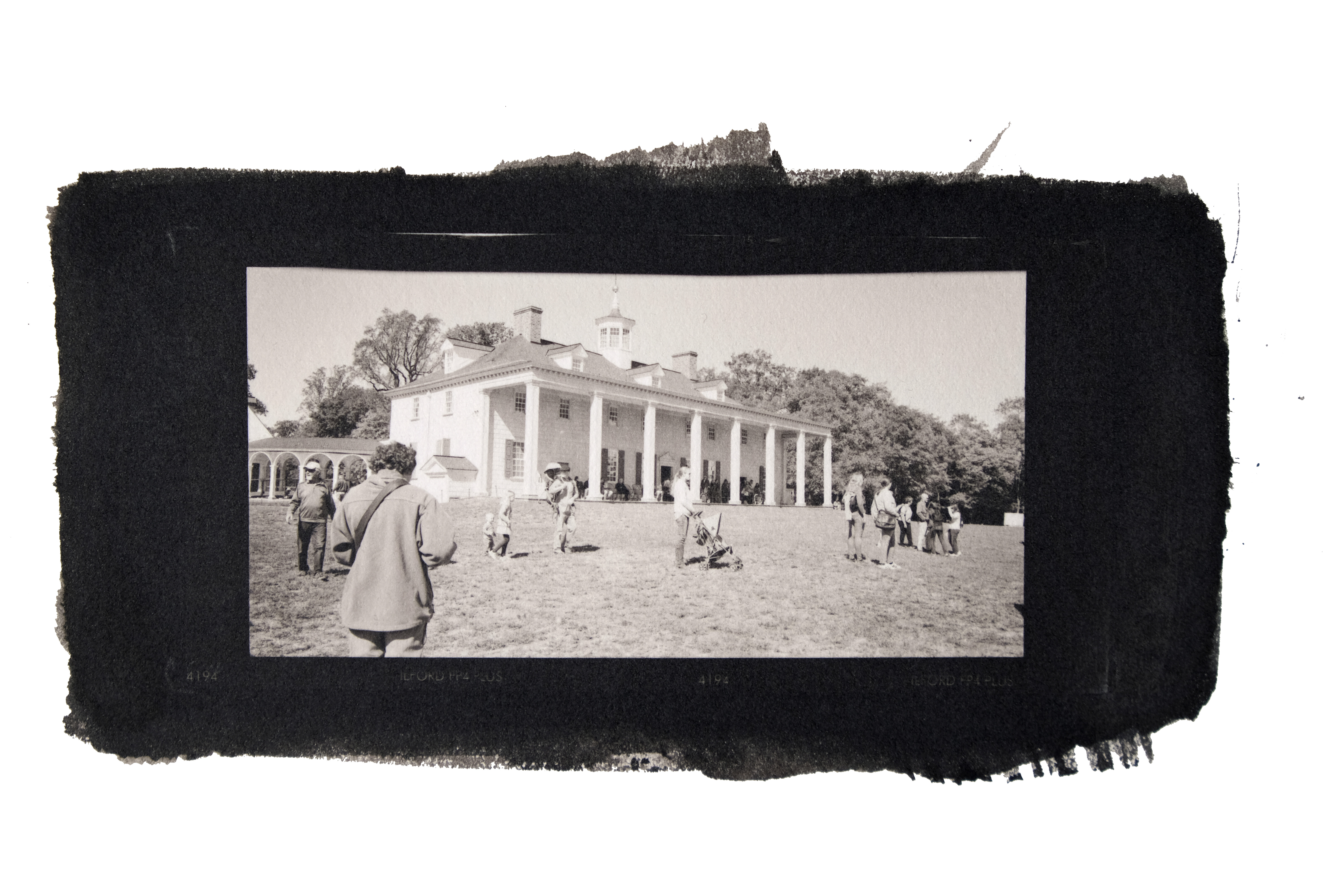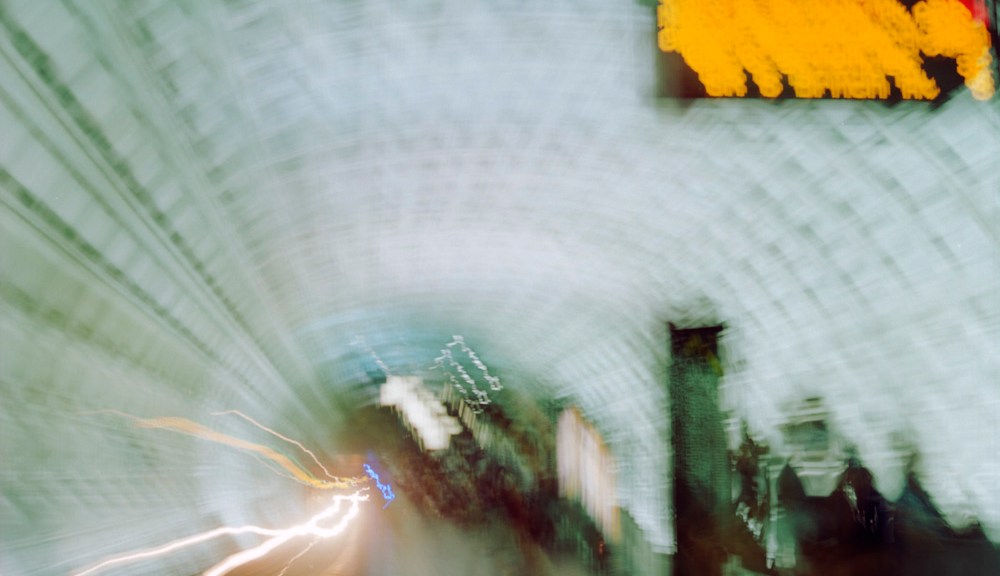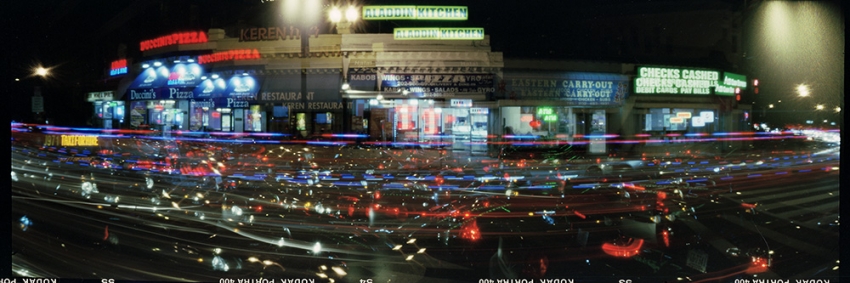
Tag Archives: art

More thoughts on the nature of photography

In trying to understand the nature of photography, and more specifically trying to come up with a single unifying theory of photography, I think it helps to break it down into two broad overarching categories of photography, specifically as it relates to the notion of “truth”. There is what I would term “informational” photography – photographs whose purpose is to convey information, and any aesthetic considerations are purely secondary, and “aesthetic” photographs where informational content is secondary, if not irrelevant, to the aesthetic/artistic considerations of the image. There is a fluidity between the two, of course – binaries are never absolute – but I think it still helps to have that general categorization to understand an image when looking at it .

We can look at certain genres of image and understand that they provide clear-cut if not extreme examples of each of these categories – a forensic photograph showing a failed machine part, or a crime scene photograph documenting the state of a room where a murder victim was encountered would be clear-cut examples of photographs where aesthetic concerns are not just in the back seat, they’re in the very last row of the bus when it comes to the priorities of the photographer taking the image.

This is not to say that there cannot be aesthetically pleasing images of failed machine parts or crime scenes; it is just that in these cases, aesthetic qualities are accidental, subconscious, or even generated by the perception of the viewer in an attempt to establish a relationship with the image.

An example of the extreme of an aesthetic image would be something like a chemigram, where no lens has even been involved in the making of the image, the content is purely abstract, and any information gleaned from the photograph is the product of the viewer’s attempt to establish a relationship with the image. Yes, a chemigram may be used clinically to evaluate chemical interactions between light, silver, and developing agents, but that is not the intent.

We can start to spiral the drain toward the middle of these two positions looking at other genres of photographs and see that very quickly they take on some aspects of each. You can look at vernacular photographs – “indigenous images made for indigenous purposes”: photographs made for personal consumption, and whose intended audience is purely domestic. Aesthetic concerns, while not the back row of the bus, are still secondary behind conveying basic information (“I was in this place at this time”, “Cousin Sally graduated high school”, or even “there was something about that tree/rock/dent in the car fender that I want to recall in the future”). The “something about this tree/rock/dent” images are so personal that the image functions like Proust’s Madelines; that information is utterly lost to anyone outside the photographer. I can look at a picture of a rock that I took and it immediately brings me back to the summer day in 1975 when I tripped on that rock and chipped a tooth, but anyone else looking at it will be oblivious to that event and wonder why I took that picture of that rock because it has no perceptible aesthetic qualities.

However, it is possible to take that photograph of the same rock with aesthetically pleasing qualities for the same Madeline-esque purpose to trigger my personal memory. At that point though, it begins to cross the line out of an anonymous vernacular – intentional aesthetics imply the intent of a non-domestic audience.

This also relates to the question (which I will deposit here and only briefly touch upon, and return to at a later date) of when does one become a photographer? The term itself is sufficiently broad as to allow for a wide range of photographic activities, from the completely casual (the only photos one takes are family vacation snaps and the dent in the fender of the car to send to the insurance company), the amateur (vacation photos that include more than just record shots of the family in front of various landmarks), the professional (photographs that have commercial value, and therefore are driven by informational AND aesthetic concerns), to the artistic (aesthetic concerns are foremost). Once one starts down the road of photography beyond the completely casual, picking up a camera with intent, that is the moment I would posit that the label “photographer” applies. Of course, once one becomes a photographer of one sort or another, that does not mean that ones role and relationship to photographs is fixed. A professional photographer can take a record shot of their breakfast to show a friend, or some tchotchke in a gift shop to ask their partner about a potential purchase, without involving aesthetic concerns.
New Work – Experimentation

I’ve been doing a LOT of printing lately, in preparation for the shows in Mexico City. I did some serious darkroom cleaning too, getting my print washers disassembled and scrubbed clean of all the mineral deposits that accumulate from using DC city water, and got all the stuff out of the sink that was cluttering it up so I could print big. I’ll be doing some copy photos of the big prints I did shortly, and have them posted here. But all that work inspired me to not only do more printing, but to be adventurous in my artistic endeavors, and push out of my comfort zone.

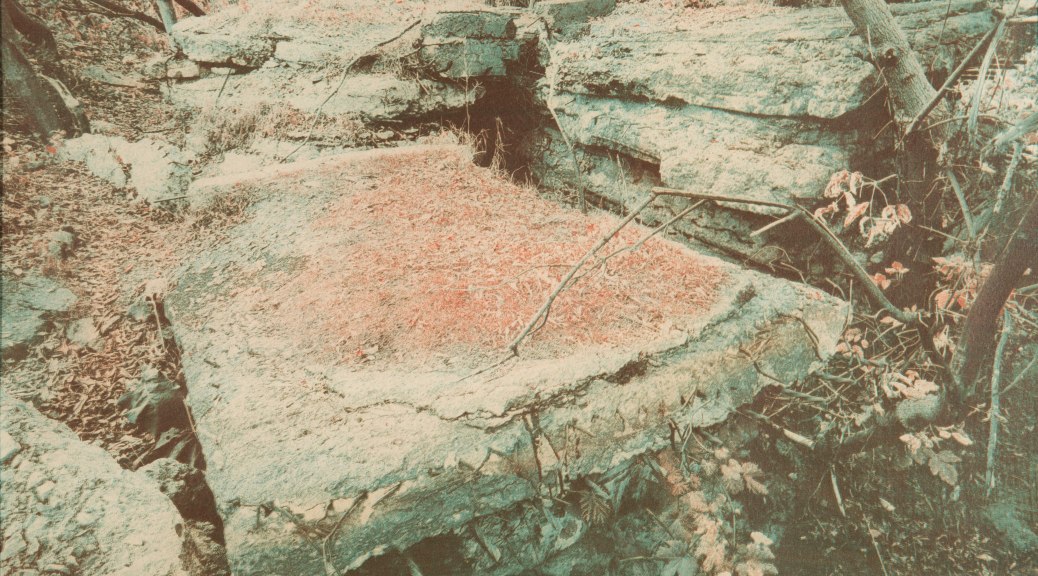
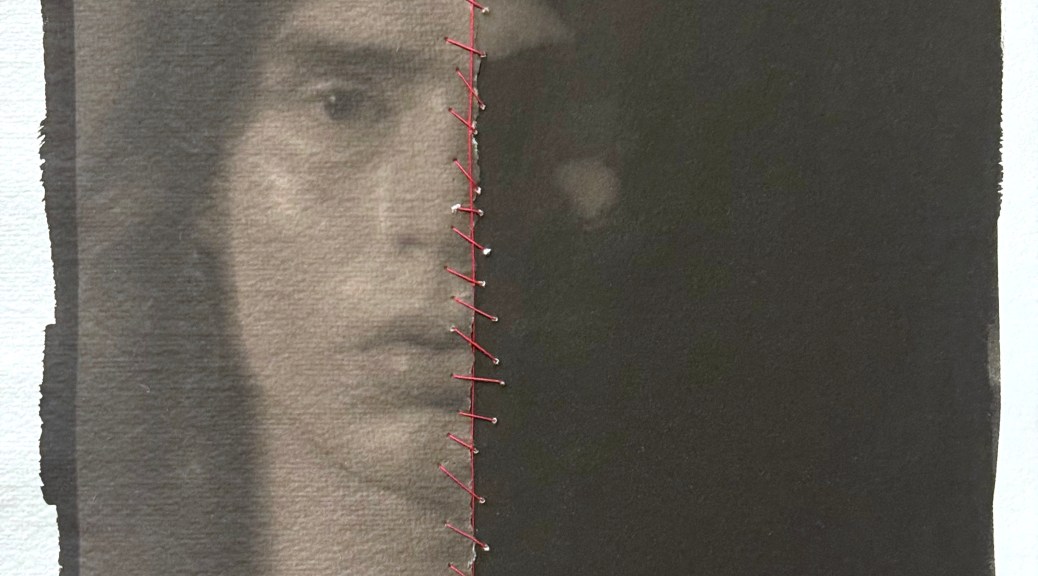
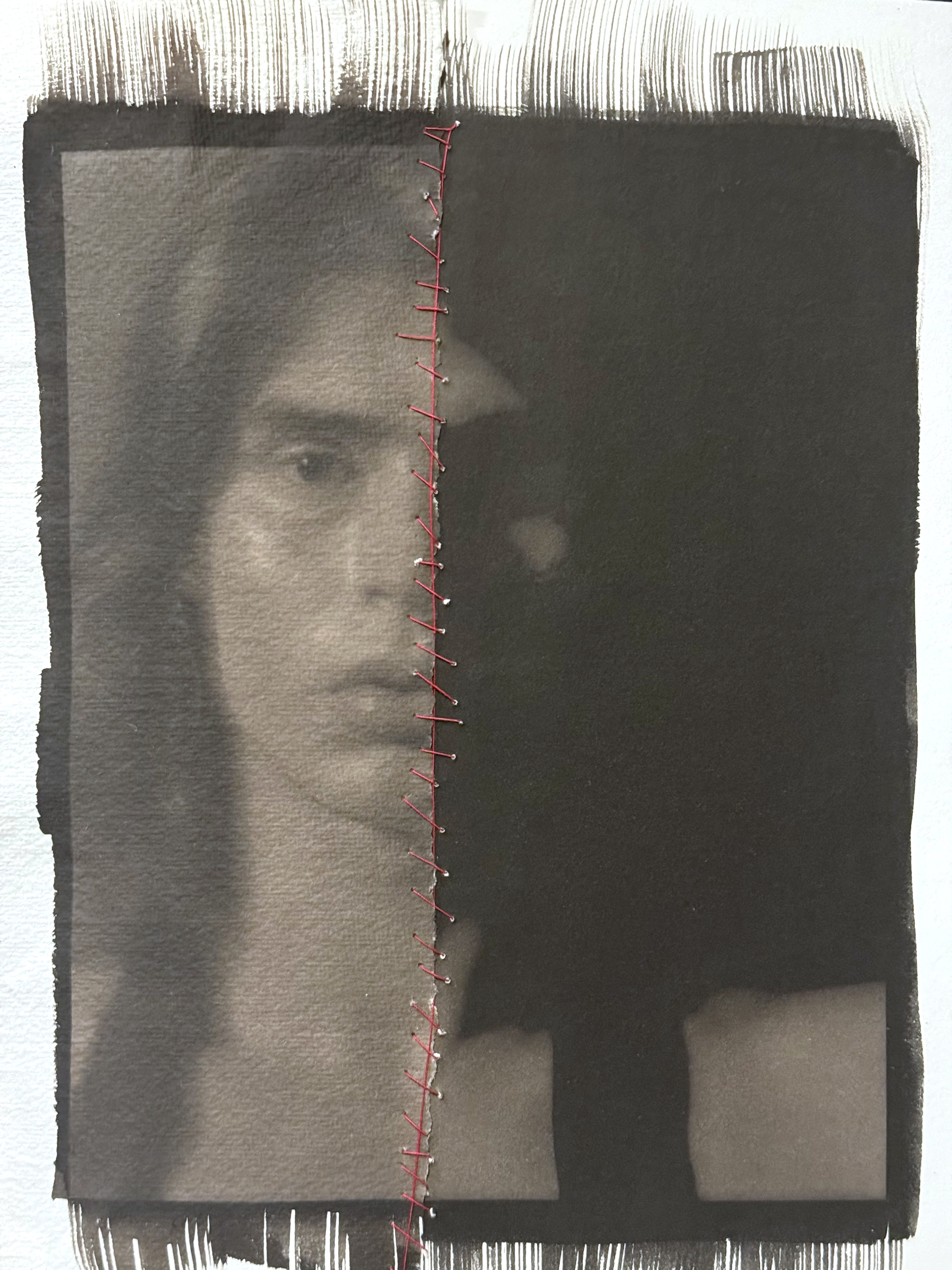
I have thought for quite some time about trying this, and thanks to a little push from my friend Jeremy Moore who lives down in Texas, I took the plunge last night and did some interventions on my prints that many would consider heretical. I made two different digital negatives from the same image, one with high contrast and one with normal contrast. The one with normal contrast I printed on Velke Losiny Prague, which is a light-weight cold-press paper with lots of texture. The high-contrast/dark print is on Revere Platinum, which is a heavy-weight hot press smooth paper. I then tore the print on the Velke Losiny paper in half, and then stitched the two prints together with red thread.

This is an exciting change for me, getting more experimental and risk-taking with my photographs. I’m going to do a lot more with the “destructive/reconstructive” mode of working – I think it opens up the work to being less literal and more visually and psychologically explorative.

Advice to New Artists – Gallery Shows

For many people, getting a gallery show is the holy grail of their artistic ambitions. Even though the art world is undergoing a major transformation with relationship to brick-and-mortar galleries, many people still see getting a gallery show as a mark of accomplishment (and it is – it means that someone who has money invested in an exhibition space is willing to commit their time, energy, reputation, and cash to showing and marketing YOUR work). Having achieved this, I’d like to pass on some salient advice for anyone still struggling to get there.

HAVE AN IDEA

Before you ever begin to look for a gallery show, have a rock-solid concept about your work. You can take all the pretty pictures in the world, but if you don’t have some idea, some message behind your work, then you probably won’t get very far.  I’m not saying that your concept/message must be a social/political/intellectual/academic one, but it should be more than just “they’re all photos of Yosemite because I think it’s pretty”.

ARTICULATE THAT IDEA

Develop your elevator pitch – if you need help writing it, find someone you know who is a good writer to come up with a couple of sentences that encapsulate what your work is about, and then practice delivering it to your friends and family until you are able to rattle it off with confidence.

In my case, it was:

Sinister Idyll: Historical Slavery in the Modern Landscape is a visual narrative of the physical evidence of the slave-holding past in and around the nation’s capital. The work consists of 2 1/4 inch by 4 1/4 inch palladium prints that, by virtue of their size, force the viewer into an uncomfortable intimacy with images that are both familiar and unknown.

That was the hook to pull the interest of the gallerist.  After that, I had the attention of the gallery owner, and was able to tell the story of how I got started on my series, what was my motivation, and all the other bits about the work that made it worth showing.

NETWORKING

Go to art openings – lots of them. Go see different galleries and keep track of the kinds of work they show. Get to know other artists and talk to them about their work, especially artists whose work you identify with. Get them to introduce you to the gallery owners – having a personal introduction from someone the gallerist already knows and works with is a big leg up in getting your work in front of them.

GALLERY OWNERS

At the openings,  go talk to the gallery owners. Don’t be afraid to identify yourself as another artist looking to show your work, but don’t introduce yourself that way if you’re meeting them cold. Engage them in conversation – ask them about the show, how they chose the work to include, and so on. When they turn to you and ask you about who you are, then tell them, “I’m Bob Jones (or whatever your name is) and I’m a photographer. I’ve been working on a series about xyz for the last three years”.  Have your elevator pitch ready to go – if they’re interested, they’ll ask, and you can give them your confident, practiced hook. Have a few images of your work on your phone, at the top of your phone’s gallery, so they’re ready to show, if the gallerist asks to see some.  If they don’t, don’t whip out the phone and start showing them anyway.

ETIQUETTE

If the owner is interested, ask what their process for viewing new work is – maybe they have portfolio drop-offs once a month, maybe they schedule appointments, maybe it’s an online process. Whatever it is, FOLLOW THEIR PROCESS. Nothing will piss off a gallery owner more than someone ignoring what they consider to be the most basic of basic rules. They will see it at best as a waste of their time, and you’ll likely never get your work reviewed by them, and there won’t be a second chance.

If they look at your work, and they like it but don’t have a space to show it soon, don’t take this as a no. Say thank you, let them know you appreciated their time, and listen to any advice they might dispense. Get their business card before you leave. When you get home, that same day, or next day at the latest, send them a thank you email, and find out if they would be interested in getting future communication from you about your work. If they say yes, do send them links and announcements about new bodies of work you’re doing. Do it often enough they won’t forget you, but not more than say 3-4 times a year so you aren’t a pest. Don’t send them announcements about every time you get a photo hung in a cafe somewhere, but do let them know if you get a major show or you get a write-up in a serious publication like a national newspaper or art magazine.

SELF-PROMOTION

A lot of this stuff above falls under the umbrella of self-promotion. It’s a practice, not a one-time event. You’ve got to kiss LOTS of frogs to find a prince, so if this doesn’t lead to a solo show the first time you try, don’t give up. Lather, rinse, repeat.

DON’T BE A DIVA

Unless your last name is Mapplethorpe, Avedon, or Liebowitz, you can’t get away with being a diva. So don’t even try. Your goal (I assume) is to get invited back to show again. Producing a show, even a solo show, is a collaborative effort. The gallerist will know their space and have a pretty clear idea of how to hang your work in their space to be most effective. Listen to them. You can politely disagree and discuss their ideas, of course, but don’t take a “my way or the highway” approach to hanging the show.  If you pull a stunt and say, “I’m not doing this unless…”, it had better damn well be a hill you want to die on. “Doing that would compromise my artistic vision” is 99% of the time a bullshit excuse. Be willing to share a wall. Be willing to have your pictures arranged in a way you hadn’t thought of. Don’t insist that “if this picture isn’t in the show, I’m not doing the show”. The gallery owner will remember if you’re a temperamental diva, and they won’t want to work with you again. The art gallery world is small – word gets around and if you’re a diva, more doors will close than open.


Is Photography Reality? No.

This was inspired by an online discussion I was engaged in on a photography forum.

Photography occupies a unique niche in the arts. Because of its easy verisimilitude, its capacity to effortlessly record detail with precision, it presents the comfortable illusion that it is reality. I would argue that it is in fact no more reality than painting, and in some ways even less, precisely because of its easy verisimilitude.

PalacioBellasArtesSol
Palacio de Bellas Artes, Mexico City. A seemingly hyper-realistic image.

Object Permanence

Why do I say that photography is less real than painting? Because it claims representational status when it is merely descriptive. When people look at an average photograph, because the subject of the photograph appears to be an exact likeness of the subject, they assume that it is a 1:1 correspondence because it is in their own personal interest to assume such. It is comforting to think that “this photograph IS the person in that moment the photograph was taken”.

In a way it allows us to reverse the childhood lesson of object permanence. When a child is very small, if you show them a toy, then you hide it, they will not understand that the toy is still there, just out of sight. A photograph allows you to imagine that something is there even when you know it is not. The subject of the photograph is not physically present at the moment of viewing the photograph, and may even be dead or transformed beyond recognition, but still exists in the mind of the viewer at the moment of viewing.

Dimensionality

Photographs render their subject from four dimensions (length, depth, height, time) to two. They also perform a selective removal of context. In reality, a subject exists in an omnidirectional, infinite context. Taking a photograph of that subject requires excluding a near-infinite amount of that context – you are viewing that subject from a single direction, from a fixed perspective, as it presents itself for the duration of the exposure. That duration of exposure is necessarily self-limiting and as such is not tied to the experience of the subject holistically – it is possible to make a subject appear dramatically different than it does 99.99% of the time, to the point of being unrecognizable, through the use of light, composition, color, and time.

Organ Grinder, Calle Madero

You are recording that subject in a single quantity and quality of light. And you are photographing it at a single moment in time (even if you are doing a solagraph that requires a year to expose, in the span of infinite time, it is a moment).

18thFloridaColorNight2x

Because of the mechanics of making a photograph, while everything that appears in the above photograph was in front of the camera during the exposure, this scene in no way looks like this, ever. Yet it is a photograph. This was made by two separate exposures of twelve minutes each, moving the camera closer to the subject during the second exposure, utilizing a pinhole camera.

Verisimilitude

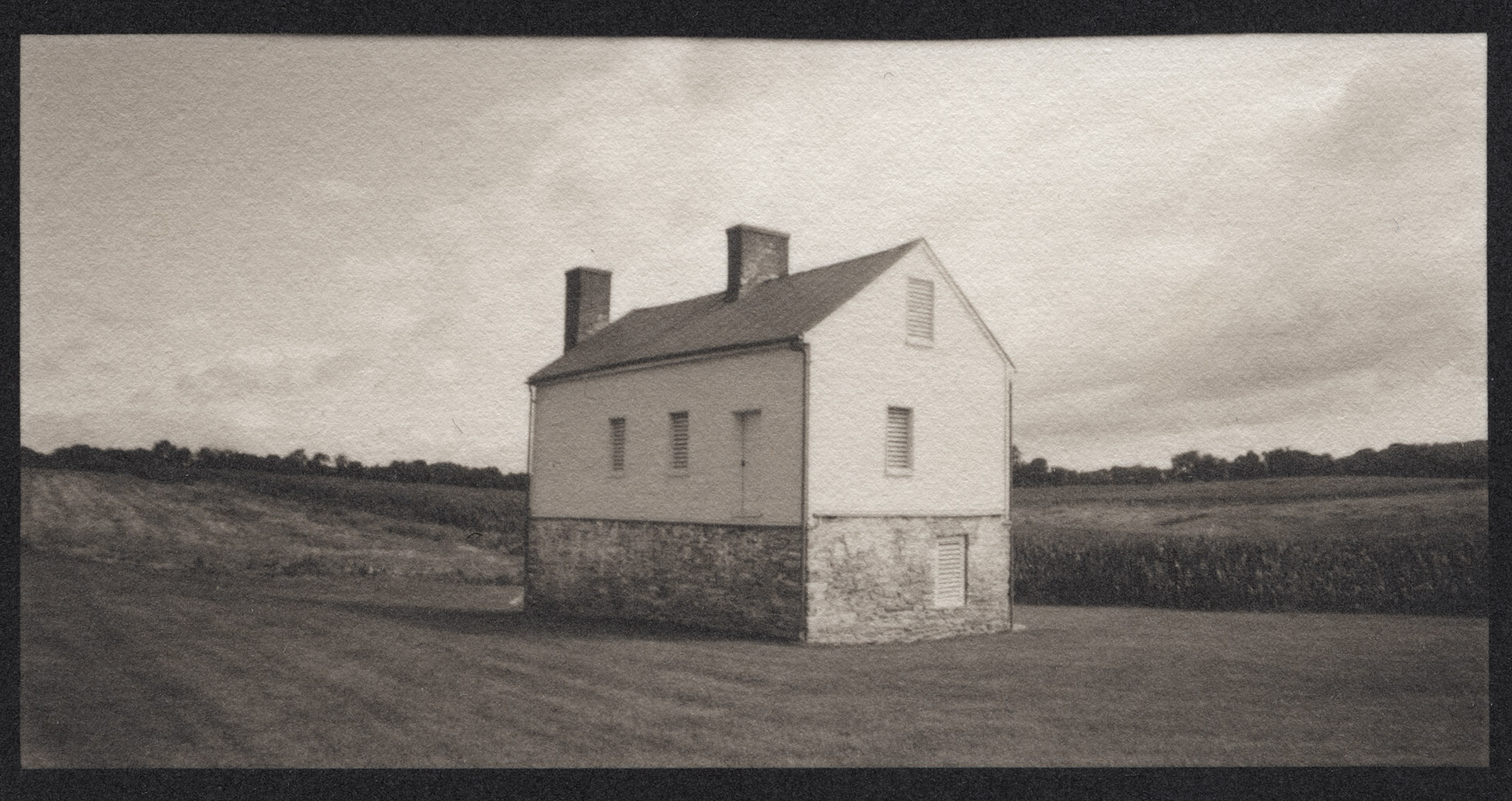
You are choosing to reproduce that subject using some method that is at best a precise simulacrum of that subject. Should you choose to reproduce the recorded image in any number of alternative media, then you have completely eschewed realism – while a photograph of a house may look like the house, the house has never ever appeared like the palladium print of the house.

Bachelors House, Best Farm

The house is NOT that color, nor is it that texture, nor even that exact brightness – it is stone and brick and painted wood, not paper fiber. It is an interpretation by the photographer of the relative brightness of the objects in the scene rendered on a piece of film with its own spectral sensitivities, translated through chemistry onto a piece of paper. That chemistry has its own particular responsiveness to light, temperature, humidity, paper pH, and other factors that alter the appearance of the final image. Yet if you were to take this image and go to the place where it was taken, you would say, yes, this is that house. It is similarly delusional to talk about the permanence of the one versus the other. Both are subject to the vicissitudes of time, and there is no guarantee either one will outlast the other.

Photographs as Language

Let me start this section by prefacing it with a bit of academic theory. While I am thoroughly annoyed by one of the great bete noirs of 20th century academia, post-structuralism or deconstruction, the theory does have one very useful concept at its core: the understanding that language is NOT literal. Words are symbolic, abstract representations of the things they relate to. The word “rock” for example, is a vast generalization about rocks. When we read it, it conjures up in our mind a whole slew of associations with objects of geologic origin, and when YOU hear the word or read the word, the mental image you form is different from the mental image formed in MY head.

I can apply more and more words as modifiers to the word “rock” until you and I can both understand we are referring to the SAME rock (a chunk of granite, three centimeters in length, two in width, 1.3 in height, with reddish brown mottling and flecks of gold-like minerals contained within, whose surfaces have been polished to a mirror-like smoothness, on display in the Smithsonian Natural History Museum’s mineral collection), but even then, those words are NOT the actual rock.

Well, neither is a photograph of that rock. The photograph may represent the rock, and it may represent it with extreme accuracy (the rock in the photograph may be reproduced with the identical dimensions of the actual rock). But it is still two-dimensional, not three, and the colors of the rock in the photograph are composed of organic dyes, not the same minerals and elements of which the rock is composed.

And what of the fact that the photograph can be (re) produced in many different ways so that those aspects of verisimilitude are distorted or thrown out altogether? Perhaps my original capture of the image of the rock is a 1:1 scale representation of the rock, but I enlarge it to be twenty feet across, rather than three centimeters. Or I intentionally (or accidentally) alter the color balance so that the rock appears green rather than red. Or I reproduce it to be smaller than the actual rock. All these things are possible, and true.

If anything, a photograph that attempts to be a literal record represents a failure of the imagination and creativity because it is suppressing those acts through its verisimilitude. An “accurate” photo is encouraging the viewer NOT to think and NOT to interpret, but to take on face value the subject presented because there is the possibility that it might be accurate.

Photographs and Time

One of the great challenges of ascribing literal representation to a photograph is the factor of time in its creation. Because of the speed of production of a photograph, we assume that there is some literal truth and purity to the image. While it is more fundamentally assumed today due to the nature of photographic technology (there are digital cameras today that can record an image in less than 1/10,000th of a second even without the aid of stroboscopic light), even at the dawn of photography when a Daguerreotype could be made in minutes, rather than hours or days for a sketch or a painting, photographs were thought of as “instantaneous”. This can be seen in marketing for early portrait studios: “Instantaneous Likenesses” were the frequent topic of advertising.

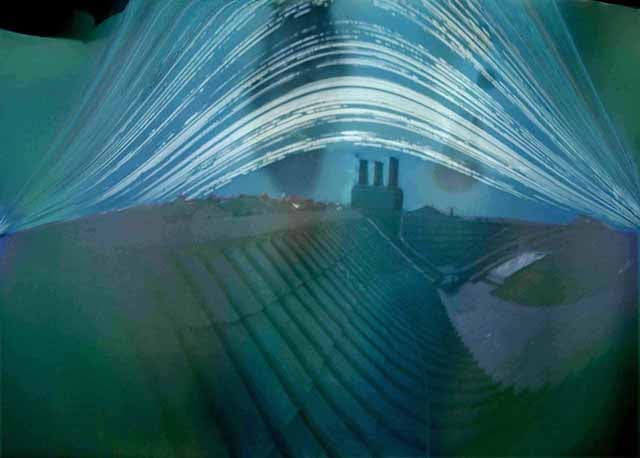
But just because a photograph CAN be captured in fractions of a second does not mean that it can ONLY be captured that way, and cannot be ascribed as a fundamental character of a photograph. A pinhole image may be made over hours or days, or a solagraph can be recorded over an entire year.  There is nothing literal in a one-year solagraph – it captures the movement of the sun through the scene every day, and the changing position of the sun in that scene every day.  The effect on the film or paper is so profound as to not only cause chemical reactions but actual physical reactions – the sun will be sufficiently intense as to burn the film or paper.

solargraphExample

If you view that scene where this image was taken, it would look nothing like that, ever. You would NEVER observe that. Yet it is a photograph. It is simultaneously literal and profoundly distorted.

At the moment I’m struggling to come up with a nice tidy academic conclusion to this essay. I don’t know that I have it in me at this time, because I’m not done thinking about this topic and I need to spend a healthy chunk of time organizing and re-organizing my thoughts. I will come back to this idea of the paradoxical simultaneous literalness and non-literalness of photographs and how we interpret them (or fail to interpret them).

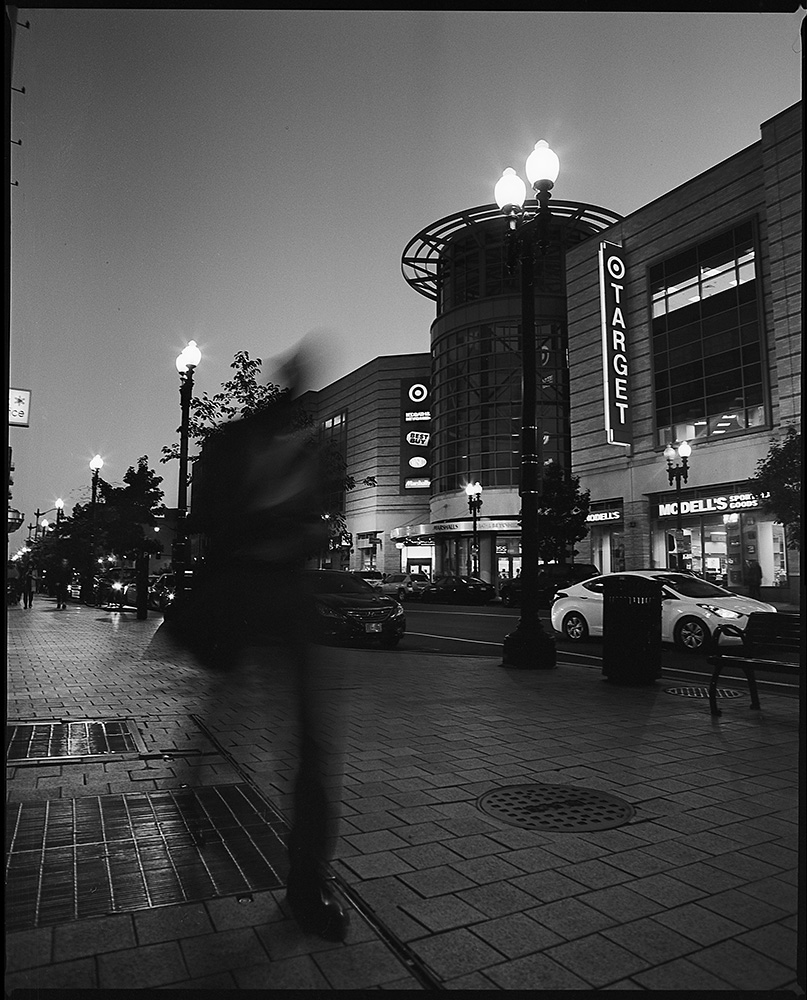
Ghost Man, Columbia Heights

GhostManCoHi

This is a case of where the mechanics of photographing lead to something emotionally resonant in a powerful way – the blurred moving man under other circumstances could be considered a flaw, but here becomes a metaphor.

The Primitive Eye: Learning to See Through a Pinhole September 12-October 24

Do you want to improve your photographic vision, but find yourself frustrated with your images? The Primitive Eye is a six-week guided exercise in seeing. The course meets on Tuesdays from 7-9pm, September 12 to October 24th. The only requirements are that you are ready and willing to tackle some challenging assignments, and that you obtain a pinhole objective for your camera. This could be a pinhole in a body cap, it could be a custom pinhole objective, or it could be a dedicated pinhole camera that shoots film or photographic paper. It could be a digital camera or it could be a Quaker Oats tube.

By stripping down your gear to the most basic of photographic tools, the pinhole lens, you will be forced to contend with the three fundamental components of a photograph – light, composition, and time.

Foggy Bottom Metro, Waiting

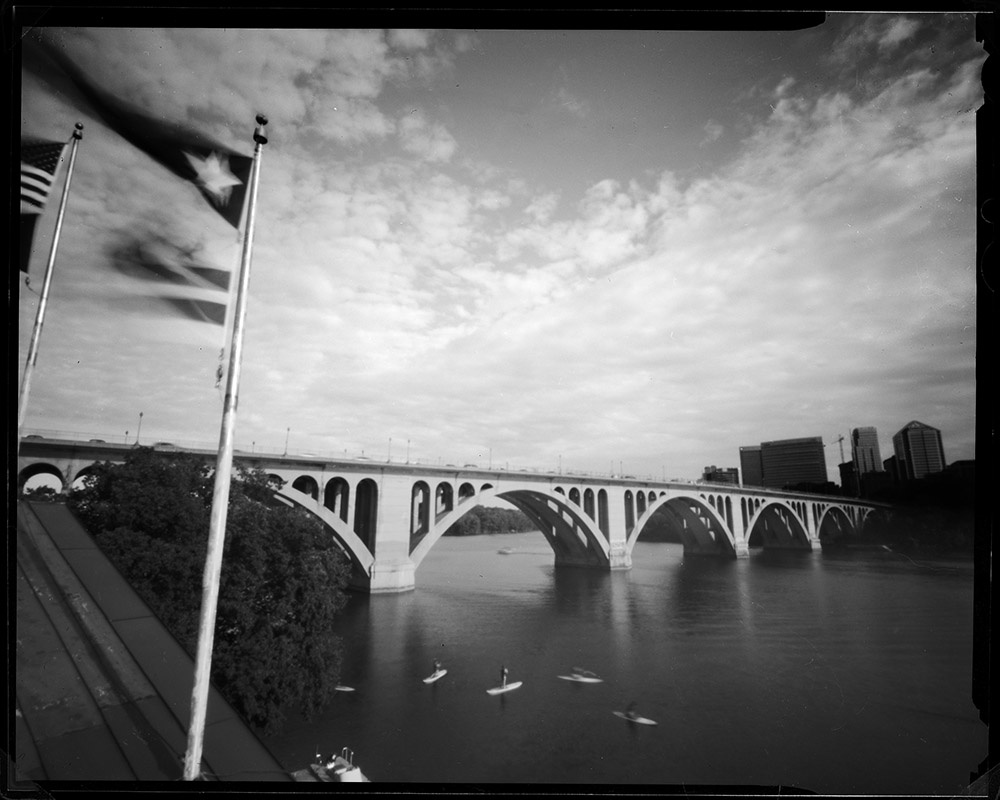
Light: light itself, with directionality, quality, and quantity, must be critically accounted for in pinhole photography. There’s no gaming the system with a fast lens.

KeyBridgeFlagsPinhole
Key Bridge, Georgetown

Composition:

Typically, pinhole objectives are wide-angle. Because they are so small, composing through the objective is difficult at best. You have to carefully plan your composition, or you have to open yourself up to serendipity. Either way, you have to know how your camera sees before you set it up, or you’ll have no control over what you get.

Pan-American Health Organization HQ

Time:

Pinhole objectives force a recognition of the importance of time in a photo. With modern, automated cameras that have mechanical shutters that freeze slices of time as small as 1/8000th of a second, and electronic ones much faster, we are used to thinking of photographs as truly static objects, and movement and blur are objectionable. With pinhole photography where a 1 second exposure is quite fast, you must carefully plan for how movement will be captured by your camera, because it will. It will also force you to re-think the notion of a photograph as being time-less and two-dimensional, and being time-ful and four-dimensional.

The Primitive Eye: Learning to See Through a Pinhole is a six-week class on how to develop your vision through simplification. Strip away all the bells and whistles of technology, and you have to concentrate on the fundamentals of photography: light, composition, and time. To register, go to the Photoworks website or click here:

Register for: The Primitive Lens

Pinhole Resources

Where to find:

Pinhole Pro – multi-aperture pinhole for various DSLR/Mirrorless mounts

B&H Photo – pinhole cameras

B&H Photo- Pinhole Body Caps

eBay – pinhole

Work to Inspire:

Pinhole.org

FslashD – Pinhole Photography (my work was published in their inaugural anthology volume)


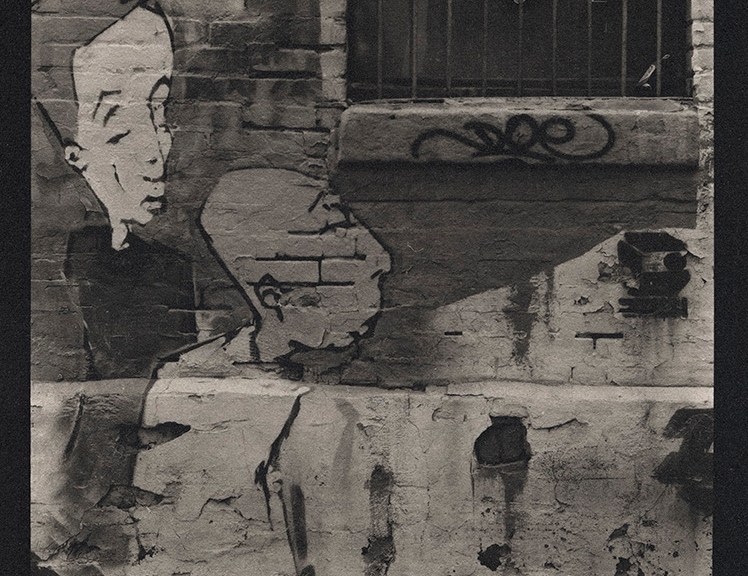
U Street Graffiti – Palladium Print

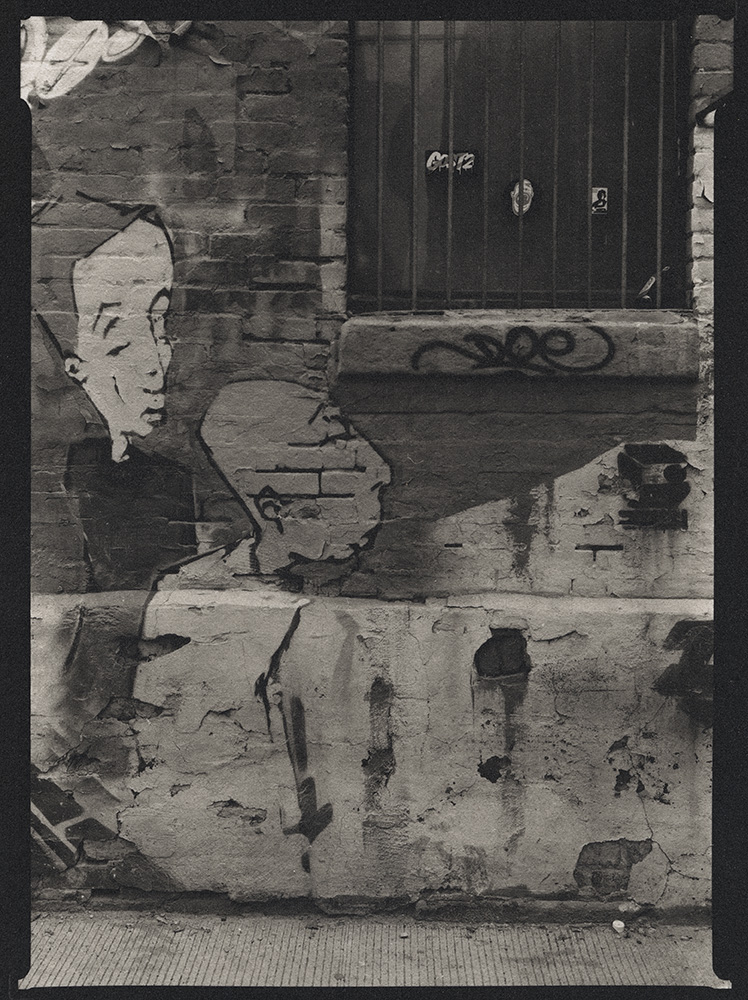
In my latest iteration of my Intro to Platinum/Palladium printing class, I dug up some old negatives I had made, since my student this time was sufficiently skilled with wet darkroom processes and not interested in getting into shooting large format (in my standard group class, we take my Canham 5×7 out around Glen Echo and make a dozen or so negatives for students to work from). This was a print from that session.

UStreetGraffitiPtPd

It’s a memorial to the transitions on U Street. This is graffiti art that has since been obliterated by gentrification and re-development – the alley where this was has been re-graffiti’d, but with “sanctioned” artwork a bit more sanitized and easier to interpret.

This print is a 5×7 palladium print. The usual chocolate-brown color is missing because I gave this emulsion mix a shot of NA2 contrast agent to give it a bit more snap. The NA2 contains platinum, which is what cools off the image and makes it more neutral. If you’d like to learn how to print this way, contact me through the blog and we can schedule a class, either one-on-one or I can fit you in to an upcoming class at Glen Echo Photoworks.

Meet And Shoot – Columbia Heights

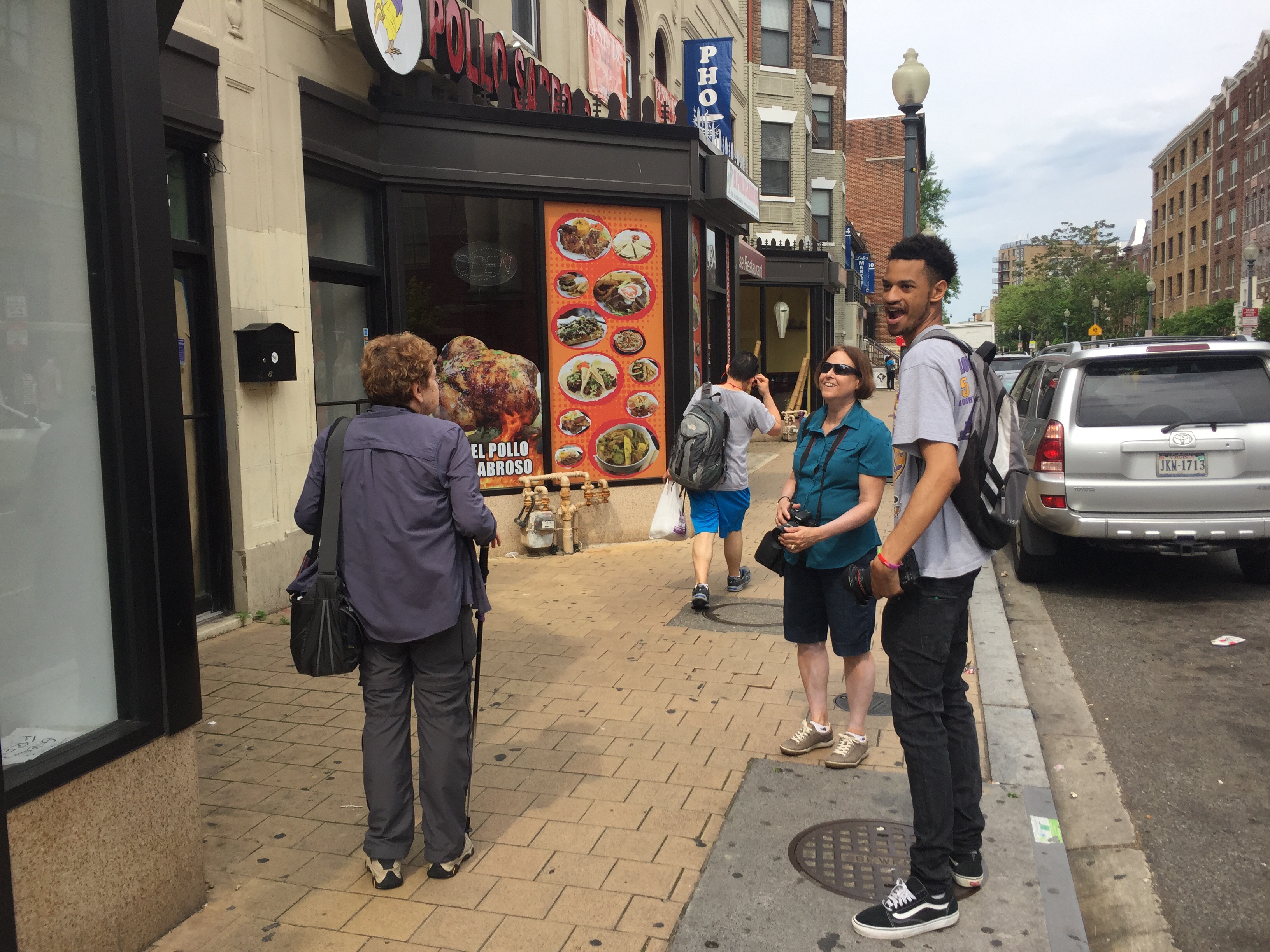
Today was my session of the “Meet & Shoot” class I co-teach with several other instructors at Photoworks. The class is a five or six session workshop on street photography where each instructor takes a group of students out for a guided photography excursion to a location of their choosing. Students can sign up for all sessions, or pick and choose which ones they want as their schedule and/or instructor preference dictates.

This time, I had three new students and three repeat students from the last time I taught this class. Due to some last-minute scheduling snafus, three of the students were unable to make it, so it was a very intimate walkabout, and I was able to teach as much as I was playing shepherd.

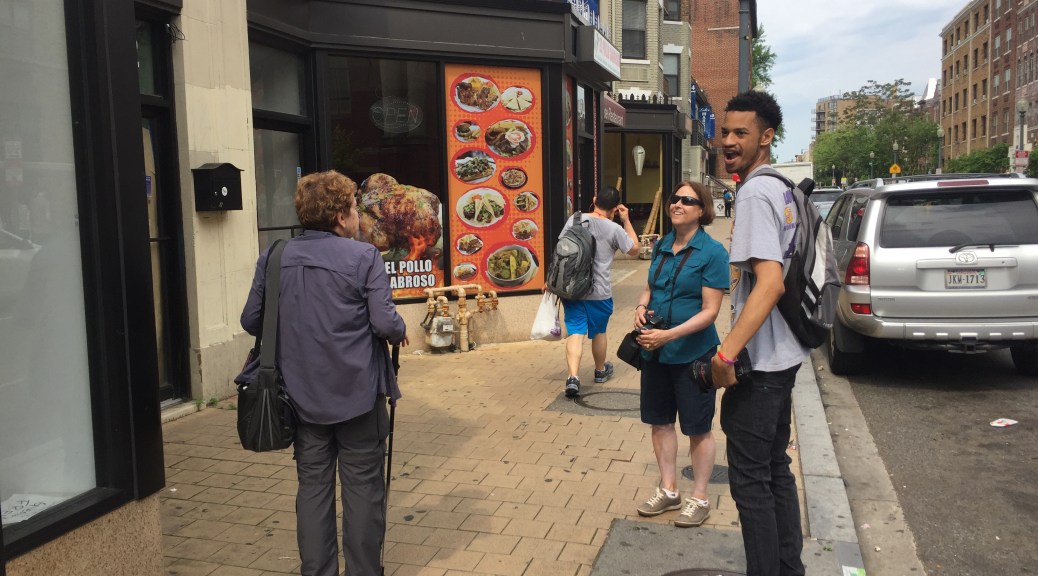
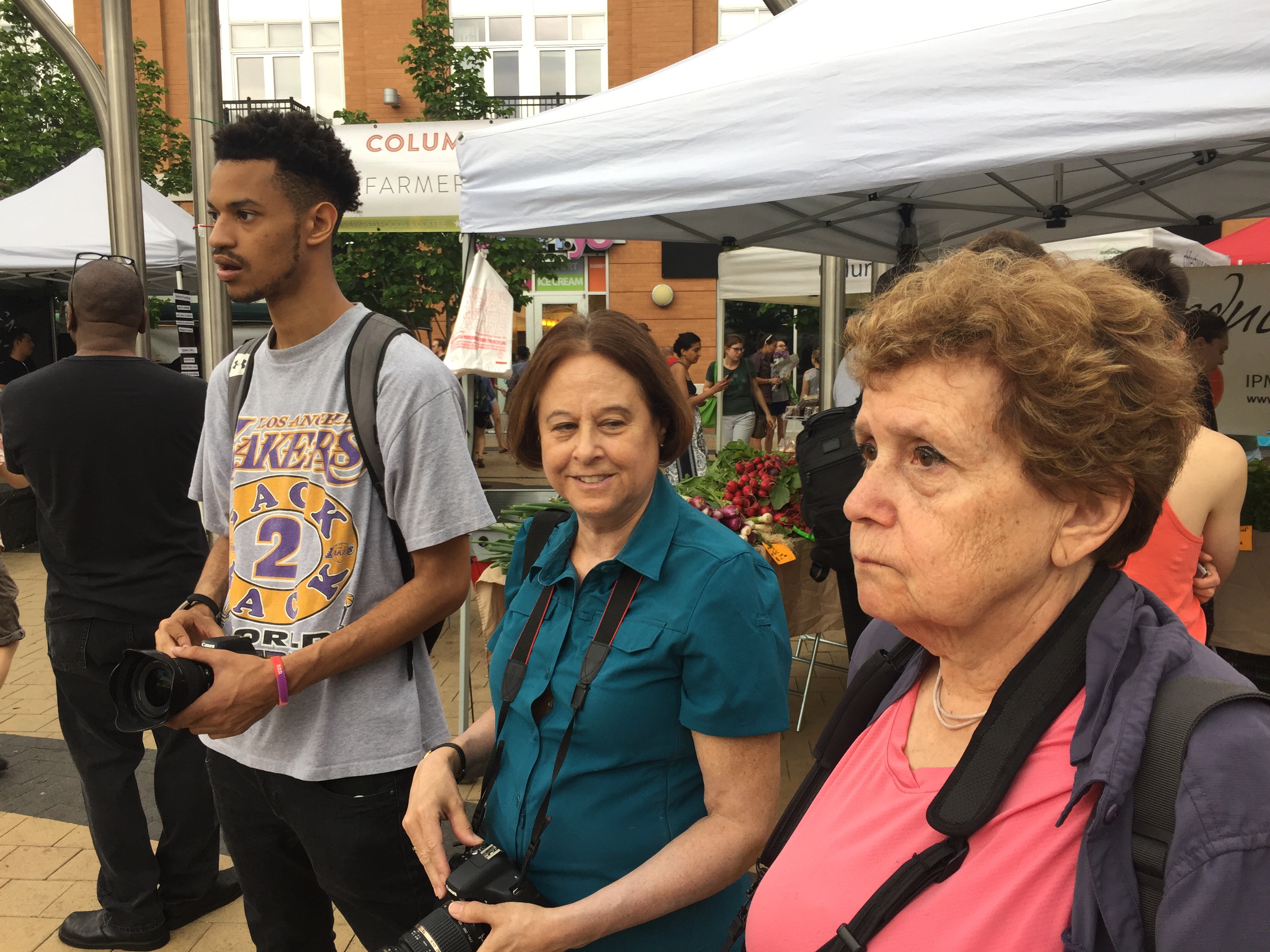
We met at the Columbia Heights Metro station, and once the crew was collected, we took a walk up to the little plaza in front of the Tivoli Theater where a saturday farmers market was in full swing. My three students, seen below (L to R: Matthew, Suzan and Bobbi) wandered around and took full advantage of my guidance for the session to use color as a foundational theme. The farmers market was a perfect opportunity, with all the fruit and vegetables on display.

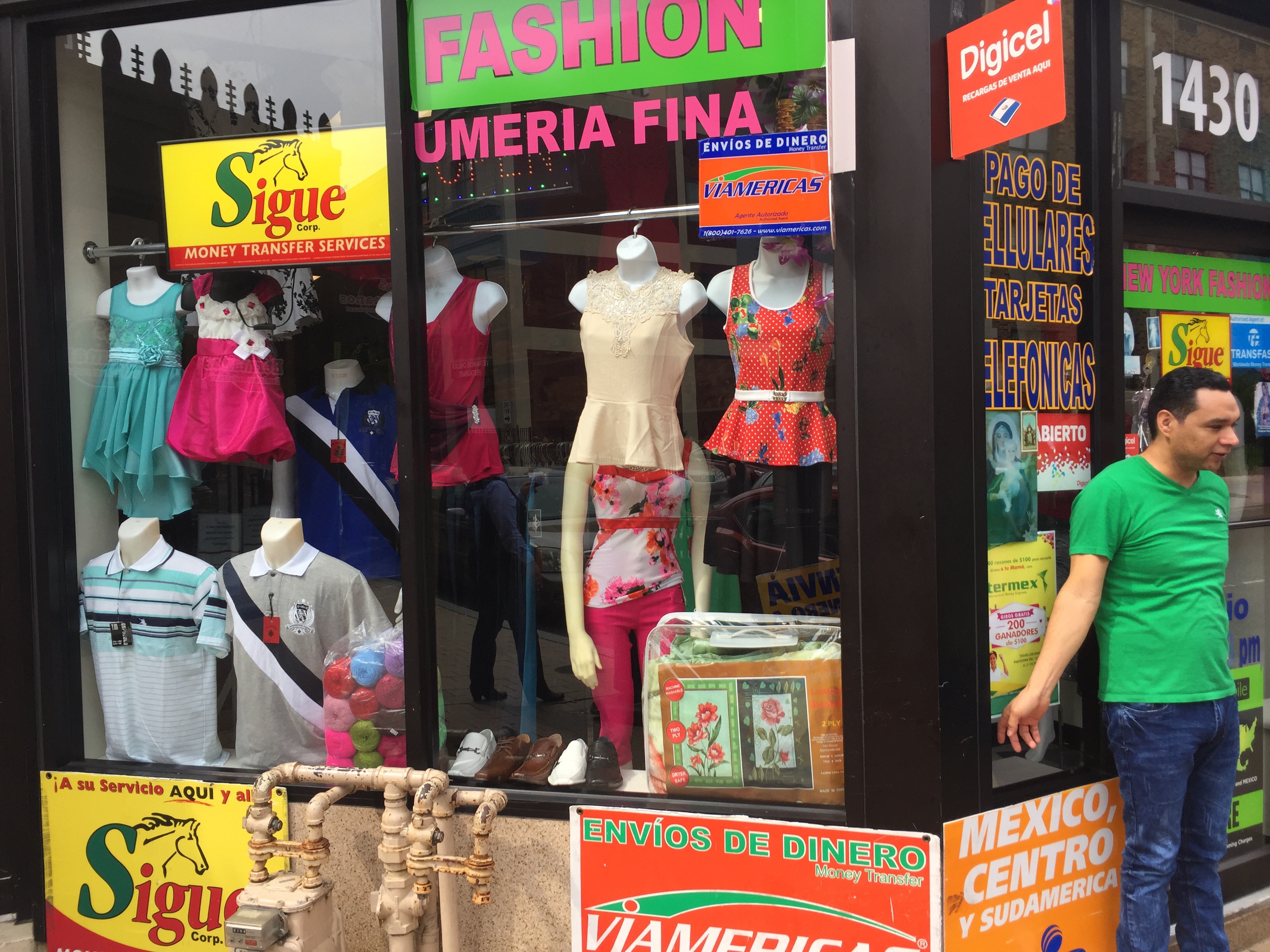
Columbia Heights is an ethnically diverse neighborhood, with a strong Latin-American presence. This is very obvious in the colors and styles of signage on shops and restaurants, and makes for a great subject for a color-based exercise.

Here Bobbi, Suzan and Matthew are examining some signage on a Dominican restaurant on Park Road.

We continued along Park Road over to Mount Pleasant, another neighborhood in Washington DC that also has a significant Latino presence. I took the opportunity to discuss including graffiti and public sculpture in your work as a “street” photographer. If you’re going to include other peoples’ art in your photography, make sure that you have a solid reason for doing so- it’s fair game as documentary, or if your capture and interpretation is transformative (abstract/close-up, for example), but if you’re planning to exhibit and market photos of other peoples’ art, even if it is displayed in public, you’re at best in an ethical gray area, and potentially in a copyright violation scenario.

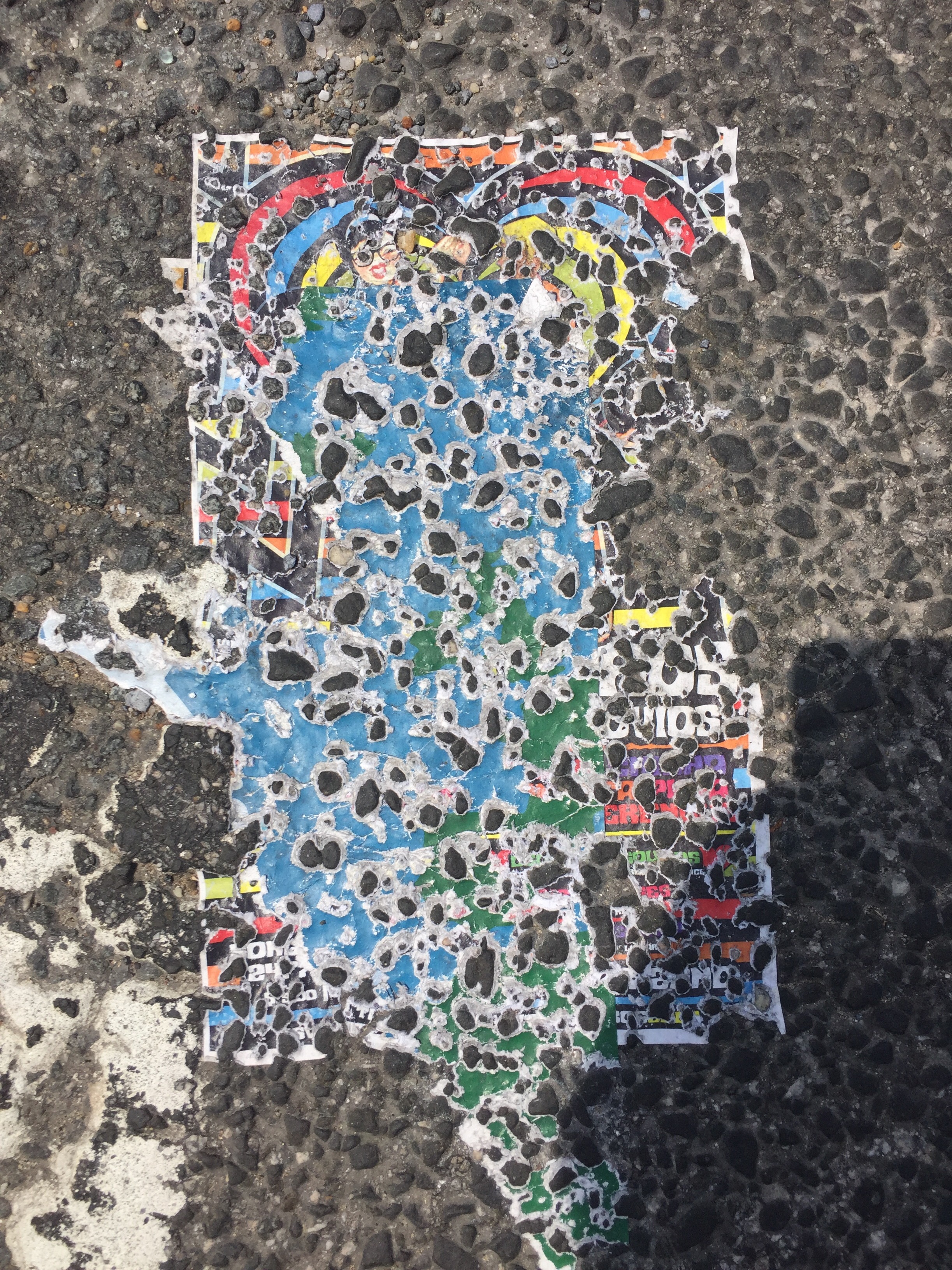
Street photography is very much about found images – you’re not setting out to intentionally create compositions, but rather responding and reacting to things you encounter, like this poster that fell into the street and got run over until the rough pavement surface pierced through turning the whole thing into an abstract composition.

We had a great morning of shooting, and wrapped up for a chat at a cafe on Columbia Road in Adams Morgan (another neighborhood bordering on Mount Pleasant and Columbia Heights). I’m very pleased with my students, and I’m looking forward to seeing their images from today at our recap class in three weeks.

Alternative Process Revolution – Philip Jessup

Another artist interview from the Alt Process Revolution series – this one with Philip Jessup, another Canadian photographer. One of the great things about this touring show is that it brings greater visibility of Canadian photographers to the US audience – I think many US photographers are aware of many other photographers from their own country, but with the possible exception of Yusuf Karsh, most could not name a single Canadian photographer living or dead.

Philip Jessup

Tell us a bit about your photographic work:

  • How did you get interested in photography?

My landscape photography is an extension of my professional work over the years advocating solutions to climate change. Many of the effects of climate change—rising sea levels, warming global temperatures, increasingly erratic precipitation patterns—are placing wilderness and communities that depend on them under unbearable stress. Many of these areas are likely to vanish, like low-lying atolls in the Pacific. I see my job as documenting such areas, so that if they do vanish or change in some unrecognizable way, humankind will remember them.

  • Do you feel your work is influenced by other media/periods/genres? If so, which ones, and why?

I’ve been influenced stylistically by other landscape photographers whose work I love. Eliot Porter, who was the first landscape photographer to work extensively in color, has always inspired me, his ability to find the abstract in the real. Other photographers who work I admire include: Fay Godwin, Harry Callahan, Brett  Weston, Toshio Shibata, Wynn Bullock, and the Canadian Edward Burtynski, who has taught us to find beauty even in the devastation being inflicted on the environment.

  • What is your experience with analog photography? Digital photography?

All of my early work dating from 2003 was shot with medium format film, Fujifilm’s Velvia 50. I love its wide color gamut and detail. From the start, however, I had my reversal film images scanned at high resolution and then printed on a Lambda using Cibachrome and later Fujiflex media. Today I shoot with a digital camera, process the images myself, and print on my own Epson P7000. I’ve been able to achieve rich, long lasting color prints this way. I would go back to Cibachrome if the media were available. Today, I occasionally shoot using film just for the pleasure and self-discipline, but in Canada availability and processing is limited and quite expensive.

  • What brought you to participate in the APR show? 

I’m always interested in exploring new ways to create an image that deepens the experience of my work with the viewer. Multiple gum over palladium produces a highly subjective final print that feels to me like a memory or a remembrance of something that is past or lost. The theme of my own work, which is trying to capture the beauty of landscapes and communities that may vanish, is a good match for this process. I also like the extreme longevity of these images. Again, it is a good match for my own goal, which is to memorialize imperiled landscapes so future generations won’t forget.

  • Do you see a continuing role in your photography practice for alternative processes?

I’m keen to explore the potential of alt processes to emotionally charge the images I place in front of the viewer. The exhibit at Glen Echo is the first step.

Alternative Photo Revolution – Interview with Brittany Fleming

As some  of you may remember from my Rendering the Spirit show, I interviewed the artists participating in the show via email. For APR, I did the same. With 40 artists participating and a quick turn on the time-frame, I’m only posting a few interviews.

Today’s interview: Brittany Fleming

Tell us a bit about your photographic work: * how did you get interested in photography? 

Born and raised in rural Ontario, Brittany spent most of her adolescence outside experimenting with a camera. It was during a three-month backpacking trip to Europe that her interest in travel and photography was sparked. “Being able to combine my passion for travel with photography opened up a new way of thinking. I came back to Canada knowing what I wanted to do.” 

Leaving Fergus behind, Brittany left for school in Ottawa where she completed a two- year photography program at Algonquin College. Before graduating, she started her career as a Lifestyle Photographer with Union Eleven, where she currently works. 

* what kind of work do you produce (how would you categorize your work)? 

I currently work for a studio in Ottawa, Union Eleven where I`m a lifestyle photographer. The work I show for galleries is my Street photography & Photojournalism. 

* what themes or subjects inspire you? 

I am currently working on three projects that are close to my heart. The first is about urban development and the ever changing cityscape. I document this environment through street photography. The second is an ongoing project about agriculture – showcasing farmers from our past, present, and the future of farming through a photojournalistic lens. Lastly, I am combining street photography and photojournalism to bring light to the human rights issues of our time, specifically women’s rights. 

How do you see your work in relationship to the larger art world:

* did you come to photography from another medium?

no

* do you feel your work is influenced by other media/periods/genres? If so, which ones, and why? 

On backpacking trips I was able to connect with locals. I have the ability to connect the camera to the heart, to feel the subjects and their story. An anthropologist at heart, my aim is to show the social landscape of my time. Deriving my photographic influences from Robert Frank, Diane Arbus, Walker Evans, Garry Winogrand, and Lee Friedlander, I always try to keep the human condition in focus. 

Could you talk a bit about the piece you submitted to the APR show? 

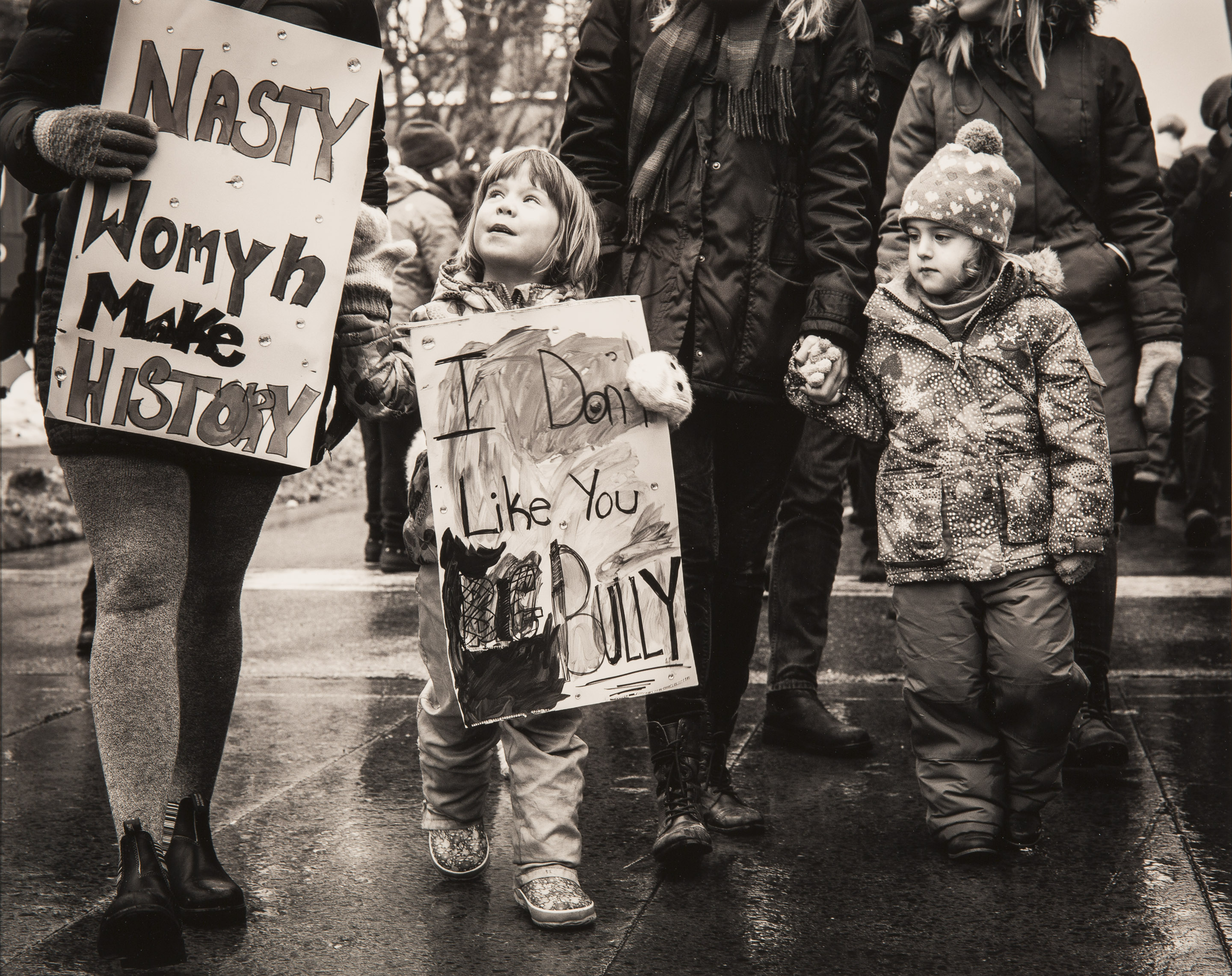
We all want to feel equal. My work is strongly influenced by this innate desire, and I’ve chosen to expose it through a female perspective. 

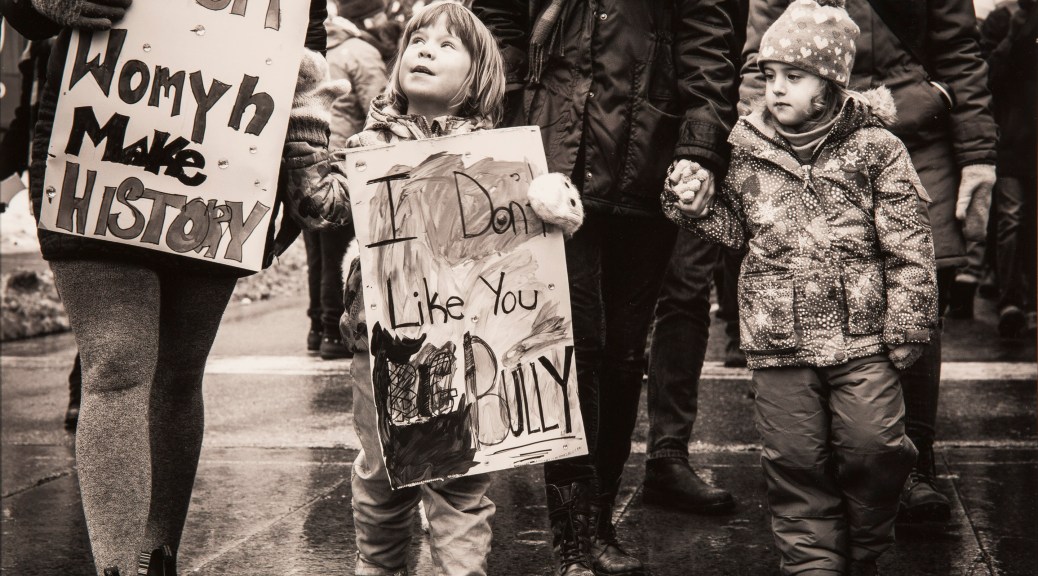
Captured in this photo are a group of people at the women rights march. Showing the young girls looking up to their mothers sparked a strong emotion. Thinking about this young girl, her past, present and, future. 

I too, yearn to feel accepted and equal. My hope, by sharing this image, is to show how truly brave these women are and how grateful they are for their rights and freedoms. We all have the power to go ahead and face our fears, follow our passions, and do so with grace. Our successes and failures are what will shape the generations of tomorrow. 

What is your experience with analog photography? Digital photography? 

When i was in school for photography we uses 4×5 cameras. Other then that I primarily shoot with my DSLR. 

Do you normally print your own work, or have others print for you? 

Bob and the team at Alternative Photo Services do an amazing job at printing my work for me. They are experts at bringing my images to life. 

Have you ever worked in alternative processes before? 

No this will be my first time 

 Brittany Fleming

Glen Echo | Glen Echo Park in the Ballroom, Backroom

March 28
Viewings will be taking place from 1-9pm with a formal reception from 6-9pm. Admission: Free

New Orleans | L’Entrepot

March 31-April 1
Private reception on Friday March 31st from 6-9pm.
General admission is $10
VIP Collector ticket is $30 admission + chance to win a unique permanent print
Stay at home ticket $25 for a chance to win a unique permanent print
Tickets can be purchased on Eventbrite.
April 1st, viewings will be open to the public from 1-9pm. The Julia Street First Saturday event is from 6-9pm with all gallery’s in the area having receptions

Toronto | Connections Gallery

May 15-June 17
Opening May 18 from 6-9pm
The Toronto portion of the exhibition is a part of the Contact Photography Festival

#ContactPhoto #202Creates #202Fotos #acreativedc #glenechophotoworks #photoworks #altprocessrevolution #DylanEllisGallery #ConnectionsGallery #Toronto #NewOrleans #NOPA

AltProRevSponsors