Category Archives: News/Announcements

Upcoming Exhibition and Class

I’ve got two news items to announce. I’ll be in an invitational show at Glen Echo Photoworks from April 12-May 7, and I’m teaching my Introduction to Platinum/Palladium Printing class May 5-6 also at Glen Echo Photoworks.

Please come to the opening reception for the show, April 22 – I’ll be speaking briefly about my work. I’ll be showing some selections of my work from Argentina.

April 13-May 7
Alternative Visions โ€“ An Alternative Process Photography Exhibition
Scott Barnes, Andrew Currie, Scott Davis, Sheila Galagan, Barbara Maloney, Janet Matthews, Richard Pippin, George Smyth, Grace Taylor
Opening reception and Gallery Talk 6-6:30pm. Sunday April 22 5-7:30

If you are interested in registering for the Intro to Platinum/Palladium, you can find the link on the Photoworks website

The class is a hands-on two day course on the basics of platinum/palladium printing. Topics covered include history, technical basics (chemistry, equipment, paper), major process controls (negatives, exposure, processing), and fine controls (contrast, process variations). This is a film and wet darkroom focused course – I will be providing a 5×7 camera and film, and we will shoot film negatives and make prints from the same. Digital negative making will NOT be covered due to the number of potential variables involved in working from student supplied images.

Please note: As of the date of this announcement, there are only two spaces remaining in the class – don’t hesitate if you are interested. If this class sells out, I will discuss running it again in the fall with the Photoworks staff.

Unexpected visitors

Edit > ย Ok – this is an update of this post – the earlier one was only the last 30 days statistic. This is all-time hits. Quite a few more total visitors and quite a few more countries. </Edit

I had a friend of mine who works for the UN, stationed in the Sudan visit my blog today, so I thought I’d go take a look at the site stats and see where my visitors are coming from. Some of the numbers are not surprising at all, and others are quite surprising.

Countries I expected volume from are pretty obvious, but Saudi? Iraq? Nigeria? Trinidad? Wow! And that I had more visits from Sudan than from New Zealand? (Well, I know why I had more visits from Sudan, but still…) Now if I could only get a fraction of these folks to COMMENT! ๐Ÿ˜€

Country Views
United States Flag    United States 485
Australia Flag    Australia 74
United Kingdom Flag    United Kingdom 44
France Flag    France 35
Canada Flag    Canada 24
Mexico Flag    Mexico 21
Sweden Flag    Sweden 17
Colombia Flag    Colombia 17
Sudan Flag    Sudan 16
Germany Flag    Germany 16
Italy Flag    Italy 13
Spain Flag    Spain 12
Brazil Flag    Brazil 11
India Flag    India 8
New Zealand Flag    New Zealand 7
Indonesia Flag    Indonesia 7
Japan Flag    Japan 6
Iceland Flag    Iceland 6
Poland Flag    Poland 5
Saudi Arabia Flag    Saudi Arabia 5
Czech Republic Flag    Czech Republic 4
Ireland Flag    Ireland 3
Philippines Flag    Philippines 3
Belgium Flag    Belgium 3
Belarus Flag    Belarus 2
Netherlands Flag    Netherlands 2
Denmark Flag    Denmark 2
Romania Flag    Romania 2
Slovenia Flag    Slovenia 2
Ecuador Flag    Ecuador 2
Bulgaria Flag    Bulgaria 2
Switzerland Flag    Switzerland 1
Moldova, Republic of Flag    Moldova 1
Argentina Flag    Argentina 1
Portugal Flag    Portugal 1
Turkey Flag    Turkey 1
Iraq Flag    Iraq 1
Trinidad and Tobago Flag   Trinidad & Tobago     1
Serbia Flag    Serbia 1
Thailand Flag    Thailand 1
Singapore Flag    Singapore 1
Nigeria Flag    Nigeria 1
Korea, Republic of Flag    Republic of Korea 1
Ukraine Flag    Ukraine 1
Peru Flag    Peru 1

Exhibition Review – Frida Kahlo: Her Photos

Yesterday I went to see an exhibit at the Arlington Artisphere of the photographic collection of Frida Kahlo, the famed Mexican painter, wife and lover of Diego Rivera. Frida Kahlo: Her Photos is open through March 25. This is the only stop in the United States for this show, so I wanted to make sure I got to see it before it leaves. One of the very interesting things about this exhibit is that Frida was working as a painter at the same time a major movement in photography was occurring, and the collection shows, albeit tangentially, the intersection of her life with Modernist photography. She grew up in an artistic household – her father was a photographer, and she painted him as such in a portrait. There is even a fine-art nude figure study her father took of himself in the exhibit. Most of the works on display are snapshots, showing the effects of an artistic life as captured by some of the great early and mid-century photographers: Edward Weston, Tina Modotti, Lola Alvarez Bravo, and Martin Munkacsi. These are almost all snapshots; in many cases, they are very small prints, and as such, Artisphere has arranged a system whereby visitors can borrow magnifying glasses to examine the photos up close. The downside to this is that the photos are often closely spaced on the wall due to their small size and the space limitations of the room, so sometimes it is hard to see other images because people are blocking them while examining another small image with the magnifying glass.

The entire exhibition is reproductions, not original images. The quality of the reproductions is in most cases first-rate; had I not read this in the introduction to the exhibit, with few exceptions I would not have known. This is a bit of a pet peeve of mine – I have seen several exhibits lately where substitutes for the original images were displayed. In this case there is a legitimate reason for the substitution – in Diego Rivera’s will, he specified that none of his or Frida’s photos were to leave Mexico. Without substitutes, this exhibit would not be possible. The only other legitimate reason I can see for using substitute images is in the case that the originals really are too fragile to display, or displaying them would mandate viewing conditions that would undermine the viewability of the rest of the exhibit. I like being able to see the frailties of objects, the fingerprints of age, time and care that have been deposited as signs of a rich and well-lived life. In this case, given that many of the original images were machine-printed snapshots made on dubious-quality paper, and some of the later color images were Polaroids, not known for their long-term color stability, setting the lighting at a safe level for the prints would indeed have compromised the exhibit.

As a general principle though, I would still argue against the propagation of substituting digital prints for original images; viewing a facsimile, even an extremely high quality facsimile, is really only one step removed from viewing the images online. This renders museums as physical entities obsolete. It also undermines the museum’s role and responsibility as a vehicle for education and connoisseurship, and preservation. Why worry about conserving art objects if we can just make simulacra and replace them time and time again as they wear out? Why worry about the authenticity of the object on display if the object itself is irrelevant, and the means to determine authenticity are lost because people can’t tell the difference between a silver-gelatin print, a platinum print and an inkjet? Lots of people can’t afford to own even a single example of the work of a named artist, let alone enough examples to derive a working knowledge of the artist’s methods and materials. Museums can, however, and by exhibiting the work, they can enable thousands to develop that critical eye.

RIP David Prifti, 1961-2011

On November 23, 2011, David Prifti, a brilliant wet-plate photographer living, working and teaching in the Boston area, passed away after an extended battle with cancer. I am deeply saddened that such a bright light and creative force for positivity has gone out. I knew his work from APUG, Large Format Info, and the Collodion Forum, but never had the chance to meet him in person. I have seen his plates live though, hanging on gallery walls, and no web reproduction can do them justice. You can see his work online at the three previously mentioned websites (all linked from here). His work was part of the Masterplaters show that just closed November 22 at the Community College of Baltimore County Catonsville campus. Plans are in the works to bring the exhibit to the Washington DC area in the not-too-distant future – keep an eye on this blog for future information. There will be a memorial service on November 30th 4pm at the First Parish Unitarian Church in Concord, MA.

Upate 11/29/2011: Here is a link to a short writeup on the Huffington Post about David:
David Prifti, 1961-2011

There will be a scholarship fund established and named after him at the school where he taught. Information on donations is available in the linked article above.

Glen Echo Photoworks demo November 9th

I received great news today – with over a week to go before the wednesday night demo, I have 10 people registered. This is terrific. I’m really looking forward to the event, and I can’t wait to meet all the people interested in the process. There’s still room to sign up if anyone is interested, so please head over to the Photoworks website and sign up.

Glen Echo PhotoWorks press release for FotoWeekDC 2011 events

Here is the press release about the Glen Echo Photoworks events coming up for FotoWeek DC. I will be participating in the “Celebration of Alternative Processes Symposium” on Sunday, November 6 and running a demo of Platinum/Palladium printing on Wednesday, November 9. I know a lot of the other presenters and they’re really great people and great artists. This will be a terrific event and I’m really looking forward to it.

PHOTOWORKS FOTOWEEK 2011

___________________________________________________________________________________

Like us on Facebook

Celebrate The Alternatives!

Alternative Process
Photo Symposium & Workshops

FotoWeek


Image by Barbara Maloney

    1
    Cyanotype Workshop with Barbara Maloney
       Date:  Saturday, November 5, 2011 
       Time:  10 AM – 4 PM 
Place:  Photoworks

      Arcade Building

             Glen Echo Park, MD 20812 

       Cost:  $125 
       Register: www.glenechopark.org or call 301-634-2226
       Info:  www.glenechophotoworks.org

       Whether you are new to non-silver processes or not,
       this one-day workshop promises to be a lot of fun.
       We will make cyanotype photographs, photograms and collages.
       The class includes toning, hand-color and overprinting gum bichromate.
 

    2
    Celebration of Alternative Process Symposium

       Date:  Sunday, November 6, 2011 

       Time:  11 AM – 4 PM  

Place:  Photoworks

      Arcade Building

             Glen Echo Park, MD 20812 

       Cost:  FREE — Lunch Break — Drinks & Desserts Provided
       RSVP:  Event is FREE.  Please RSVP at photoworks.gallery@gmail.com

       Info:  www.glenechophotoworks.org
       A group of artists whose work embraces the use of historic
       photography
processes and hand-applied emulsions
       will show and discuss their work and processes every 30 minutes.
       Guest Artists are listed below, in order of their presentations… 
    
       Barbara Maloney, “Temperaprint, Photo Etching, Cyanotype”
       Scott Davis, “Platinum and Palladium”
       Sheila Galagan, “Lith Printing”
       Andrew Currie, “Tintype”
       Grace Taylor, “VanDyke Brown”
       George Smyth, “Bromoil”
       Keith Williams, “Monobath, IR, UV”
       Richard Pippin, “Lith Printing”  


    3

    Platinum & Palladium Printing & Variations
    Workshop with Scott Davis

       Date:  Wednesday, November 9, 2011 
       Time:  7 PM – 9 PM  
Place:  Photoworks Studio

      Arcade Building

             Glen Echo Park, MD 20812 

       Cost:  $40  
       Register: www.glenechopark.org
       Info:  www.glenechophotoworks.org

       Scott Davis will demonstrate the beautiful and noble platinum,
       palladium and ziatype printing processes.  Discussion includes
       tools, chemistry, paper choices, coating techniques, processing,
       contrast control, and techniques for affecting image color.
       Tips and tricks for great prints will be shared

    4

    Bromoil Workshop with George Smyth

Date:  Sunday, November 13, 2011
Time:  10 AM – 4 PM
Place:  Photoworks

      Arcade Building

             Glen Echo Park, MD 20812 

       Cost:  $120 plus $30 supply cost 
       Register: www.glenechopark.org
       Info:  www.glenechophotoworks.org

       Bromoil is an early photographic process popular with the Pictorialists
       and is presently being revived by fine art photographers with endless
       possibilities for expression.  Topics covered are:  digital negatives,
       silver gelatin papers, mixing chemistry, and bleaching prints.
       Students will have the opportunity to ink a few prints (provided).
       Smyth will conclude with the “finishing” and presentation of prints.

Photoworks Photography School will offer
Alternative Process Workshops
in Spring 2012 as part of the course curriculum.
An Alternative Process Exhibit will be held
in the Photoworks Gallery in April 2012.


_______________________________________  

   Like us on Facebook 
     PHOTOWORKS
     7300 MacArthur Blvd
     Glen Echo, MD 20812
     301-634-2274


Updating the website

It’s been a very long time since I updated my own website, in part because this blog has kept me busy with keyboard time. I finally sat down and made some updates, including adding a link to this site on it. I also did some serious editing of the work on the site as I noticed there were a lot of older images there that didn’t really fit with what I’m doing now. I’m also feeling that I’m not crazy about the site’s look and feel overall, and want to gut the thing and start over. It is fairly clean, but I’m still not loving it. I don’t know if I should stay with the current hosting service or if I should switch. The current site uses Flash, which is becoming more of an issue when dealing with mobile devices as more and more of them are dropping Flash support. ย Please take a look at it and provide feedback!

http://www.theflyingcamera.com

FotoWeek DC events at Photoworks in Glen Echo

Photoworks in Glen Echo, Maryland (just outside Washington DC) will be putting on a slate of events as part of FotoWeek DC from November 5-12, 2011. I will be participating in the alternative process show-and-tell on Sunday, November 6, from 11AM to 4PM. I will be showing selections from my recent body of work of DC at night, all shot on large format film.

I will also be giving a platinum/palladium printing demo later that week (date/time to be determined) – admission is $40 plus a $10 materials fee. Here is the slate of presenters and schedule for November 6. I encourage everyone to come out and see the show, and if you’ve never been out to Photoworks before, please come check it out, it’s a lovely facility in the terrific (and photographically ripe) setting of Glen Echo Park, which is part of the National Park Service!

For more information about the park and its cultural, social and educational activities for people of all ages, here is a link to the park’s website:
Glen Echo Park

11:00 11:30 Barbara Maloney Intro/Temperaprint/Photoetching/Cyanotype
11:30 12:00 Scott McMahon Gum bichromate
12:00 12:30 Scott Davis Platinum/palladium
12:30 13:00 Sheila Galagan Lith Printing
13:00 13:30 Andrew Currie Tintype
13:30 14:00 break
14:00 14:30 Grace Taylor Vandyke brown
14:30 15:00 George Smyth Bromoil
15:00 15:30 Keith Williams Monobath/IR/UV
15:30 16:00 Richard Pippin Lith Printing

More photos from the Connecticut weekend

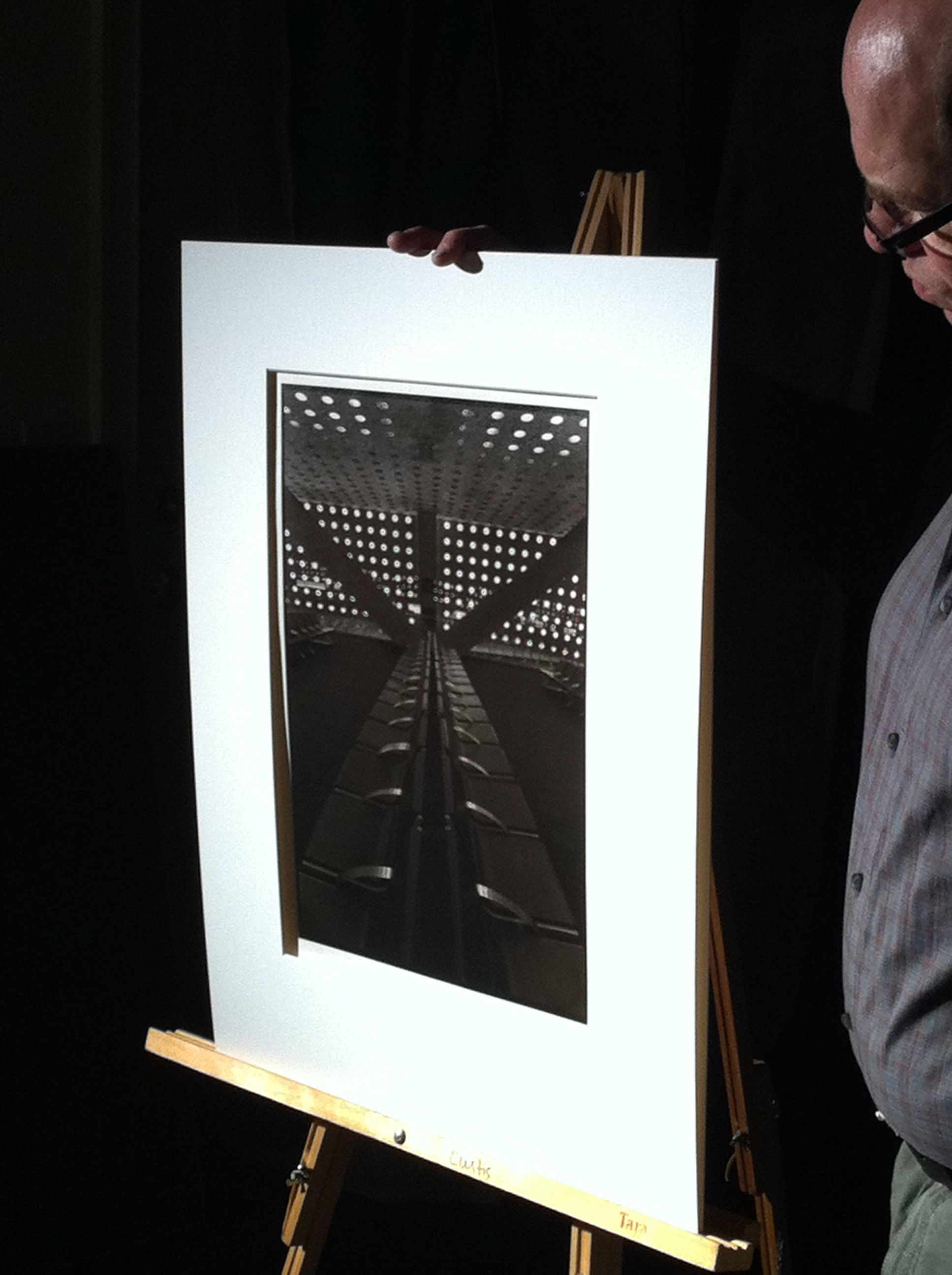
I don’t think it is obvious from these pictures, but one of the most striking qualities of carbon prints is the high relief surface. They look as much like etchings or engravings as they do photographs. This is caused by the hardening of the gelatin during exposure. Gelatin areas hardened retain their pigment and maintain density. Areas unexposed dissolve during development, leaving a void in the surface.

Photo Weekend in Connecticut

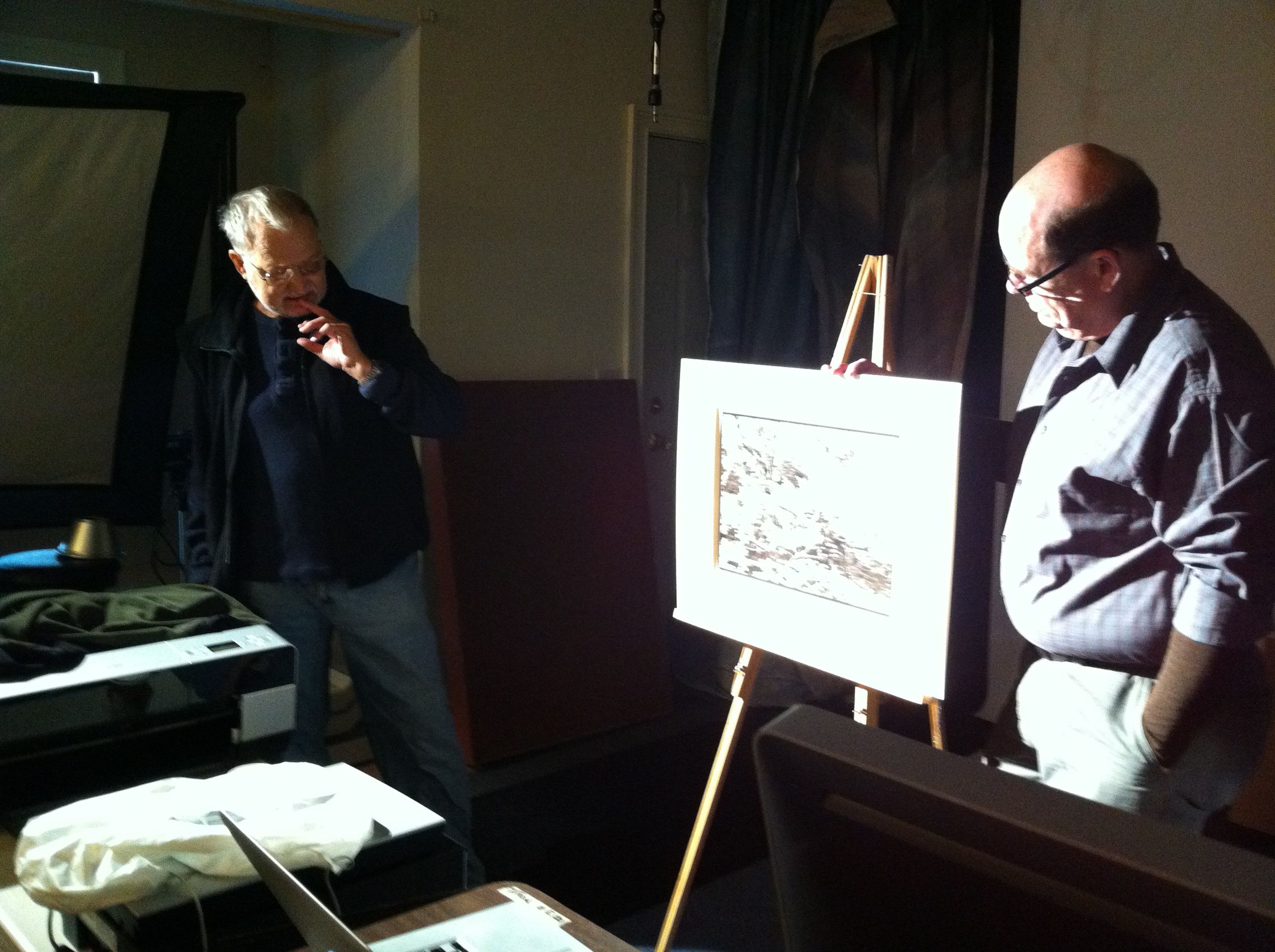
This past weekend I went up to Rocky Hill, Connecticut (just outside Hartford) to attend a two-day, three evening seminar and get-together, sponsored by the New England Large Format Photography Collective (NELFPC). The main theme of the weekend was to learn about digital negative making and carbon printing. The side benefit was most people brought examples of their current work to share and show after hours. What a terrific weekend! Our instructor for the weekend was Sandy King, an elder statesman for the chemical wet darkroom. A specialist in carbon printing, he is also the inventor of Pyrocat-HD (and its variants), a film developer with special benefit for people working in antique and historic photo processes.

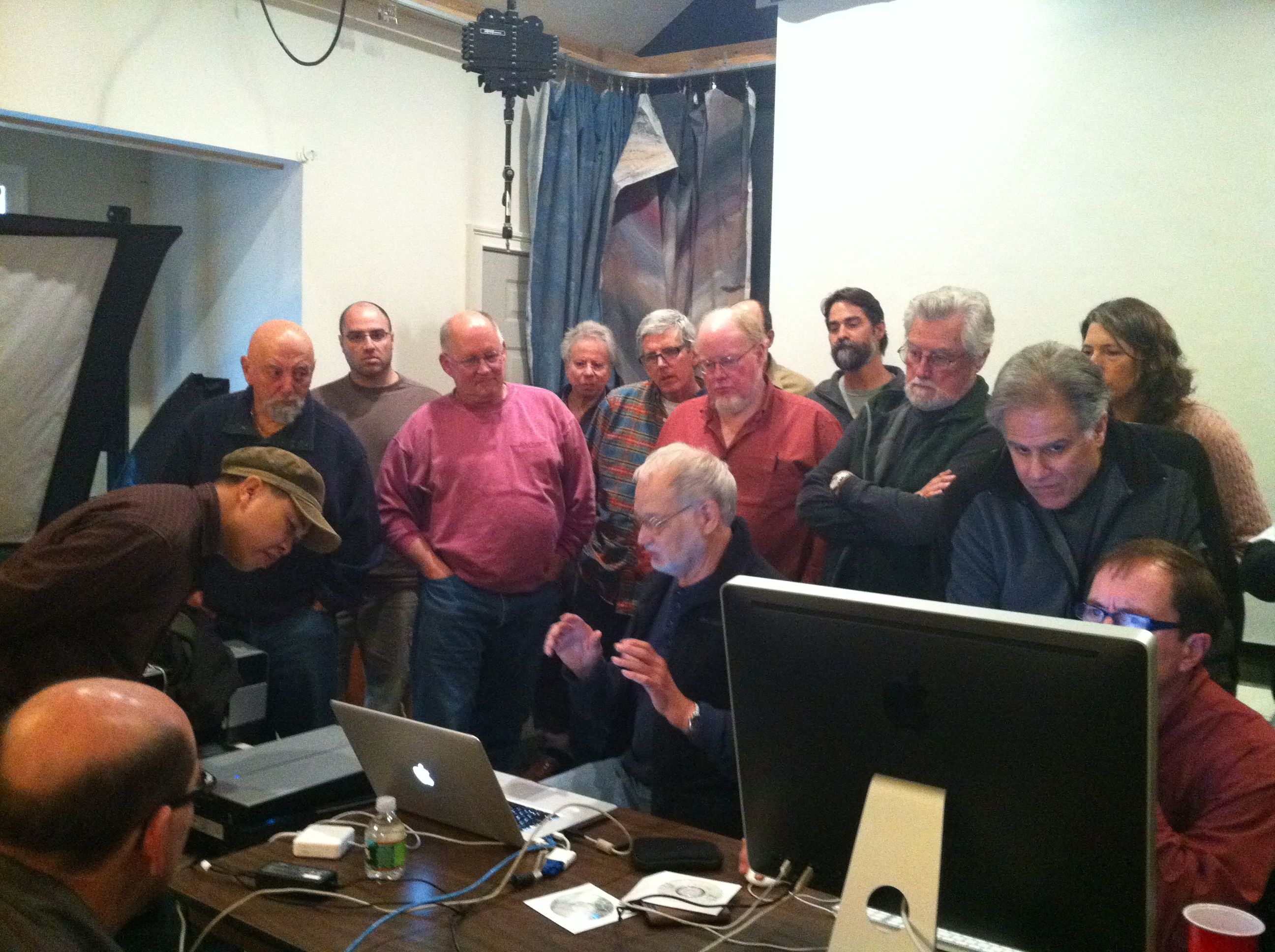
Day one began with displays of some of Sandy’s carbon prints, and a discussion of digital negative making. Sandy does still use ultra-large format cameras from time to time (he has a 20×24 with 12×20 and 10×24 reducing backs), but he mostly travels with medium format gear and then scans his film to enlarge it digitally. He demonstrated the Precision Digital Negatives system for making digitally enlarged negatives, and discussed the benefits and flaws. He then discussed the QTR (Quad Tone RIP) method which has significant advantages over the PDN system, but is far more user-unfriendly to configure. We then scanned some film and made digital negatives to print from the next day.

After all the computer wonkery was finished for the day, dinner was served and the prints to show came out. I showed my two bodies of work, the platinum/palladium travel shots and the male nudes in gum and platinum I’ve been working on. Both series drew a lot of comments and praise, which was very nice. I was especially tickled when certain individuals who I hold in very high esteem made a point of complimenting me in private.

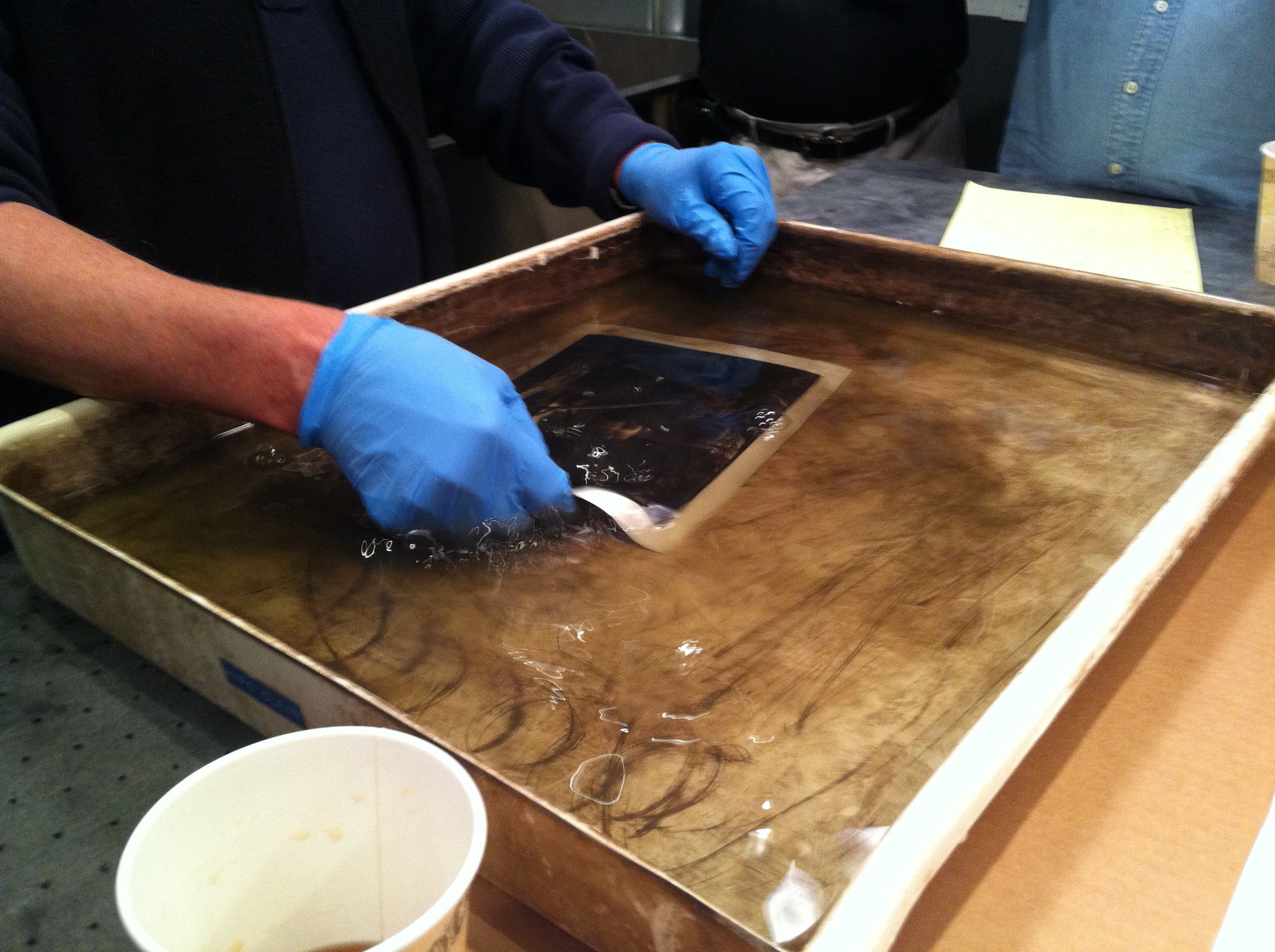
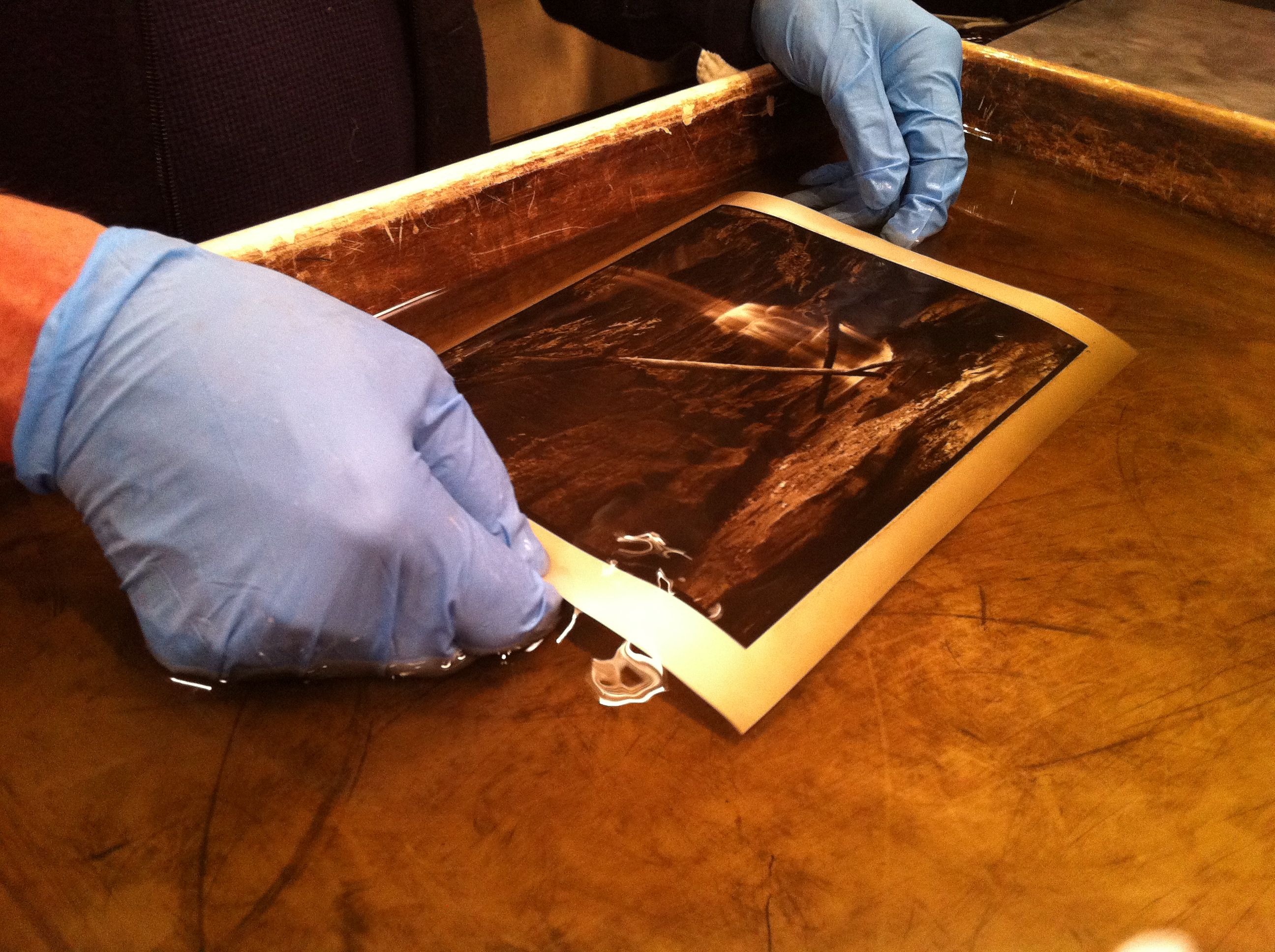
The next day we got down to the business of printing. Carbon is water-activated, like gum bichromate, and uses the same dichromate as a sensitizer. To make a carbon print, you first coat a gelatin and pigment (india ink mixed to taste with other pigment(s) to adjust the tone warmer or cooler) layer on a thin, flexible but non-absorbent medium (mylar or other similar material). This is your donor tissue. You then sensitize it with an ammonium dichromate and alcohol mix, dry it in a cool, dark place, then sandwich it with your negative, emulsion to emulsion, then expose to UV light. After exposing, you put your receiver paper (it can be anything from art papers to fixed-out silver gelatin paper) in a water bath, allow it to swell. After a minute, put the exposed carbon tissue in the water and sandwich it to the receiver paper. continue for another minute and a half or so, then take it out of the water. GENTLY separate the two, then place the receiver in another bath of warm water. You’ll see the image come up in the water bath. You can use a clearing bath as well, but it is not required. The clearing bath will greatly reduce washing time though, so it is a good idea.

To me, while learning carbon printing from a master printer was an awesome reason to travel 400 miles, the bonus that made it worth the effort was meeting the people who attended. Steve Sherman (the beyond generous host – we used his gigantic and brilliantly designed darkroom for the printing sessions and his living room for the show-and-tell sessions, general hanging out, and consuming all the amazing food), Gene LaFord, Dave Matuszek, Jack Holowitz, Glenn and Marie Curtis, Sandy King, Jim Shanesy and Diwan Bhathal (fellow Washingtonians and my travel pals for the trek up and back), Alex Wei, Armando Vergara, Robert Seto, Tim Jones, Paul Paletti just to name a few all made the weekend a really enjoyable experience and I am dying for the next one!

In the group photo, the one on the right, Sandy King is the one with the rolleiflex in his lap – which happens to be my rolleiflex. When I can get the negatives from the trip scanned, I’ll post some shots here.