I’m very pleased and thrilled to announce the entrants whose work has been accepted into the Rendering The Spirit: The Personal Image in Alternative Media exhibition at Glen Echo Photoworks. We accepted twelve artists showing a very diverse range of subject matter and technique, from wet plate collodion to photogravure to lumen prints. The exhibit is also very geographically diverse – works are coming from Texas, the Washington DC area, Switzerland, Germany and Japan.
The honored artists are:
Atalie Day Brown (Maryland)
Barbara Maloney (Maryland)
Bruce Schultz (Louisiana)
Dan Schlapbach (Maryland)
Erik Larsen (Colorado)
Eddie Hirschfield (Virginia)
Hendrik Faure (Germany)
Ian Leake (Switzerland)
John Sarsgard (New York)
Leena Jayaswal (Maryland)
Marek Matusz (Texas)
Yugo Ito (Japan)
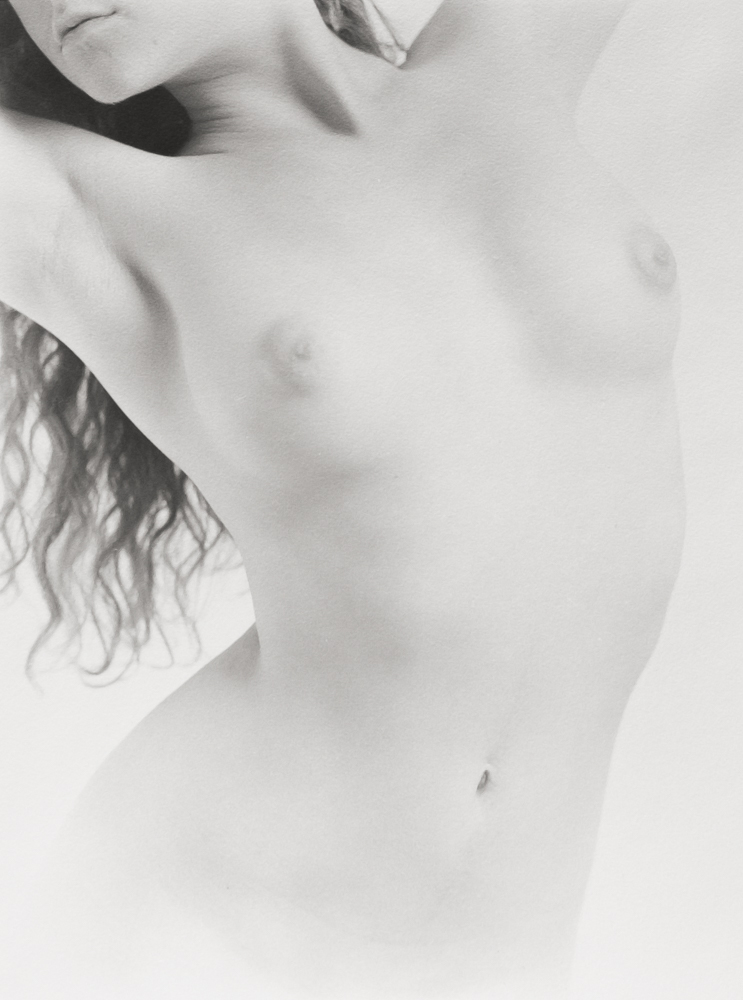
A few featured works from the exhibition:
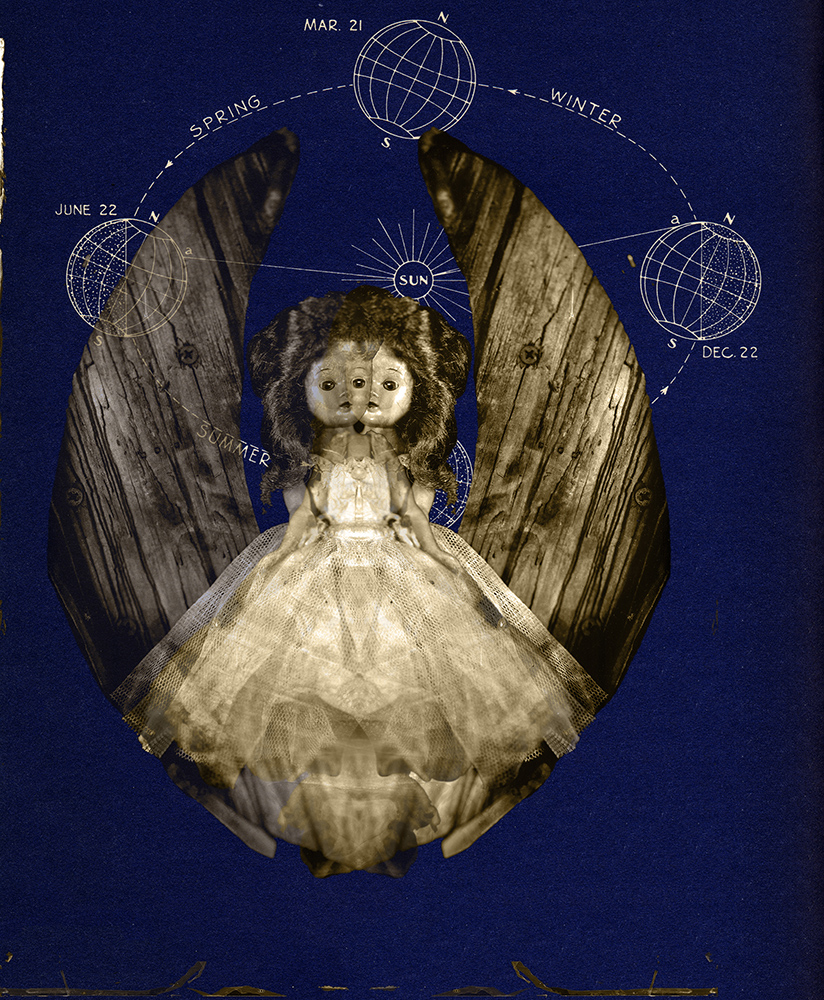
Causes of the Seasons – Dan Schlapbach
14×17 inches, digital relievo wet plate collodion ambrotype. There is a digital print behind the glass ambrotype image, creating a relief like a traditional relievo ambrotype
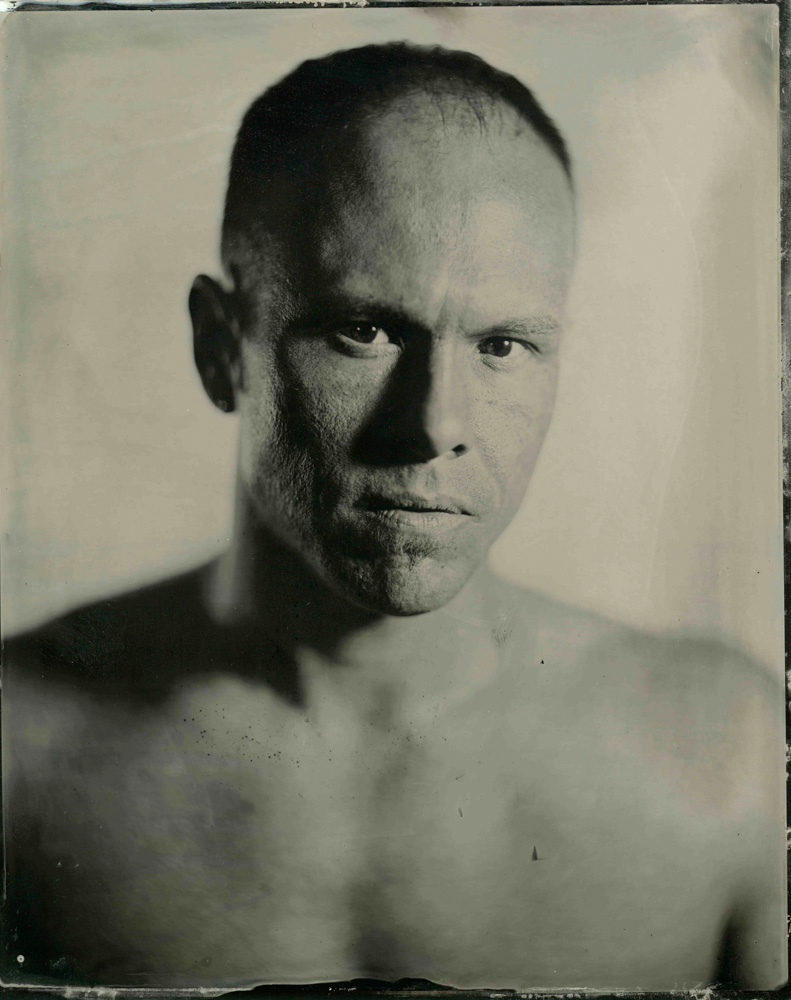
Portrait of Jared – Atalie Brown
8×10 inch tintype (direct-positive, wet-collodion on aluminum plate)
This is a reminder that the submission deadline for Rendering The Spirit: The Personal Image in Alternative Media is less than a week away, on February 21.
Photoworks is a non-profit photographic arts and education center in Glen Echo, Maryland. Last year was their 40th anniversary, and as part of the ongoing celebrations and future vision for Photoworks, we are launching a new program to provide visibility and accessibility to historic/alternative processes and artists working in these media. Rendering The Spirit is the kickoff event to highlight this programming.
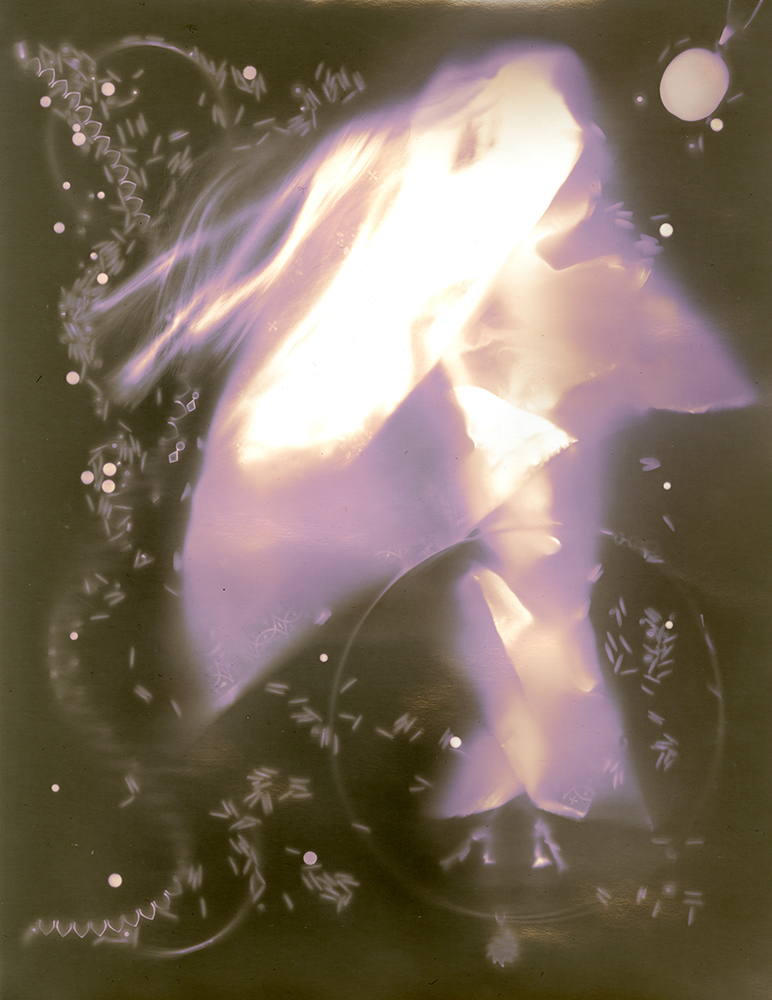
Works to be considered must be made using an alternative/historic process, including but not limited to lumen prints, daguerreotypes, gum bichromate, tintypes/ambrotypes/melainotypes, platinum/palladium, kallitypes, Van Dyke Brown, cyanotypes, carbon prints, calotypes, salt prints, albumen prints, bromoil, gumoil or some combination of the above. Silver Gelatin prints on machine-made commercial papers are not accepted. Original capture of the image can be from in-camera negatives or digital capture or some combination thereof, but the final image must be a physical object made using one or more historical processes.
Also include an artists statement, brief bio and an explanation of the work(s). All required documents (JPEGS, Artist statement/bio/explanation of works) should be emailed to photoworks.gallery@gmail.com no later than February 21st. Notifications will be sent by email to all selected artists by March 1. Works must be received by March 14. The opening reception will be held on March 26.
Render (v): to distill, to cook down to its essence, to translate, to represent.
Rendering: an act of bringing into being, of distillation, of translation, of representation.
By aiming our gaze at works created using “alternative” processes, we aim to show the diversity of work being created at this nexus of the 19th and 21st centuries and engage in a dialog about what it means to create work using anachronistic techniques.
Scott Davis is a faculty member at Photoworks where he teaches alternative processes, portraiture and studio lighting. He received formal training at Maryland Institute, College of Art. His specialty is platinum/palladium printing, and he is an avid collector of 19th century photography. He has exhibited his personal work locally, nationally and internationally, and has served as curator at the former Art Reactor Gallery in Hyattsville.
Malcolm Cosgrove-Davies is a self-taught photographer who since 1978 has been practicing historic photographic processes including gum bichromate, cyanotype, VanDyke, palladium, and carbon printing. Mac’s images derive from his extensive travel to developing countries as well as everyday life. Using antique and hand-made film cameras in various large & panoramic formats he seeks to match the image to the beauty and elegance of the selected photographic process. In addition to building the occasional camera, printing frame or other useful photographic gadget, he also creates books and presentation portfolios for his prints. He is represented in various collections such as the Smithsonian American Art Museum, Library of Congress, Maier Museum, and Lehigh University Art Galleries.
Back in November I taught a studio lighting class at Photoworks. This was my first time offering this class, so the curriculum was a bit of a gamble – I started with foundations of studio lighting, working from hot lights on still life setups and a single light source, and built my way up to electronic flash systems with multiple lights. In this case, my students had the burning itch to jump straight to portraiture, as that was their primary interest. I had a wonderful bunch of students in the class and everyone brought something to the table.
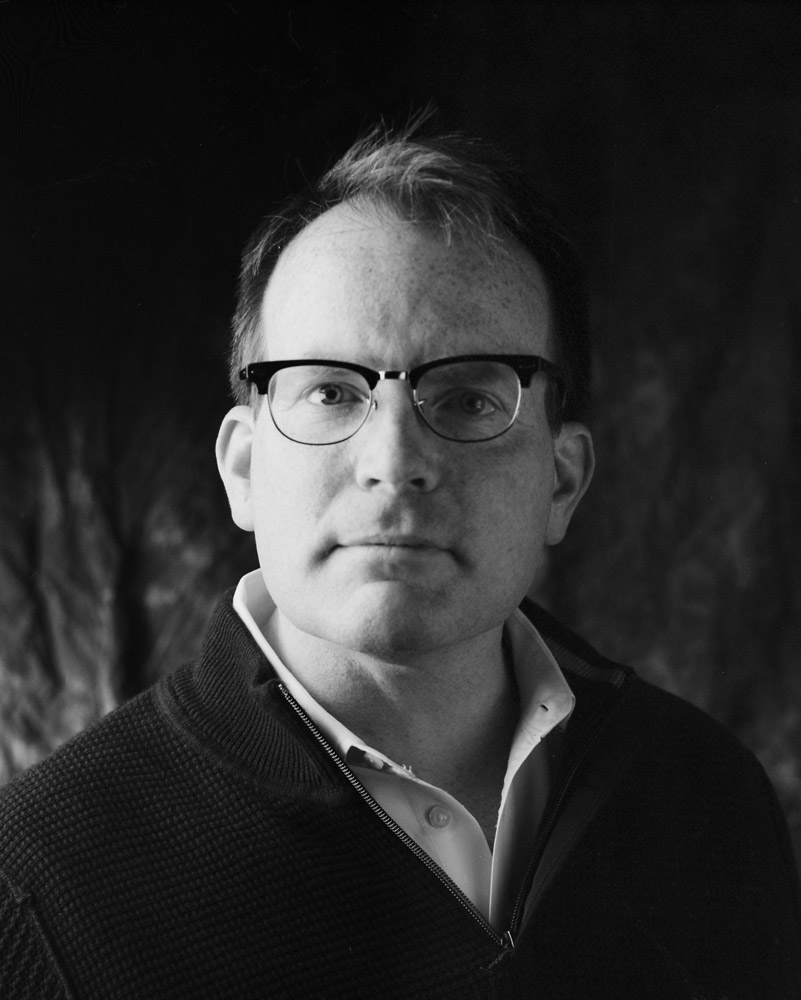
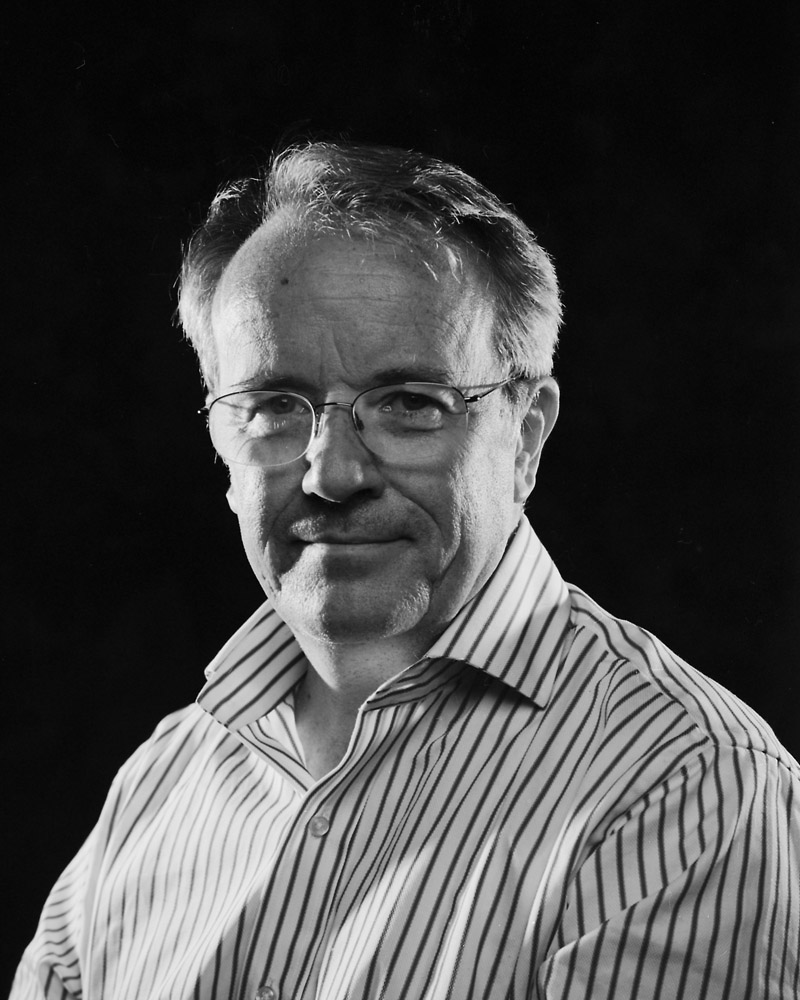
The portraits here are taken by me of my students. The portrait of Joe was done to demonstrate side light with a large diffuse light source, and a reflector. For demonstration purposes I moved the reflector in and out to lighten and darken the shadows, and shot it with both high and low contrast. This is my favorite of the bunch – there’s three-dimensional modeling of his face with the light, but the shadowed side of his face is not lost.
Joe P.
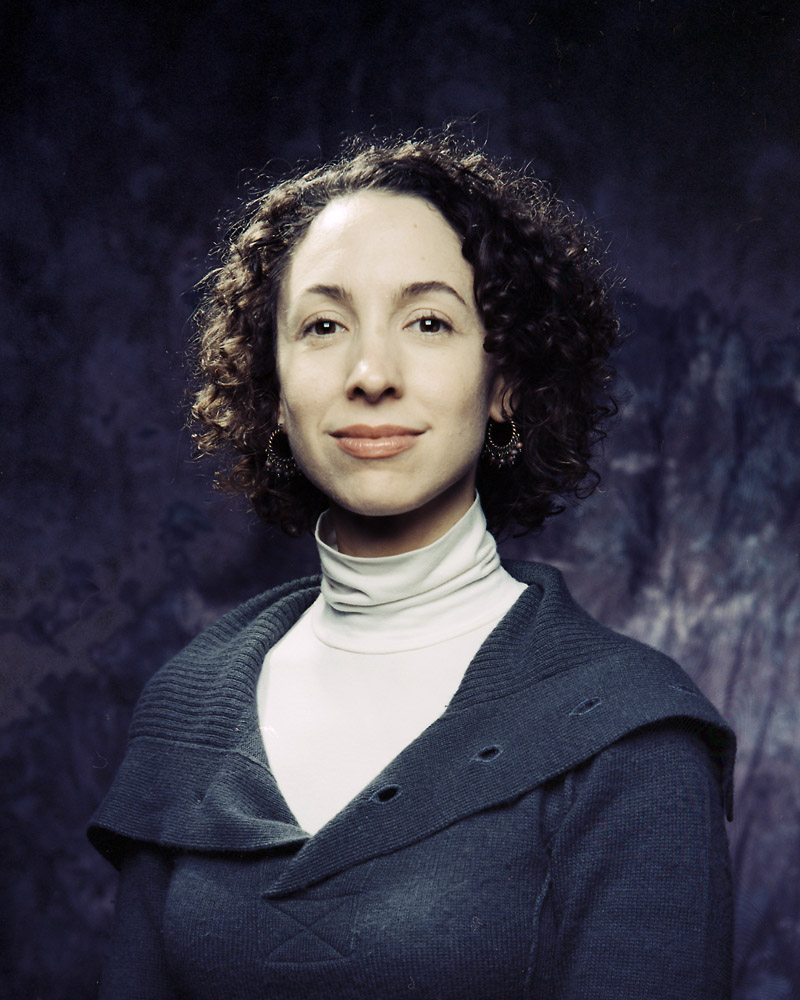
Geraldine was lit to show soft, flattering light. This was the classic “butterfly light” with a large diffuse light directly above and in front of the subject, a reflector below to open up the shadows a bit, and then hair light and background light applied to create separation of the subject from the background.
Geraldine W.
The shot of Matthew was done to demonstrate that “edge lighting” look you often see in sports photos of young athletes in shoe commercials. Obviously Matthew is no longer a high-school football player, but the look is very masculine and rugged and it works well on him. This was accomplished with two equal-powered heads in soft boxes, placed behind the sitter, at 45 degree angles to the subject-camera axis, and then adding in a little fill in the front so his face wouldn’t get lost.
Matthew F.
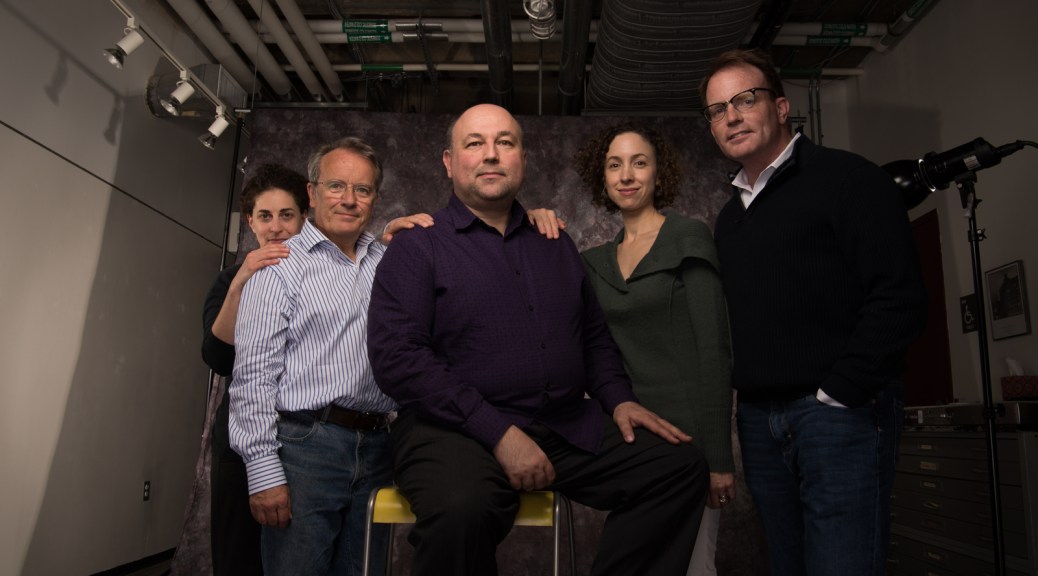
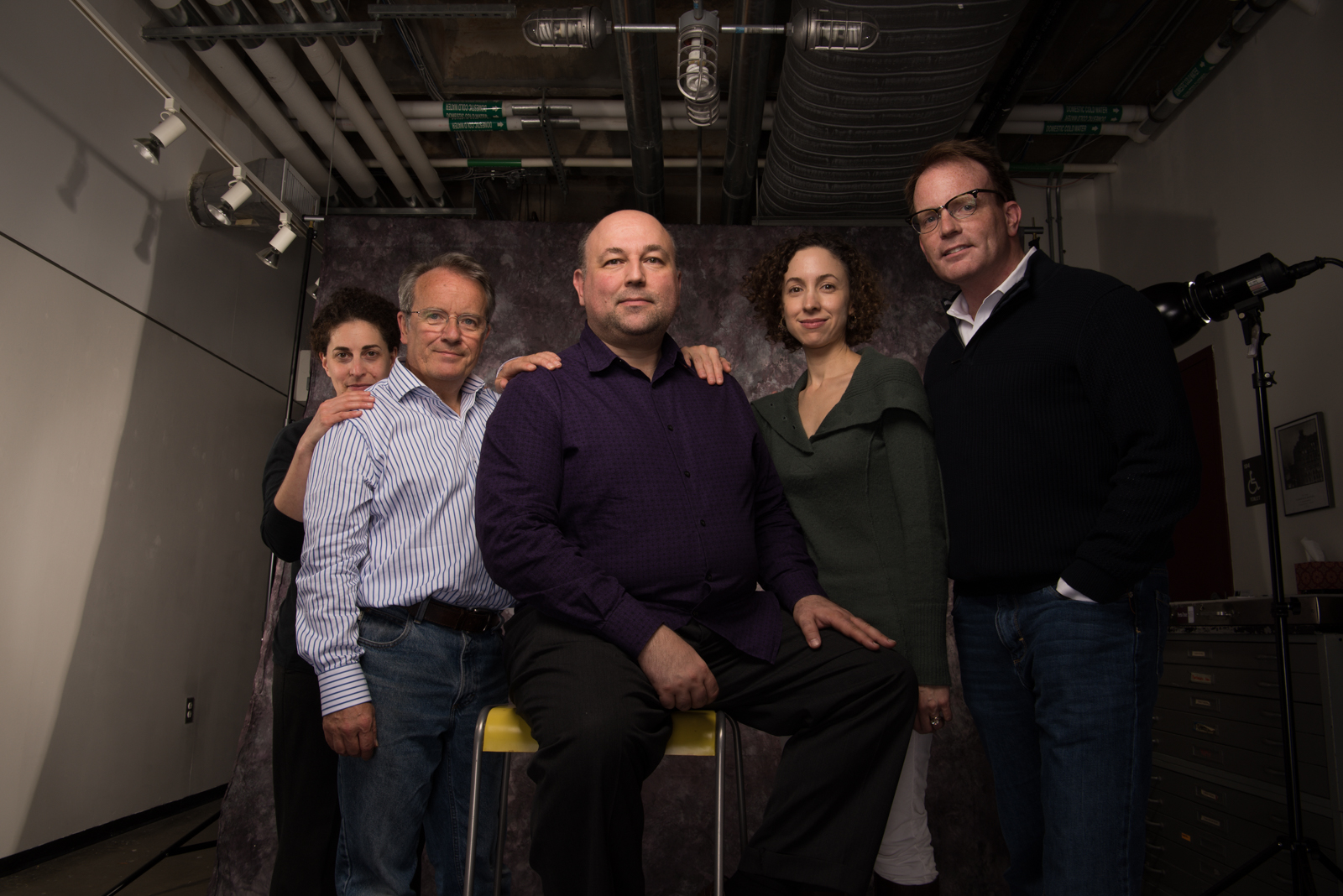
The final photo of the day is our group shot. That’s me in the center, if you’re wondering. My fourth student in the class was Leslie, who is the one hiding behind Matthew’s shoulder.
Studio Lighting Class
All individual portraits were done with a Tele-Rolleiflex and the Rolleinar 0.35 close-up adapter, on Kodak Ektar 100 color film. The two black-and-white images were converted from Photoshop. Ektar is a good portrait film in natural light, I’ve decided, but for studio portraiture, Portra 160 is better.
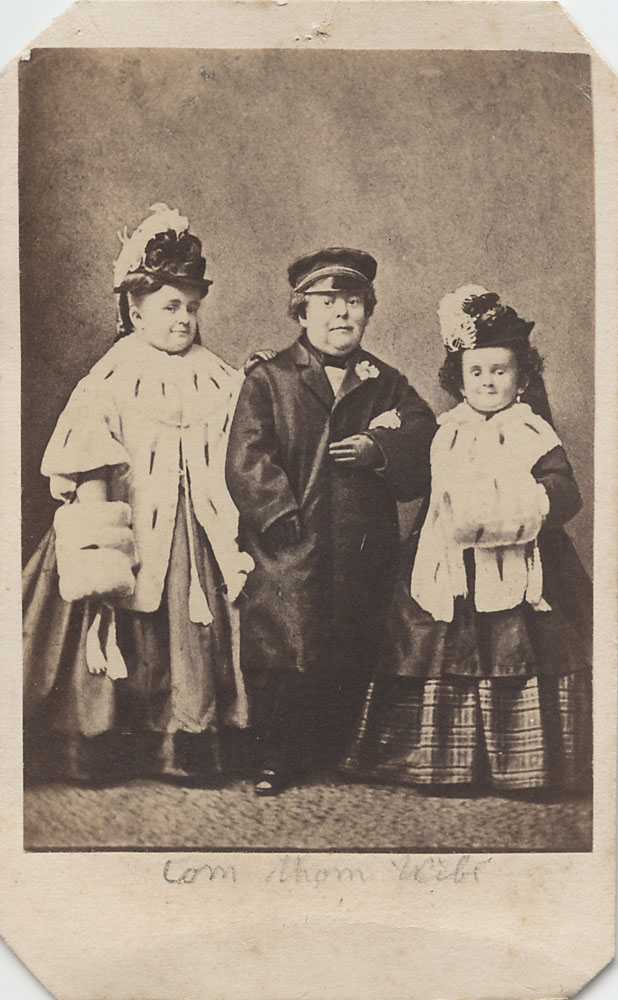
Well folks, I think it’s time and appropriate that I spin off my blogging about image collecting from my blogging about my own photographic endeavors. I want to differentiate the two activities and use this blog, dcphotoartist.com, as a professional communication channel to talk about and share my portrait work and travel images. So I hope you all will bear with me as I make the transition, and read up on both blogs. The new blog will be http://dcphotocollector.com. I’m using the theme photo of this post as the branding for the collecting site, at least for now. I’m launching it with another post about Tom Thumb and his wife.
Render (v): to distill, to cook down to its essence, to translate, to represent.
Rendering: an act of bringing into being, of distillation, of translation, of representation. By aiming our gaze at works created using “alternative” processes, we aim to show the diversity of work being created at this nexus of the 19th and 21st centuries and engage in a dialog about what it means to create work using anachronistic techniques.
Curators: Scott Davis and Malcolm Cosgrove-Davies
Scott Davis is a faculty member at Photoworks where he teaches alternative processes, portraiture and studio lighting. He received formal training at Maryland Institute, College of Art. His specialty is platinum/palladium printing, and he is an avid collector of 19th century photography. He has exhibited his personal work locally, nationally and internationally, and has served as curator at the former Art Reactor Gallery in Hyattsville.
Malcolm Cosgrove-Davies is a self-taught photographer who since 1978 has been practicing historic photographic processes including gum bichromate, cyanotype, VanDyke, palladium, and carbon printing. Mac’s images derive from his extensive travel to developing countries as well as everyday life. Using antique and hand-made film cameras in various large & panoramic formats he seeks to match the image to the beauty and elegance of the selected photographic process. In addition to building the occasional camera, printing frame or other useful photographic gadget, he also creates books and presentation portfolios for his prints. He is represented in various collections such as the Smithsonian American Art Museum, Library of Congress, Maier Museum, and Lehigh University Art Galleries.
Works to be considered must be made using an alternative/historic process, including but not limited to lumen prints, tintypes/ambrotypes/melainotypes, daguerreotypes, gum bichromate, platinum/palladium, kallitypes, Van Dyke Brown, cyanotypes, carbon prints, calotypes, salt prints, albumen prints, bromoil, gumoil or some combination of the above. Silver Gelatin prints are not accepted. Original capture of the image can be from in-camera negatives or digital capture or some combination thereof, but the final image must be a physical object made using one or more historical processes. For a submission fee of $40, each artist may submit up to five examples. Send jpegs at 72dpi, 1000 pixels on the long axis. JPEGs should be named ArtistName_number (i.e. JohnBrown_1 ).
Also include an artists statement, brief bio and an explanation of the work(s). All required documents (JPEGS, Artist statement/bio/explanation of works) should be emailed to photoworks.gallery@gmail.com no later than February 21st. Notifications will be sent by email to all selected artists by March 1. Works must be received by March 14. The opening reception will be held on March 26.
Explanation:
The explanation should enumerate the title of the work, the file name of the associated JPEG, the size of the piece (including frame dimensions), the year it was made, and any pertinent details about the creation of the work.
Example:
Image Title:
File Name:
Size:
Year Created:
Explanation:
Joseph
JohnBrown_1.jpg
8”X10”
2016
Hand-colored quarter-plate daguerreotype, distressed with fingerprints and acid etching.
All works accepted must be framed/mounted and ready to hang. Outside dimensions should be no greater than 24 inches on the long axis. All works must be available for sale – Photoworks takes a 35% commission on any sales. Artists are 100% responsible for shipping to and from Photoworks.
You must include a pre-paid return shipping label with your work; any work shipped without a return label will be considered a donation to Photoworks, and will not be returned to the artist. Artists are responsible for insuring their work – while Photoworks endeavors to take every precaution to protect and care for works while on display, they will not be liable for any loss or damage.
Artists Statement:
Please send us a one paragraph statement about your work, and in particular describe why you are using the alternative process(es) you are using; what do they mean to you, to the work, how they shape meaning, their aesthetic impact.
Artists Bio:
Please send a one paragraph biography.
Forty years ago, in a derelict building hidden among the abandoned amusement park rides of Glen Echo Park, four young photographers founded Photoworks with little more than a shared passion for the daily work of seeing, shooting, and printing images of lasting beauty and artistic integrity. The day-to-day collaboration, creative dialogue, and informal mentoring that led those artists to successful careers as fine art and commercial photographers established the values of experimentation and collegiality that define Photoworks today. Offering a diverse combination of educational programs, gallery exhibitions, and community initiatives, Photoworks is a vibrant and unique resource for student and professional photographers – an arts community in the very best sense of the word.
For more information about Photoworks, visit their homepage: Glen Echo Photoworks
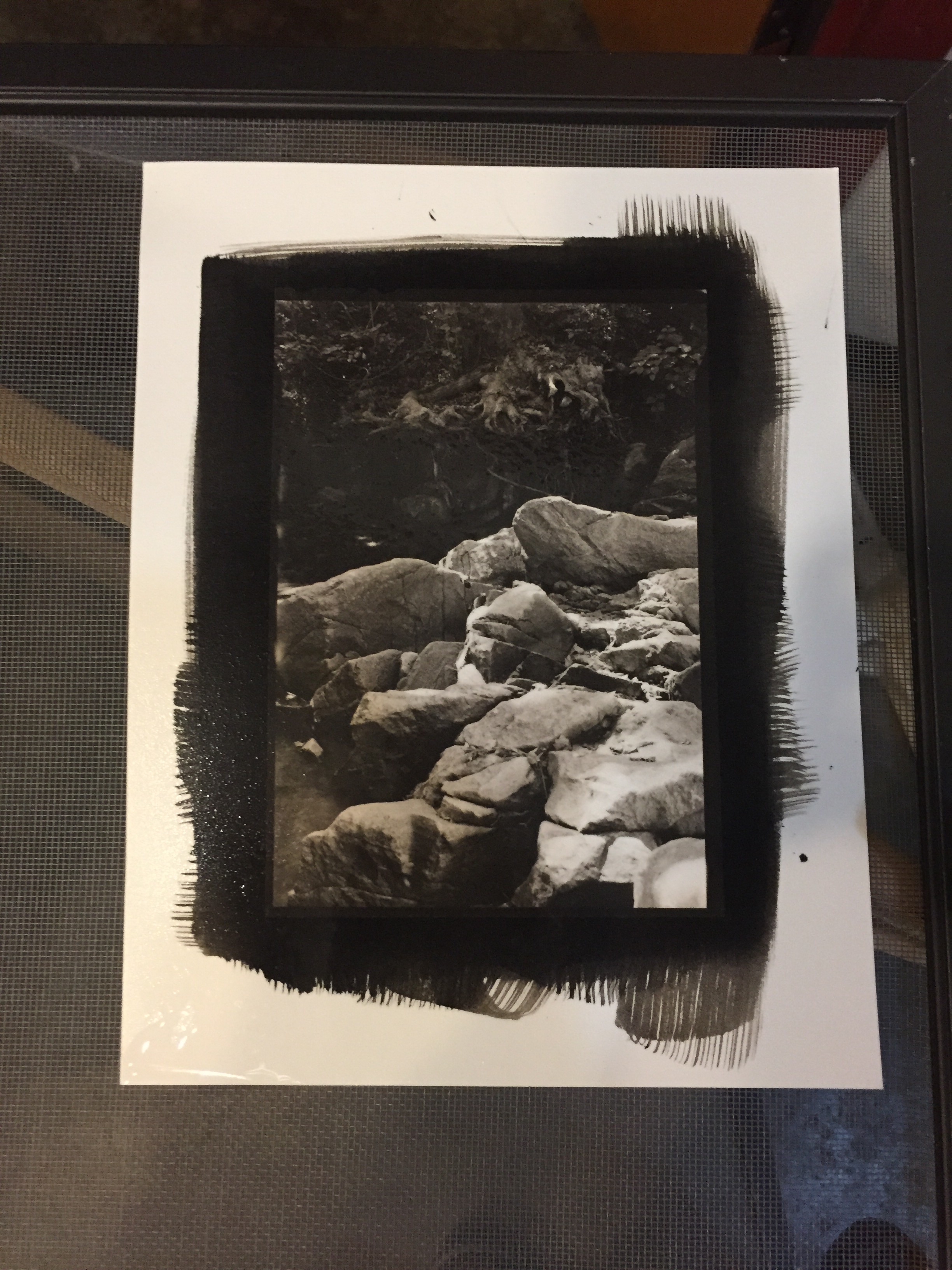
This weekend was module one of two in my revised Intro to Platinum/Palladium Printing class. Module One covered making images from in-camera film negatives. Yesterday we went out in the park at Glen Echo and shot some film with my 5×7. This first image is one of the student prints from that outing – the rocks and water in the stream that runs through the park.
Rocks, Stream, Glen Echo Park
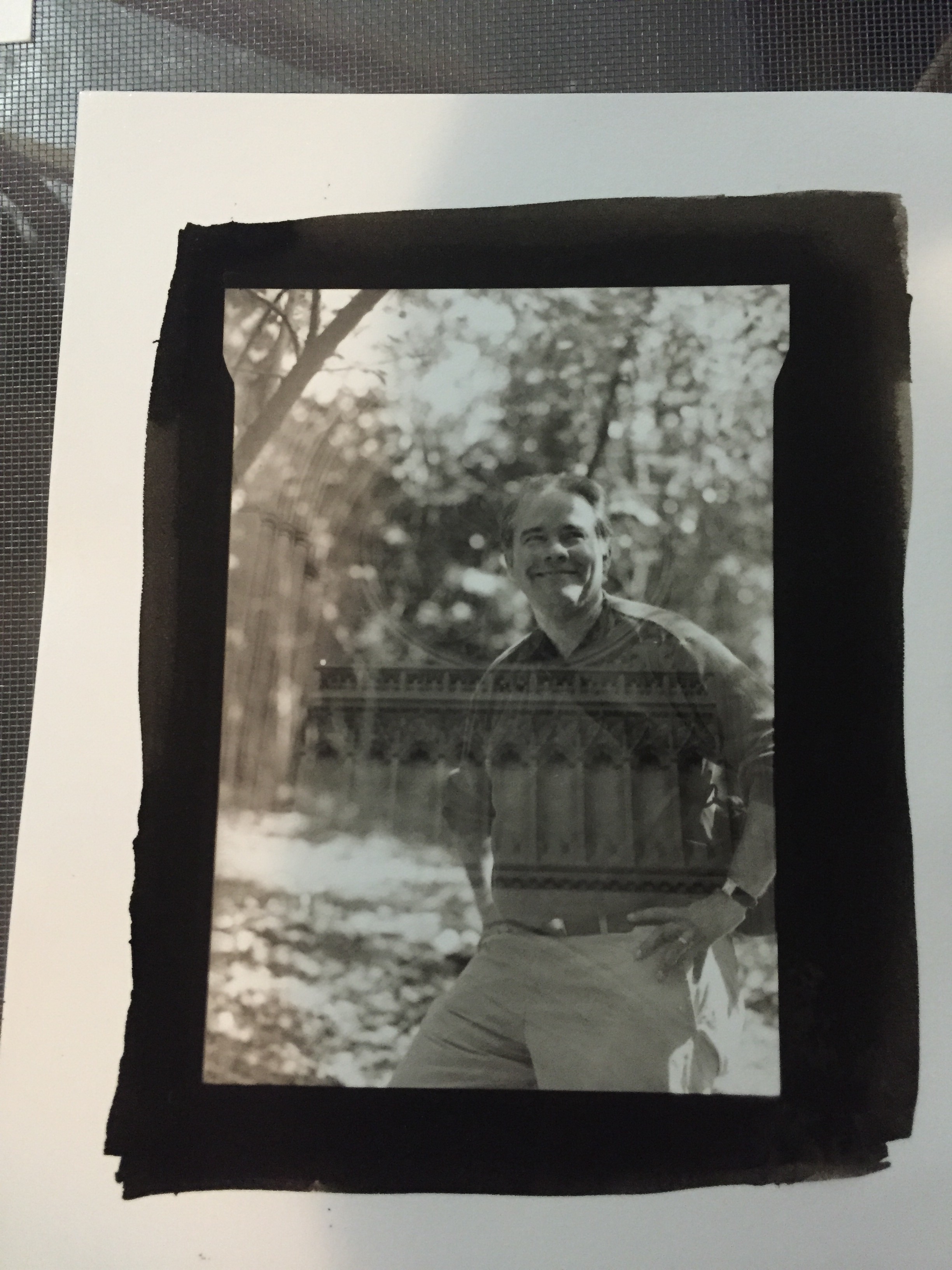
This second shot is a happy accident – one of my students wanted to do portraits, and shot this and another one (which we didn’t print) of two classmates. What we didn’t realize at the time, which was very much my fault, was that those two sheets had previously been exposed by me on an outing with my Intro to Large Format class to the National Cathedral, but not developed. So we had two negatives of students in the woods superimposed on the facade of the National Cathedral. In the other one, the student’s face was obscured by the rose window, but here it works well. We were joking that it would make a great political campaign photo.
Happy Accident – Double Exposure
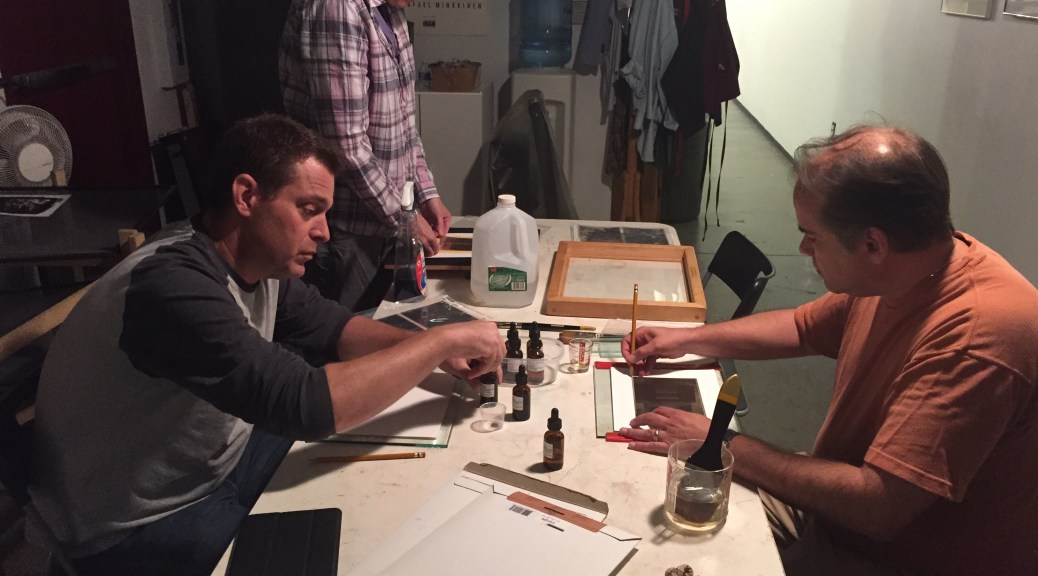
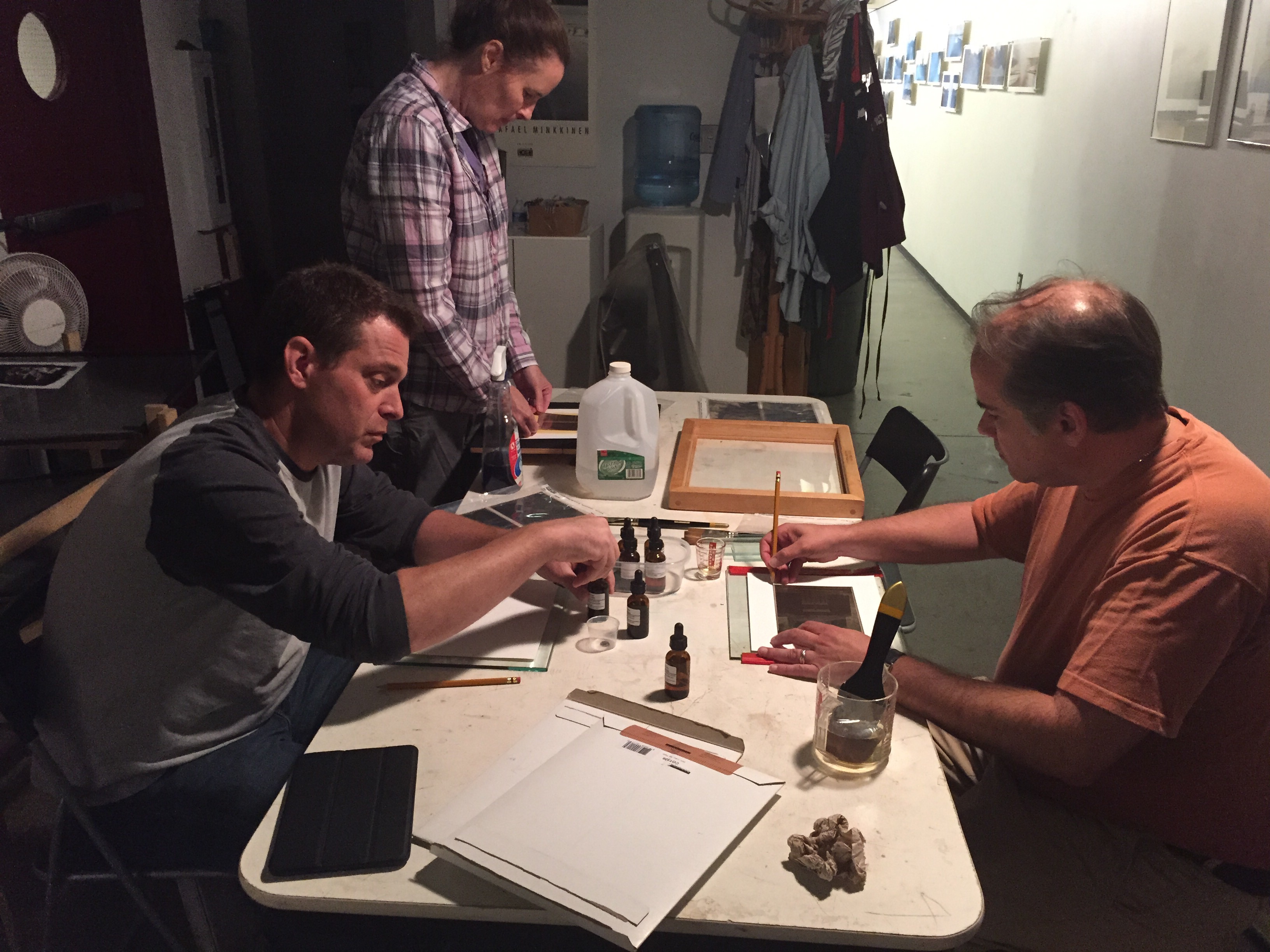
Here are my students busy coating paper and working hard.
Students Coating Prints
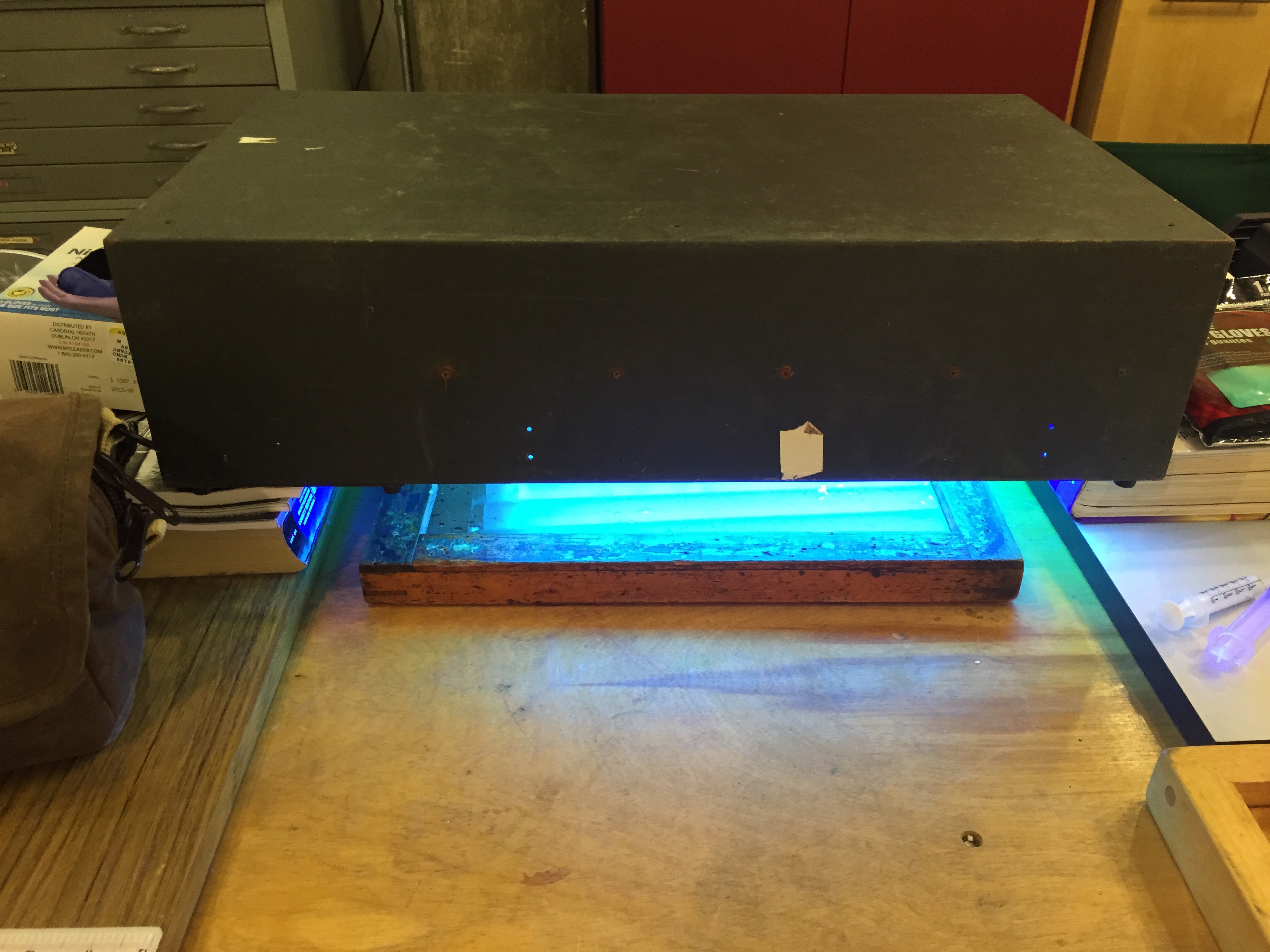
Another faculty member had been given this UV exposure unit by one of our long-time patrons, Grace Taylor. Grace is now retired from photography as she’s in her late 90s, and had given it to him when she stopped printing. At the time he passed it along to me, he said it might have an electrical issue and so may or may not work properly. I was leery therefore, but determined to give it a try. If it didn’t work, I would still have a fallback option of the blacklight compact fluorescent fixture I’ve used before. Fortunately, not only did it work, but it worked well. It gave us very fast exposure times (3 minutes was our base exposure, instead of the 6.5 I normally get with my own unit or the 7-9 we were getting with the CF fixture). So Grace, if you’re aware of this, a big thanks for your UV unit, it has found a new home and is once again being productive!
Grace Taylor’s Old UV Unit in Action
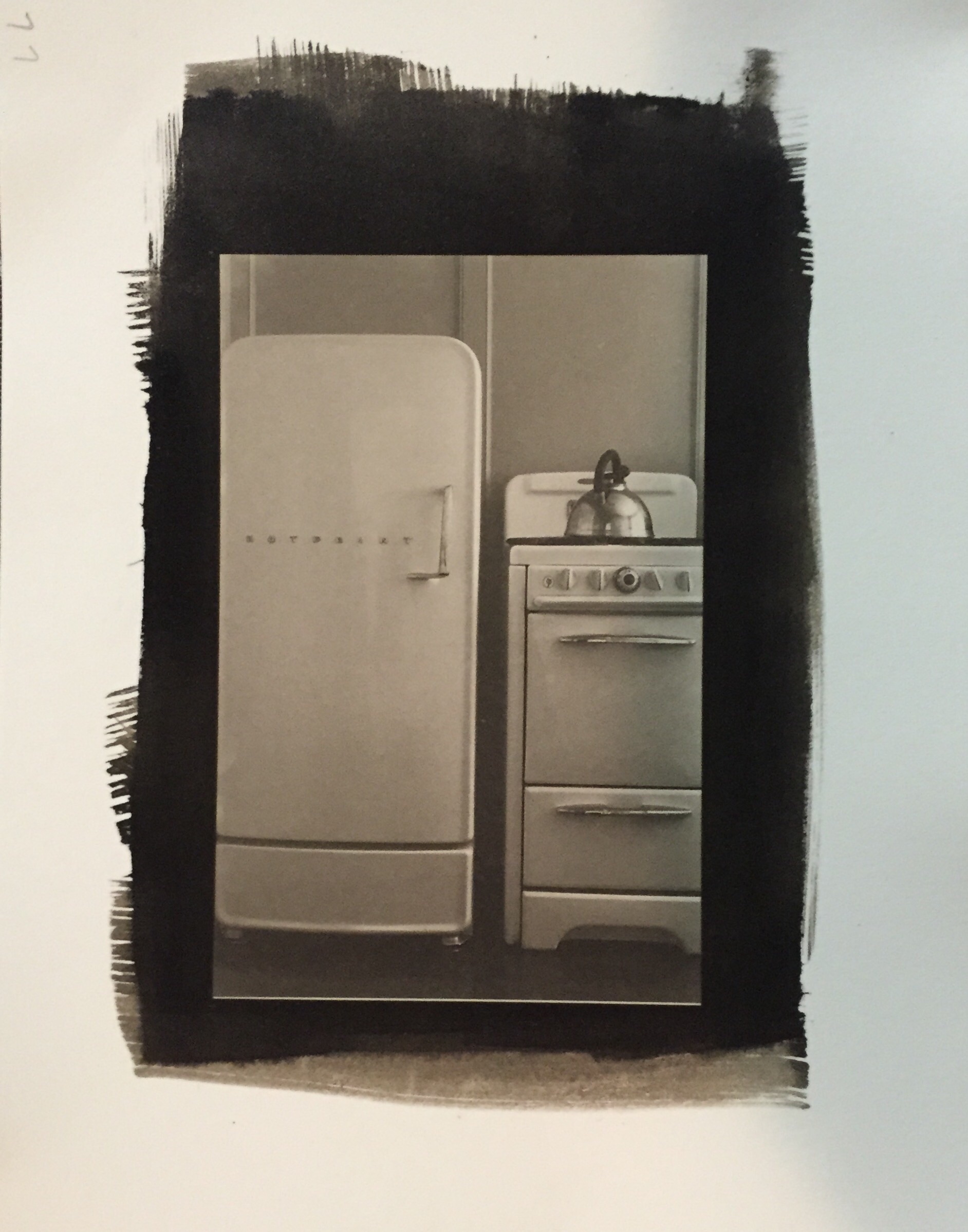
This was another student image, this time one that one of the students brought in, from a digital negative she had made herself. The shot is an interior of one of the hotel rooms at the Chateau Mormont in Los Angeles. This foreshadows next weekend’s module, making digitally enlarged negatives for alt process printing. She had made this negative using the Dan Burkholder method, including using the printer adjustment curve he supplied as a download. The curve he supplied is a good baseline starting point, but as we saw in several tweaks of the print through the day, using someone else’s curve is not a true substitute for making your own.
Chateau Mormont Interior – Digital Negative
I’ll have the students work through making their own curves next Saturday, and then we’ll make some digital negatives of our own and print from them. I’m having them use Ron Reeder’s book, Digital Negatives for Palladium and other Alternative Processes as the textbook for the digital negative process, specifically focusing on creating adjustment curves rather than using QTR to interpret the adjustments needed to create the negative. Ron covers both techniques in his book, and going through the ordeal of making a QTR to adjust the printer output has the advantage of being non-destructive to your digital file (meaning that it doesn’t make any permanent changes, so you don’t have to create multiple files to print negatives for each alternative process you want to use), but for all but the computer-geekiest of folks, it’s way too intimidating.
I have a great crop of students this time (well, I almost always do!) and I think I’m having at least as much fun as they are!
Just wanted to put out a reminder about my upcoming classes at Glen Echo. My Intro to Platinum/Palladium class is almost sold out – five of six slots have been taken already.
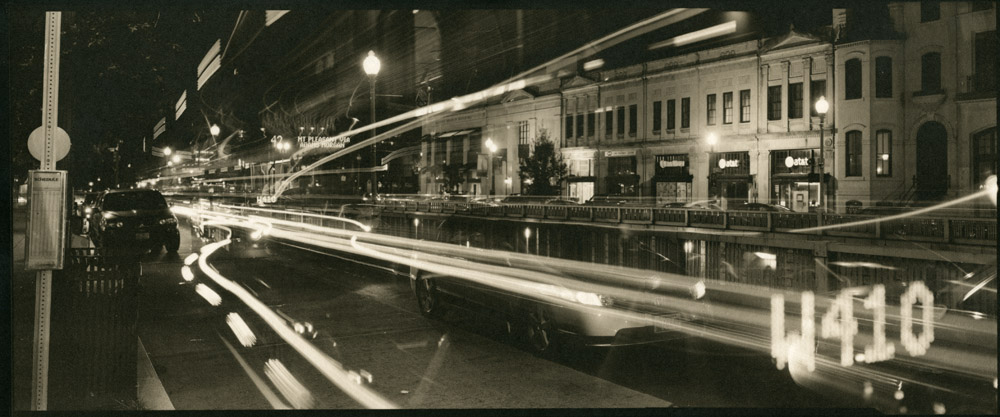
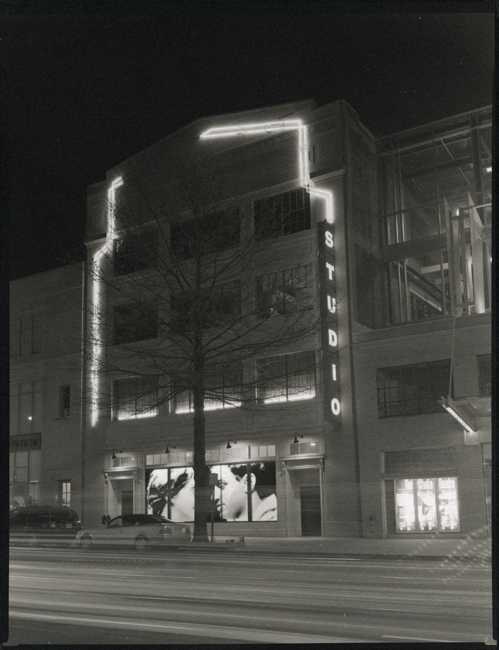
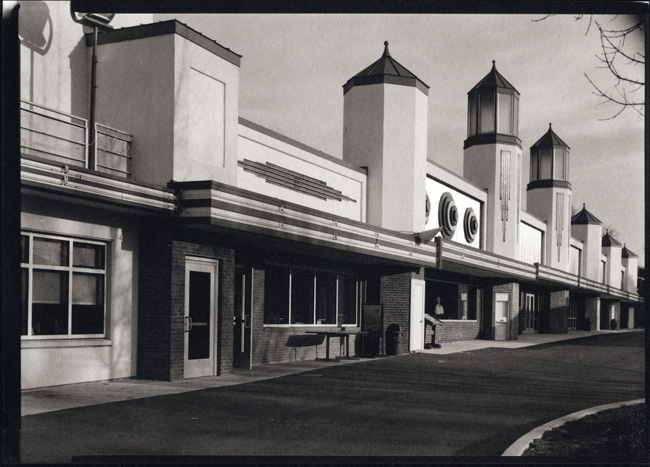
Studio Theater, 14th Street, Night
This is a new formulation of this class for me – two weekends instead of one, and the second weekend is a module on making digitally enlarged negatives for platinum/palladium printing. The first weekend we will make in-camera negatives for platinum/palladium printing, and learn about what will make a good composition for the medium. We will process those negatives and print them the first weekend. The second weekend will be devoted to making digitally enlarged negatives. Students are advised to get the Ron Reeder book on making digitally enlarged negatives in advance so they will have it in hand in time for the digital negative module.
I am also running an intro to studio lighting class from October 28 to December 2. We will cover basics of light in the studio, from a single hot light (there is only one sun!) to a multiple light strobe environment. We’ll also cover light modifiers from basic reflectors to umbrellas, soft boxes to Fresnel lights.
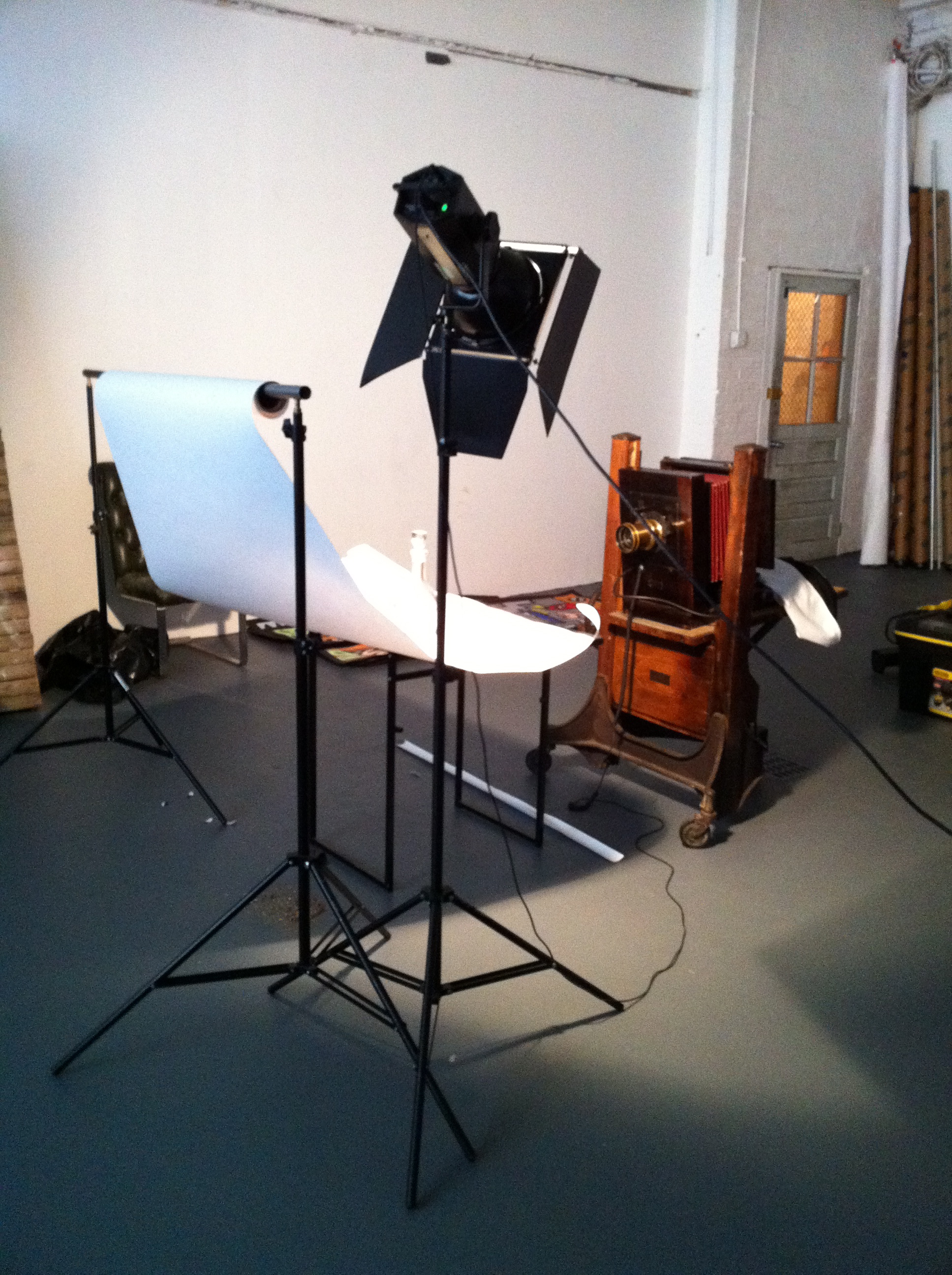
Studio setup #2
One of the biggest challenges working in the studio, especially for folks coming in for the first time from shooting natural light, is that there is no light in the studio but what you put in it. You have total control, and therefore you also have total responsibility for what gets captured. This course will help you learn to see light and how it creates form and volume, and how to control it for contrast and texture.
I’m going to be running my Intro to Platinum/Palladium Printing class again this fall, with an expansion into making digitally enlarged negatives. The new class will be a two-weekend course, September 19th & 20th, 26th & 27th. The 26th will be from 1-5 pm due to a morning scheduling conflict, but the rest of the sessions will be from 10 am – 4 pm.
Platinum/palladium is the catchall term for two chemically interchangeable but visually distinct printing processes first pioneered in the 1870s by William Willis. As the names imply, they use platinum and palladium as their primary metal salt in image formation. A platinum print will be more of a cool gray tone with higher contrast, and a palladium print will be more of a rich chocolate-brown tone with lower contrast. They are capable of producing very long tonal scales, rendering very fine gradations, therefore needing very little if any manipulation during printing. Platinum/Palladium are also among the most archivally stable printing processes – when properly processed and displayed, your prints will last as long as the paper underneath them.
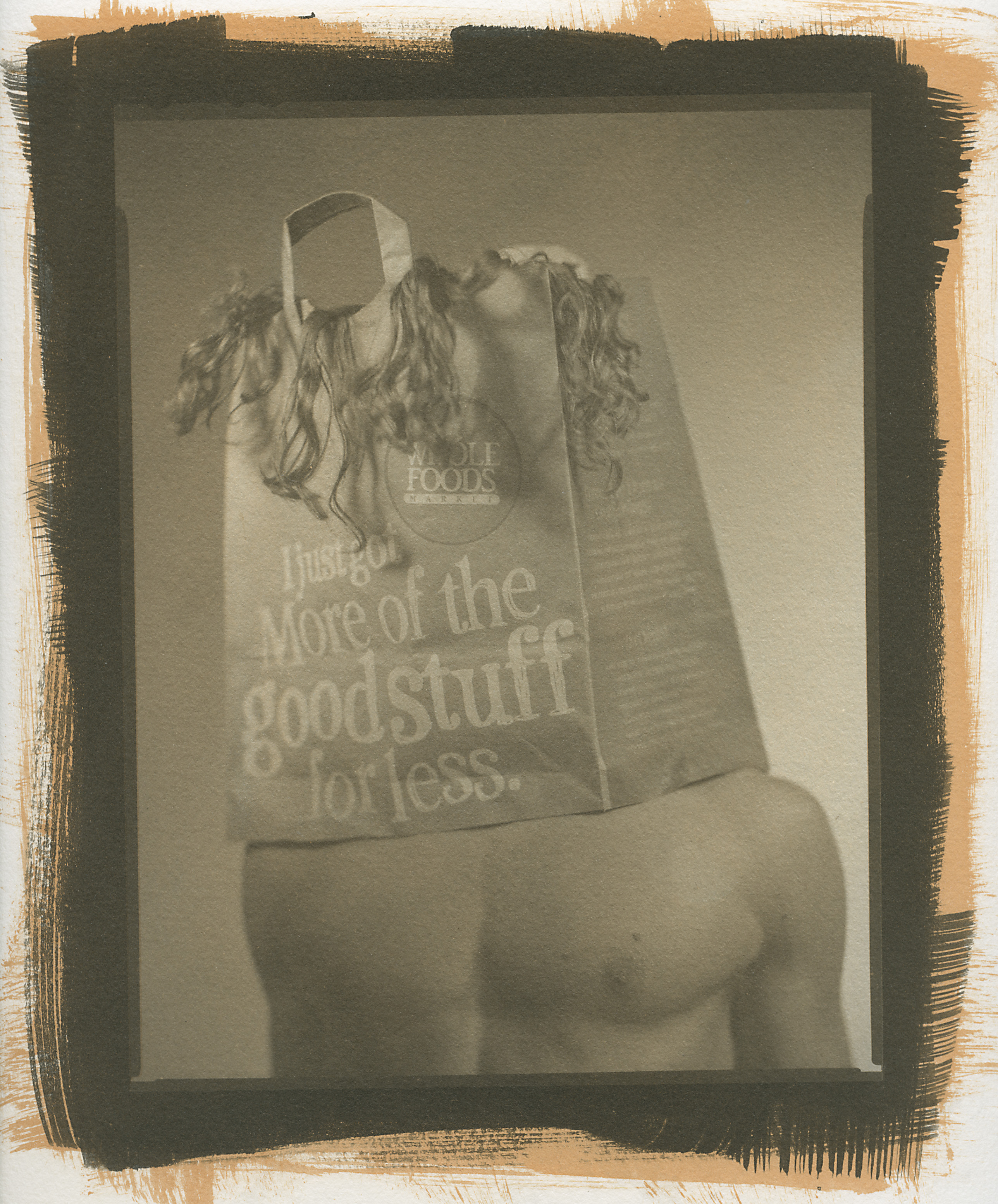
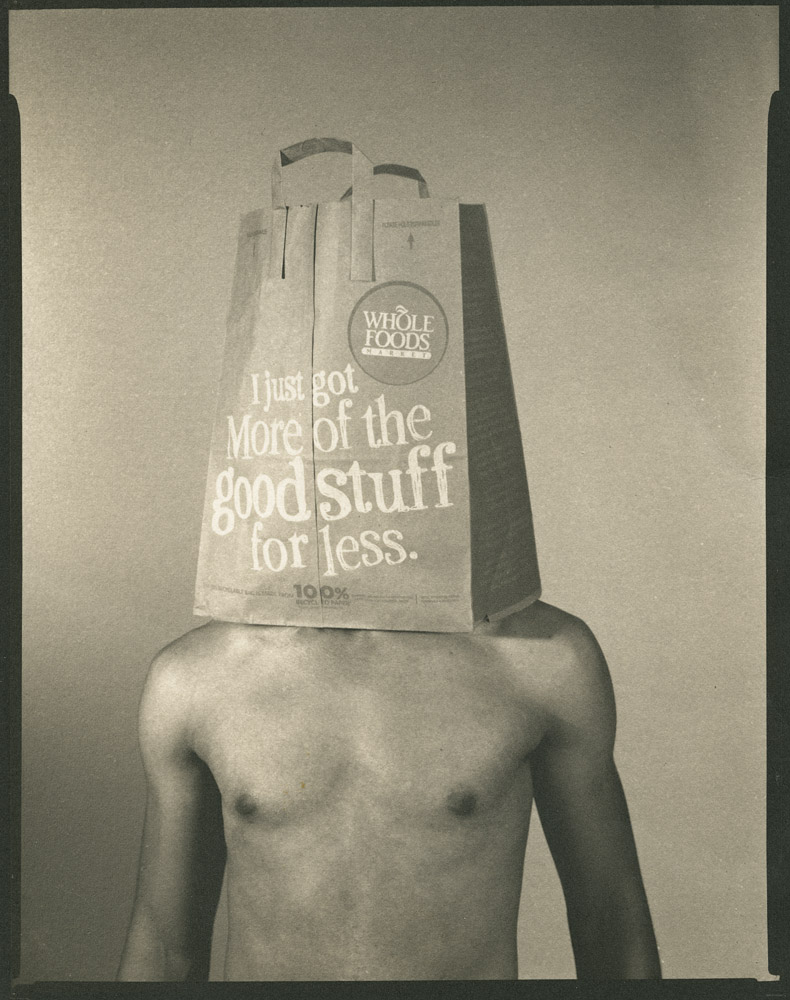
More of the Good Stuff
I traditionally have limited the class to working from in-camera negatives because I want to give people the best possible opportunity to start by making successful prints. As a friend of mine, Ian Leake, puts it in the new edition of his book on Platinum/Palladium printing, “it is possible to make a successful print from a problematic in-camera negative, but it is extremely difficult to make an even marginally successful print from a problematic digital negative” (I’m paraphrasing here).
The addition of making digitally enlarged negatives opens up the process to a whole new range of photographers, as shooting large format is both an encumbrance and a cost that is not for everyone. We will still begin the class with a full weekend of making in-camera film negatives and printing from those negatives. For that class, I will supply the camera and the film. We’ll make our images in and around the park, process the film, and then spend the next day printing.
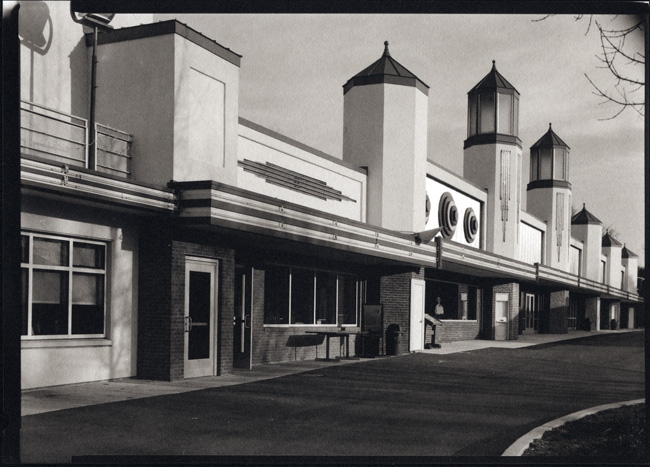
Glen Echo Midway
The second weekend will be devoted to making digitally enlarged negatives and printing from them. We will cover scanning, preparing your file, and printing the negative. I have a required text for the course, Ron Reeder’s “Digital Negatives for Palladium and Other Alternative Processes” which you can order on Amazon. Ron gives a very concise, clearly illustrated and explained step-by-step for how to produce a proper digitally enlarged negative, tailored to the process you want to print with. His technique is not limited to platinum/palladium, but once learned can be applied to any and all alternative processes.
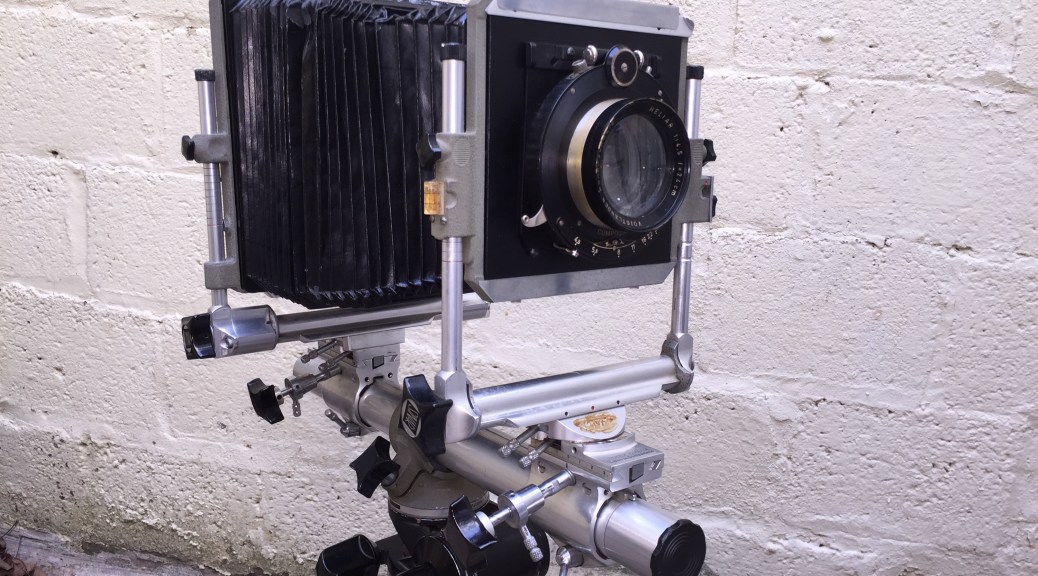
I have to toot my own horn a little today – my spring session of Introduction to Large Format Photography is sold out! I’m even adding three additional seats today to accommodate the folks who contacted me yesterday about registering. The class will cover the basics of how to use a large format camera. We’ll get an understanding of the camera itself – the various types of large format camera, the components of the camera, how to use it, and especially in this digital day and age, WHY to use it. To paraphrase Edward Weston’s comment about color photography: “There are things you can say in large format that you can’t say in anything smaller”. We’ll have specific lessons on film handling and processing for large format, portraiture, studio/tabletop photography, and architecture.
Glen Echo Midway
I teach at Photoworks Glen Echo, a non-profit photography education center in Glen Echo Park, which is operated by the National Park Service. Glen Echo Park is a former amusement park a few miles away from downtown DC in Glen Echo, Maryland on the banks of the Potomac River. Originally envisioned as a suburban housing development for the elite of Washington at the end of the 19th century, the only resident to ever build and take up residence was Clara Barton. It became a Chataqua meeting center, and then in the early years of the 20th century, an amusement park. It rose to its peak by being at the terminus of a street car line running out from Georgetown (a neighborhood in DC and formerly a separate incorporated city in itself). The park endured changing demographics and evolving tastes, but closed up shop in 1970. The US Park Service took over and converted it into a community art center where people can come to learn pottery, glassblowing, cast and fused glass, stone carving, photography, painting. There is a children’s dance theater and puppet theater, and the 1902 Spanish Ballroom has square, contra, ballroom, and swing dancing events practically every night of the week. The centerpiece of the park is now and has been since its installation in the 1920s, the Dentzel Carousel which is freshly restored and fully operational. The carousel offers rides daily from May to October.
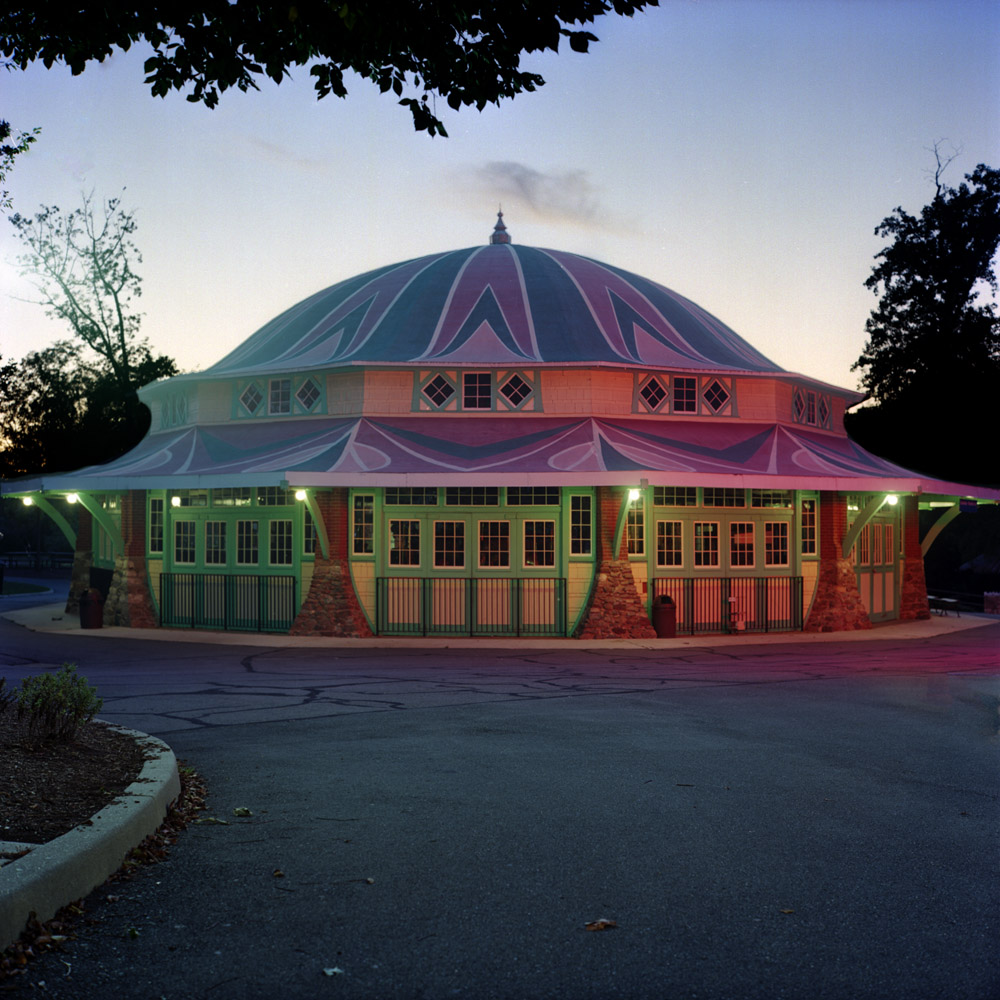
Dentzel Carousel, Glen Echo, Sunset
Photoworks is the photography center, located in the Main Arcade building. This year marks their 40th anniversary. They offer a full range of classes from introductory photography for children and teens to advanced classes on topics such as The Long-Term Photo Project, iPhone Fun (getting the most of mobile device photography), Photographic Editing and Presentation, and Platinum/Palladium Printing. Photoworks has a full wet darkroom for film processing and black-and-white printing up to 16×20 inches, a fully equipped digital darkroom with Macintosh workstations, Epson flatbed scanner and Nikon 35mm dedicated film scanner, and Epson printers for up to 24″ wide prints.
Saturday
February 21
8-10 PM
Photoworks Gallery @ Glen Echo Park
Silent Auction and Photography Raffle
Champagne and Desserts
Black and White Attire Suggested
Come Celebrate the Photoworks Community!
Step 1: RSVP lgmphotoworks@gmail.com
Step 2: Purchase your Gala Ticket
2 Ticket Options
Platinum Gala Ticket
$150 ticket admits 1 and includes SIGNATURE PHOTOGRAPH
Silver Gala Ticket
$50 ticket admits 1 person to the event
Click Here for Ticket Purchase
Final Notes:
1. Space is limited!
2. We recommend that you purchase your tickets before Feb 7th
3. Visit www.glenechophotoworks.org to purchase tickets
4. RSVP lgmphotoworks@gmail.com to save your spot
Questions? lgmphotoworks@gmail.com
Visit us on facebook at glenechophotoworks