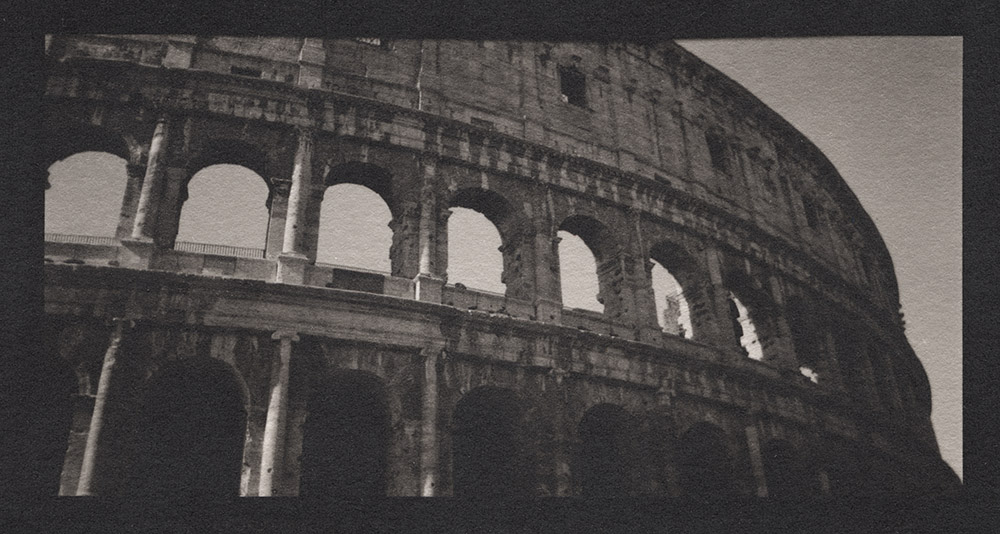
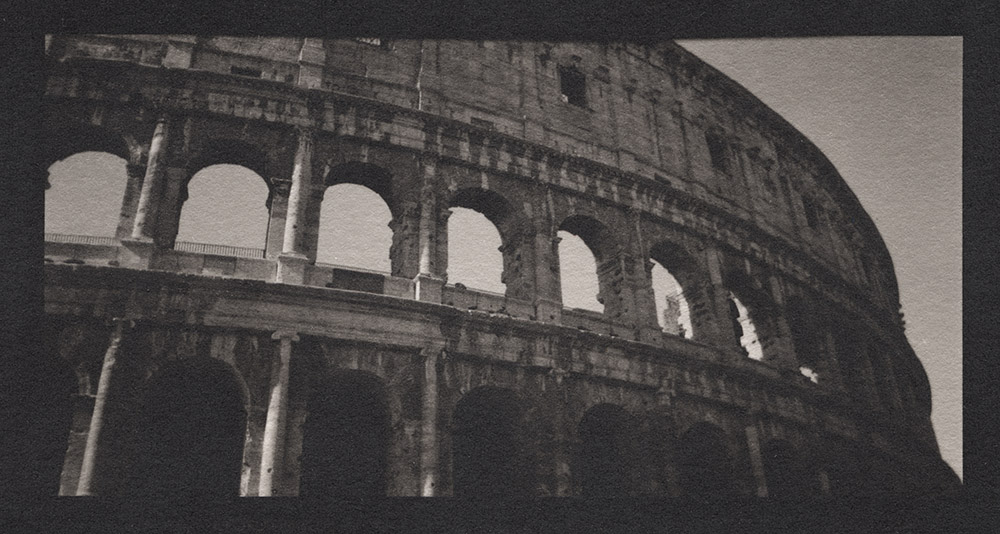
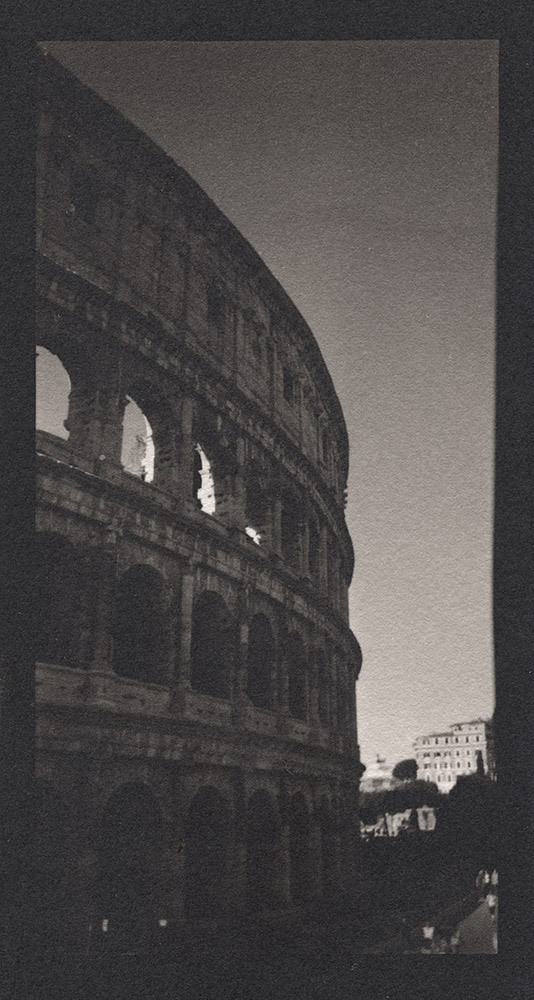
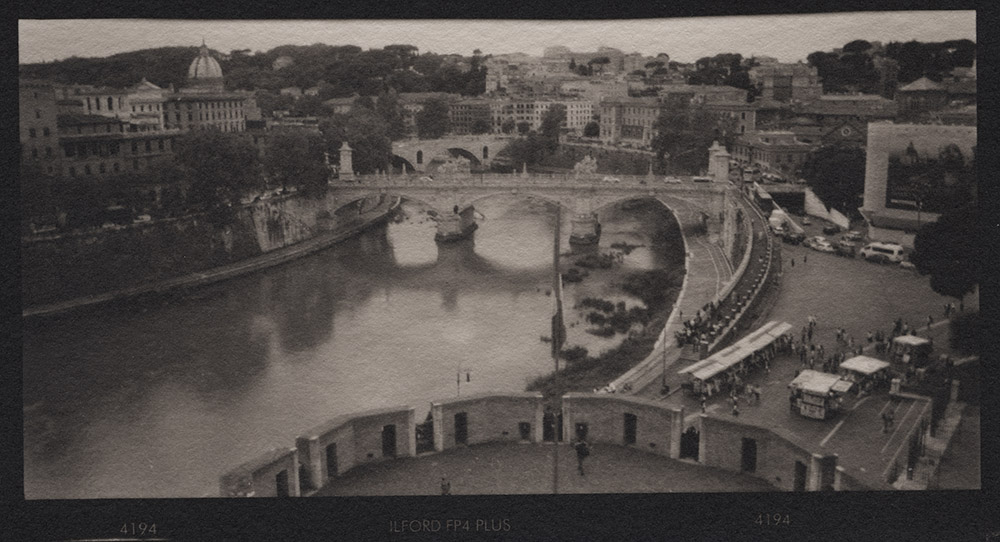
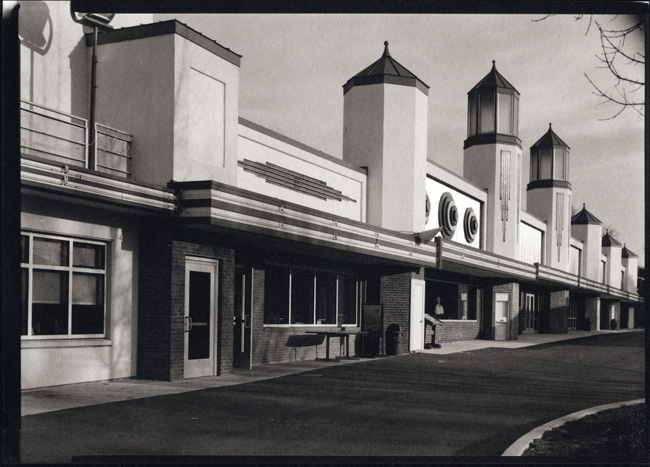
When I was in Rome last year… (no jokes please!) I shot a bunch of panoramic images with my new-to-me Lomo Belair X6-12. My just completed session of the Intro to Platinum/Palladium Printing class I teach inspired me to dig them out and see how they would fare in the medium. I’m really loving these tiny prints – 2 1/4 by 4 1/4 inches! They make you get up close and intimate with the print. I’m matting them in 11×14 inch 8-ply mats for extra measure.
Sometimes you have to walk away from a process or a practice for a while, which happened to me with platinum/palladium. I was on a kick of doing other stuff, shooting my travels with the Rolleiflex. Then it was the Fuji rabbit hole with digital and the X-T1. Then this class came along and I needed something to jumpstart my printing. These images were just the ticket. Photographers in general have an obsession with how big they can make their prints, and even the general public too. But there’s something to be said for tiny prints. I still remember the Andre Kertesz show at the National Gallery where they had a lot of his early work on display – in his youth, he could only make contact prints off of small negatives from roll film cameras because he was poor and didn’t have space for a dedicated darkroom. Getting up close and personal with his images, like “Underwater Swimmer”, which is all of 1 1/2 by 2 1/4 inches, really makes you think about the image itself instead of being awed by its size. Not that I have several million dollars to spare, but I’d much rather spend that kind of money on a print of “Underwater Swimmer” than on Andreas Gursky’s “Rhein II”. Fortunately, the Kertesz would be a lot cheaper to buy than the Gursky anyway.
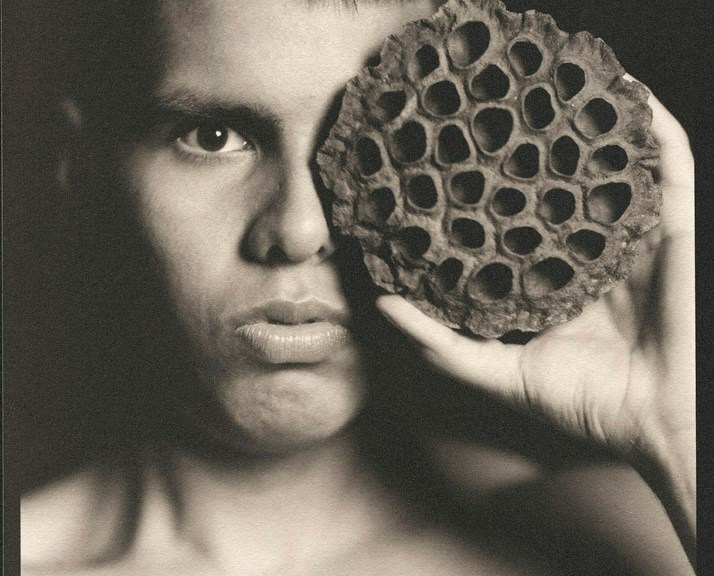
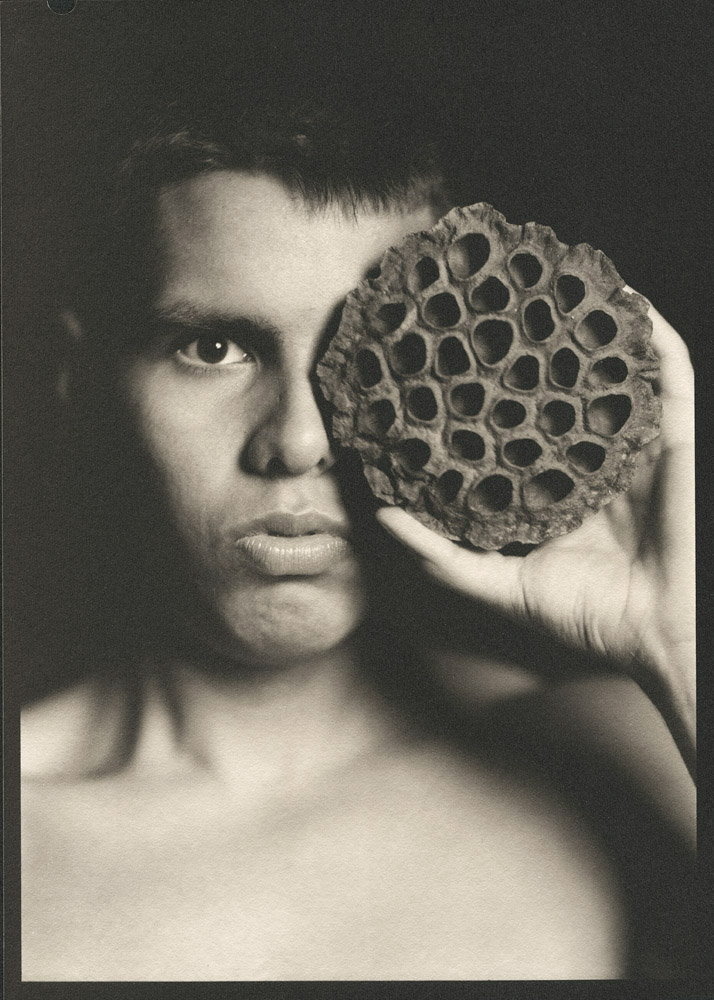
On a separate note, I’d like to give a shout-out to Carol Boss at Hahnemuhle papers. All three images above were printed on the new Hahnemuhle Platinum Rag paper. She has very generously become a sponsoring partner of my Intro to Platinum/Palladium class at Glen Echo Photoworks, and is supplying us with our paper. It is a wonderful new paper- very easy to coat and print on. It may well displace my old standard Bergger COT 320.
I have some very exciting news to announce – my upcoming Introduction to Platinum/Palladium Printing class is now sponsored by Hahnemuhle, makers of fine art printing papers since 1584. They recently introduced a new paper specially formulated for alternative process printing, specifically platinum/palladium, and are graciously supplying the class with a very generous stock of paper for the students to use. I hope this will be the beginning of a long and fruitful partnership.
How did you get into photography as an art medium (as opposed to casual or professional use)?
That went hand-in -in hand with the discovery of alternate processes
Which alternative processes do you practice?
Just about anything: platinum/palladium, silver/iron processes, chrysotype (gold), gum bichromate
What attracted you to alternative processes in general?
I was attracted to the chemistry at first and then the aspect of creating one of a kind hand made images
What drew you to the specific media you practice?
Platinum and palladium prints were are of the technically most accomplished and able to produce most delicate highlights and deep shadows. Seeing great examples of early XX century work in museums and galleries made mu pursue the process . I have started over 25 years ago and the information back then was scant and confusing
How does the choice of media influence your choice of subject matter (or vice versa)?
When taking and composing a picture I try to visualize which alternative process would fit, whether I wand process edges showing, etc.
In today’s mobile, electronic world of instant communication and virtual sharing of images, how important is it to you to create hand-made images?
Two aspects are important. Education of consumer in the existence and quality of hand made images and history of photography through a practice of XIX century processes. The second is keeping and enlarging patron/collector market. Real collector wants something to be touched and held in hand, not a shared digital image.
Is your choice to practice alternative, hand-made photography a reaction to, a complement to, or not influenced by the world of digital media?
It would be totally silly to ignore the digital world. It exists regardless of our feelings about it (good, bad??). SO with that respect it is just a complement. But it is also a strong protests against huge color enhanced digital prints that have invaded galleries.
Do you incorporate digital media into your alternative process work?
Yes, I use the technology as a toll. Some of my captures are digital, most of my negatives are created with digital processes. I am also not against digital alterations of the photograph in the process of creating a picture
What role do you see for hand-made/alternative process work in the art world of today? Where do you see yourself in that world?
I see myself as a part of alternative photography movement. A small (by digital standards) but growing group of practitioners and educators that shares information, practices and the word of photography at its roots
How did you get into photography as an art medium (as opposed to casual or professional use)?
My interest in using photography as an art medium was sort of chosen for me. I cannot paint or draw very well at all, hence I took to photography to satisfy my creative needs. I enjoy the varied and beautiful geography that surrounds me in Colorado and I want to try
to put what I feel and see in the landscape onto a print that the viewers will connect with.
Which alternative processes do you practice?
I’ve got a little A.D.D. when it comes to the different alternative processes. I use platinum/palladium, kallitype, albumen and gum printing as my “go to” methods, but if I feel the image warrants a different process or if I just want to see what a print looks like in another process I’ll use cyanotype, gumoils, carbon.
What attracted you to alternative processes in general?
Flexibility in appearance of the print is what the interest in alternative processes is for me. So much can be done to influence the final look of a print it is almost limitless. I also really enjoy spending hours in the darkroom, it is very satisfying for me. Being able to print on many different papers types with all the textures and tones available is a big plus in my attraction to alternative processes.
What drew you to the specific media you practice?
Sort of similar to the above question, it is very flexible in what can be achieved in the look and feel of an image. You can get a straight platinum/palladium look, or if you add a little gum over the print it can totally change the character of the print. I enjoy the gum over process (platinum/palladium or kallitype) because if all I want to do is enhance the shadows without affecting the rest of the print it is a good solution. On the other hand, I might change the whole tone of a platinum print with a deep gum printing over the top. The flexible nature I guess would be reason for the processes I use.
How does the choice of media influence your choice of subject matter (or vice versa)?
I am primarily a landscape photographer. I have never been into printing large prints, rarely over 11×14 inches in size. I want the viewer to get close to the print, study it for all it glory and flaws. I don’t know if it is a conscious decision for me to choose my media based on the subject matter, but I prefer for my images an intimate up close experience and I feel the processes I use are what fits my style best.
In today’s mobile, electronic world of instant communication and virtual sharing of images, how important is it to you to create hand-made images?
It’s paramount! We are saturated with images all day long. There is a certain satisfaction for me to spend countless hours printing and reprinting and image until I get what I want and I hope viewers will appreciate the effort involved, sometimes that hope is in vain but it means something to me to make a hand made image.
Is your choice to practice alternative, hand-made photography a reaction to, a complement to, or not influenced by the world of digital media?
I’m not influenced by digital media really at all. It doesn’t interest me as a tool as I enjoy using film and am comfortable with it’s attributes and limitations. If I’m honest I guess I kind of enjoy being one of a few alternative printers versus being one in a billion digital photographers.
Do you incorporate digital media into your alternative process work?
Not in a serious way. I may use a digital negative if the film negative is unsuitable to use for the given process I wish to print in.
If so, how do you incorporate it? Is it limited to mechanical reproduction technique, or does it inform/shape/influence the content of your work?
It’s just making a digital negative, my photoshop skills render me unable to go much further than that unfortunately.
What role do you see for hand-made/alternative process work in the art world of today? Where do you see yourself in that world?
I believe in the photography art world, the alternative processes will continue to be valued and appreciated for both it’s aesthetic appeal as well as for the craft involved. That being said, a good photograph is a good photograph regardless of how it was made. As for myself in that world, that is for others to judge. I will keep doing what I enjoy doing and let the chips fall where they may.
John Sarsgard. It’s of Danish origin… two of my great grandparents were immigrants from Denmark, and two from Norway, on my father’s side.
Where are you from?
I was born and grew up and was educated in Mississippi, where my Iowa farm boy father met my mother during his military service in World War II.
How did you get into photography as an art medium (as opposed to casual or professional use)?
I was initially attracted to photography via the darkroom, as a combination of science and magic. We lived in a small house with one bathroom, the only place a darkroom could work, and I learned to develop and print very quickly. I suppose I initially photographed things I liked or disliked or was attracted to for other reasons. I think I began documenting these subjects without much notion of art, but as I continued, I gradually wanted to make my photographs reflect my reaction to the subject, and make it more visually interesting. When steam locomotives were still around, for example, I wanted to photograph them because they were going away, and I had to have my own images of them. But then I noticed that all my locomotives looked similar to other photos I had seen, and started thinking about how to incorporate my thoughts and feelings about them, and how to make images that I thought pleasing. For years until now, that has continued. Photographing subjects to which I feel a connection, and attempting to express my connection and at the same time to make an image I find pleasing. And making prints myself has continued to be part of the process, although with a now dedicated darkroom! I wish I still had the 120 contact prints of the locomotives.
Which alternative processes do you practice?
Platinum/palladium
What attracted you to alternative processes in general?
Alternative processes provide much more freedom of interpretation for the artist. When I make an inkjet print, the final medium plays a much smaller part in my expression. I work on the image in Lightroom and/or Photoshop and then attempt to get the printed image to look about like what I have on the screen. Many of the inkjet papers are quite beautiful, but the possibilities for personal expression in the alternative processes are much richer. I am not attracted to them just because they are old. New alternative processes and variations on the historic ones will continue to be developed, and I would not reject them because they are new.
What drew you to the specific media you practice?
I saw Stieglitz’s platinum portraits of Georgia O’Keefe in the Metropolitan Museum and loved them. Along with daguerreotypes, I started appreciating photographs as objects of beauty in addition to a means of recording an image. Then I saw many of Carl Weese’s platinum prints up close, and held them in my hands, and knew I wanted to learn to make these things. I studied with Carl to learn. Perhaps I will try daguerreotypes some day, but for now, I would rather focus on making better platinum prints. Also, I am attracted first to the contact printing processes because I worked in the information technology industry for 35 years, have fairly good hands on computer skills, and am quite comfortable making digital negatives. I was a fairly good darkroom printer in silver gelatine, but the things I always wished I could do better printing in the darkroom are much easier for me in Photoshop. Maybe I will try some of the other contact processes, but for now I am enjoying getting better and better at pt/pd. I do dream a little about getting a big camera and learning one of the wet plate processes.
How does the choice of media influence your choice of subject matter (or vice versa)?
Good question, one I still am working at answering. When platinum printing was king, people used it for all kinds of things because that was what they had. Most of the subjects to which I am attracted result in portraits, landscapes, or people in places to which they are connected one way or another. I think all those work well in pt/pd. I did a series on young men in New York playing hard ball street basketball in a park in Greenwich Village. I enjoyed doing it but never thought of it as a platinum subject, but I would consider individual portraits of these guys as works for platinum.
In today’s mobile, electronic world of instant communication and virtual sharing of images, how important is it to you to create hand-made images?
It is just what I do. I do not complain about the electronic world and virtual sharing and all that goes with it. I participate in it. But I believe there is a place for photographs as things that can be held in the hand that have a beauty of process as well as a beauty of subject and composition. I do not create hand-made images because I think there is something wrong with electronic ones. I do it for their own sake and because I love doing it.
Is your choice to practice alternative, hand-made photography a reaction to, a complement to, or not influenced by the world of digital media?
Pretty much same answer as above. I make these things because I like what they look like and love making them. I do not reject digital media. People download lots of music from iTunes, and people still buy vinyl. They don’t buy vinyl because they are Luddites, but because they appreciate its special qualities. That’s how I feel about alternative, hand-made photography.
Do you incorporate digital media into your alternative process work?
I do. I print almost entirely from digital negatives.
If so, how do you incorporate it? Is it limited to mechanical reproduction technique, or does it inform/shape/influence the content of your work?
I would not say that digital media informs my alternative process work. I would say that my alternative process work drives what I do digitally.
What role do you see for hand-made/alternative process work in the art world of today? Where do you see yourself in that world?
Hand-made/alternative processes have unique qualities all their own that add greatly to the more conventional images most people know more about. Painters and sculptors employ lots of different media and materials, and are richer for it. So can photography. But it is up to us as artists and to the rest of the photography establishment to help people learn about these alternative methods and materials most people have never heard of or seen. I love this kind of work, and I want others to see and appreciate it, so I try to get it out there for people to see. I like to do small things to help people see platinum/palladium prints up close and without barriers. I think doing thinks like showing work framed but not under glass helps. I show platinum prints to portrait clients.
Nowadays I live in Switzerland, but I am originally from England.
How did you get into photography as an art medium (as opposed to casual or professional use)?
I discovered Charlie Waite’s landscapes. These showed me that photography could be a personal statement as much as a documentary record. Charlie opened my eyes and changed my life.
Which alternative processes do you practice?
Platinum/palladium printing. I occasionally dabble with other alt processes, but not for serious work.
What attracted you to alternative processes in general?
As an artist I feel it is important to be involved throughout the creative process. I want what I make to be my creation. You can only truly achieve this when working by hand.
What drew you to the specific media you practice?
I made my first platinum/palladium print in 2005: a close-up of some flowers on a slate embankment. I still have it somewhere. I had seen pictures of platinum/palladium prints online, but the first one I saw in the real-world was that first print I made. It was an epiphany, and I very quickly realised that there was nothing else I wanted to make. Platinum/palladium allows me a depth of emotional engagement that I don’t have with traditional silver gelatin or digital machine-made prints. This emotional engagement is really important. I want what I feel in my studio when working with the model to be conveyed in my finished work. Platinum/palladium allows this.
How does the choice of media influence your choice of subject matter (or vice versa)?
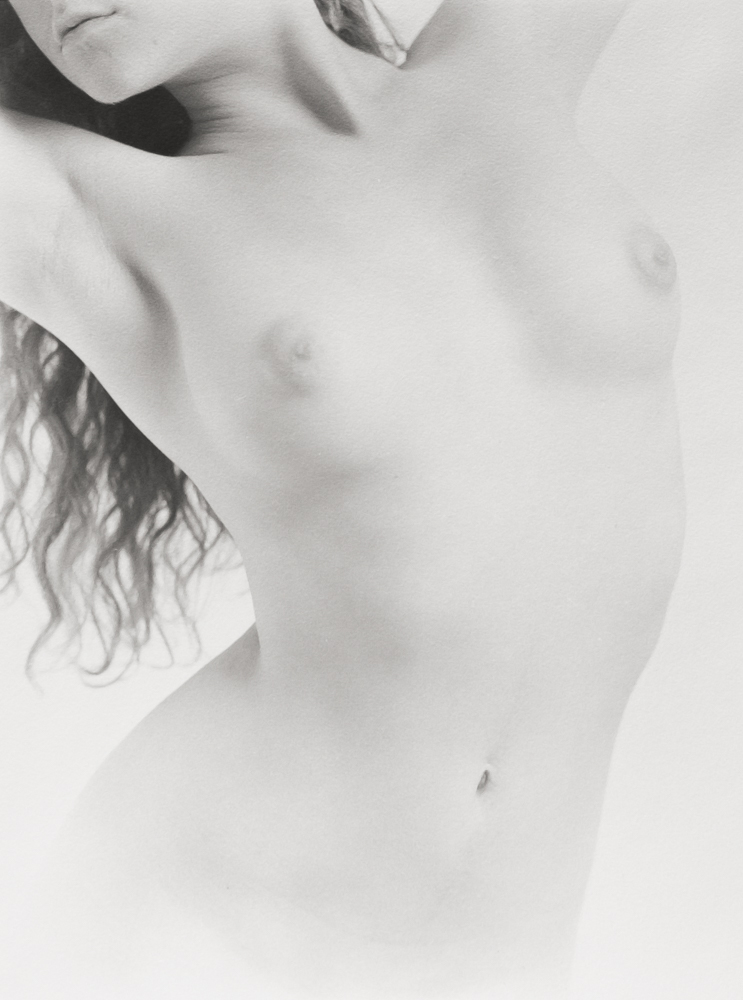
I find platinum/palladium to be the perfect medium for nudes. It renders soft, graceful and beautiful images that are far more subtle than the shouty, high contrast stuff we are routinely bombarded with.
In today’s mobile, electronic world of instant communication and virtual sharing of images, how important is it to you to create hand-made images?
I can’t really see the point in churning out machine-made images. Anyone can do this.
Is your choice to practice alternative, hand-made photography a reaction to, a complement to, or not influenced by the world of digital media?
I was making platinum/palladium before the digital revolution really took off. I use digital cameras, of course, but not for serious work. The workflow is so different and feels so shallow to me.
Do you incorporate digital media into your alternative process work?
In general, I would say no. I do use digital negatives from time to time, but this isn’t a significant part of my creative life.
What role do you see for hand-made/alternative process work in the art world of today? Where do you see yourself in that world?
Most photography collectors want distinctive, exclusive and personal artwork. Small limited editions of hand-made prints made using the finest of materials by a master of the creative process all contribute to this. And of course the enormous lifespan of platinum/palladium prints ensures that these photographs will pass the test of time. A well made platinum/palladium print will last as long as the paper it is printed upon. Many collectors like the fact that their investments will be there to be enjoyed by their grandchildren’s grandchildren.
Ian Leake’s work can also be found at IanLeake.com
This is a reminder that the submission deadline for Rendering The Spirit: The Personal Image in Alternative Media is less than a week away, on February 21.
Photoworks is a non-profit photographic arts and education center in Glen Echo, Maryland. Last year was their 40th anniversary, and as part of the ongoing celebrations and future vision for Photoworks, we are launching a new program to provide visibility and accessibility to historic/alternative processes and artists working in these media. Rendering The Spirit is the kickoff event to highlight this programming.
Works to be considered must be made using an alternative/historic process, including but not limited to lumen prints, daguerreotypes, gum bichromate, tintypes/ambrotypes/melainotypes, platinum/palladium, kallitypes, Van Dyke Brown, cyanotypes, carbon prints, calotypes, salt prints, albumen prints, bromoil, gumoil or some combination of the above. Silver Gelatin prints on machine-made commercial papers are not accepted. Original capture of the image can be from in-camera negatives or digital capture or some combination thereof, but the final image must be a physical object made using one or more historical processes.
Also include an artists statement, brief bio and an explanation of the work(s). All required documents (JPEGS, Artist statement/bio/explanation of works) should be emailed to photoworks.gallery@gmail.com no later than February 21st. Notifications will be sent by email to all selected artists by March 1. Works must be received by March 14. The opening reception will be held on March 26.
Render (v): to distill, to cook down to its essence, to translate, to represent.
Rendering: an act of bringing into being, of distillation, of translation, of representation.
By aiming our gaze at works created using “alternative” processes, we aim to show the diversity of work being created at this nexus of the 19th and 21st centuries and engage in a dialog about what it means to create work using anachronistic techniques.
Scott Davis is a faculty member at Photoworks where he teaches alternative processes, portraiture and studio lighting. He received formal training at Maryland Institute, College of Art. His specialty is platinum/palladium printing, and he is an avid collector of 19th century photography. He has exhibited his personal work locally, nationally and internationally, and has served as curator at the former Art Reactor Gallery in Hyattsville.
Malcolm Cosgrove-Davies is a self-taught photographer who since 1978 has been practicing historic photographic processes including gum bichromate, cyanotype, VanDyke, palladium, and carbon printing. Mac’s images derive from his extensive travel to developing countries as well as everyday life. Using antique and hand-made film cameras in various large & panoramic formats he seeks to match the image to the beauty and elegance of the selected photographic process. In addition to building the occasional camera, printing frame or other useful photographic gadget, he also creates books and presentation portfolios for his prints. He is represented in various collections such as the Smithsonian American Art Museum, Library of Congress, Maier Museum, and Lehigh University Art Galleries.
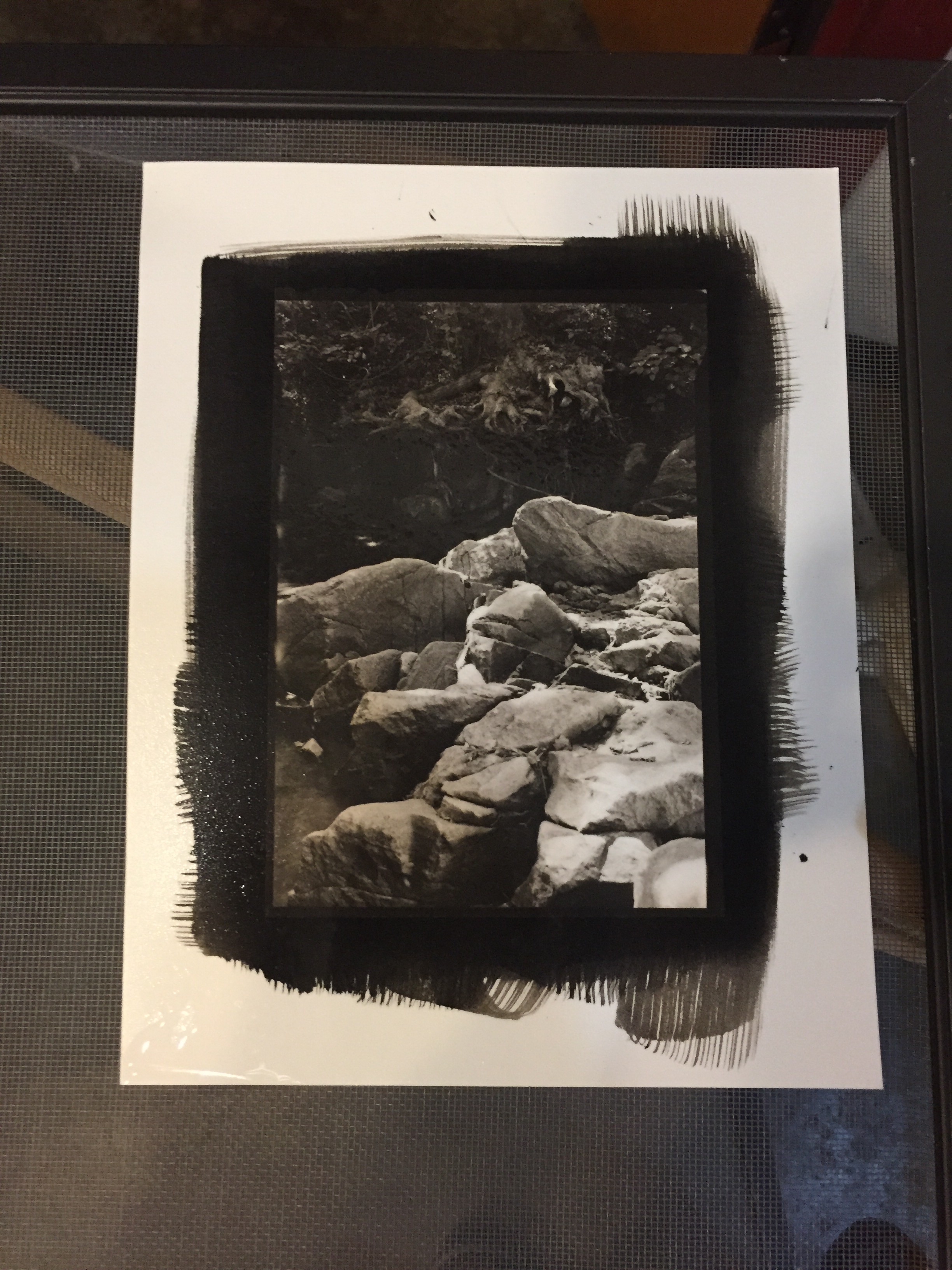
This weekend was module one of two in my revised Intro to Platinum/Palladium Printing class. Module One covered making images from in-camera film negatives. Yesterday we went out in the park at Glen Echo and shot some film with my 5×7. This first image is one of the student prints from that outing – the rocks and water in the stream that runs through the park.
Rocks, Stream, Glen Echo Park
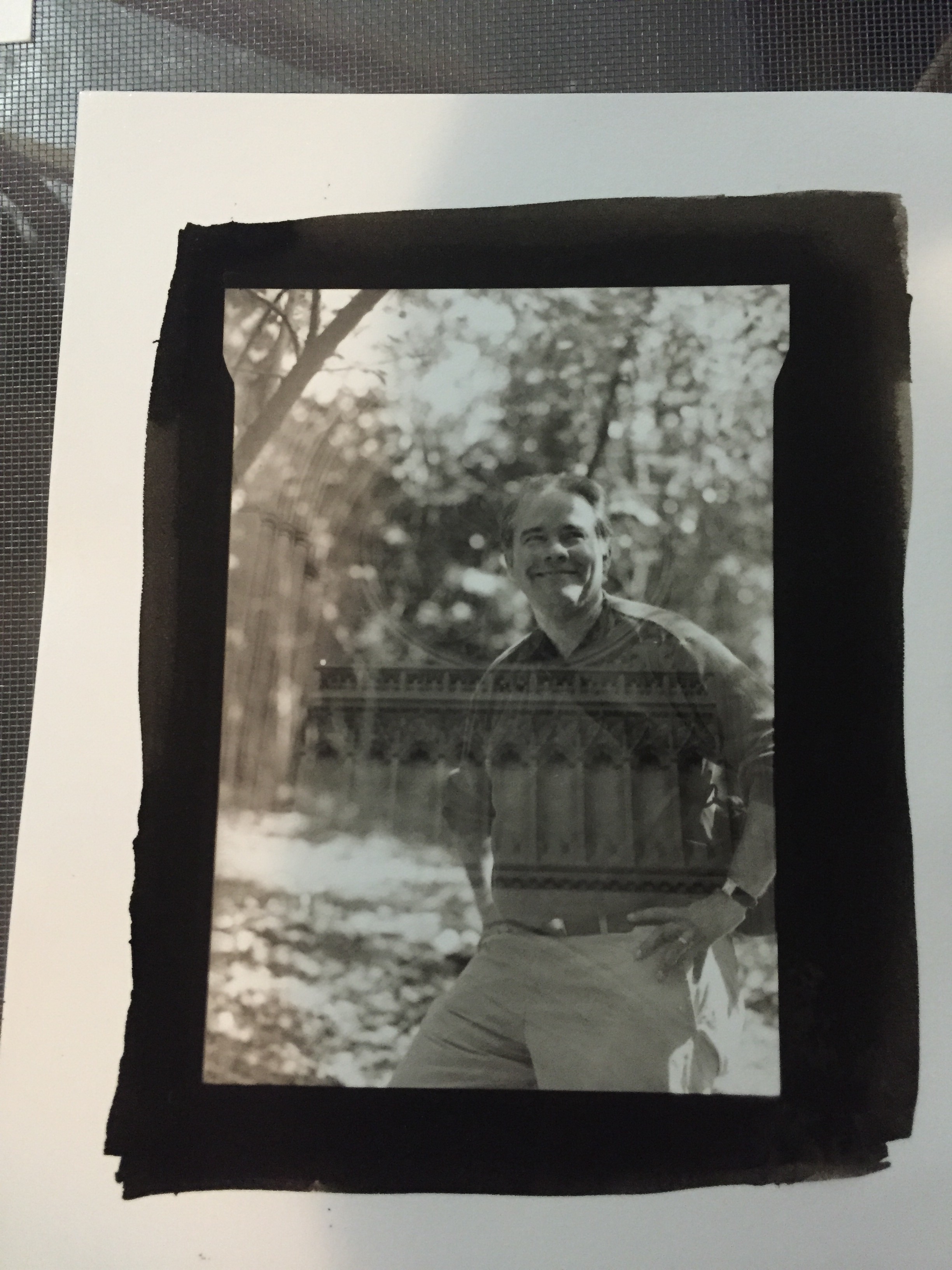
This second shot is a happy accident – one of my students wanted to do portraits, and shot this and another one (which we didn’t print) of two classmates. What we didn’t realize at the time, which was very much my fault, was that those two sheets had previously been exposed by me on an outing with my Intro to Large Format class to the National Cathedral, but not developed. So we had two negatives of students in the woods superimposed on the facade of the National Cathedral. In the other one, the student’s face was obscured by the rose window, but here it works well. We were joking that it would make a great political campaign photo.
Happy Accident – Double Exposure
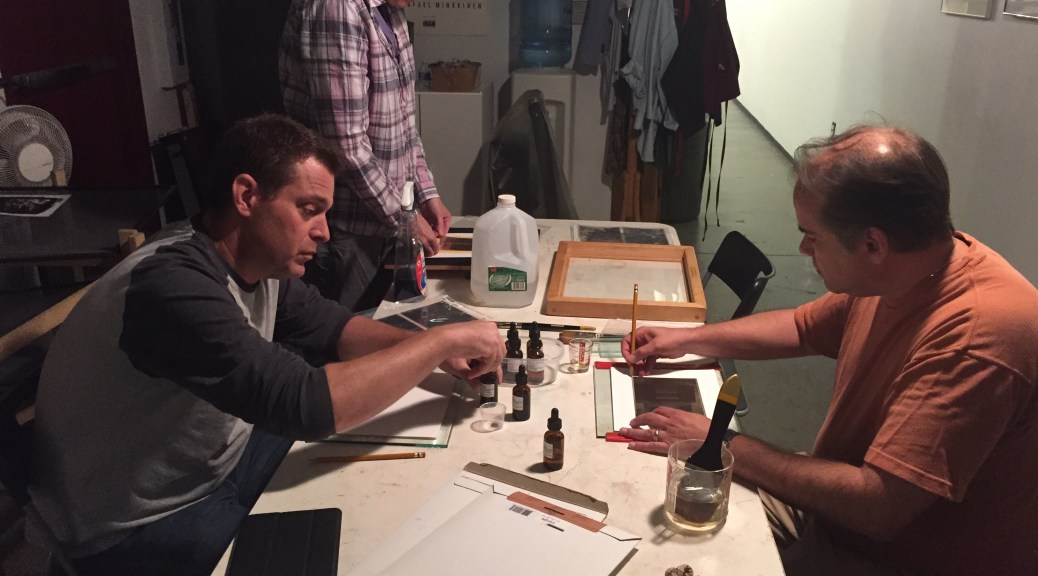
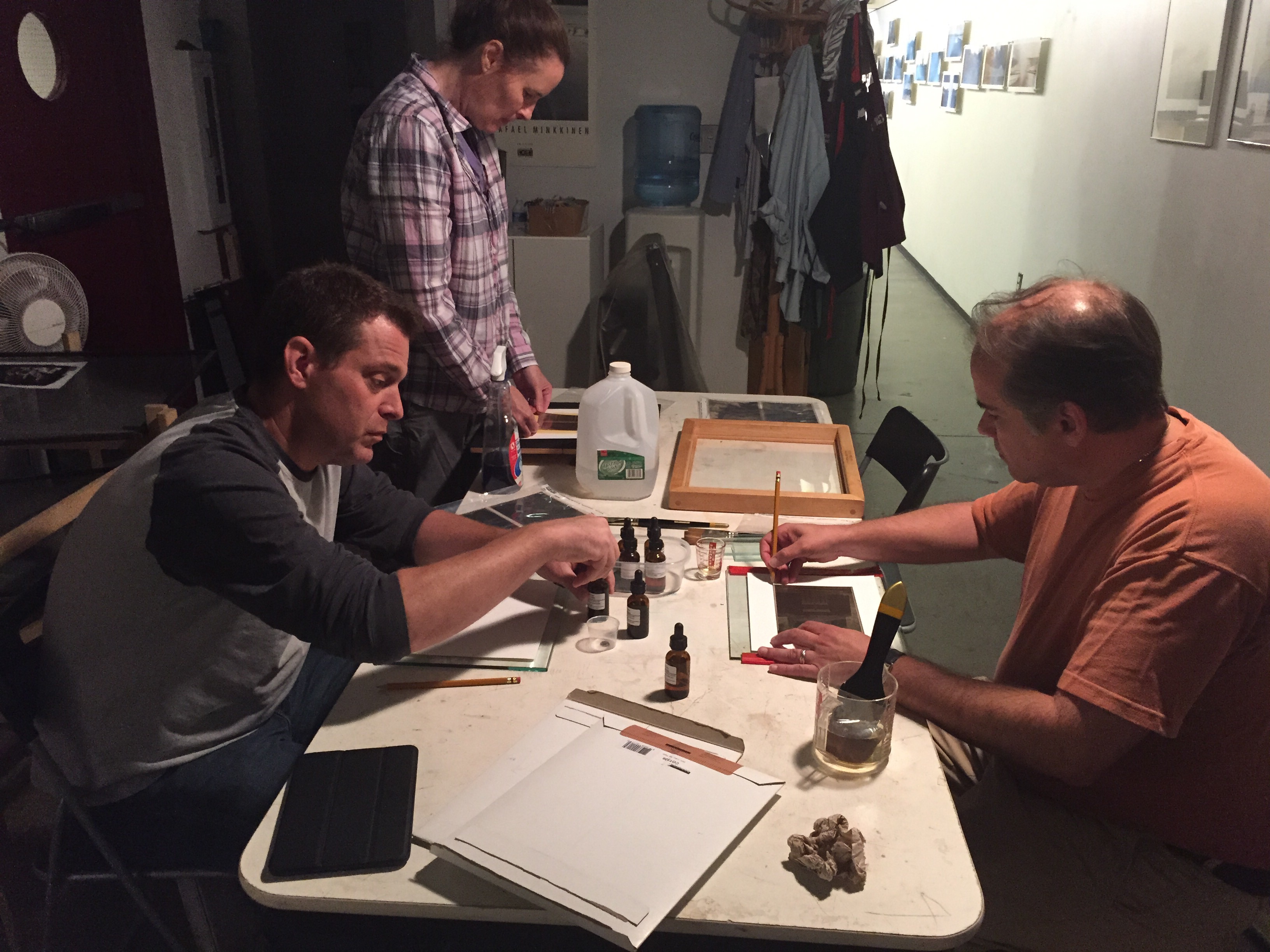
Here are my students busy coating paper and working hard.
Students Coating Prints
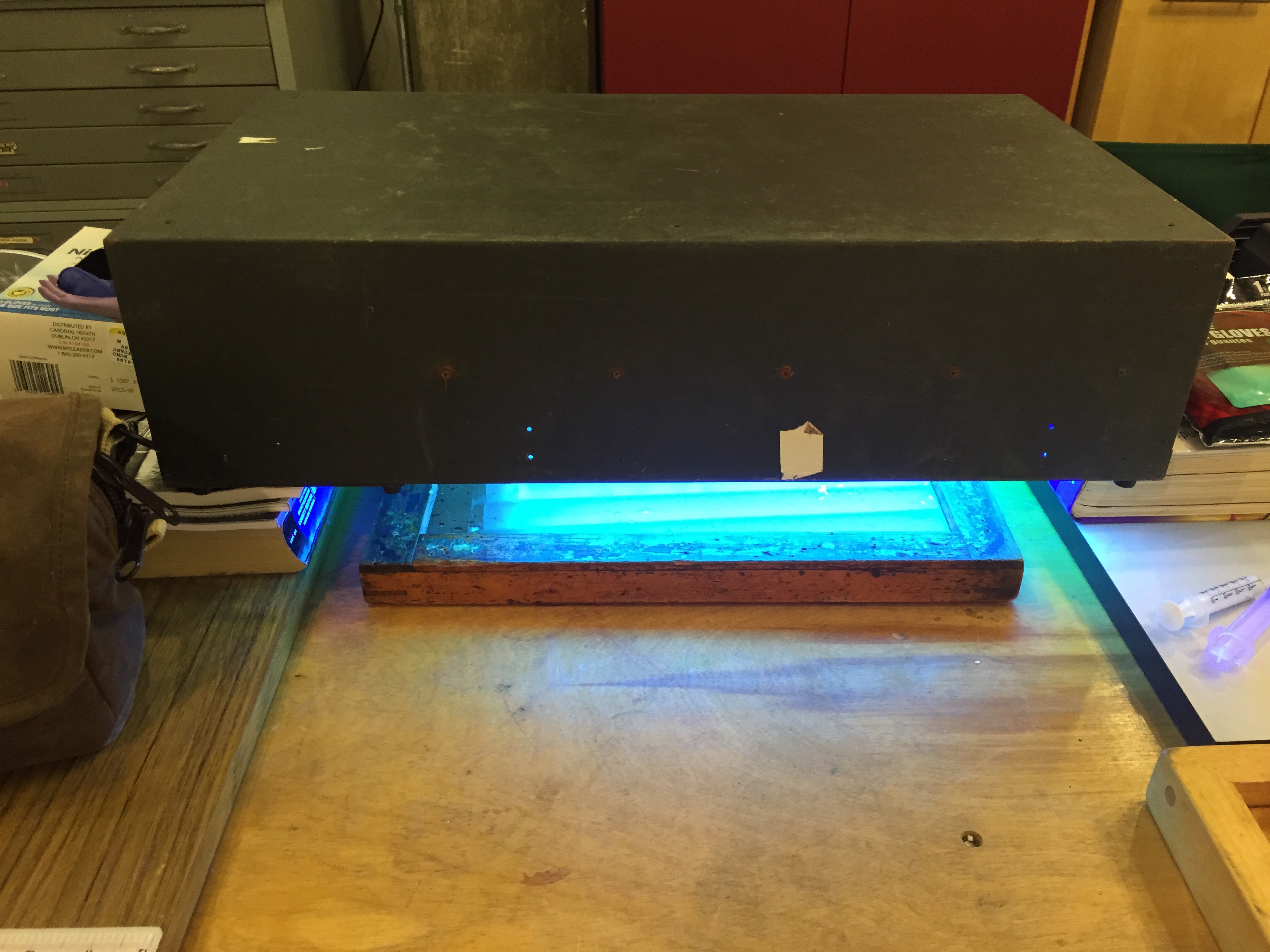
Another faculty member had been given this UV exposure unit by one of our long-time patrons, Grace Taylor. Grace is now retired from photography as she’s in her late 90s, and had given it to him when she stopped printing. At the time he passed it along to me, he said it might have an electrical issue and so may or may not work properly. I was leery therefore, but determined to give it a try. If it didn’t work, I would still have a fallback option of the blacklight compact fluorescent fixture I’ve used before. Fortunately, not only did it work, but it worked well. It gave us very fast exposure times (3 minutes was our base exposure, instead of the 6.5 I normally get with my own unit or the 7-9 we were getting with the CF fixture). So Grace, if you’re aware of this, a big thanks for your UV unit, it has found a new home and is once again being productive!
Grace Taylor’s Old UV Unit in Action
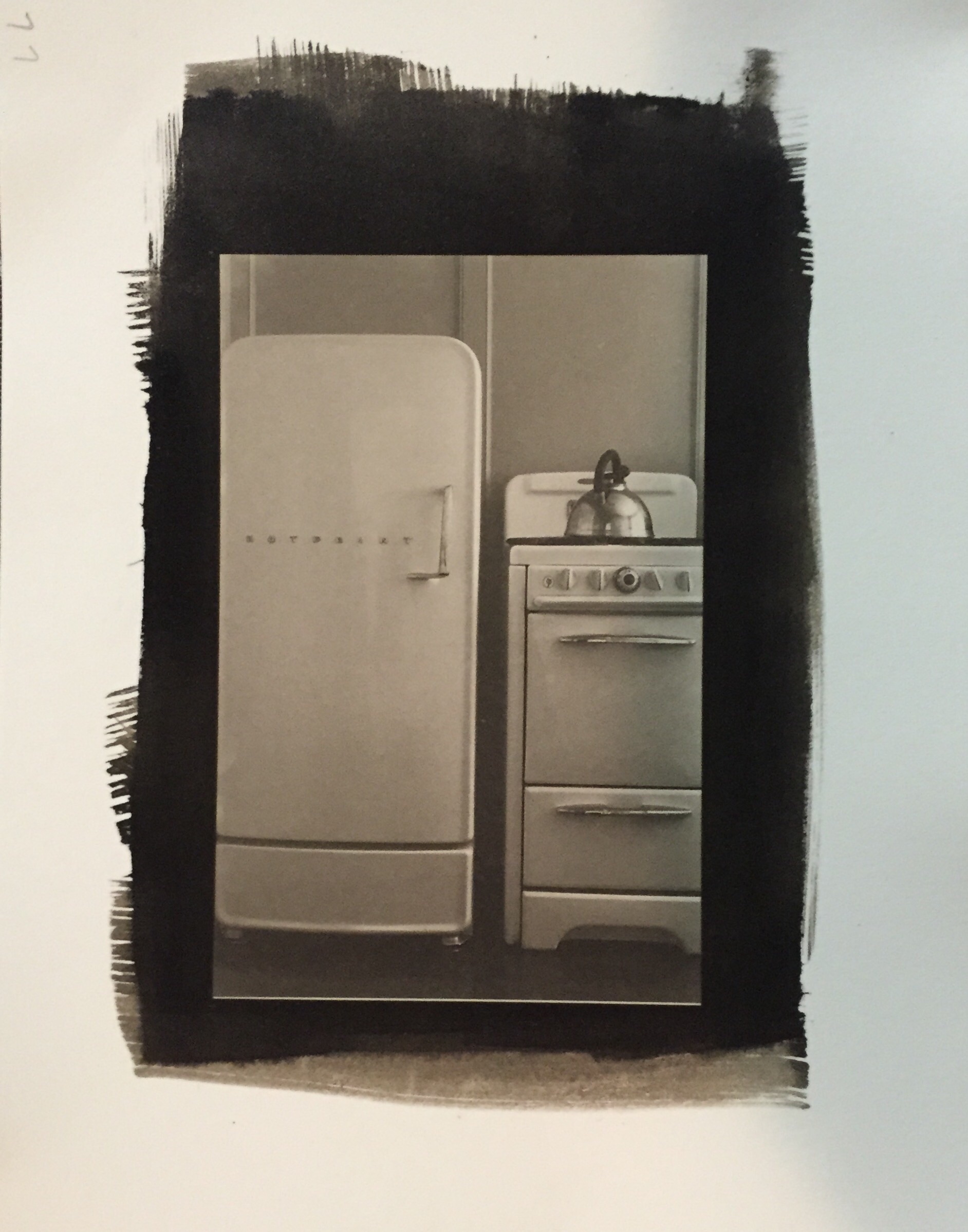
This was another student image, this time one that one of the students brought in, from a digital negative she had made herself. The shot is an interior of one of the hotel rooms at the Chateau Mormont in Los Angeles. This foreshadows next weekend’s module, making digitally enlarged negatives for alt process printing. She had made this negative using the Dan Burkholder method, including using the printer adjustment curve he supplied as a download. The curve he supplied is a good baseline starting point, but as we saw in several tweaks of the print through the day, using someone else’s curve is not a true substitute for making your own.
Chateau Mormont Interior – Digital Negative
I’ll have the students work through making their own curves next Saturday, and then we’ll make some digital negatives of our own and print from them. I’m having them use Ron Reeder’s book, Digital Negatives for Palladium and other Alternative Processes as the textbook for the digital negative process, specifically focusing on creating adjustment curves rather than using QTR to interpret the adjustments needed to create the negative. Ron covers both techniques in his book, and going through the ordeal of making a QTR to adjust the printer output has the advantage of being non-destructive to your digital file (meaning that it doesn’t make any permanent changes, so you don’t have to create multiple files to print negatives for each alternative process you want to use), but for all but the computer-geekiest of folks, it’s way too intimidating.
I have a great crop of students this time (well, I almost always do!) and I think I’m having at least as much fun as they are!
Just wanted to put out a reminder about my upcoming classes at Glen Echo. My Intro to Platinum/Palladium class is almost sold out – five of six slots have been taken already.
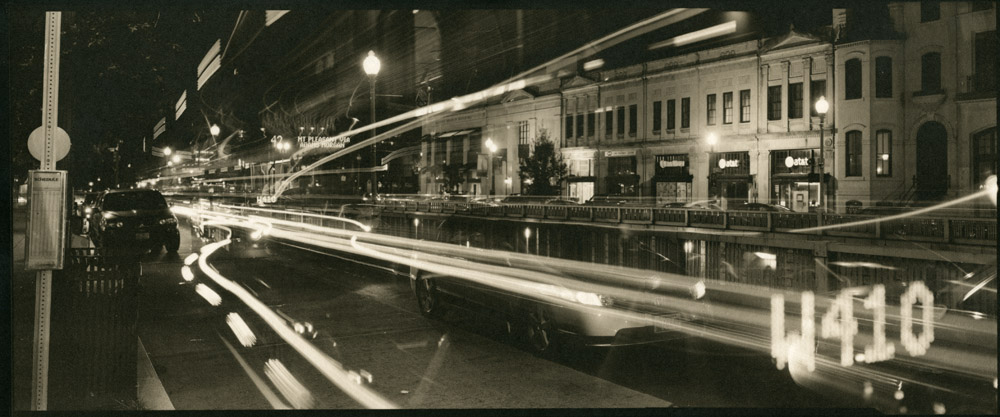
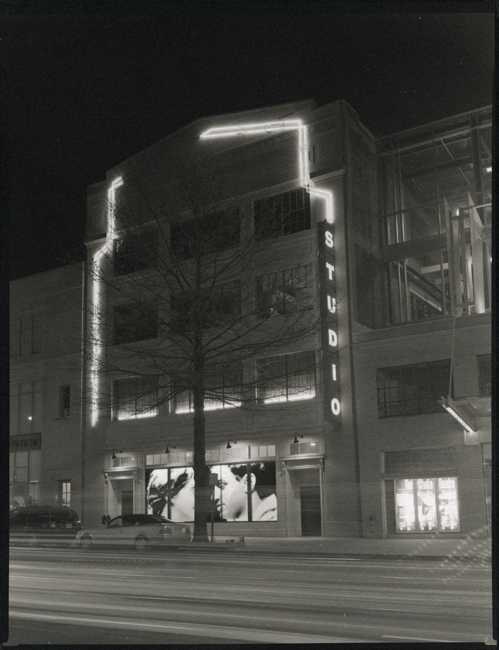
Studio Theater, 14th Street, Night
This is a new formulation of this class for me – two weekends instead of one, and the second weekend is a module on making digitally enlarged negatives for platinum/palladium printing. The first weekend we will make in-camera negatives for platinum/palladium printing, and learn about what will make a good composition for the medium. We will process those negatives and print them the first weekend. The second weekend will be devoted to making digitally enlarged negatives. Students are advised to get the Ron Reeder book on making digitally enlarged negatives in advance so they will have it in hand in time for the digital negative module.
I am also running an intro to studio lighting class from October 28 to December 2. We will cover basics of light in the studio, from a single hot light (there is only one sun!) to a multiple light strobe environment. We’ll also cover light modifiers from basic reflectors to umbrellas, soft boxes to Fresnel lights.
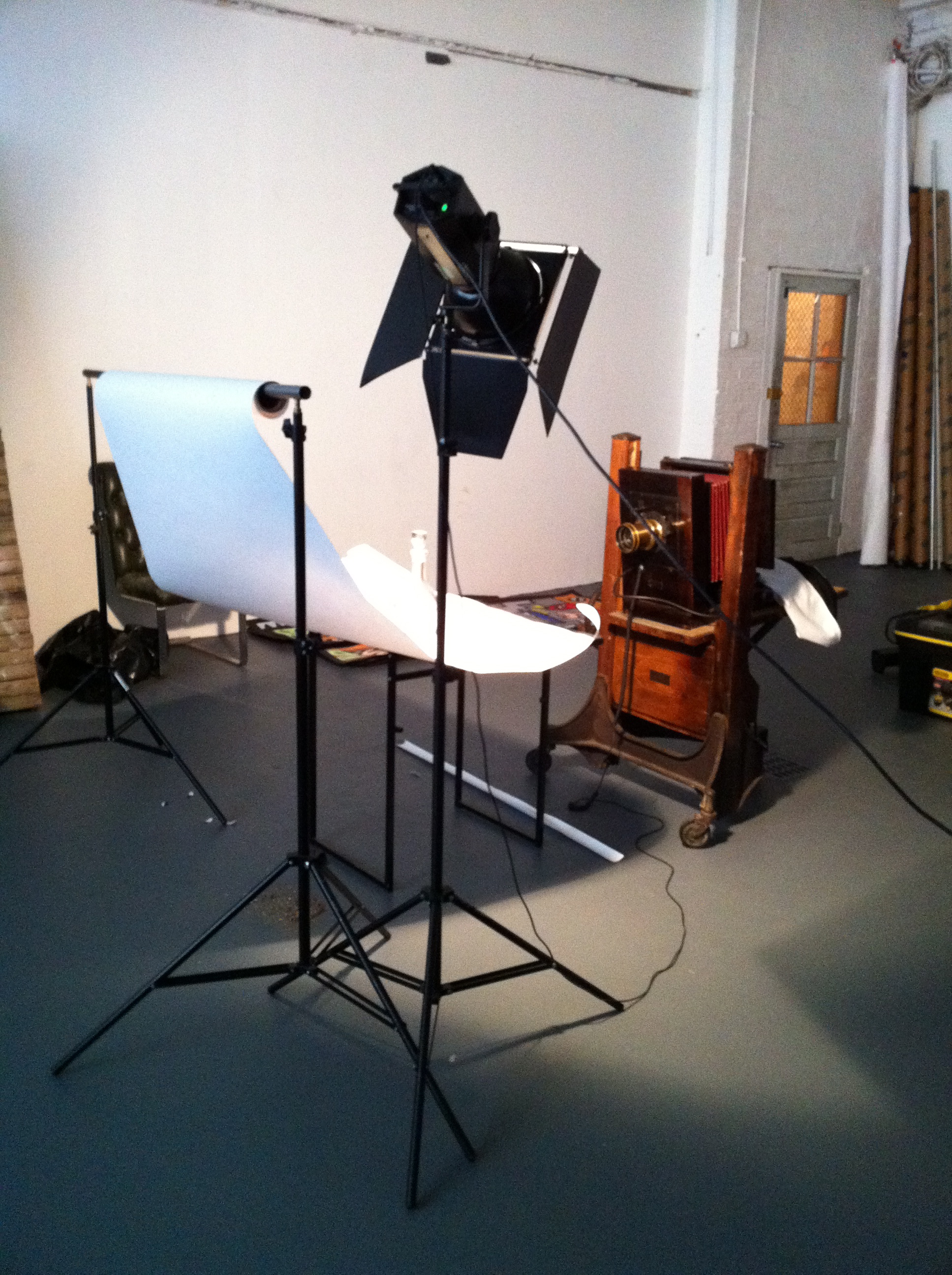
Studio setup #2
One of the biggest challenges working in the studio, especially for folks coming in for the first time from shooting natural light, is that there is no light in the studio but what you put in it. You have total control, and therefore you also have total responsibility for what gets captured. This course will help you learn to see light and how it creates form and volume, and how to control it for contrast and texture.
I’m going to be running my Intro to Platinum/Palladium Printing class again this fall, with an expansion into making digitally enlarged negatives. The new class will be a two-weekend course, September 19th & 20th, 26th & 27th. The 26th will be from 1-5 pm due to a morning scheduling conflict, but the rest of the sessions will be from 10 am – 4 pm.
Platinum/palladium is the catchall term for two chemically interchangeable but visually distinct printing processes first pioneered in the 1870s by William Willis. As the names imply, they use platinum and palladium as their primary metal salt in image formation. A platinum print will be more of a cool gray tone with higher contrast, and a palladium print will be more of a rich chocolate-brown tone with lower contrast. They are capable of producing very long tonal scales, rendering very fine gradations, therefore needing very little if any manipulation during printing. Platinum/Palladium are also among the most archivally stable printing processes – when properly processed and displayed, your prints will last as long as the paper underneath them.
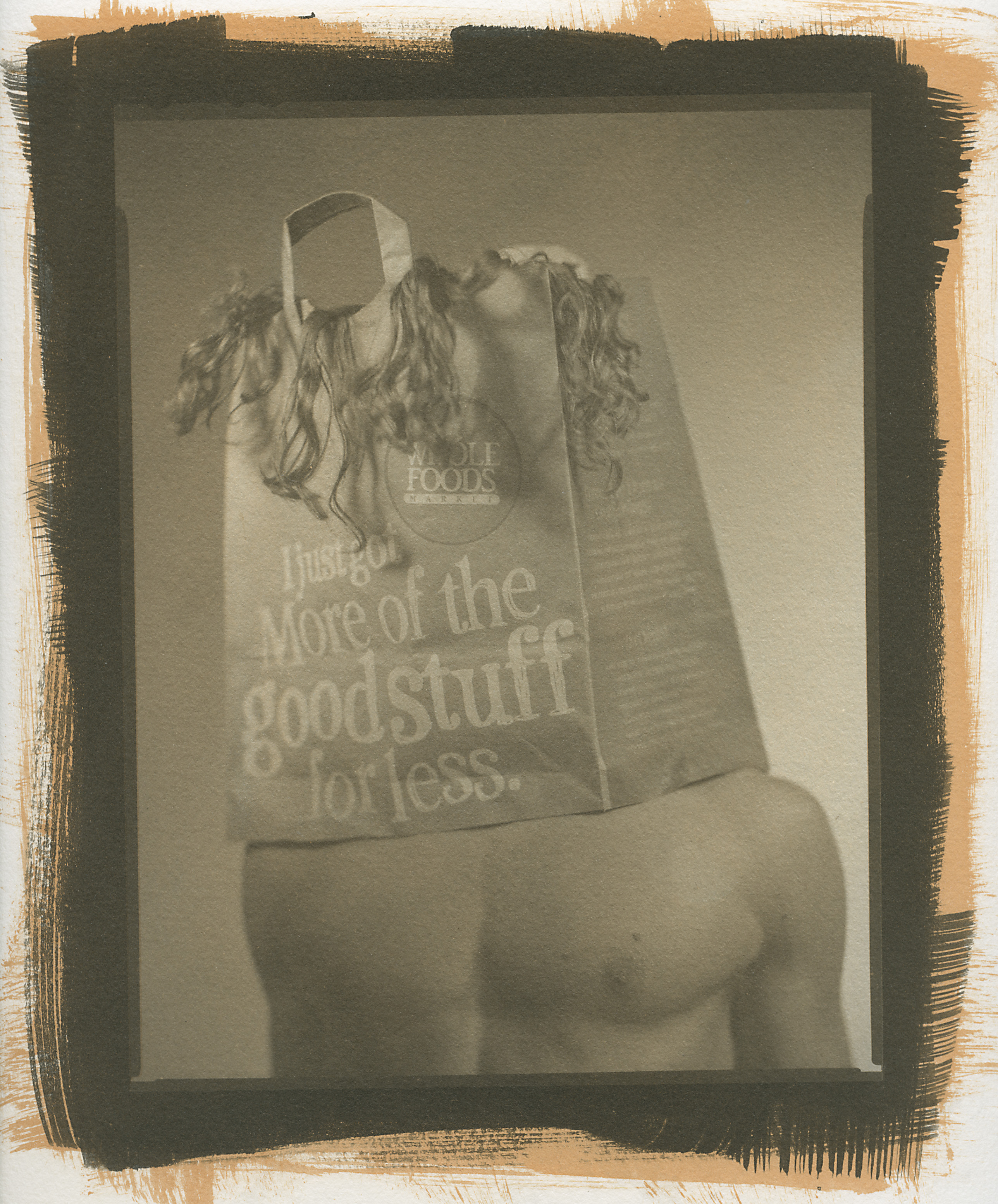
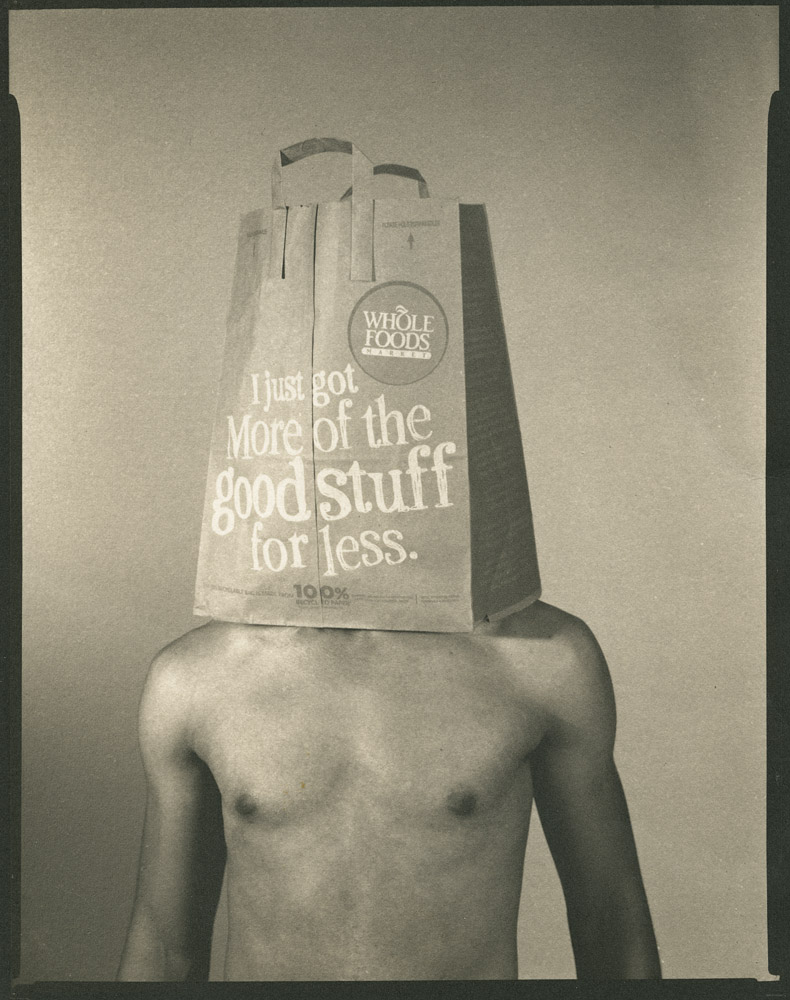
More of the Good Stuff
I traditionally have limited the class to working from in-camera negatives because I want to give people the best possible opportunity to start by making successful prints. As a friend of mine, Ian Leake, puts it in the new edition of his book on Platinum/Palladium printing, “it is possible to make a successful print from a problematic in-camera negative, but it is extremely difficult to make an even marginally successful print from a problematic digital negative” (I’m paraphrasing here).
The addition of making digitally enlarged negatives opens up the process to a whole new range of photographers, as shooting large format is both an encumbrance and a cost that is not for everyone. We will still begin the class with a full weekend of making in-camera film negatives and printing from those negatives. For that class, I will supply the camera and the film. We’ll make our images in and around the park, process the film, and then spend the next day printing.
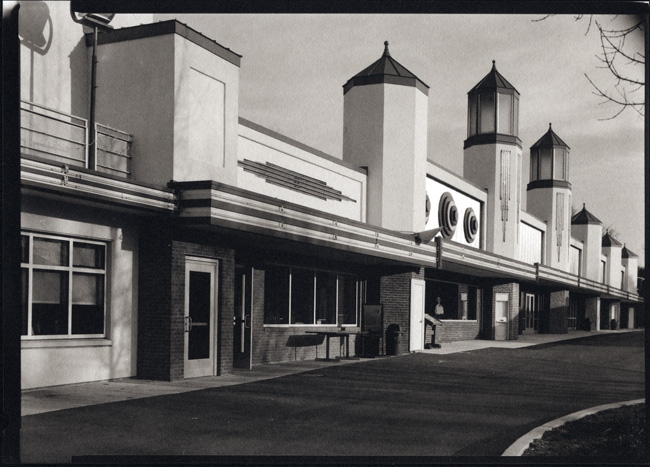
Glen Echo Midway
The second weekend will be devoted to making digitally enlarged negatives and printing from them. We will cover scanning, preparing your file, and printing the negative. I have a required text for the course, Ron Reeder’s “Digital Negatives for Palladium and Other Alternative Processes” which you can order on Amazon. Ron gives a very concise, clearly illustrated and explained step-by-step for how to produce a proper digitally enlarged negative, tailored to the process you want to print with. His technique is not limited to platinum/palladium, but once learned can be applied to any and all alternative processes.
 dcphotoartist